
What is AutoRAG
AutoRAG is a novel autonomous iterative retrieval model jointly developed by researchers from the Institute of Computing Technology, Chinese Academy of Sciences (ICT/CAS), the Key Laboratory of AI Safety of the Chinese Academy of Sciences, and the University of Chinese Academy of Sciences. It is designed specifically for large language models (LLMs) and can enhance performance in knowledge-intensive tasks. Based on multi-turn conversations with a retriever, AutoRAG systematically plans retrieval and refines queries, autonomously synthesizes reasoning-based decision instructions, and acquires and utilizes valuable external knowledge. AutoRAG can dynamically adjust the number of iterations according to the complexity of the question and the relevance of the retrieved knowledge, without human intervention, improving performance and efficiency.
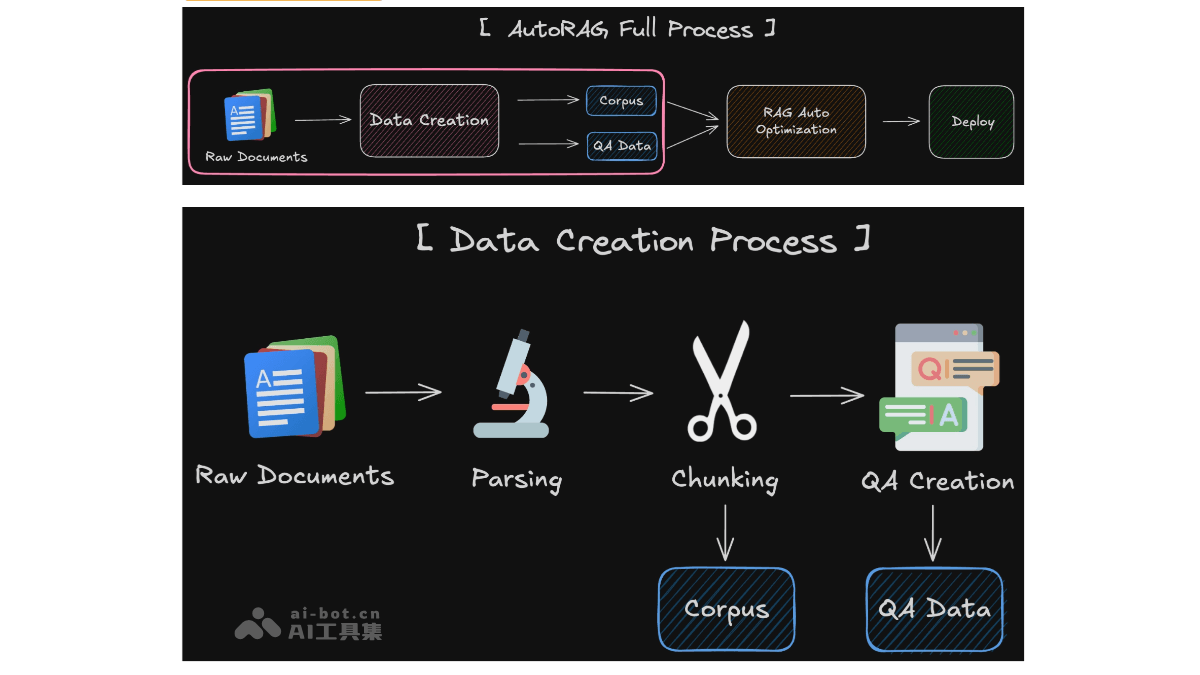
Main Features of AutoRAG
- Autonomous iterative retrieval: AutoRAG can conduct multi-turn conversations with a retriever, autonomously perform retrieval planning and query refinement, and acquire the external knowledge needed to solve problems.
- Reasoning and decision-making: The model uses its internal reasoning ability to decide when new information needs to be retrieved and which specific information needs to be retrieved.
- Dynamic adjustment of the number of iterations: It autonomously adjusts the number of interactions with the retriever according to the complexity of the question and the relevance of the retrieved knowledge.
- Performance improvement: It shows superior performance in multiple benchmarks, especially when handling complex and multi-hop question-answering tasks.
- Enhanced interpretability: The model expresses the iterative retrieval process in natural language, improving the model's interpretability and allowing users to understand the model's operations more intuitively.
Technical Principles of AutoRAG
- Decision-making based on LLMs: AutoRAG is built on the powerful decision-making capabilities of large language models, achieving autonomous decision-making through fine-tuning and utilizing the model.
- Multi-turn conversation: The model interacts with the retriever over multiple turns, simulating the information retrieval process of humans when solving problems.
- Iterative retrieval process: Iterative retrieval is treated as a dialogue process containing multiple iterations, each of which includes retrieval planning, information extraction, and answer inference.
- Data construction and training: It automatically synthesizes reasoning-based decision instructions, constructs training datasets, and performs supervised fine-tuning on LLMs.
- Reasoning types: It incorporates three types of reasoning into iterative retrieval: retrieval planning, information extraction, and answer inference, simulating human cognitive processes.
- Data filtering and formatting: When generating data, it filters and formats the data to ensure the quality of reasoning and queries, as well as the accuracy of the final answer.
AutoRAG Project Address
- Project official website:auto-rag.com
- GitHub repository:https://github.com/Marker-Inc-Korea/AutoRAG
- HuggingFace model library:https://huggingface.co/AutoRAG
- arXiv technical paper:https://arxiv.org/pdf/2411.19443
Application Scenarios of AutoRAG
- Intelligent question-answering systems: As the core of intelligent question-answering systems, it handles user questions and retrieves accurate answers from large amounts of data.
- Academic research assistant: It assists researchers in quickly acquiring knowledge in specific fields, supporting academic exploration and paper writing.
- Enterprise market analysis: It helps enterprises extract insights from market data and supports business strategy formulation.
- Online education platforms: It provides educational resources and automatically generates answers, enhancing the online learning experience.
- Customer Service Automation: Provide knowledge base-based automatic answers in customer service to improve response efficiency.