
What is AutoGen Studio
AutoGen Studio is an open-source interface tool launched by Microsoft Research, designed to simplify the process of building, debugging, and evaluating multi-agent systems. AutoGen Studio provides a web-based interactive interface and Python API, allowing users to define agents and workflows through drag-and-drop and declarative specifications without writing code. AutoGen Studio supports rapid prototyping, interactive evaluation, and a reusable component library, encouraging community collaboration and sharing. AutoGen Studio is suitable for developers and researchers who want to quickly build and test multi-agent interactions.
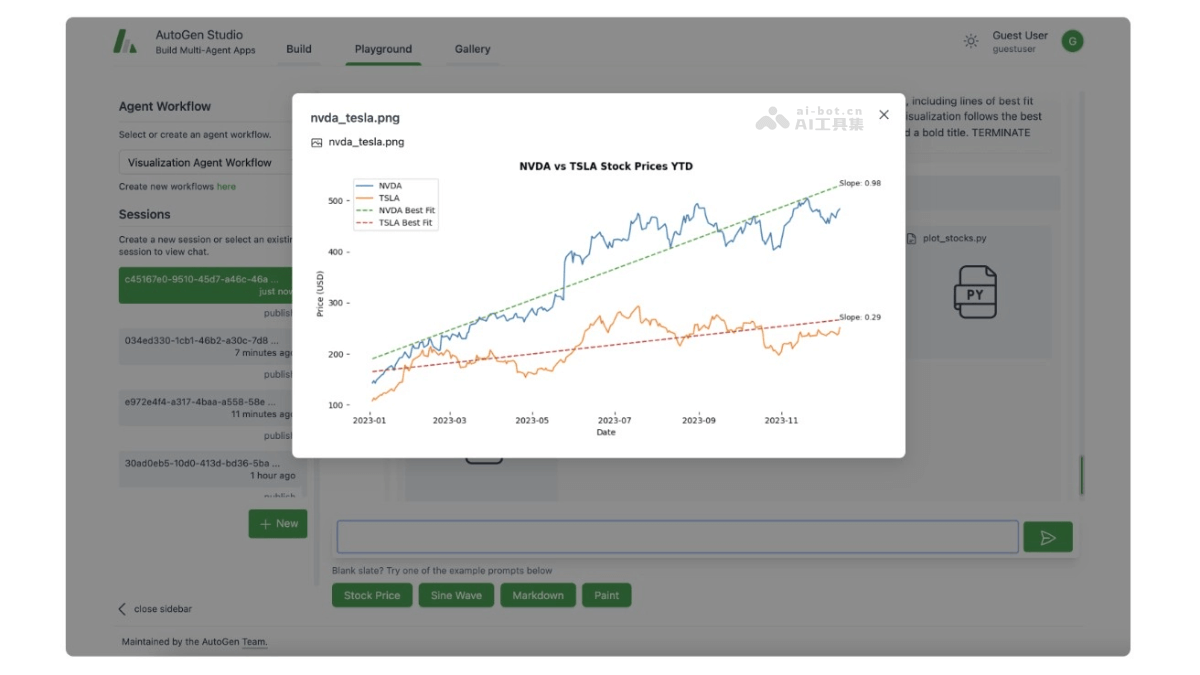
Main features of AutoGen Studio
- Drag-and-drop interface: Provides an intuitive drag-and-drop user interface, allowing users to define and debug agent workflows with clicks and drags.
- Interactive evaluation and debugging: Supports interactive evaluation and debugging of workflows, providing visual tools for analyzing messages and actions.
- Reusable component library: Includes a library of reusable and shareable agent components, simplifying the development process of multi-agent systems.
- Open-source implementation: As an open-source project, AutoGen Studio encourages community contributions and collaboration.
- Multi-agent workflows: Supports defining complex multi-agent workflows, including role transitions and state-driven workflows.
- Skill addition: Allows users to explicitly add skills to agents to accomplish more tasks.
Technical principles of AutoGen Studio
- Declarative specification: Declaratively defines agents and workflows based on formats such as JSON.
- Python API: Provides a Python interface, supporting more advanced scripting and automated workflow definitions.
- Web interface: A web-based user interface that supports user access and operation through a browser.
- Backend API: Uses frameworks such as FastAPI to build the backend API, handling HTTP requests and workflow execution.
- Modular design: AutoGen Studio's backend and frontend are separate; the backend provides API interfaces, and the frontend calls the interfaces to implement user interaction.
AutoGen Studio project address
- Project official website:microsoft.github.io/autogen/docs/autogen-studio
- GitHub repository:https://github.com/microsoft/autogen/tree/main/samples/apps/autogen-studio
Application scenarios of AutoGen Studio
- Customer service automation: Build chatbots and virtual assistants to handle customer inquiries and answer questions, improving customer service efficiency.
- Collaborative work: In team collaboration tools, coordinate task assignment, meeting scheduling, and project management based on multi-agent systems.
- Education and training: Develop personalized teaching assistants that provide customized teaching content based on students' learning progress and comprehension ability.
- Content creation: Assist content creators in generating articles, stories, or other text content, improving creation efficiency.
- Data annotation and analysis: Automate data cleaning and annotation processes, improving the accuracy and efficiency of data analysis.