
What is AutoBE
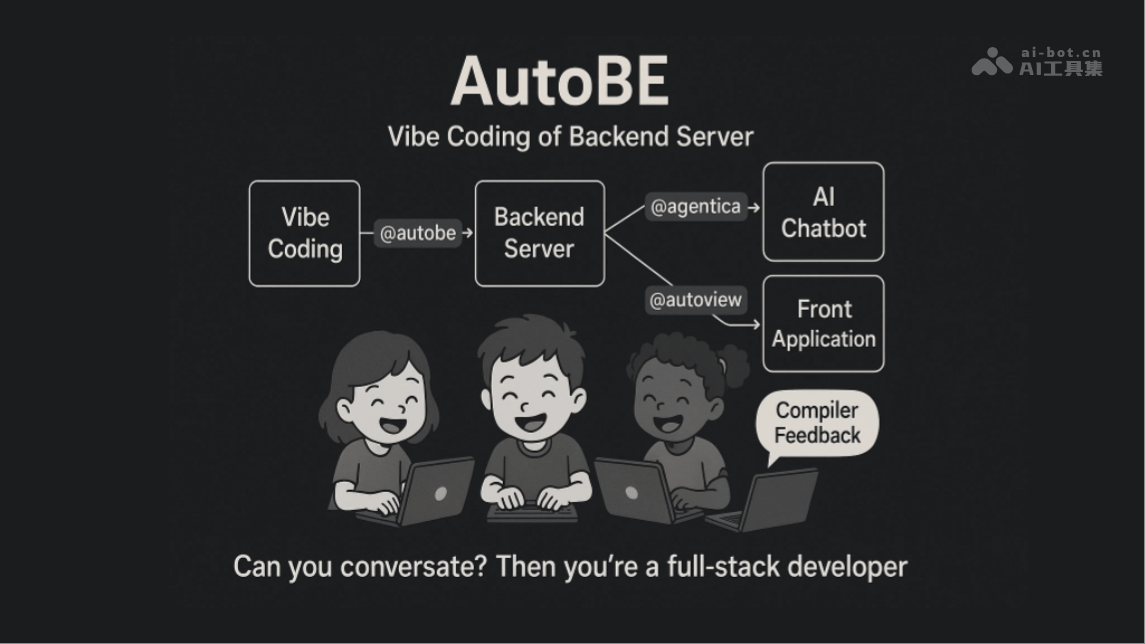
AutoBE is an AI-driven backend server code generation tool that automatically generates high-quality backend code based on user-described requirements. Built on a tech stack of TypeScript, NestJS, Prisma, and Postgres, it emphasizes "vibe coding" (Vibe Coding), iteratively optimizing code through continuous user feedback and compiler feedback. AutoBE combines the advantages of the waterfall model and the spiral model to ensure code reliability and security.
AutoBE's Main Features
- Requirements Analysis (Analyze): It can analyze user requirements and generate structured requirements specification documents, providing clear guidance for subsequent code generation.
- Database Schema Generation (Prisma): Generates Prisma-format database schemas and ERD (Entity Relationship Diagram) documents based on requirements specifications, making it easier for developers to understand and design databases.
- API Interface Design and Code Generation (Interface): Designs API interfaces based on requirements specifications and ERD documents, generates API interface code and DTO (Data Transfer Object) schemas, helping developers quickly build backend interfaces.
- Test Code Generation (Test): Generates E2E (end-to-end) test code for each API interface to ensure the reliability of the generated code quality.
- Code Implementation (Realize): Writes implementation code for each API function, completing the code generation for the entire backend functionality.
AutoBE's Technical Principles
- Natural Language Understanding: AutoBE understands user requirements descriptions through natural language processing technology and converts them into specific code generation instructions.
- Code Generation Model: A deep learning-based code generation model, such as the Transformer architecture, can generate high-quality code based on input requirements descriptions.
- Tech Stack Integration
- TypeScript: As a development language, TypeScript provides static type checking, which helps developers discover potential errors in advance and improves code reliability and maintainability.
- NestJS: As a TypeScript-based framework, NestJS provides a modular and extensible architecture, making it convenient for developers to build complex backend applications.
- Prisma: As an ORM (Object-Relational Mapping) tool, Prisma simplifies database operations, enabling developers to interact with the database in a more intuitive way.
- Postgres: As a backend database, Postgres provides powerful data storage and query capabilities, meeting complex application requirements.
- Compiler Feedback: During the code generation process, AutoBE uses compiler feedback information to optimize the code. For example, if the generated code has issues such as syntax errors or type mismatches, the compiler provides corresponding error information, and AutoBE adjusts its code generation strategy based on this information.
- Waterfall Model: In the stages of requirements analysis, design, coding, and testing, AutoBE proceeds sequentially in the order of the waterfall model, ensuring that the work at each stage meets expectations.
- Spiral Model: AutoBE incorporates the ideas of the spiral model, performing verification and testing at each stage to promptly discover and resolve issues, ensuring code quality and reliability.
AutoBE's Project Address
- Github Repository:https://github.com/wrtnlabs/autobe
AutoBE's Application Scenarios
- Rapid Development of New Projects: AutoBE can quickly generate high-quality backend code based on users' requirement descriptions, helping developers set up the basic framework of a project in a short time.
- Improve development efficiency: For large projects or complex systems, AutoBE can automatically generate database schemas, API interface code, test code, etc.
- Teaching and training: AutoBE can also be used in teaching and training scenarios. By generating code examples, it can help students or novice developers better understand the concepts and practices of backend development.
- Code optimization and refactoring: AutoBE's "vibe coding" philosophy emphasizes iteratively optimizing code through continuous user feedback and compiler feedback. Developers can optimize and refactor existing projects to improve code quality.