
What is Augmented Physics
Augmented Physics is an innovative educational tool based on integrated machine learning technology that converts static diagrams in physics textbooks into interactive and embedded physics simulations. The tool is based on advanced computer vision technologies, such as Segment Anything and multimodal large language models (LLM), allowing users to semi-automatically extract diagrams from textbooks and generate interactive simulations. Students can explore and understand physics concepts such as optics, kinematics, and circuits through hands-on operation. Augmented Physics supports multiple simulation types and uses a web-based interface to seamlessly integrate interactive visual output into scanned textbook pages, providing students with a more intuitive and personalized learning experience. Augmented Physics supports teachers and students in creating simulations with simple operations, without any programming knowledge, making complex physics phenomena easy to understand and master.
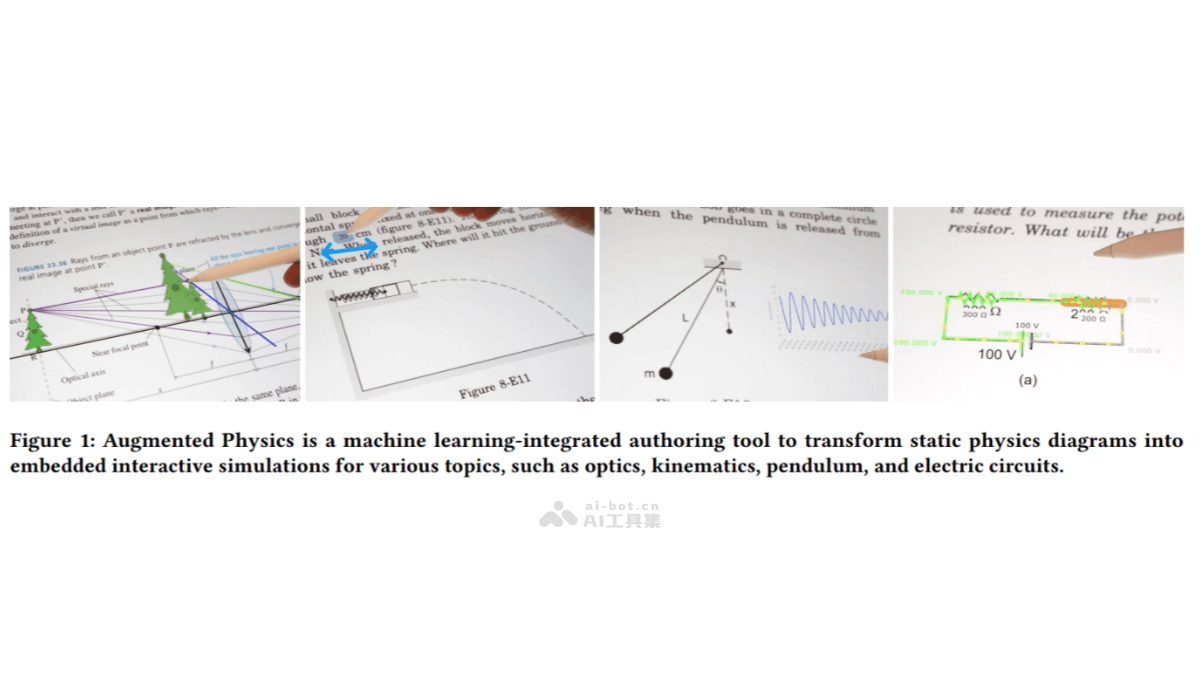
Main features of Augmented Physics
- Automatic diagram extraction: Automatically identify and extract diagrams from physics textbook PDFs.
- Generate interactive simulations: Convert static diagrams into dynamic physics simulations, supporting users in adjusting parameters and observing results.
- Dynamically visualize data: Display dynamic charts of physical quantities changing over time, such as changes in pendulum angle.
- Augmented experiments: Users directly operate physics simulations on the screen, such as changing object positions or circuit parameters.
- Animated diagrams: Turn static diagrams into looping animations that show physical phenomena changing over time.
Technical principles of Augmented Physics
- Computer vision technology: Use the Segment Anything model for object recognition and segmentation in images, and OpenCV for image processing to achieve path extraction and contour detection.
- Multimodal large language models (LLM): Understand the textual descriptions in diagrams, recommend corresponding physics simulation types, and automatically set simulation parameters.
- Physics engine integration: Use physics engines such as Matter.js to simulate physical behavior and handle physical phenomena such as gravity and light reflection.
- Interactive simulation generation: The system automatically recognizes and segments objects in diagrams, supporting users in assigning physical properties and interacting with them.
- Dynamic visualization and animation: Support converting static diagrams into dynamic animations to show the process of changes in physical phenomena.
Project address of Augmented Physics
- arXiv technical paper:https://arxiv.org/pdf/2405.18614
Application scenarios of Augmented Physics
- Computer vision technology: Use the Segment Anything model for object recognition and segmentation in images, and OpenCV for image processing to achieve path extraction and contour detection.
- Multimodal large language models (LLM): Understand the textual descriptions in diagrams, recommend corresponding physics simulation types, and automatically set simulation parameters.
- Physics engine integration: Use physics engines such as Matter.js to simulate physical behavior and handle physical phenomena such as gravity and light reflection.
- Interactive simulation generation: The system automatically recognizes and segments objects in diagrams, supporting users in assigning physical properties and interacting with them.
- Dynamic visualization and animation: Supports converting static charts into dynamic animations to demonstrate the changing process of physical phenomena.