
What is AudioX
AudioX is a unified diffusion transformer model jointly proposed by the Hong Kong University of Science and Technology and Moonshot AI, specifically designed to generate audio and music from arbitrary content. The model can handle multiple input modalities, including text, video, images, music, and audio, and generate high-quality audio output. The core innovation lies in the multimodal masked training strategy, which randomly masks input modalities, forcing the model to learn from incomplete inputs and enhancing cross-modal representation capabilities.
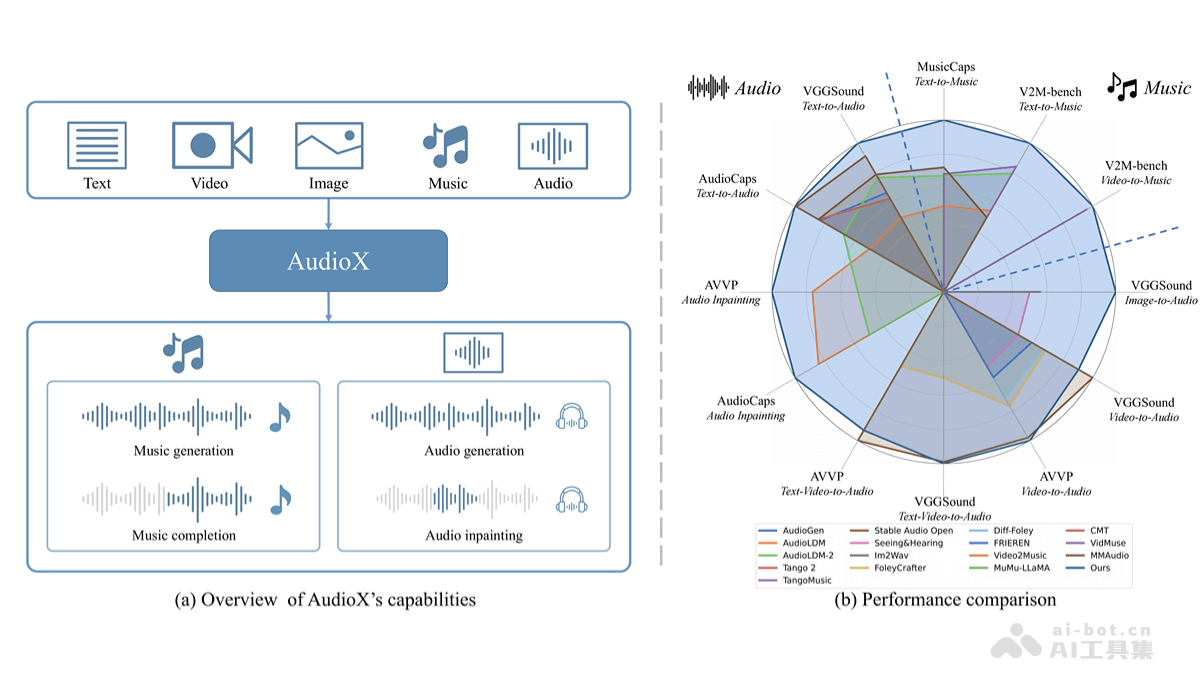
AudioX's main features
- Multimodal input support
- Text-to-Audio: Generate corresponding sound effects based on text descriptions. For example, input "dog barking", and the model can generate the audio of a dog barking.
- Video-to-Audio: Generate matching sound effects based on video content. For example, input a video of a car driving, and the model can generate the sound of a car engine.
- Image-to-Audio: Generate corresponding sound effects based on image content. For example, input a picture of a storm, and the model can generate the sound of a storm.
- Music Generation: Generate music based on text descriptions or video content. For example, input "relaxing piano piece", and the model can generate a relaxing piano piece.
- Audio Inpainting: Repair missing parts in audio based on contextual information. For example, input an audio clip with blanks, and the model can fill in the blank parts to make the audio complete.
- Music Completion: Generate subsequent parts based on a given music segment. For example, input the beginning of a piece of music, and the model can generate the subsequent music segment.
- High-quality audio generation: AudioX uses Diffusion Model technology and can generate high-quality, high-fidelity audio and music, ensuring that the generated audio is close to real audio in sound quality and details.
- Flexible natural language control: Users can precisely control the generated audio content through natural language descriptions. For example, users can specify the type of sound effect, the style of music, the instruments used, etc., making the generated audio better meet their needs.
- Cross-modal learning capability: AudioX can handle inputs from multiple modalities and effectively integrate them to generate audio consistent with the input conditions. For example, when text and video are input simultaneously, the model can comprehensively consider the semantic information of both to generate audio that better fits the scene.
- Strong generalization ability: It performs excellently on multiple datasets and tasks, including AudioCaps, VGGSound, MusicCaps, V2M-bench, etc., proving its generalization ability and adaptability in different scenarios.
- Zero-shot generation capability: Without specialized training for a specific modality (such as images), AudioX can generate high-quality audio under zero-shot conditions, demonstrating strong general generation capability.
AudioX's technical principles
- Diffusion Model: AudioX uses the core idea of diffusion models, gradually adding noise to the input data, and then gradually removing the noise through a reverse process, ultimately generating high-quality audio or music.
- Forward diffusion process: Gradually add Gaussian noise to the input data to generate a series of noisy latent variables.
- Reverse denoising process: By training a denoising network (usually a Transformer), gradually remove noise and reconstruct clean audio data.
- Multimodal Masked Training Strategy: To enhance the model's cross-modal learning ability, AudioX adopts a multimodal masked training strategy. During training, the model randomly masks part of the input modalities, forcing the model to learn from incomplete inputs, thereby improving the model's robustness and generalization ability.
- Multimodal Encoder and Decoder: AudioX integrates multiple specialized encoders to process input data from different modalities separately, and then fuses these encoded features into a unified latent space.
- Video Encoder: Uses CLIP-ViT-B/32 to extract features from video frames.
- Text Encoder: Uses T5-base to extract text features.
- Audio Encoder: Uses an autoencoder to extract audio features.
- Feature Fusion: Fuses features from different modalities into a unified multimodal embedding vector through linear transformations and concatenation operations.
- Conditional Embedding in the Diffusion Process: In the diffusion process, the multimodal embedding vector serves as conditional input, helping the model generate audio or music consistent with the input conditions. The fused multimodal features are input into the diffusion model together with the diffusion timestep. By gradually removing noise, high-quality audio or music matching the input conditions is generated.
- Datasets and Training: To train AudioX, the researchers constructed two large-scale multimodal datasets: vggsound-caps, based on the VGGSound dataset, containing 190K audio captions. V2M-caps, based on the V2M dataset, containing 6 million music captions.
AudioX Project Address
- Project Official Website:https://zeyuet.github.io/AudioX/
- Github Repository:https://github.com/ZeyueT/AudioX
- arXiv Technical Paper:https://arxiv.org/pdf/2503.10522
AudioX Application Scenarios
- Video Soundtrack: Automatically generate background music or sound effects based on video content, enhancing the video's appeal and emotional resonance.
- Animation Sound Effects: Generate matching sound effects for animated scenes, such as footsteps, wind sounds, explosion sounds, etc., enhancing the immersion of the animation.
- Music Generation: Generate music based on text descriptions or style requirements, providing inspiration or assisting creation for music creators.
- Language Learning: Generate sound effects or background music related to language learning content, enhancing the learning experience.