
What Is AudioGenie
AudioGenie is a multimodal audio generation tool launched by the Tencent AI Lab team. It can generate various audio outputs such as sound effects, speech, and music from multiple modal inputs including video, text, and images. The tool adopts a training-free multi-agent framework and achieves efficient collaboration through a two-layer architecture consisting of a generation team and a supervision team. The generation team is responsible for decomposing complex inputs into specific audio sub-events and dynamically selects the most suitable model for generation through an adaptive Mixture of Experts (MoE) collaboration mechanism. The supervision team is responsible for spatiotemporal consistency verification and performs self-correction through a feedback loop to ensure highly reliable generated audio.
AudioGenie has established MA-Bench, the world's first benchmark test set for the Multimodal-to-Multi-Audio generation (MM2MA) task, containing 198 videos with multiple types of audio annotations. In testing, AudioGenie reached or approached state-of-the-art levels across 9 metrics and 8 tasks, performing especially well in audio quality, accuracy, content alignment, and aesthetic experience.
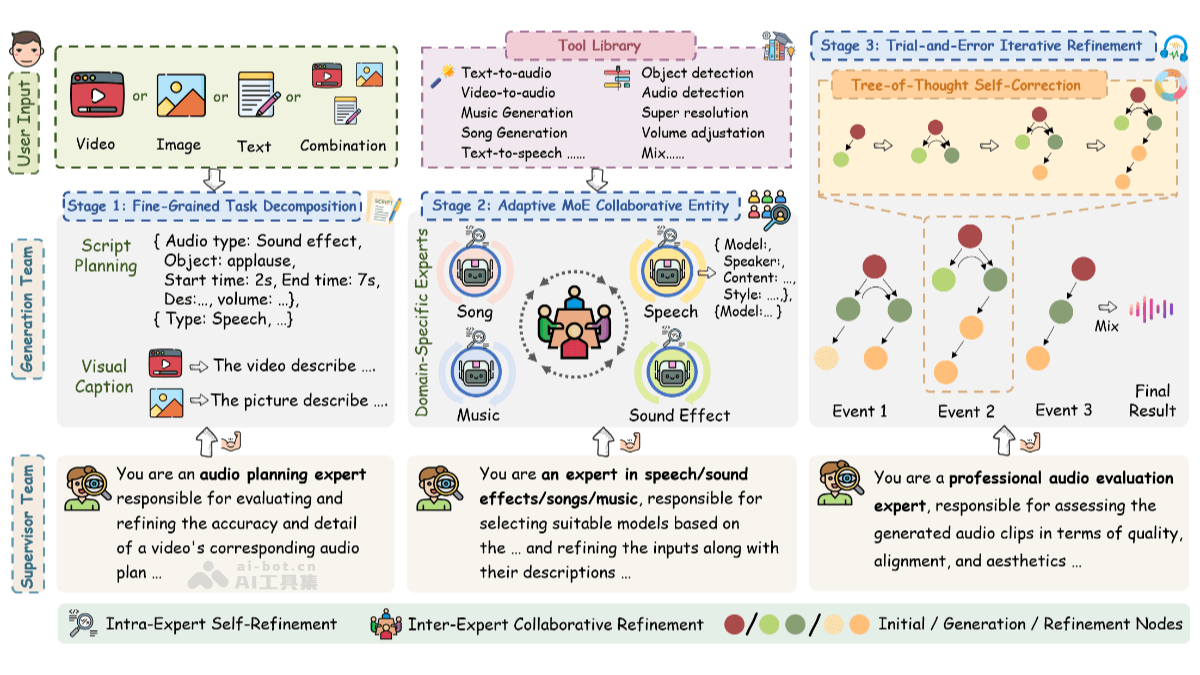
Main Features of AudioGenie
-
Multimodal Input and Multi-Audio Output: Supports multiple modal inputs such as video, text, and images, and generates multiple audio types such as sound effects, speech, and music.
-
Training-Free Multi-Agent Framework: Adopts a two-layer architecture. The generation team is responsible for task decomposition and dynamic model selection, while the supervision team is responsible for verification and self-correction, ensuring the reliability of outputs.
-
Fine-Grained Task Decomposition: Decomposes complex multimodal inputs into specific audio sub-events, precisely annotating audio type, start and end times, and content descriptions to form a structured generation blueprint.
-
Trial-and-Error and Iterative Optimization: Adopts an iterative optimization process based on a "tree of thoughts." The system generates candidate audio, and the supervision team evaluates it from dimensions such as quality, alignment, and aesthetics. If flaws exist, a correction or retry process is automatically triggered until the output meets the requirements.
Technical Principles of AudioGenie
-
Two-Layer Multi-Agent Architecture: Adopts a two-layer architecture consisting of a generation team and a supervision team. The generation team is responsible for decomposing and executing audio generation tasks, while the supervision team is responsible for verifying the spatiotemporal consistency of outputs and providing feedback to optimize generation results.
-
Adaptive Mixture of Experts (MoE) Collaboration: Dynamically selects the most suitable model for generation according to different audio subtasks, and optimizes generation plans through collaboration and correction mechanisms among experts, improving generation quality and efficiency.
-
Training-Free Framework: Adopts a training-free multi-agent system, avoiding the problems of data scarcity and overfitting in traditional training methods and improving the system's generalization ability and adaptability.
-
Spatiotemporal Consistency Verification: The supervision team verifies the spatiotemporal consistency of generated audio through a feedback loop, ensuring that the generated audio is coordinated with the input content in time and space.
Project Address of AudioGenie
- Project Official Website:https://audiogenie.github.io/
Application Scenarios of AudioGenie
-
Film and Television Production: Quickly generates background music, environmental sound effects, and character dubbing that highly match video content, improving production efficiency and enhancing the audience's sense of immersion.
-
Virtual Character Dubbing: Generates natural and fluent speech for virtual characters such as virtual streamers and virtual customer service agents, with greater expressiveness and realism.
-
Game Development: Automatically generate realistic ambient sound effects, background music, and character voices based on the game scene, enhancing players' immersion and gaming experience.
-
Podcast Production: Automatically generate music that rises and falls with the storyline based on the podcast content, enhancing the podcast's appeal and professionalism.
-
Commercial Editing: Quickly match sound effects and music that align with the brand's tone, saving production time and cost while enhancing the commercial's appeal and emotional impact.