
What is Audio2Face
Audio2Face is an AI facial animation generation model launched by NVIDIA, capable of generating realistic facial animations from audio input. The model can analyze phonemes and intonation in audio, drive the character's lip movements and expressions, and achieve precise lip synchronization and emotional expression. The model is now open source, and developers can quickly generate high-quality animations in tools such as Maya and Unreal Engine 5 through the SDK and plugins, or customize the model with the training framework. Audio2Face is widely used in games, virtual customer service, and other fields, greatly improving the production efficiency and realism of digital characters.
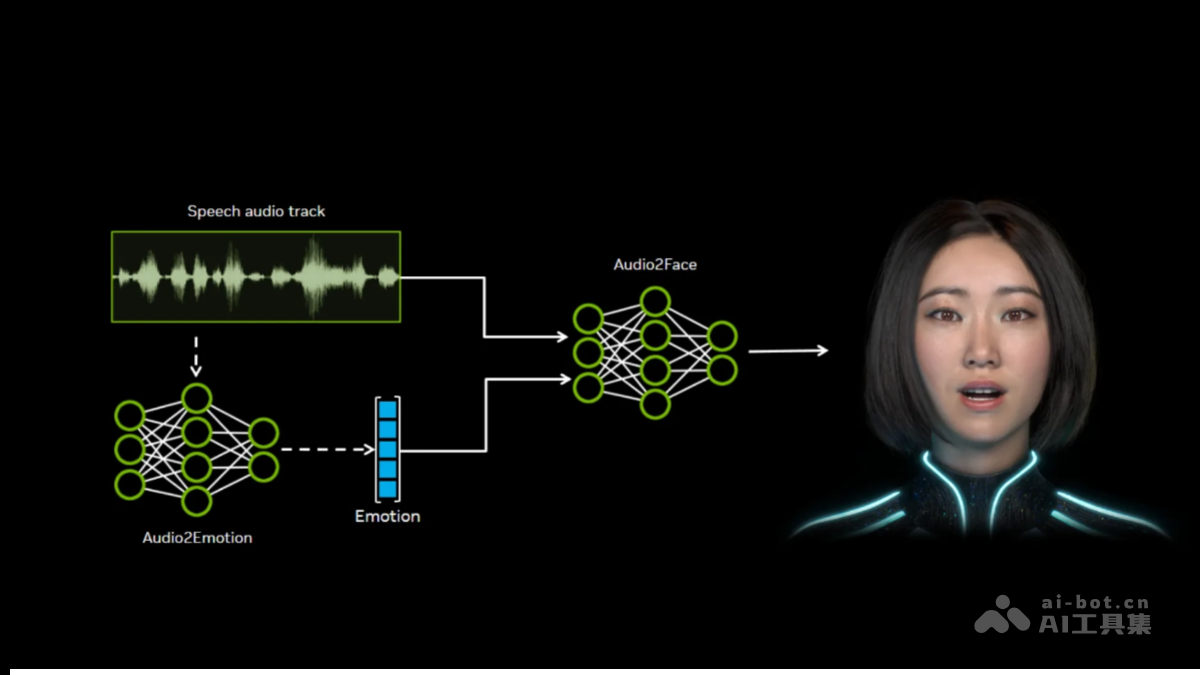
Main features of Audio2Face
-
Precise lip synchronization: Generates lip movements that match the speech content in the audio (such as phonemes and intonation), ensuring that the character's lip movements when speaking are natural and accurate.
-
Emotional expression: The model can generate corresponding emotional expressions, such as smiles and frowns, based on the emotional features in the audio (such as intonation and rhythm), making the character more expressive.
-
Real-time animation generation: Supports real-time rendering and can quickly convert audio into animation, suitable for real-time interactive scenarios (such as virtual customer service, live streaming, etc.).
-
Multi-platform support: Provides integration plugins with mainstream 3D software (such as Autodesk Maya and Unreal Engine 5), making it convenient for developers to use on different platforms.
-
Customizability: Developers can fine-tune the model with their own datasets through the training framework to adapt to specific styles or character needs.
Technical principles of Audio2Face
- Audio feature extraction: The system extracts key features from the input audio, such as phonemes (the basic units of speech), intonation, rhythm, etc. The key features are the foundation for generating facial animations. For example, different phonemes correspond to different lip shapes, and intonation and rhythm affect changes in expression.
- Deep learning models: Audio2Face uses pre-trained deep learning models (such as GANs or Transformer models) to map audio features to facial animations. The model is trained on large amounts of audio and corresponding facial animation data, learning how to associate audio features with facial movements.
- Generative adversarial networks (GANs): GANs include a Generator and a Discriminator. The Generator is responsible for generating facial animations based on audio features, and the Discriminator is used to evaluate whether the generated animations are realistic. Through continuous training, the Generator can generate increasingly realistic facial animations.
- Emotion analysis: Audio2Face analyzes the emotional features in the audio (such as pitch height and tempo speed, etc.) and maps them to corresponding emotional expressions.
Audio2Face project address
- Project official website:https://developer.nvidia.com/blog/nvidia-open-sources-audio2face-animation-model/
- GitHub repository:https://github.com/NVIDIA/Audio2Face-3D
Application scenarios of Audio2Face
-
Game development: In game production, quickly generate character facial animations, reduce the time required for manually creating lip shapes and expressions, and improve the character's realism and interactivity.
-
Virtual customer service: Provide natural lip movements and expressions for virtual customer service characters, enhance user experience, make virtual customer service look more like real people, and improve communication effectiveness.
-
Animation production: In animated films or short films, drive character facial animations through audio to improve production efficiency.
-
Virtual live streaming: Help streamers generate facial expressions and lip movements that match their speech in real time during virtual livestreaming, enhancing the fun and interactivity of the stream.
-
Education and Training: In virtual teaching scenarios, generate vivid expressions and lip movements for virtual teachers, making the teaching content more engaging for students and improving learning outcomes.