
What is Audio-SDS
Audio-SDS is an innovative technology launched by the NVIDIA AI research team. It extends Score Distillation Sampling (SDS) technology to text-conditioned audio diffusion models, bringing a major breakthrough to the field of audio processing. Without retraining the model, any pretrained audio diffusion model can be turned into a versatile tool, widely used in tasks such as sound effect generation, audio source separation, FM synthesis, and speech enhancement. Audio-SDS guides audio generation through text prompts and supports a high degree of customization to meet creative and industrial needs.
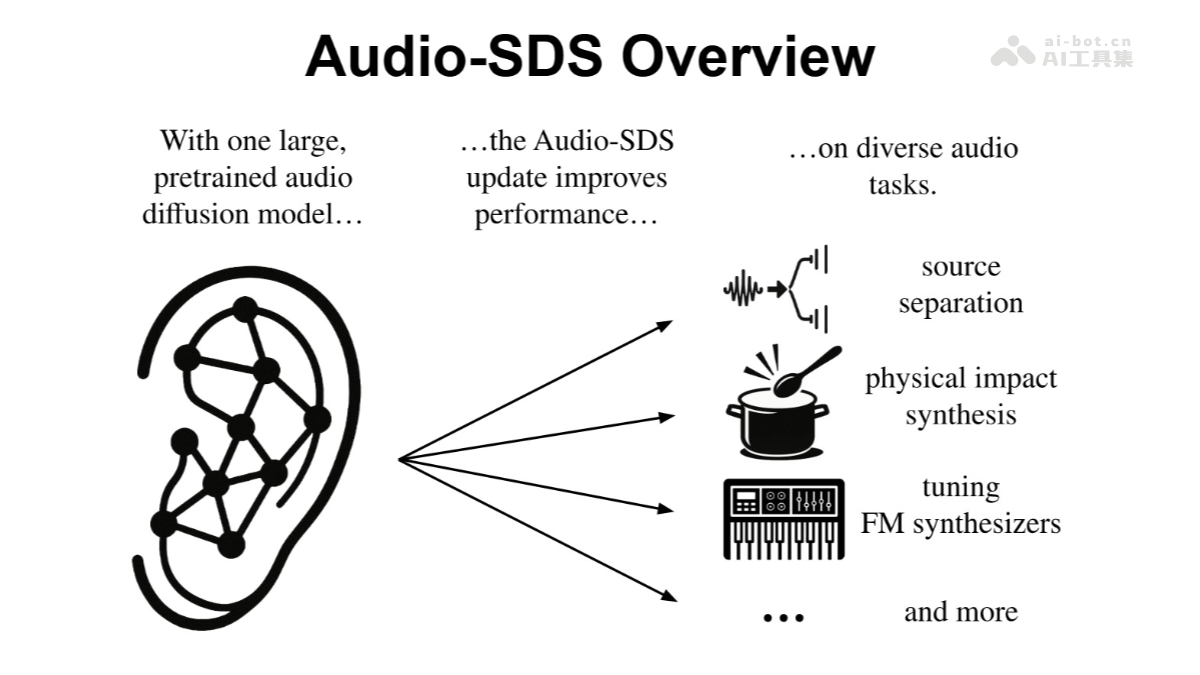
Main features of Audio-SDS
- Sound effect generation: It can generate various environmental sound effects or creative sound effects based on text prompts, such as explosions, wind, and more, helping game development and virtual reality (VR) applications.
- Audio source separation: It accurately extracts target tracks from mixed audio, suitable for music production and video post-processing. For example, it can perform fully automatic source separation on real-world audio without manually labeling sources or requiring specialized datasets.
- Physics-informed sound simulation: It can guide physics-informed sound simulation, such as simulating the sound of object collisions.
- FM synthesis parameter calibration: It supports high-quality frequency modulation synthesis for expressive timbre design.
- Speech enhancement: It improves speech clarity, suitable for audio editing software and intelligent voice assistants.
Technical principles of Audio-SDS
- Pretrained audio diffusion model: Audio-SDS is based on a pretrained audio diffusion model as its foundation. This model can generate high-quality audio samples and contains rich audio prior knowledge.
- Text-conditioned guidance: The audio generation process is guided through text prompts. Text prompts are encoded as condition vectors to guide the audio diffusion model in generating audio that matches the description.
- Score Distillation Sampling (SDS): During the audio generation process, SDS optimizes model parameters by calculating the difference between the generated audio and the target audio, making the generated audio closer to the target audio. Specifically, SDS is implemented through the following steps:
- Noise addition: Add random noise to the audio sample to generate noisy audio.
- Loss calculation: Calculate the difference between the noisy audio and the real audio, and optimize the parameters through gradient descent to minimize the difference between the predicted noise and the real noise.
- Optimization objective: The SDS loss function is based on the probability density distribution of the diffusion model and optimizes parameters by minimizing the KL divergence between the noise distribution and the real distribution.
- Versatile extension: Audio-SDS does not require retraining the model and can turn a pretrained audio diffusion model into a versatile tool, suitable for many tasks such as sound effect generation, audio source separation, FM synthesis, and speech enhancement.
- Efficient inference: The optimized SDS algorithm reduces computational complexity while maintaining high-quality output, improving the feasibility of real-time applications.
Audio-SDS project address
- Project official website:https://research.nvidia.com/labs/toronto-ai/Audio-SDS/
- arXiv technical paper:https://arxiv.org/pdf/2505.04621
Audio-SDS application scenarios
- Sound effect generation: Audio-SDS can generate various realistic environmental sound effects or creative sound effects based on text prompts, such as explosions, wind, rain, etc., providing immersive sound design for film, games, and virtual reality (VR) applications and enhancing the user experience.
- Audio Source Separation: In music production and video post-processing, Audio-SDS can accurately extract target tracks from mixed audio, for example, separating vocals from accompaniment, making it convenient for music producers to mix or create new musical works.
- Audio Editing: It provides efficient tools for music producers and content creators, lowering the threshold for professional audio processing. Creators can generate high-quality audio content through simple text descriptions without complex audio editing skills.
- Music Education: Extracting a cappella tracks can be used to create karaoke accompaniment, and also helps with transcription and learning in music education.
- Smart Home: Automatically recognize various sounds in the home environment, such as a baby crying, a leaking faucet, etc., improving the level of smart living.