
What is Audio Flamingo Next
Audio Flamingo Next is a new-generation audio language model (LALM) jointly open-sourced by NVIDIA and the University of Maryland. As the latest version of the Audio Flamingo series, it supports complex audio inputs up to 30 minutes long and covers unified understanding of speech, environmental sounds, and music. The model uses Temporal Audio Chain-of-Thought technology to achieve time-anchored reasoning, is trained on over 1 million hours of data, surpasses open-source models of comparable scale on more than 20 audio understanding benchmarks, and forms strong competition with commercial closed-source models.
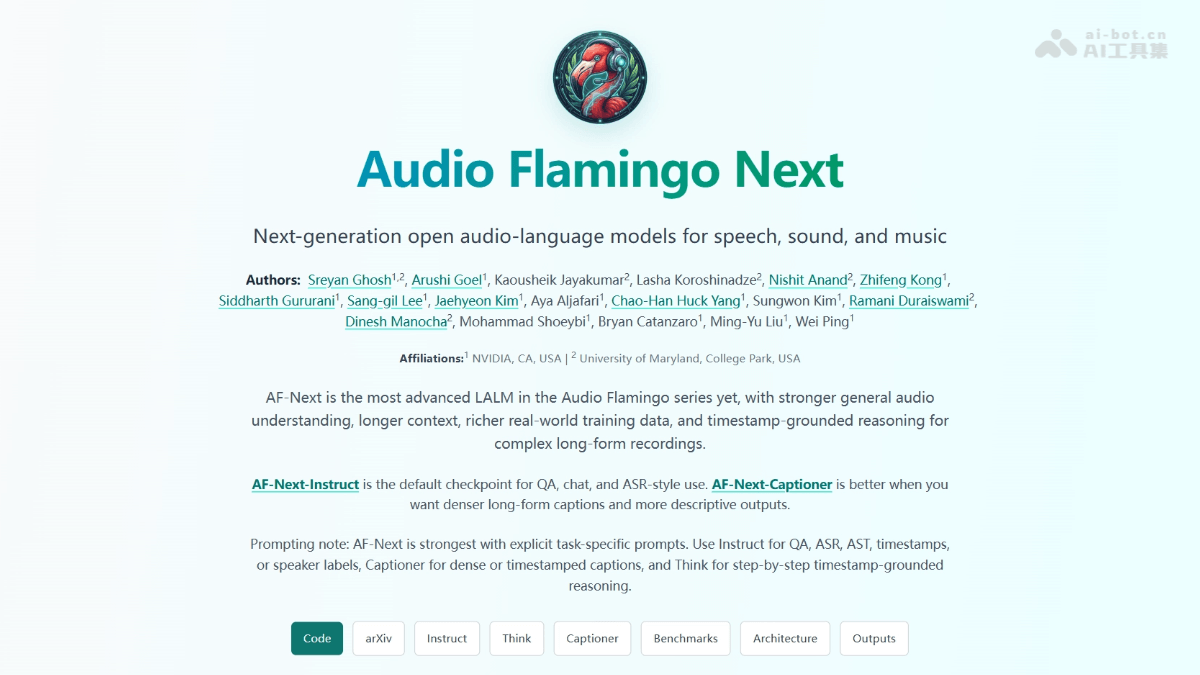
Main Features of Audio Flamingo Next
- Long-form Audio Understanding: Supports complex audio clip inputs up to 30 minutes long, can handle mixed audio scenarios containing speech, music, and environmental sounds, and achieves unified understanding across spans from seconds to hours.
- Time-Anchored Reasoning: Uses Temporal Audio Chain-of-Thought technology to explicitly anchor the reasoning process to audio timestamps, giving the model fine-grained temporal awareness and enabling it to precisely locate and aggregate evidence scattered across long audio.
- Multimodal Audio Processing: A single model architecture simultaneously covers the three major tasks of speech recognition, music analysis, and environmental sound understanding, eliminating the need to switch between specialized models for tasks such as speech ASR, music classification, and soundscape recognition.
- Multi-Speaker Tracking: Supports speech recognition and turn detection in multi-speaker scenarios, distinguishes different speaker identities and tracks conversation turns, and is suitable for multi-speaker scenarios such as meeting transcription and podcast analysis.
- Fine-Grained Information Retrieval: Has "needle-in-a-haystack"-style long audio retrieval capability, can precisely locate specific keywords, events, or spoken content in tens of minutes of audio, and answer detailed questions about specific time points.
- Task-Specific Variants: Provides three specialized model versions, Instruct, Think, and Captioner, optimized respectively for general question answering, complex reasoning tasks, and detailed audio description tasks, supporting flexible scenario adaptation.
How to Use Audio Flamingo Next
- Model Acquisition: Download the open-source weights through the Hugging Face platform (huggingface.co/nvidia), including the three variants Instruct, Think, and Captioner, and choose the corresponding version according to task requirements.
- Quick Deployment: Use the provided Colab notebook or Gradio application template to launch a cloud inference environment with one click, supporting quick experience with no coding background.
- Local Running: Clone the GitHub repository and install dependencies, load the model weights, and then call it through the Python interface, supporting command-line interaction and API service deployment.
- Variant Selection Guide: Choose the Instruct variant for general audio question answering, the Think variant for complex tasks requiring temporal reasoning, and the Captioner variant to generate detailed audio descriptions.
- Input Format: Supports standard audio file formats (WAV, MP3, etc.), recommends a sampling rate of 16kHz, has a maximum single-file duration of 30 minutes, and can support longer audio through chunked processing.
- Hardware Requirements: Local deployment requires GPU support (an environment with sufficient VRAM is recommended), and the cloud Colab version provides a free T4 GPU experience option.
Technical Principles of Audio Flamingo Next
- Time-Anchored Reasoning Mechanism: Introduces the Temporal Audio Chain-of-Thought paradigm, explicitly anchoring intermediate reasoning steps to audio timestamps, solving the problem of aggregating temporally dispersed evidence in long audio, and achieving time-aware positional encoding by replacing standard RoPE with RoTE (Rotary Time Embeddings).
- Four-stage curriculum learning: Adopts a progressive training strategy of pretraining (audio encoder and adapter alignment), mid-training (extended to 10-30 minute long audio), post-training (GRPO reinforcement learning to optimize dialogue safety and instruction following), and CoT training (time-anchored chain-of-thought fine-tuning).
Key information and usage requirements of Audio Flamingo Next
- Development team: Jointly developed by NVIDIA and the University of Maryland
Open-source status: Model weights, training code, and dataset are fully open source (research-use license)
Model scale: Built on Qwen-2.5-7B, with approximately 7B total parameters
Hardware requirements: Requires GPU support, supports 128K tokens long context
Audio support: Up to 30 minutes, 16kHz sampling rate
License agreement: Research-use license (non-commercial)
Core advantages of Audio Flamingo Next
-
Long-audio leadership: LongAudioBench score of 73.9, surpassing Gemini 2.5 Pro's 60.4.
-
Unified omni-modality: A single model simultaneously handles speech, music, and environmental sound, with no need for task-specific switching.
-
Temporal interpretability: The reasoning process is explicitly associated with timestamps, supporting fine-grained evidence tracing.
-
ASR performance breakthrough: LibriSpeech test-clean word error rate reduced to 1.54, setting the best in the LALM category.
Project addresses of Audio Flamingo Next
- Project official website:https://afnext-umd-nvidia.github.io/
- GitHub repository:https://github.com/NVIDIA/audio-flamingo
- HuggingFace model library:https://huggingface.co/nvidia/audio-flamingo-next-hf
- arXiv technical paper:https://arxiv.org/pdf/2604.10905
Comparison of Audio Flamingo Next with similar competitors
| Dimension | Audio Flamingo Next | Qwen2.5-Omni | Gemini 2.5 Pro |
|---|---|---|---|
| Developer | NVIDIA/University of Maryland | Alibaba Cloud | |
| Open-source status | Fully open source (weights + code + data) | Open-source weights | Closed-source API |
| Audio duration | 30 minutes | Relatively long audio | Long audio |
| MMAU average | 75.76(Captioner) | Not disclosed | Not disclosed |
| MMAU-Pro | 58.7(Think) | Not disclosed | 57.4 |
| LongAudioBench | 73.9 | Not disclosed | 60.4 |
| LibriSpeech WER | 1.54 | Competitive level | Not disclosed |
| Distinctive capabilities | Time-anchored chain-of-thought | End-to-end omni-modality | General long context |
| Parameter scale | 7B | Unknown | Unknown |
| License restrictions | Research use | Commercial-friendly | Commercial API |
Application scenarios of Audio Flamingo Next
- Podcast and long-audio analysis: Supports content summarization and in-depth question answering for podcast episodes and interview recordings up to 30 minutes long, helping users quickly grasp the core topics and key discussion points of long-duration audio.
- Meeting transcription and multi-speaker recognition: Automatically transcribe multi-speaker meeting content and track speaker turns, generate structured meeting minutes and action item extraction, improving enterprise meeting efficiency and the quality of information archiving.
- Music Education and Analysis: Identify instrument types, analyze musical form and structure, and answer music theory-related questions in music teaching scenarios, helping students understand the constituent elements and performance techniques of complex musical works.
- Film and Television Post-Production Assistance: Generate detailed audio descriptions and metadata tags for video content, support sound effect retrieval, soundtrack analysis, and content annotation, accelerating the audio asset management process in film and television production.