
What Is Atlas
Atlas is the world's first multimodal world model launched by World Labs, founded by Fei-Fei Li. The model can natively understand text, images, video, and 3D spatial information, anchoring frames in three-dimensional coordinates through spatial context to achieve pixel-level precise camera-controlled generation, sparse-photo 3D reconstruction, and spatiotemporal simulation. With just a few ordinary photos, the model can generate long videos with arbitrary camera movements, reconstruct real scenes, and build simulation training environments for robots.
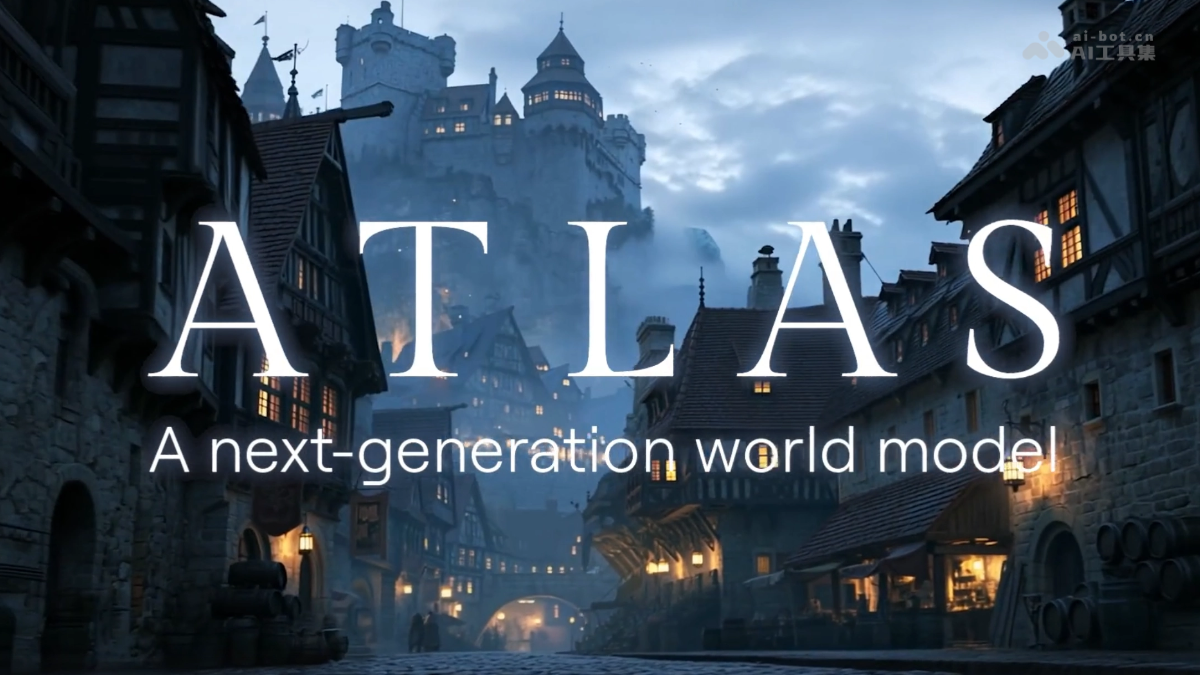
Atlas's Main Features
- Camera-Controlled Generation: Input 1–6 photos and specify camera poses to generate up to 1-minute, 1440p camera-movement videos with highly consistent spatial geometry.
- Spatial Reconstruction: With only 2–25 ordinary photos, it can reconstruct 3D point clouds or Gaussian splatting models of real scenes, with no professional scanning equipment required.
- Spatiotemporal Simulation: Understands spatial structure and world evolution, supports "bullet time"-style multi-camera reconstruction, and provides Real-to-Sim simulation training environments for robots.
- Image Generation: Generates high-quality images and 360° panoramas based on text or image prompts, supporting complex prompts and multiple visual styles.
Atlas's Technical Principles
- Multimodal Autoregressive Diffusion Transformer: Atlas was pretrained from scratch with a unified architecture that encodes text, image frames, video frames, camera poses, and 3D depth maps into the same kind of "spatial context" sequence, then generates output element by element in an autoregressive manner; at the same time, it uses a diffusion mechanism to progressively denoise high-dimensional continuous data (images/videos), balancing the sequence flexibility of LLMs with the high-quality rendering capability of video generation models.
- Spatial Context: Unlike the text context of LLMs, Atlas binds each input image to explicit three-dimensional coordinates and depth information, building internally a spatially constrained 3D scene representation; when generating new views, the model extrapolates and completes within this established spatial framework, ensuring cross-view geometric consistency and physical plausibility.
How to Use Atlas
- Visit the Official Website: Apply for Atlas access https://form.typeform.com/to/zHFR4r3A。
-
Camera-Controlled Video Generation: Upload 1–6 reference images, set camera poses and motion trajectories, and Atlas generates a camera-movement blockbuster of up to 1 minute.
-
3D Spatial Reconstruction: Upload 2–25 ordinary photos, no professional equipment needed, and Atlas automatically reconstructs them into a walkable 3D point cloud or Gaussian splatting scene.
-
"Bullet Time" Effects: Use 3–5 ordinary phones to shoot the same video from different angles, and after reconstruction Atlas supports free playback from any angle.
-
Robot Simulation Training: Shoot a short video of a real environment, and Atlas automatically generates a high-precision digital twin scene for robots to run mapping and trial-and-error.
-
Text-to-Image/Panorama: Input a text prompt or reference image to directly generate high-quality images or 360° panoramas.
Atlas's Core Advantages
-
Pixel-Level Camera Control: Treats camera poses as native input rather than relying on vague text descriptions, achieving director-level precise camera movement.
-
Extreme Sparse Reconstruction: Just a few ordinary phone photos are enough to reconstruct high-precision 3D scenes, far surpassing traditional scanning solutions.
-
Spatial geometric consistency: Based on Spatial Context, images are anchored in 3D coordinates, generating across viewpoints without collapse or flicker.
-
Unified multi-task architecture: A single model simultaneously covers generation, reconstruction, simulation, and image generation, with no need to switch between specialized tools.
-
Real-to-Sim closed loop: It can directly convert real-world videos into robot simulation environments, greatly reducing the cost of embodied intelligence training.
-
Continuous scaling: Pretrained from scratch and verified to continuously improve in performance as compute increases, with an extremely high future ceiling.
Atlas project address
- Project official website:https://www.worldlabs.ai/blog/atlas
Comparison of Atlas with similar competitors
| Comparison dimension | Atlas(World Labs) | Genie 3(Google DeepMind) |
|---|---|---|
| Positioning | Omni world model for spatial intelligence | General-purpose real-time interactive world model |
| Core input | Text, images, video, camera poses, 3D depth maps | Images, action instructions, state history |
| Camera control | Pixel-level precision, native support for camera pose parameter input | Mainly controlled indirectly through text/action descriptions |
| 3D reconstruction | 2–25 ordinary photos are enough to reconstruct point clouds/Gaussian splatting | Focuses on interactive world generation, not specialized in sparse reconstruction |
| Video generation | Up to 1 minute, 1440p, with extremely strong spatial geometric consistency | Focuses on real-time interaction, with relatively short single-segment duration |
| Physics simulation | Supports robot training environment generation through Real-to-Sim | Emphasizes a self-learning physics engine and real-time interactive feedback |
| Output format | Images, video, point clouds, 3D Gaussian Splatting | Interactive world states, video frames |
Atlas application scenarios
- Film and VFX production: The director provides a few scene photos and designs a camera movement trajectory; Atlas can generate precise cinematic shots at up to 1440p resolution, and can use a few phones to achieve a "bullet time" effect, eliminating the need for hundreds of professional camera arrays.
- Game and virtual scene construction: The art team uploads a small number of real-world photos, and Atlas automatically reconstructs them into a walkable 3D Gaussian Splatting scene that can be directly imported into a game engine, greatly shortening the production cycle for open-world or VR scenes.
- Robotics and embodied intelligence training: Use a phone to shoot a short video of a real environment, and Atlas automatically generates a high-precision digital twin scene, allowing robots to repeatedly run maps and trial-and-error in virtual space, solving the core pain points of slow real-data collection and high cost.
- Architecture and real estate presentation: A complete 3D model of a building or interior space can be reconstructed from just a few on-site photos, supporting roaming from any angle and aerial-view generation, for use in property presale presentations or digital archiving of historic sites.
- Advertising and e-commerce content generation: Input a product image or text prompt to quickly output a 360° panoramic showcase video or stylized advertisement film, ensuring high consistency of product geometry and lighting under different camera movements through pixel-level camera control.