
What is ASAP
ASAP (Aligning Simulation and Real Physics) is a two-stage framework jointly launched by Carnegie Mellon University and NVIDIA to address the mismatch between humanoid robot simulation and real-world dynamics. In the pre-training stage, ASAP learns motion tracking policies in a simulated environment, using human motion data to generate target actions. In the post-training stage, ASAP collects real-world motion data, trains a Delta action model to compensate for the dynamics gap between simulation and reality, and fine-tunes the policy so that it adapts to the real physical environment. The framework significantly improves the agility and whole-body coordination of humanoid robots in complex movements, reduces motion tracking errors, enables efficient skill transfer from simulation to reality, and provides a new technical path for developing more expressive and agile humanoid robots.
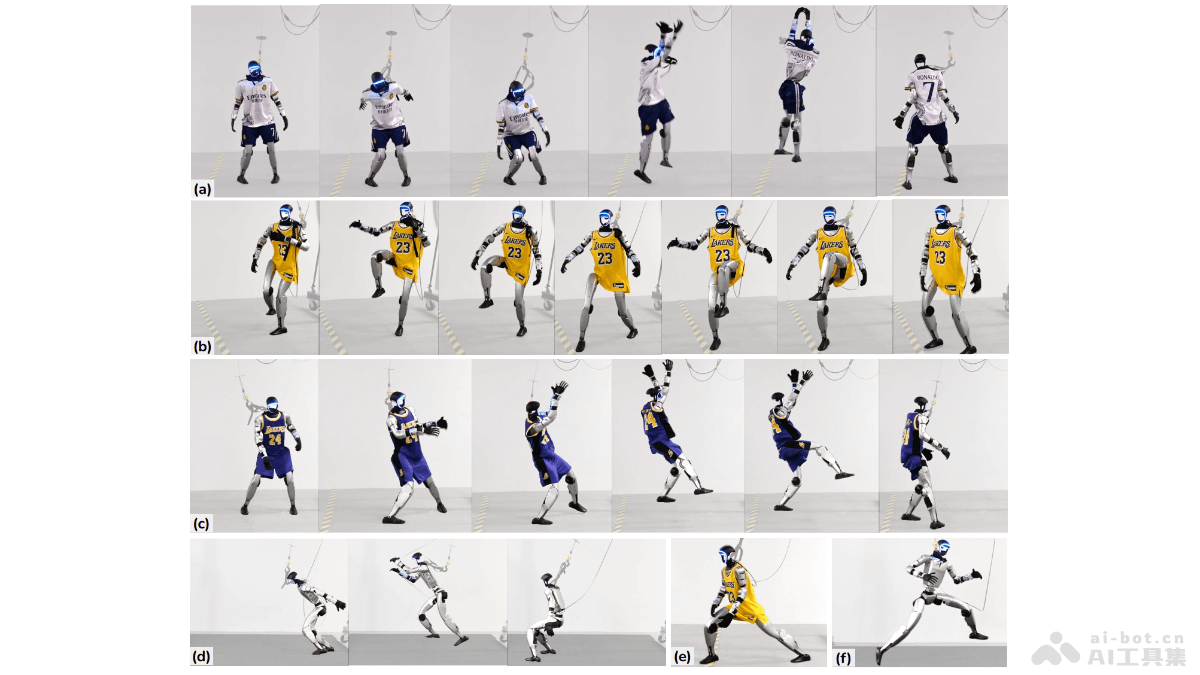
ASAP's Main Features
- Transfer of agile whole-body skills: Efficiently transfer motion control policies trained in a simulated environment to real robots to perform complex whole-body movements such as jumping, balancing, and rapid turning.
- Dynamics compensation and adaptation: Based on a learned Delta action model, automatically compensate for the dynamics gap between simulation and reality, including hardware characteristics, friction, inertial parameters, etc., so that the robot exhibits performance in the real environment similar to that in simulation.
- Improved motion tracking accuracy: Significantly reduce the robot's motion tracking error when performing tasks, improve the accuracy and stability of actions, and maintain good performance in complex dynamic tasks.
- Enhanced generalization ability: The framework is applicable to the specific motions used during pre-training and can effectively adapt to unseen motions (i.e., "out-of-distribution"), enhancing the robot's generalization ability in the real world.
ASAP's Technical Principles
- Pre-training Stage (Pre-training):
- Data generation: Extract motion data from human motion videos, retarget it onto the robot model, and generate a motion dataset for training.
- Motion tracking policy training: In a simulated environment, use reinforcement learning (RL) to train a motion tracking policy so that the robot can track predefined motion trajectories. The policy is trained based on a time phase variable and adapts to motion sequences of different lengths.
- Post-training Stage (Post-training):
- Real-world data collection: Deploy the pre-trained policy to a real robot and collect motion data during task execution, including information such as joint positions, velocities, and accelerations.
- Delta action model training: Based on the collected real-world data, train the Delta action model. The model learns how to compensate for dynamics mismatch by minimizing the difference between simulated states and real states. Specifically, the Delta action model outputs a "corrective action" (delta action), which is added to the original action to adjust the dynamics characteristics of the simulated environment.
- Policy fine-tuning: Integrate the trained Delta action model into the simulator and fine-tune the pre-trained motion tracking policy. By continuing training in the corrected simulated environment, the policy can better adapt to the physical characteristics of the real world and improve performance on the real robot.
ASAP's Project Address
- Project official website:https://agile.human2humanoid.com/
- GitHub repository:https://github.com/LeCAR-Lab/ASAP
- arXiv technical papers:https://arxiv.org/pdf/2502.01143
Application scenarios of ASAP
- Sports and performance: Robots simulate athletes' movements for sports training, motion analysis, and performance, enhancing visual effects.
- Disaster rescue: Robots perform agile movements to quickly reach dangerous areas and carry out rescue missions, improving rescue efficiency.
- Industrial manufacturing: Robots adapt to complex industrial tasks, improving production efficiency and flexibility while reducing errors.
- Home services: Robots complete daily household chores and assist the elderly or disabled, providing convenience and safety support.
- Virtual reality and gaming: Generate realistic virtual character movements, enhancing game immersion and development efficiency.