
What is ArtCrafter
ArtCrafter is a text-to-image style transfer framework jointly launched by Tsinghua University, Peng Cheng Laboratory, and Lenovo Research. Based on diffusion models, it addresses the limitations of traditional methods in style expression, content consistency, and output diversity. ArtCrafter is implemented based on an embedding reconstruction architecture and includes three key components: an attention-based style extraction module, which uses a multi-layer architecture and perceptron attention mechanism to extract delicate style features from reference images; a text-image alignment enhancement module, which maps image and text embeddings to a shared feature space based on attention interaction, making generated images closer to the content of text prompts; and an explicit modulation component, which fuses original and multimodal embeddings based on linear interpolation and concatenation to generate diverse and text-related images.
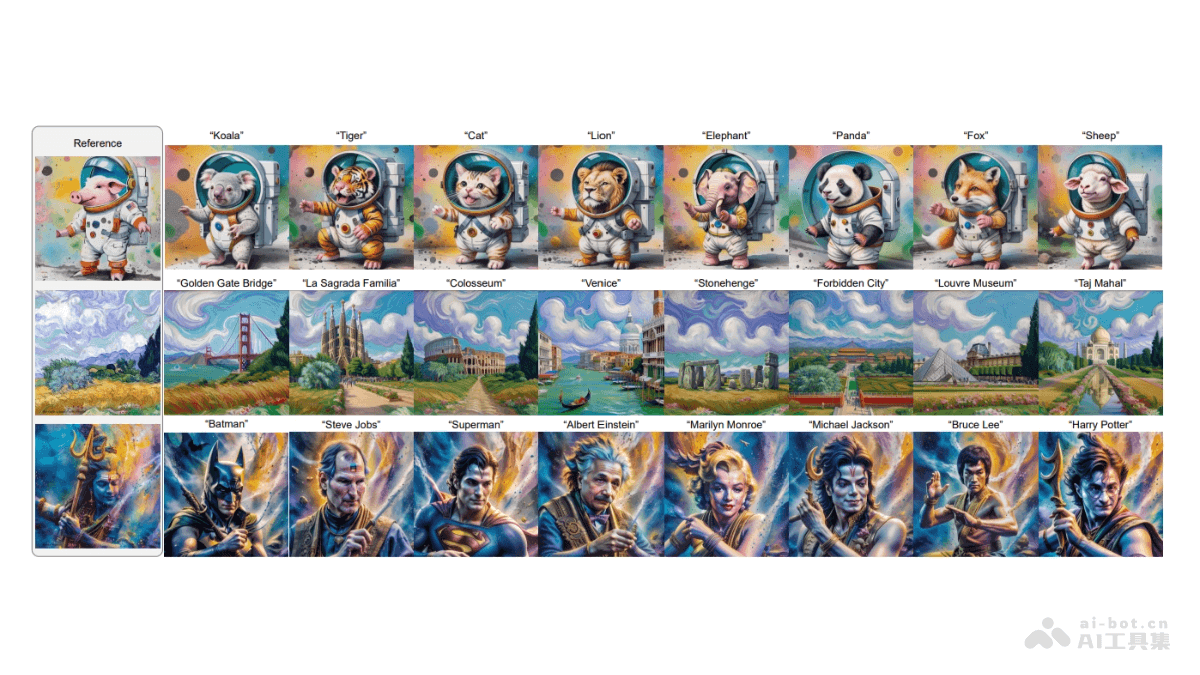
Main Features of ArtCrafter
- Style Transfer: Transfers the style features of reference images to generated images, achieving diverse artistic style expression.
- Text Guidance: Generates images consistent with their content based on text prompts, meeting personalized creation needs.
- Enhanced Diversity: Generates images with rich visual expression and style variation, avoiding overly monotonous results.
- Maintained Consistency: During style transfer, maintains a high degree of consistency between generated images and the content of text prompts and reference images.
- Strong Compatibility: Compatible with existing controllable tools, flexibly applicable to different creation scenarios and needs.
Technical Principles of ArtCrafter
- Based on Diffusion Models: Based on the generative capability of diffusion models, gradually denoises to generate images.
- Embedding Reconstruction Architecture: Based on an embedding reconstruction design, maps text and image embeddings to a shared feature space, achieving cross-modal fusion and interaction.
- Attention-Based Style Extraction: Adopts a multi-layer architecture and perceptron attention mechanism to extract local and global style features from reference images, ensuring the accuracy and richness of style encoding.
- Text-Image Alignment Enhancement: Uses carefully designed attention interaction to dynamically adjust the importance of different parts of text prompts, enabling generated images to better reflect text content.
- Explicit Modulation: Based on methods such as linear interpolation and concatenation, fuses original image and text embeddings with multimodal embeddings, enhancing the model's adaptability and the diversity of generated results.
Project Address of ArtCrafter
- arXiv Technical Paper:https://arxiv.org/pdf/2501.02064
Application Scenarios of ArtCrafter
- Personalized Creation: Helps artists quickly realize creative ideas and explore more artistic possibilities.
- Entertainment and Gaming: Game developers generate characters that match style settings during design, adding unique visual elements to games.
- Art Education: When an art teacher explains Impressionist art style to students, they generate several landscape paintings with Impressionist characteristics, allowing students to intuitively experience Impressionism's unique handling of light, shadow, and color, deepening their understanding of the art style.
- Advertising Creativity: Sports brand designers generate vibrant, sunny sports scene images for use in advertising production, attracting the attention of young consumers.
- Art Style Analysis: By comparatively analyzing the generated images, art history researchers can more deeply explore the common characteristics and innovations of artists in a specific art period regarding aspects such as human body proportions and the handling of light and shadow.