
What is ArcLoop
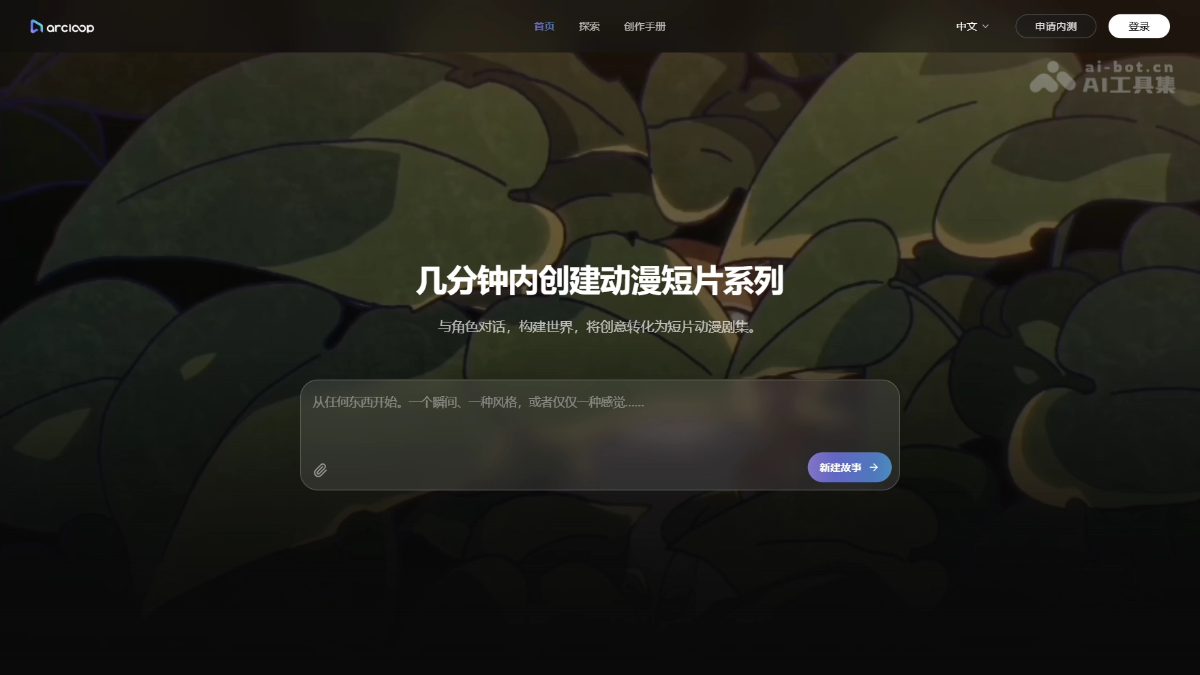
ArcLoop isan AI comic drama generation platform, with IP World as its core architecture, consolidating characters, scenes, visual styles, and asset materials within the same project, continuously creating Stories and Episodes. The Agent automatically generates story outlines, storyboards, and shots, supports calling assets with @character name, and locks the art style with Visual Reference, avoiding visual drift in long-running serials. ArcLoop covers formats such as short dramas, anime, Live2D, and voiceover, allowing the character world to be reused long-term across episodes and seasons.
Main features of ArcLoop
-
IP World worldview management: Characters, scenes, props, and visual styles are uniformly consolidated in the same "world" for long-term reuse across episodes and stories.
-
Story Brief project settings: When creating a new project, select the language, aspect ratio, visual style, and underlying model all in one place.
-
AI script and outline generation: The Agent automatically produces the core conflict, character goals, and episode direction, and supports modification or partial rewriting of specified passages.
-
Character and asset management: Characters have independent asset pages; Library manages materials, and Asset manages reusable objects for precise calling by the Agent.
-
Episode and storyboard generation: The Story is split into Episodes; the Agent generates a Storyboard, and shot cards record actions, composition, dialogue, and camera movement.
-
@ references and visual locking: In shot descriptions, @character name/scene/prop automatically calls the asset, and Visual Reference locks the art style to prevent cross-episode drift.
-
Video generation and online editing: You can generate a specified Shot individually or an entire episode of video, adjust order and duration on the timeline, replace clips, and generate dialogue voiceover and background music.
-
Multi-format creation tools: Script to Video, AI Short Drama, Anime Generator, Live2D animation, and Character Voice voiceover all share the same set of assets at the underlying level.
How to use ArcLoop
-
Register and log in: Visit ArcLoop's official website https://arcloop.cn/,用邮箱或第三方账号注册并登录。
-
Create a new project: Create an ArcLoop project, fill in the Story Brief, and select the language, aspect ratio, visual style, and model to use.
-
Generate a story outline: The Agent automatically produces a story outline (core conflict, character goals, episode direction), which can be modified directly or partially rewritten for specified passages.
-
Build character assets: On the character asset page, fill in identity, personality, and visual settings, upload character reference images, and bind multiple looks (such as training outfit and stage costume).
-
Organize materials and assets: Put images, videos, and audio into the Library, and create characters, scenes, and props separately as Assets and bind the corresponding materials.
-
Split episodes: Split the Story into several Episodes, each corresponding to a key event.
-
Generate storyboards: Enter an episode and have the Agent generate a Storyboard; the shot cards will clearly write the actions, composition, dialogue, and camera movement.
-
Reference assets to write shots: In the shot description, enter @character name, scene, or prop name to automatically call the created assets without repeatedly describing appearance and clothing.
-
Set visual reference: Create a Visual Reference, save the confirmed visual style as a reference, and lock in the color and lighting to avoid visual drift.
-
Generate Video Shots: Choose to generate only a few specified Shots, or generate the entire episode in one go.
-
Editing and Voiceover: On the editing page, adjust shot order and duration, replace clips, generate character dialogue voiceovers, and add background music.
ArcLoop's Core Advantages
-
Long-Term Accumulation in IP World: Characters, scenes, and settings are reused across seasons, solving the consistency problem in long-running serials where "the longer a character appears, the less they look like themselves."
-
@-Reference Creation: In a shot description, @character name automatically brings in their appearance and clothing, eliminating the need to repeatedly write prompts line by line.
-
Visual Reference Locks the Art Style: Save the finalized style as a reference asset to reduce visual drift between different episodes.
-
Layered Management of Assets and Materials: Library manages raw materials, Asset manages reusable objects, and Agent recognition and invocation are more precise.
-
Full-Process Agent-Driven: From outline and storyboard to shot generation and partial rewriting, creative efficiency is far higher than manually debugging shot by shot.
-
One-Stop Closed Loop: Outline -> storyboard -> generation -> editing -> voiceover -> music is completed within one project, with no need to switch back and forth between multiple tools.
-
Model Decoupling: Even if the underlying model is changed, settings are not lost; the character world and assets are retained long-term with the project.
-
Multiple Formats Share One Set of Data: Tools such as short dramas, anime, Live2D, and voiceover share the same underlying character asset library.
-
Extensibility for Spin-Offs and New Stories: After the main storyline ends, spin-offs or new Stories can be started directly, continuously amplifying IP value.
Comparison of ArcLoop with Similar Competitors
| Comparison Dimension | ArcLoop | LibTV | Seko |
|---|---|---|---|
| Product Positioning | A full-stack AI story engine, centered on long-term worldview management in IP World | A one-stop AI video creation platform, focusing on "infinite canvas + node-based workflow" | The industry's first "creation and editing integrated" AI video creation Agent, producing a finished video from one sentence |
| Core Architecture | Characters, scenes, and visual styles are accumulated in IP World, around which Stories and Episodes are created | Script, storyboard, shots, and editing each become nodes, connected into a pipeline on the canvas | Agent serves as the main axis, calling down to characters/scenes/context accumulated on the infinite canvas, and integrating upward with the Skill ecosystem |
| Consistency Solution | @character name references assets + Visual Reference locks the art style, and character profiles can be bound to multiple design images | Consistency management via the subject library + character three-view sheets; reference images need to be manually brought in again across episodes | Self-developed SekoIDX "negative reference image" technology locks facial features, clothing, and scene details |
| Exclusive Technology | No self-developed model; focuses on an engineered production system | Self-developed Star Video video model | SekoIDX + SekoTalk (the industry's first multi-person same-frame lip sync, with a single shot up to 60 seconds and 60 voice tones) |
| Underlying Models | Defaults to Seedream 5.0 Lite + Seedance 2.0, and can be changed | Star Video + Kling 3.0, Seedance, Wan, Hailuo, Vidu, and other 20-50 options | Integrates Seedance 2.0, Kling, Vidu, Wan, PixVerse, Hailuo, Midjourney, Nano Banana, etc., with intelligent orchestration |
| Degree of automation | Agent generates outlines, storyboards, and full episodes, with support for partial rewrites | Dual entry points: human canvas fine-tuning + Agent generating the entire process from a single sentence via an open-source Skill interface | From a one-sentence idea or an uploaded original web novel manuscript, the Agent automatically breaks down the script, sets the style, plans storyboards, and produces the final film with voiceover and music |
| Serialization capability | Long-term accumulation across seasons and stories, positioned for long-running serials of dozens to hundreds of episodes (benchmarked against projects like "Wan Yao Tu Lu Zhuan") | Leans toward single-title/series project production | Continuous creation across multiple series up to 100 episodes, with automatic inheritance of character parameters and scene settings across episodes |
| Skill ecosystem | Tools are kept within its own project system | Agent Skill interface is open to the outside | Co-packages more than 20 Skills across 6 major categories with leading creators (xiuxian anime drama, overseas short drama, storyboard master, etc.) |
| Editing capability | Built-in timeline editing, voiceover, and music | Can export CapCut project files to connect with external tools | Built-in native editor + conversational modification, the timeline is fairly basic, and fine-tuning requires external tools |
ArcLoop's application scenarios
-
Long-running serialized AI anime drama: For works like "Wan Yao Tu Lu Zhuan" that run for more than a dozen seasons and over a thousand episodes, use IP World to keep character appearance, outfits, moves, and worldview self-consistent over the long term.
-
Mass production of vertical-screen AI short dramas: Use the AI Short Drama tool to mass-produce 50-second vertical-screen short dramas, relying on the Agent to automatically generate outlines and storyboards to quickly gain traction.
-
Anime / Makoto Shinkai-style animation creation: Use Anime Generator and Live2D tools to turn static character images into anime or Live2D-style animated videos.
-
IP spin-offs and new story development: After the main storyline concludes, launch supporting-character spin-offs and restart new stories in the same world, reusing existing character and scene assets to continuously amplify IP value.
-
One-click script-to-video: Use Script to Video to directly read a complete script, automatically split storyboards, generate shots, and add voiceover and music, suitable for novel adaptations and audio comic production.