
What is AppAgentX
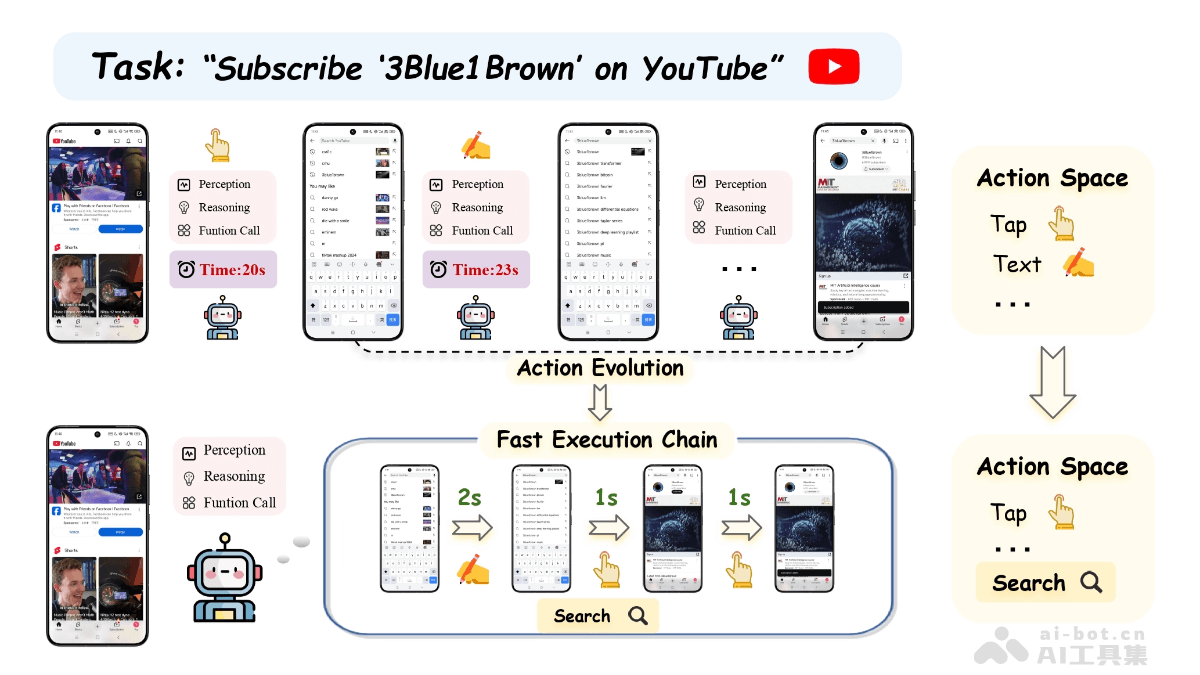
AppAgentX is a novel self-evolving GUI (Graphical User Interface) agent framework launched by Westlake University, which improves the efficiency and intelligence of agents in smartphone interaction by abstracting high-level actions from execution history. AppAgentX combines a memory mechanism and an evolution mechanism to record task execution processes, identify repetitive operation sequences, and replace them with more efficient high-level actions, reducing dependence on step-by-step reasoning. AppAgentX achieves continuous optimization of behavior based on a chained knowledge framework, enhancing adaptability and efficiency. AppAgentX significantly outperforms existing methods in multiple benchmarks, demonstrating higher accuracy and efficiency, and providing new ideas for the application of intelligent agents in complex task execution.
Main Features of AppAgentX
- Automatic induction of efficient operation patterns: Detects repetitive operations during task execution and automatically summarizes them into high-level "one-click" operations, simplifying the operation process.
- Reduce repetitive computation and improve execution efficiency: Based on memory and reuse of execution strategies, it avoids repetitive reasoning and makes task execution more efficient.
- Vision-based general operation capability: It relies on screen visual information for operations, requires no backend API support, is universal across different software and devices, and achieves "plug-and-play".
- Support for complex tasks and cross-application operations: It operates various applications like a human and supports complex cross-application tasks, such as scraping information from web pages and filling it into Excel, or performing linked operations across multiple software programs.
Technical Principles of AppAgentX
- Memory mechanism: It records task execution history based on a chained structure, including page nodes and element nodes. Page nodes record descriptions and element information of UI pages, while element nodes record specific interaction details. LLMs are used to generate functional descriptions of pages and elements, and duplicate descriptions are merged to form unified records.
- Evolution mechanism: It analyzes task execution history and identifies repetitive low-level operation sequences. Repeated sequences are abstracted into high-level actions (called "shortcut nodes") to replace the original low-level operations. The action space is expanded by incorporating high-level actions into the agent's operation set, improving execution efficiency.
- Chained knowledge framework: It uses a graph-based storage structure (such as Neo4j) to record nodes and relationships in task execution. Nodes include pages, elements, and high-level actions, and relationships represent the interactions and transitions between them. The chained structure enables continuous optimization and evolution of behavior.
- Task execution process: During task execution, the agent identifies the current page and elements based on visual matching. If a high-level action is matched, the corresponding low-level operation sequence is executed directly, reducing reasoning steps. If the high-level action is not applicable, it falls back to the low-level action space to ensure the task can still be completed.
Project Address of AppAgentX
- Project official website:https://appagentx.github.io/
- GitHub repository:https://github.com/Westlake-AGI-Lab/AppAgentX
- arXiv technical paper:https://arxiv.org/pdf/2503.02268
Application Scenarios of AppAgentX
- Automating daily operations: It automatically completes mobile phone settings adjustments, in-app tasks, etc., reducing manual operations.
- Intelligent assistant enhancement: It is integrated into intelligent assistants to help users quickly execute complex tasks.
- Enterprise process automation: It is used for repetitive tasks such as enterprise data entry and report generation, improving efficiency.
- Cross-application task management: Supports switching and operating between different apps, enabling cross-platform automation.
- Assisting special groups: Simplifies operation processes, helping elderly people or those with physical inconvenience use mobile phones more easily.