
Which economic tasks are accomplished through artificial intelligence? Evidence from millions of Claude conversations
Authors
Kunal Handa*, Alex Tamkin*, Miles McCain, Saffron Huang, Esin Durmus
Sarah Heck, Jared Mueller, Jerry Hong, Stuart Ritchie, Tim Belonax, Kevin K. Troy
Dario Amodei, Jared Kaplan, Jack Clark, Deep Ganguli
Anthropic
Abstract:
Although discussion about the impact of artificial intelligence on the future of work is widespread, we lack systematic empirical evidence on how these systems are used for different tasks. This paper proposes a new framework for measuring patterns of artificial intelligence use in the economy. Using a recent privacy-preserving system, we analyzed more than four million Claude.ai conversations, analyzed through the lens of tasks and occupations in the U.S. Department of Labor's O*NET database. Our analysis finds that artificial intelligence use is concentrated mainly in software development and writing tasks, which together account for nearly half of all total usage. However, artificial intelligence use is broader across the economy, with about 36% of occupations using artificial intelligence for at least a quarter of their tasks. We also analyzed how artificial intelligence is used for tasks and found that 57% of usage indicates augmenting human capabilities (for example, learning or iterating on outputs), while 43% indicates automation (for example, completing requests with minimal human involvement). Although our data and methods face important limitations and depict artificial intelligence use on only one platform, they provide an automated, nuanced method for tracking the evolving role of artificial intelligence in the economy and identifying potential future implications as these technologies continue to advance.

Get the original PDF file of the "Anthropic – AI Economic Index Report", scan the QR code to follow the official account and reply:20250211 Claim
1. Introduction
The rapid development of artificial intelligence has profound implications for the evolution of the labor market. Although predicting and preparing for these changes is crucial, we lack systematic empirical evidence on how artificial intelligence systems are being integrated into the economy. Existing methods—whether developing predictive models or regularly surveying users—cannot track the dynamic relationship between advances in artificial intelligence capabilities and their direct, practical use in the economy.
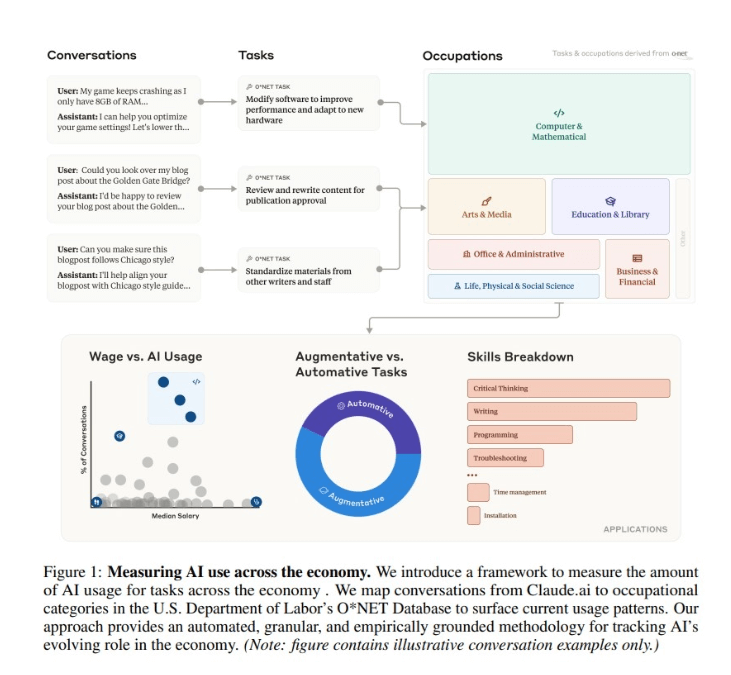
Here, we propose a new empirical framework for measuring artificial intelligence use across different tasks in the economy, based on privacy-preserving analysis of millions of real conversations on Claude.ai. By mapping these conversations to occupational categories in the U.S. Department of Labor's O*NET database, we can not only identify current usage patterns, but also discover early signs of which economic areas may be most affected as these technologies continue to advance.
We use this framework to make five key contributions:
-
We provide the first large-scale empirical measurement revealing which tasks in the economy have seen artificial intelligence use (see Figure 1, Figure 2, and Figure 3). Our analysis finds the highest rates of artificial intelligence use in tasks in software engineering roles (for example, software engineers, data scientists, bioinformatics technicians), as well as in occupations requiring substantial writing ability (for example, technical writers, copywriters, archivists) and analytical roles (for example, data scientists). In contrast, tasks involving physical manipulation of the environment (for example, anesthesiologists, construction workers) currently show very little use.
-
Quantified the depth of AI use within occupations (see Figure 4). Only about 4% of occupations use AI for at least 75% of their tasks, suggesting that deep task-level use may exist in certain roles. More broadly, about 36% of occupations use AI for at least 25% of their tasks, indicating that AI has begun to diffuse into the task portfolios of a substantial portion of the workforce.
-
Measured which occupational skills are most representative in human-AI conversations (see Figure 5). Cognitive skills, such as reading comprehension, writing, and critical thinking, show high presence rates, while physical skills (e.g., installation, equipment maintenance) and managerial skills (e.g., negotiation) show minimal presence—reflecting a clear complementarity between humans and current AI capabilities.
-
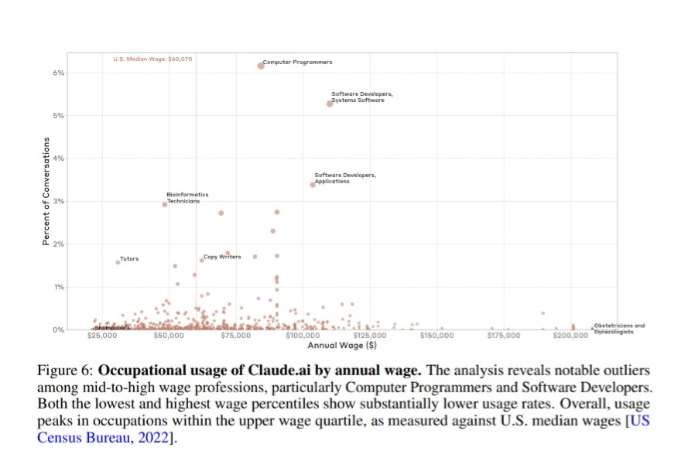
Analyzed the correlation between wages and entry barriers and AI use (see Figure 6 and Table 2). We find that AI use peaks in the upper quartile of the wage distribution but declines at both ends of the wage distribution. Most high-use occupations are concentrated in the upper quartile, mainly corresponding to software industry positions, while high-wage occupations (e.g., doctors) and low-wage positions (e.g., restaurant workers) show relatively low use. This pattern may reflect the limitations of current AI capabilities, the physical manipulation requirements inherent in these roles, or both. A similar pattern also emerges for entry barriers, with use peaking in occupations requiring considerable preparation (e.g., a bachelor's degree) rather than in occupations requiring minimal or extensive training.
-
Assessed whether people use Claude to automate or augment tasks (see Figure 7). We find that 57% of interactions show an augmentation pattern (e.g., iterating back and forth on a task), while 43% show automation-focused use (e.g., directly executing a task). Although this proportion varies across occupations, most occupations show a mix of automation and augmentation in tasks, indicating that AI is both an efficiency tool and a collaborative partner.
Our method provides an automated, granular, and empirically based approach for tracking AI use patterns as AI capabilities and societal use evolve. This early visibility into emerging trends gives policymakers and civil society critical lead time to respond to how AI is changing the way work is done. However, we acknowledge several key limitations (discussed in Section 4.1); for example, our usage data cannot reveal how Claude's outputs are used in practice, and our reliance on O*NET's static occupational descriptions means we cannot account for entirely new tasks or occupations that AI may create.
Nevertheless, this framework provides a foundation for understanding the evolving economic impact of AI. Although our methods are not perfect, they provide a systematic way to track use patterns and identify early indicators of economic impact across different sectors. As AI capabilities and adoption continue to advance, we believe such empirical measurement is essential for understanding and preparing for the broader economic impact of the technology.
2. Background and Related Work
Our research builds on several lines of research that attempt to model, measure, and predict the economic impact of AI.
Economic Foundations and Task-Based Frameworks A large body of economics literature has proposed theoretical models to understand the impact of automation on the labor market. Most notably, it advocates modeling the labor market through the lens of discrete tasks, which can be performed by human workers or machines—for example, debugging code or cutting hair. Based on this framework, Autor [2015] showed that although technology automates some tasks, it often augments human capabilities in other tasks because of complementarity between humans and machines, thereby increasing the demand for labor. In addition, Acemoglu and Restrepo [2018] used this framework to explore a model in which automation technology can create entirely new tasks rather than merely replacing old ones.
Predicting the impact of artificial intelligence on the labor market Another branch of research uses task-based frameworks to predict the prevalence of automation in the future economy, often based on descriptions of tasks and occupations in the ONET occupational information database provided by the U.S. Department of Labor. For example, Frey and Osborne [2017] applied a Gaussian process classifier to a dataset of 70 labeled occupations to predict which occupations are vulnerable to computerization. Brynjolfsson et al. [2018a] hired human annotators to rate 2,069 detailed work domains in the ONET database, with particular attention to their potential to be performed by machine learning. Webb [2019] analyzed the overlap between patent documents and job descriptions to predict the degree of task "exposure" to artificial intelligence, finding that high-education, high-wage occupations have the highest exposure—a pattern partly reflected in our empirical usage data, although we find the highest usage in mid-to-high-wage occupations rather than in occupations at the highest wage levels.
Real-world research on actual use of artificial intelligence To complement these predictions based on human or machine judgment, other studies have attempted to collect concrete data to understand the current adoption of artificial intelligence in the labor market. For example, research in late 2023 found that half of workers in exposed occupations in Denmark had used ChatGPT, estimating that it could halve the working time of about one-third of tasks, while a follow-up study in August 2024 found that 39% of U.S. working-age adults had used generative artificial intelligence, with about one-quarter of them using it weekly [Bick et al., 2024]. In addition, further research has attempted to measure the breadth and depth of this use, finding that generative artificial intelligence tools have a positive impact on productivity across a wide range of individual domains, including software engineering, writing, customer service, consulting, translation, legal analysis, and data science.
By combining these independent methods, we conducted the first comprehensive analysis of how advanced artificial intelligence systems are used for tasks and occupations in the economy. We build on the task framework, but unlike predicting potential impact (occupational "exposure" to artificial intelligence), we use Clio to measure real-world usage patterns. This is a recent system capable of privacy-preserving analysis of millions of human-model conversations on major model providers. This allows us to complement controlled studies of domain-specific artificial intelligence productivity effects, providing a comprehensive perspective on how artificial intelligence is being integrated into work in the economy. Our method can dynamically track these patterns as artificial intelligence capabilities and societal adoption evolve, revealing current usage trends and early signs of future diffusion.
3. Methods and Analysis
To understand how AI systems are being used for different economic tasks, we utilize Clio, an analysis tool that uses Claude to provide aggregated insights from millions of human-model conversations. We use Clio to classify conversations, covering occupational tasks, skills, and interaction patterns, revealing the distribution of these different categories. All analyses are based on conversation data collected during December 2024 and January 2025. More details and prompts are in Appendices B, E, and F, including validating the composition of our dataset and how to classify when there is a large number of categories (e.g., O*NET tasks).
3.1 Task-level analysis of AI usage
Using Clio to analyze a dataset of 1 million Claude.ai Free and Pro conversations, we map each interaction to the most relevant task category in the ONET database. Since ONET contains nearly 20,000 unique task statements, we use Clio to create a hierarchical tree of tasks and perform assignment by traversing the tree. Although a conversation can often map to multiple valid tasks, when mapping a single conversation to multiple tasks, we observed that the qualitative results were very similar. We also provide more details and analysis in Appendix B, including how we map conversations to tasks (Appendix B.1), the hierarchy creation process (Appendix B.1), the fact that we obtained similar results for conversation-level and account-level data (Appendix B.2), and our validation of the dataset composition (Appendix B.7). In addition, we discuss human validation of our task hierarchy classification (Appendix C) and the results for cluster-level data (Appendix G).
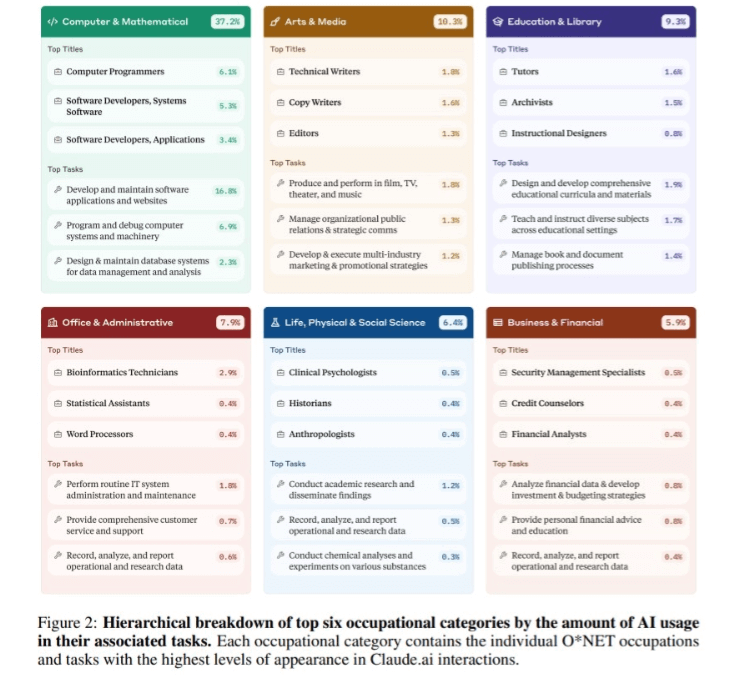
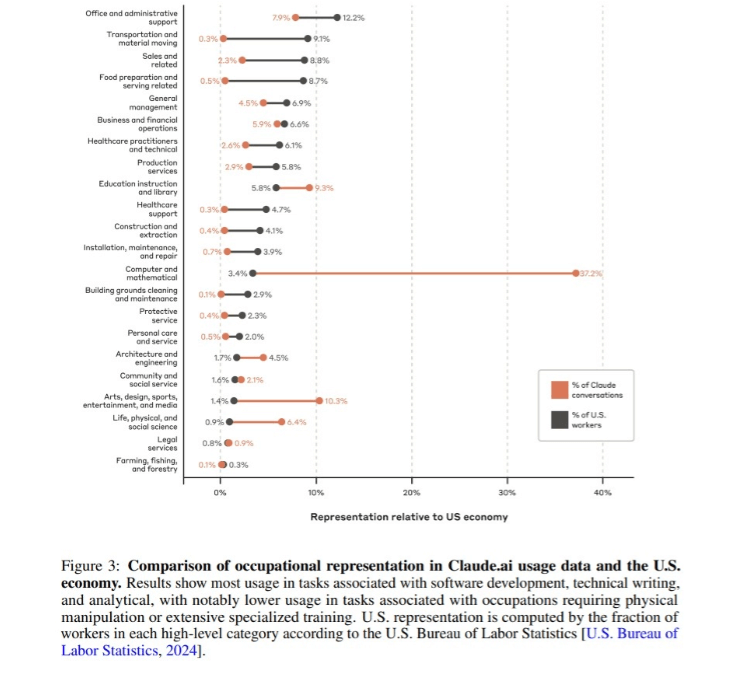
Computer-related tasks have the largest amount of AI usage, followed by writing tasks in educational and communication contexts. To understand broader patterns, we group these tasks according to the O*NET occupational framework—first mapping them to specific occupations (such as computer network architects), and then to broader occupational categories (such as computer and mathematical occupations). Figure 2 shows the distribution of these occupational categories, displaying the most frequent occupations and tasks within each group, while Figure 3 compares these usage patterns with the actual occupational distribution of the U.S. workforce.
It is worth noting that the occupational classification of a conversation does not necessarily mean that the user is a professional in that field. For example, some queries about nutrition may come from dietitians, but they may also come from individuals seeking personal dietary advice. This broad access to traditionally professional tasks—even if this assistance is not perfect—may have significant impacts on these fields, although analyzing these impacts is beyond the scope of this study. We further discuss these limitations in Section 4.1.
In summary, these data reveal some profound insights:
- Consistent with our findings at the task level, computer and mathematical occupations show the highest related AI usage rate, accounting for 37.2% of all queries. The related AI usage rate is the highest, accounting for 37.2% of all queries.
- Arts, design, entertainment, sports, and media occupations have the second-highest related AI usage rate (10.3%). (10.3%), which may reflect that in Claude.ai queries, marketing, writing, and other types of content generation are very common. In Claude.ai traffic, marketing, writing, and other types of content generation are very common.
- Educational occupations also have a high proportion, including education teaching and library occupations, as well as subject-specific occupations. and library occupations, as well as subject-specific occupations, such as life, physical, and
- Social science occupations. A large portion of Claude.ai traffic belongs to business-related occupations: business and financial occupations, office and administrative support occupations, and management occupations.
- Surprisingly, occupations requiring physical labor are the least represented, such as transportation and material moving occupations. Transportation and material moving occupations; healthcare support occupations; and farming, fishing, and forestry occupations,
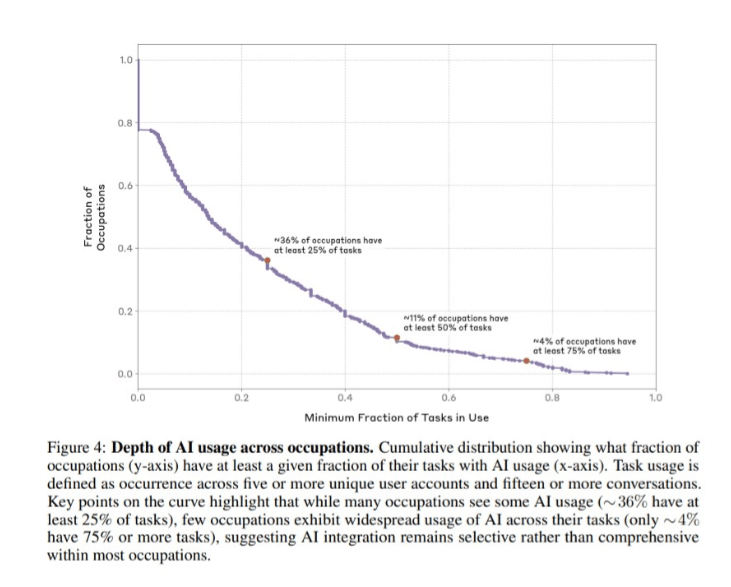
How many tasks within each occupation used AI?To assess the degree of AI integration across occupations, we examined how many of the tasks in each occupation appeared in our Clio run results. As shown in Figure 4, we found that AI task use exhibits a severely skewed distribution. Only about 4% of occupations used AI in at least 75% of their relevant tasks; for example, in the occupation of foreign language and literature teachers (75% of tasks), we observed AI being used for tasks such as collaborating with colleagues to solve teaching problems and planning course content, but not for activities such as writing grant applications or maintaining student records. Only about 11% of occupations used AI in half or more of their tasks, such as marketing managers (50% of tasks), where we saw AI being used for tasks such as market research analysis and strategy development, but not for activities such as product specification consultation or trade show coordination. At a lower threshold, the picture expands, with about 36% of occupations using AI in at least a quarter of their tasks, such as physical therapists (25% of tasks), where we observed AI being used for tasks such as research and patient education, but not for activities such as actual treatment or home care instruction. This distribution suggests that although AI today may touch many occupations, deep integration across most tasks still remains to be improved. At present, full automation in any particular occupation is still rare. Today's AI appears to be mainly used for specific tasks within occupations rather than completely replacing entire jobs.
The O*NET database contains 35 occupational skills, which identify the necessary abilities workers need to perform tasks in different jobs. These skills include critical thinking, complex problem solving, persuasion, and equipment maintenance, among others. We used Clio to identify all occupational skills demonstrated by the model associated with a given Claude.ai conversation, as shown in Figure 5.
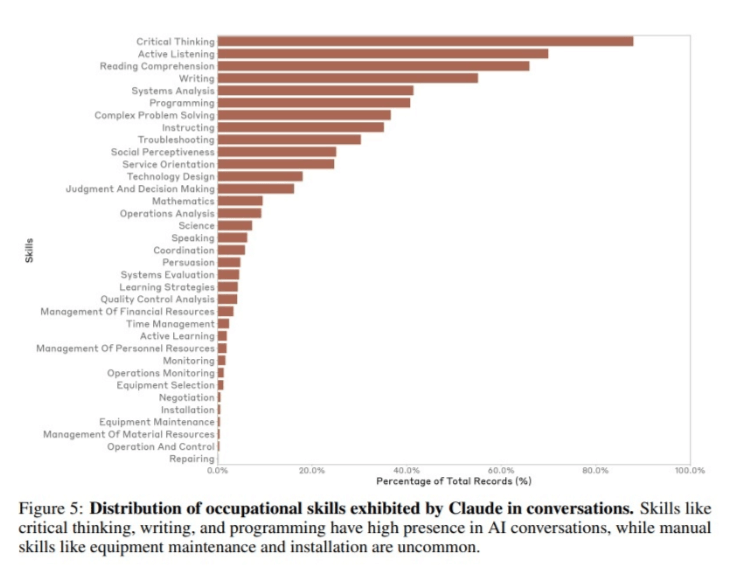
Intuitively, skills requiring physical interaction, such as installation, equipment maintenance, and repair, appear least frequently in Claude.ai traffic. In contrast, cognitive skills such as critical thinking, reading comprehension, programming, and writing appear most frequently. However, our analysis only captures whether a skill is demonstrated in Claude's response, not whether that skill is central to the user's purpose or whether it is performed at an expert level. For example, although active listening is the second most common skill, this may reflect Claude's default conversational behavior—for example, restating user input and asking clarifying questions—rather than users specifically seeking listening-centered interaction.
Wage Figure 6 shows how AI usage varies with the median wage of an occupation. We find that usage peaks in the upper quartile of the wage distribution, involving computational occupations such as computer programmers and web developers. At both ends of the wage distribution, usage is lower for occupations. For example, waiters and anesthesiologists (low-wage and high-wage occupations) are among the least represented occupations in the data, consistent with our finding that skills requiring physical interaction are the rarest in the data.
Entry Barrier Occupations in the O*NET database are divided into job zones 1 through 5, categories defined by the level of human preparation required to perform a given occupation. Occupations requiring higher levels of education, experience, and training are classified into higher job zones. As job zones increase from 1 to 4, the representation of that zone in our data also increases, peaking at job zone 4, which typically requires a four-year bachelor's degree. However, for job zone 5, which requires extensive preparation, representation declines, with most occupations requiring an advanced degree. These results clearly indicate that human entry barriers may be very different from those of language models. For complete results, see Appendix D.2 and Table 2.
3.4 Automation and Augmentation Users Although the preceding analysis reveals which tasks have the highest AI usage, it does not tell us how AI is being used for these tasks. A key distinction in the economics literature is automation—technology replacing human labor—versus augmentation—technology supplementing and enhancing human capabilities. To understand which pattern is more prevalent, we used Clio to classify conversations into five different collaboration modes (see Table 1), divided into two broad categories: automation and augmentation.
In interactions with Claude.ai, both augmentation and automation collaboration behaviors exist, with augmentation conversations (57%) slightly more numerous than automation (43%). However, we note an important caveat, namely that users may edit and adjust responses received from Claude outside the chat window, suggesting that the actual proportion of augmentation conversations may be higher. Furthermore, even automation of simple tasks, when embedded in a broader workflow of human guidance, can augment human capabilities.
To better understand how these collaboration modes are distributed across different occupational tasks, we consider how automation versus augmentation behaviors vary across different occupational tasks:
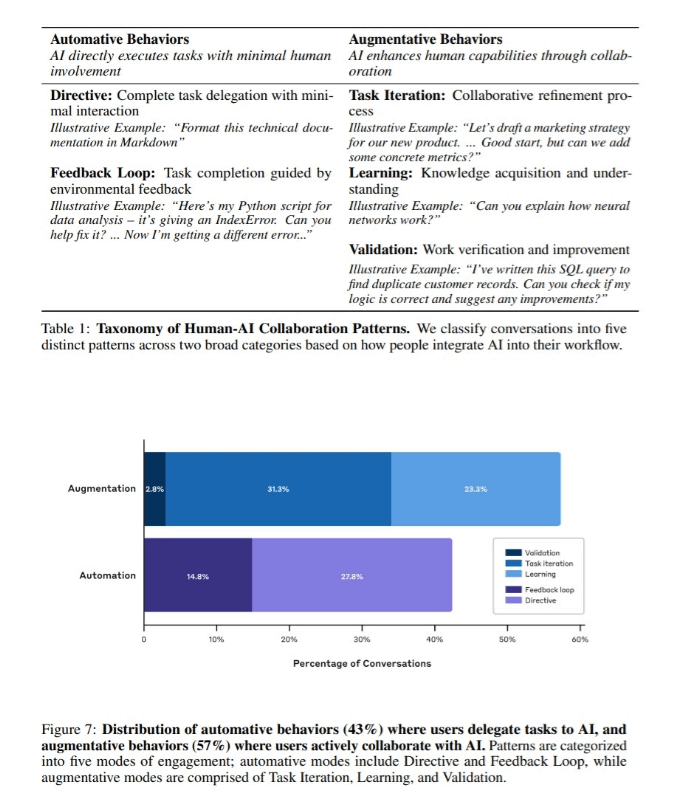
Automation Behavior Most directive conversations consist of writing and other content generation tasks. In business-related tasks, such as "drafting and refining professional business email communications," as well as in school assignment-related clusters, such as "solving diverse geometry problems involving computation and proofs," the proportion of directive conversations is also high. Most feedback loop conversations are related to coding and debugging, with users repeatedly feeding errors received back to the model.
Augmentation Behavior Task iteration conversations typically involve front-end development (such as "assisting with web development tasks and UI improvements" and "creating and modifying landing pages and key website components") as well as professional communication tasks (e.g., "optimizing resumes, cover letters, and job applications" and "assisting with professional and academic writing and communication"). Learning conversations appear most frequently in general education tasks, such as "explaining and analyzing the implementation of martial law and its effects," "providing gastrointestinal health and digestive health advice," and "assisting with microcontroller programming and embedded systems projects." Validation is the smallest category by conversation volume, almost entirely focused on language translation tasks.
3.5 Usage Patterns by Model Type
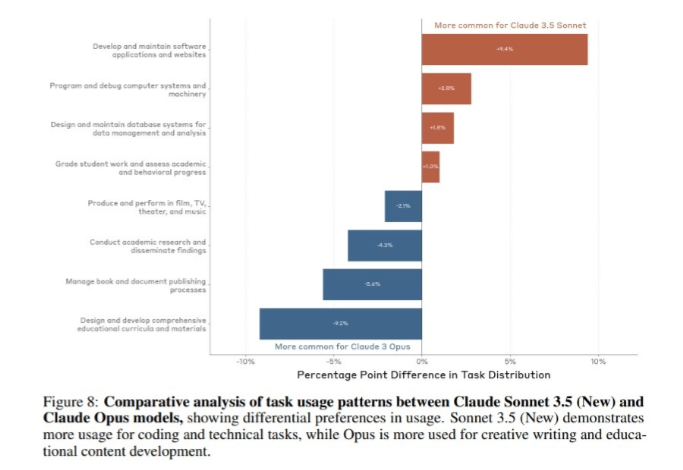
As AI capabilities evolve, understanding how different models are used can help predict shifts in usage across different economic sectors. We explore this by comparing usage patterns of two Claude models: Claude 3 Opus, released in March 2024, and Claude 3.5 Sonnet (New), released in October 2024. Our analysis reveals a clear specialization in usage patterns across these models (see Figure 8). Compared to Sonnet, Opus has higher usage in creative and educational work (e.g., 'producing and performing in film, television, theater, and music,' 'managing book and document publishing processes,' 'designing and developing comprehensive educational curricula and materials,' and 'conducting academic research and disseminating findings'). These patterns align with widespread user observations of Opus's distinctive personality and writing style. In contrast, Claude 3.5 Sonnet (New) is better suited for coding and software development tasks (e.g., 'developing and maintaining software applications and websites' and 'programming and debugging computer systems and machines'), consistent with external evaluations that highlight its relatively strong coding abilities.
By tracking these task-level usage patterns across model versions, we can better understand which capability improvements drive meaningful changes in AI usage across different economic sectors.
4. Discussion
We conducted the first large-scale empirical analysis of how advanced AI systems are used for economic tasks. Although our work provides broad insights into AI usage in the economy, we note key limitations and areas for future research.
4.1 Limitations
Data Sample We used snapshots of Claude.ai Free and Pro conversations over a 7-day period. It is possible that our sample is not representative of Claude.ai usage over a longer time window, and it is very likely that our sample differs in important ways from API data or data from other AI model providers, due to differences in their model capabilities, product features, and user bases. Additionally, Claude.ai outputs only text, not other modalities. This excludes key potential users who might rely on image or video output (e.g., fashion designers). Therefore, our findings should be viewed as an imperfect snapshot of AI usage in the labor market, while noting that a broader understanding of model interaction patterns will emerge as more researchers and organizations are able to share usage data from diverse deployment environments.
Reliability of Model-Driven Classification Our use of Claude to classify user conversations may also introduce potential inconsistencies if the model's understanding of tasks differs from the intended reading in the O*NET database. Although we conducted human validation (Appendix C), relied on past validation of Clio[^Tamkin et al., 2024^], and corroborated our results with cluster-level analysis (Appendix G), it is important to note that these classifications may contain some inherent noise.
Varying Complexity of User Queries Although we made efforts to exclude conversations unrelated to any occupational task (Appendix B), our approach does not account for the complexity of user queries—for example, providing instructions for a basic omelet does not indicate culinary expertise. Therefore, we may overestimate the usage rate of certain tasks by classifying novice users' conversations as those tasks.
Limitations of the O*NET Database Although the ONET database provides valuable insights into current economic sectors, its static nature poses key limitations for analyzing AI's impact on the labor market. The database cannot capture emerging tasks and occupations that AI systems like Claude may create or transform. Additionally, although OO*NET covers a large number of tasks, but it cannot include all tasks in the economy. Moreover, these tasks are often written in general terms, leading to inherent ambiguity when classifying conversations—many tasks are similar across multiple different occupations. Finally, as a U.S.-centric classification system, O*NET may overlook significant occupational categories and tasks in other regions, which could distort our analysis of the distribution of global Claude.ai usage. This limits our analysis, because AI usage patterns may vary across international contexts[^Gmyrek et al., 2023^].
Lack of full context on user workflows Although our work analyzes conversation data on Claude.ai, our method cannot capture how users use the output of Claude.ai conversations. For example, we cannot observe whether users copy code snippets into a development environment, incorporate writing suggestions into documents, fact-check responses, or use the output as inspiration rather than verbatim content. Therefore, determining the extent to which Claude's output is actually incorporated by users into their tasks remains unattainable. We aim to provide a preliminary framework and findings for such further research.
4.2 Implications and Future Work
Despite acknowledging these limitations, our analysis reveals several key implications for how to study and respond to the economic impact of AI.
Comparison with Forecasting Research Our empirical findings both validate and challenge previous predictions about AI's impact on work. Webb predicted the highest AI exposure in occupations near the 90th percentile of the wage distribution, whereas we find that usage peaks in middle-to-high-wage occupations and is lower at both ends of the wage distribution. This pattern suggests that factors beyond technical feasibility—such as implementation costs, regulatory barriers, and organizational readiness—may be suppressing adoption in the highest-wage sectors. Eloundou et al. predicted that 80% of U.S. workers have at least 10% of their work tasks affected by language models; in contrast, our empirical data show that the current adoption rate is that about 57% of occupations have at least 10% of tasks using AI—lower than the prediction, but potentially trending toward their prediction as capabilities improve and adoption barriers decrease. However, their prediction of higher usage in industries such as healthcare has not yet materialized in our data, and we observe higher usage in scientific applications than they expected, highlighting sector-specific diffusion barriers and the impact of unexpected developments in model capabilities. These discrepancies between predictions and actual usage emphasize the importance of empirical measurement in understanding the evolving economic impact of AI, and suggest that technical feasibility alone may be insufficient to predict where and how AI will be adopted in the economy.
Dynamic Tracking of AI Usage Our research provides a framework for systematically tracking the integration of AI into the workforce over time. Unlike surveys that capture self-reported behavior, our method reveals real AI usage patterns that naturally occur in the workplace, providing a more accurate and nuanced picture of true integration. This capability serves several critical functions: it enables early detection of emerging usage patterns, helps identify sectors approaching technological inflection points, and reveals where adoption barriers may be causing uneven diffusion across industries. By monitoring both the breadth (across occupations) and depth (within specific roles) of AI usage, policymakers can design targeted interventions—whether supporting sectors showing promising (or lagging) productivity gains, or addressing potential displacement effects in rapidly automating areas. Dynamic measurement systems provide policymakers and organizations with critical lead time to respond to technological transformation, rather than reacting only after disruption has already occurred.
Task-level measurement Our findings highlight the importance of analyzing AI usage at the task level rather than the job level. Currently, the usage we observe is concentrated in specific tasks (e.g., software engineering, content creation), rather than comprehensive automation of entire occupations. If this pattern persists—with AI affecting only some tasks within jobs—it suggests that occupations will evolve rather than disappear. However, if the breadth of task usage continues to grow without signs of saturation, this may indicate that more comprehensive transformations in the workplace could occur.
Augmentation and automation Within affected tasks, the ways AI systems are used may differ significantly. Our analysis reveals an important distinction: while some users employ AI systems to fully automate tasks, others use them as collaborative tools that enhance their capabilities. This distinction matters for workers and productivity alike. When AI acts as an augmentation partner rather than a replacement, research shows productivity gains while individuals maintain meaningful engagement in their work[^Noy and Zhang, 2023^][^Peng et al., 2023^][^Cui et al., 2024^]. These patterns can inform policy priorities—supporting the development of collaborative AI interfaces in areas with clear benefits, while preparing for areas where automation is more widespread.
From usage patterns to broader impactsUnderstanding how current AI usage patterns translate into broader economic changes remains a key challenge. Although our data reveal where AI is being used today, inferring long-term consequences from these early usage trends poses significant empirical challenges[^Acemoglu et al., 2022^]. For example, high usage in certain occupations may foreshadow future productivity gains or displacement effects, and the uneven distribution of AI usage across wage levels may offer early signs of how AI is reshaping economic opportunity and inequality. Although our current results cannot definitively map these relationships, longitudinal analysis tracking usage patterns and outcomes may help reveal the mechanisms by which AI usage drives workplace change.
Overall, our findings indicate that AI has already begun to be used in a substantial share of tasks in the economy. We offer this initial framework for tracking AI's evolving impact on work, and hope to collaborate with policymakers, economists, and other stakeholders to develop policy recommendations that can spread the benefits of AI throughout the economy.
5. Conclusion
Understanding how artificial intelligence affects the economy requires grounding our analysis in real-world data. Our analysis of millions of Claude.ai conversations reveals clear patterns: AI use peaks in software development and technical writing, with about 4% of occupations using AI for three-quarters of their tasks and about 36% of occupations using AI for at least a quarter of their tasks. Use is split almost evenly between augmenting human capabilities (57%) and automation (43%). Although these patterns are informative, they capture only the beginning stages of AI integration into work. As AI systems expand from text to processing video, speech, and physical manipulation through robots, and as AI agents become capable of performing extended tasks more autonomously, the nature of human-AI collaboration will change dramatically. New tasks, and even entirely new occupations, may emerge around these capabilities. An empirical framework that dynamically tracks these changes is essential for predicting and preparing for an evolving work landscape. The challenge ahead is not only to measure these changes, but also to use our understanding of them to help shape a better future.
6. Acknowledgments
We thank Avital Balwit, Landon Goldberg, Logan Graham, Zac Hatfield-Dodds, Andrew Ho, Kamya Jagadish, Rebecca Lee, Liane Lovitt, Jennifer Martinez, Andi Peng, Ankur Rathi, Orowa Sikder, Colt Steele, Janel Thamkul, and Meg Tong for helpful ideas, discussions, and feedback. In addition, we thank Jonathon Hazell, Anders Humlum, Molly Kinder, Anton Korinek, Benjamin Krause, Michael Kremer, John List, Ethan Mollick, Lilach Mollick, Arjun Ramani, Will Rinehart, Robert Seamans, Michael Webb, and Chenzi Xu for productive comments and discussions on early findings and drafts of the paper.
References
D. Acemoglu. The Potential Harms of Artificial Intelligence. National Bureau of Economic Research technical report, 2021.
D. Acemoglu and P. Restrepo. The Race Between Man and Machine: Implications for Growth, Factor Shares, and Employment. American Economic Review, 108(6):1488–1542, 2018.
D. Acemoglu, D. Autor, J. Hazell, and P. Restrepo. Artificial Intelligence and Jobs: Evidence from Online Vacancies. Journal of Labor Economics, 40:S293 – S340, 2022.
Anthropic. The Claude 3 Model Family: Opus, Sonnet, Haiku. 2024.
D. H. Autor. The “Task Approach” to Labor Markets: An Overview. Journal for Labour Market Research, 46(3):185–199, 2013.
D. H. Autor. Why Are There Still So Many Jobs? The History and Future of Workplace Automation. Journal of Economic Perspectives, 29(3):3–30, 2015.
D. H. Autor, F. Levy, and R. J. Murnane. The Skill Content of Recent Technological Change: An Empirical Exploration. The Quarterly Journal of Economics, 118(4):1279–1333, 2003.
A. Bick, A. Blandin, and D. J. Deming. The Rapid Adoption of Generative AI. National Bureau of Economic Research technical report, 2024.
E. Brynjolfsson, T. Mitchell, and D. Rock. What Can Machines Learn, and What Does It Mean for Occupations and the Economy? AEA Papers and Proceedings, 108:43–47. American Economic Association, 2014 Broadway, Suite 305, Nashville, TN 37203, 2018a.
E. Brynjolfsson, T. Mitchell, and D. Rock. What Can Machines Learn, and What Does It Mean for Occupations and the Economy? AEA Papers and Proceedings, 108:43–47, 2018b. DOI: 10.1257/pandp.20181019. URL: https://www.aeaweb.org/articles?id=10.1257/pandp.20181019.
E. Brynjolfsson, D. Li, and L. R. Raymond. Generative AI at Work. National Bureau of Economic Research technical report, 2023.
J. H. Choi and D. Schwarcz. "Artificial Intelligence-Assisted Legal Analysis: An Empirical Study." Available on SSRN, 2023.
M. Comunale and A. Manera. "The Economic Impact of Artificial Intelligence and Its Regulation: A Review of the Academic Literature and Policy Actions." 2024.
Z. K. Cui, M. Demirer, S. Jaffe, L. Musolff, S. Peng, and T. Salz. "The Effects of Generative AI on High-Skilled Work: Evidence from Three Field Experiments with Software Developers." Available on SSRN, 2024.
F. Dell'Acqua, E. McFowland III, E. R. Mollick, H. Lifshitz-Assaf, K. Kellogg, S. Rajendran, L. Krayer, F. Candelon, and K. R. Lakhani. "Navigating the Jagged Technological Frontier: Field Experimental Evidence on the Effects of AI on Knowledge Worker Productivity and Quality." Harvard Business School Technology and Operations Management Department Working Paper, (24-013), 2023.
T. Eloundou, S. Manning, P. Mishkin, and D. Rock. "GPTs are GPTs: Early Observations on the Labor Market Impact Potential of Large Language Models," 2023. URL: https://arxiv.org/abs/2303.10130.
E. Felten, M. Raj, and R. Seamans. "How Will Language Models Like ChatGPT Affect Occupations and Industries?" arXiv preprint arXiv:2303.01157, 2023.
C. B. Frey and M. A. Osborne. "The Future of Employment: How Susceptible Are Jobs to Computerisation?" Technological Forecasting and Social Change, 114:254–280, 2017.
P. Gmyrek, J. Berg, and D. Bescond. "Generative AI and Jobs: A Global Analysis of Potential Effects on Job Quantity and Quality." International Labour Organization Working Paper, 2023.
A. Hering. "Indeed's AI at Work Report: How Generative AI Will Affect Jobs and the Skills Needed to Perform Them." Indeed Hiring Lab Research Report, 2023.
A. Humlum and E. Vestergaard. "The Adoption of ChatGPT." University of Chicago Becker Friedman Institute for Economics Technical Report, April 2024.
A. Kilbourne-Quirk. onet-dataviz. https://github.com/adamkq/onet-dataviz, 2019. A project for scraping, tabulating, and displaying job data from the O*NET website. Non-commercial use.
M. Kinder, X. de Souza Briggs, M. Muro, and S. Liu. "Generative AI, the American Worker, and the Future of Work." October 2024.
N. Maslej, L. Fattorini, R. Perrault, V. Parli, A. Reuel, E. Brynjolfsson, J. Etchemendy, K. Ligett, T. Lyons, J. Manyika, J. C. Niebles, Y. Shoham, R. Wald, and J. Clark. "AI Index Report 2024", 2024. URL: https://arxiv.org/abs/2405.19522.
A. Merali. "Scaling Laws for Economic Productivity: Experimental Evidence from LLM-Assisted Translation." arXiv preprint arXiv:2409.02391, 2024.
A. Mnih and G. Hinton. "Scalable Hierarchical Distributed Language Models." Proceedings of the Neural Information Processing Systems Conference, 22nd International Conference on Neural Information Processing Systems, NIPS'08, pages 1081–1088, Red Hook, NY, USA, 2008. Curran Associates Inc. ISBN 9781605609492.
F. Morin and Y. Bengio. "Hierarchical Probabilistic Neural Network Language Model." In R. G. Cowell and Z. Ghahramani, editors, Proceedings of the Tenth International Workshop on Artificial Intelligence and Statistics, volume R5, Proceedings of Machine Learning Research, pages 246–252. PMLR, 06–08 Jan 2005. URL: https://proceedings.mlr.press/r5/morin05a.html. Reissued on March 30, 2021.
National Center for ONET Development. ONET OnLine, 2025a. URL: https://www.onetonline.org/. Accessed: 2025-01-17.
National Center for ONET Development. ONET OnLine, 2025b. URL: https://www.onetonline.org/. U.S. Department of Labor Employment and Training Administration (USDOL/ETA). Licensed under CC BY 4.0.
S. Noy and W. Zhang. "Experimental Evidence on the Productivity Effects of Generative Artificial Intelligence." Science, 381(6654):187–192, 2023.
S. Peng, E. Kalliamvakou, P. Cihon and M. Demirer. 'The Impact of AI on Developer Productivity: Evidence from GitHub Copilot'. arXiv preprint arXiv:2302.06590, 2023.
N. Reimers and I. Gurevych. all-mpnet-base-v2: MPNet-based sentence embedding model. https://huggingface.co/sentence-transformers/all-mpnet-base-v2, 2022. A sentence transformer model based on MPNet, trained on over 1 billion training pairs.
A. Tamkin, M. McCain, K. Handa, E. Durmus, L. Lovitt, A. Rathi, S. Huang, A. Mountfield, J. Hong, S. Ritchie, M. Stern, B. Clarke, L. Goldberg, T. R. Sumers, J. Mueller, W. McEachen, W. Mitchell, S. Carter, J. Clark, J. Kaplan and D. Ganguli. 'Clio: Privacy-Preserving Insights into Real-World AI Use', 2024. URL: https://arxiv.org/abs/2412.13678.
P. Trammell and A. Korinek. 'Economic Growth Under Transformative AI'. National Bureau of Economic Research Working Paper 31815, October 2023. URL: http://www.nber.org/papers/w31815.
U.S. Bureau of Labor Statistics. U.S. Bureau of Labor Statistics. https://data.bls.gov/oes/#/home, 2024.
US Census Bureau. 'Income in the United States: 2022'. Census.gov, 2022.
M. Webb. 'The Impact of Artificial Intelligence on the Labor Market'. Journal of Innovation Economics, 2019.
E. Wiles, L. Krayer, M. Abbadi, U. Awasthi, R. Kennedy, P. Mishkin, D. Sack and F. Candelon. 'GenAI as Exoskeleton: Experimental Evidence on Knowledge Workers Using GenAI to Learn New Skills'. Available at SSRN, 2024.
Get the original PDF file of the 'Anthropic – AI Economic Index Report', scan the QR code to follow the official account and reply:20250211 to claim