
What is AniDoc
AniDoc is a simplified 2D animation coloring AI model jointly launched by the Hong Kong University of Science and Technology, Ant Group, Nanjing University, Zhejiang University, and the University of Hong Kong. Based on video diffusion models, it automatically converts sketch sequences into color animations, following the reference character design. The model uses correspondence matching technology to handle differences between the character design and sketches, achieving accurate transfer of color and style. AniDoc supports binary sketch input, improves model robustness based on background augmentation, and uses a sparse sketch training strategy to reduce the need for manually drawing intermediate frames. AniDoc can improve colorization accuracy and inter-frame consistency, reduce the labor cost of animation production, accelerate the content creation process, and is suitable for anime and various digital art fields.
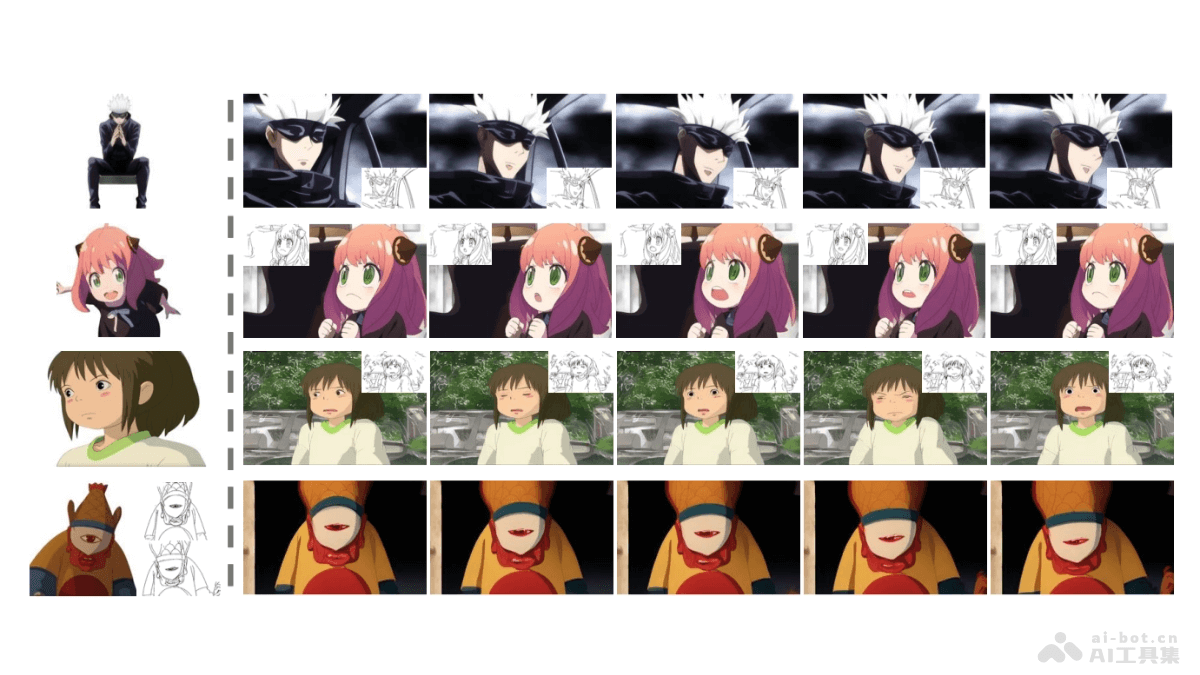
AniDoc's Main Features
- Automatic Coloring: Automatically converts sketch sequences into color animations, reducing the workload of manual coloring.
- Correspondence Matching: Based on correspondence matching technology, handles inconsistencies between the reference character design and sketches, such as differences in angle, proportion, and pose.
- Background Augmentation: Through background augmentation strategies, improves the model's ability to distinguish foreground and background, and improves coloring quality.
- Sparse Sketch Training: Uses sparse sketch input, reduces the work of drawing intermediate frames, and generates smooth animations through keyframe interpolation.
- Multi-Style Adaptation: Adapts to reference images of different styles, providing consistent coloring effects for different sketches of the same character.
AniDoc's Technical Principles
- Video Diffusion Model: Based on video diffusion models, with the ability to capture temporal dynamics and visual coherence.
- Correspondence-Guided Coloring: Uses an explicit correspondence mechanism to integrate color and style information from the reference character design into sketches, improving color accuracy and consistency.
- Binarization and Background Augmentation: Binarizes conditional sketches, and uses background augmentation strategies to improve the model's robustness.
- Sparse Sketch Training: Adopts a two-stage training strategy, first learning coloring ability, then removing intermediate sketches to learn interpolation ability, reducing dependence on dense sketches.
- 3D U-Net Architecture: Includes a denoising 3D U-Net designed for video generation, integrating reference image information into the coloring process.
AniDoc's Project Address
- Project Official Website:yihao-meng.github.io/AniDoc
- GitHub Repository:https://github.com/yihao-meng/AniDoc
- arXiv Technical Paper:https://arxiv.org/pdf/2412.14173
AniDoc's Application Scenarios
- Animation Production: In the traditional 2D animation production process, automatically completes the coloring of character line art, reducing the time and labor intensity of animators' manual coloring.
- Anime Industry: For anime production companies, improves the efficiency of animation production, reduces costs, and maintains consistency of character colors across different scenes.
- Game Development: In game development, quickly generates game character animations, especially in situations requiring a large amount of character animation resources.
- Digital Art Creation: Artists and designers can experiment with and explore different color schemes, quickly preview coloring effects on sketches, and accelerate the creation process.
- Education and Training: In animation education and training, as a teaching tool, it helps students understand the animation coloring process and practice animation production techniques.