
What is Amazon Bedrock
Amazon Bedrock is a fully managed service launched by AWS (Amazon Web Services) that integrates foundation models from multiple top AI companies and provides them through a single API. Amazon Bedrock enables enterprises to easily experiment with, evaluate, and customize AI models, build agents that perform complex tasks, and securely integrate them into applications. New Amazon Bedrock features include automated reasoning checks to prevent AI hallucinations, multi-agent collaboration to improve work efficiency, and model distillation technology to enhance performance and reduce costs. Amazon Bedrock simplifies the development of generative AI applications without the need for complex infrastructure management.
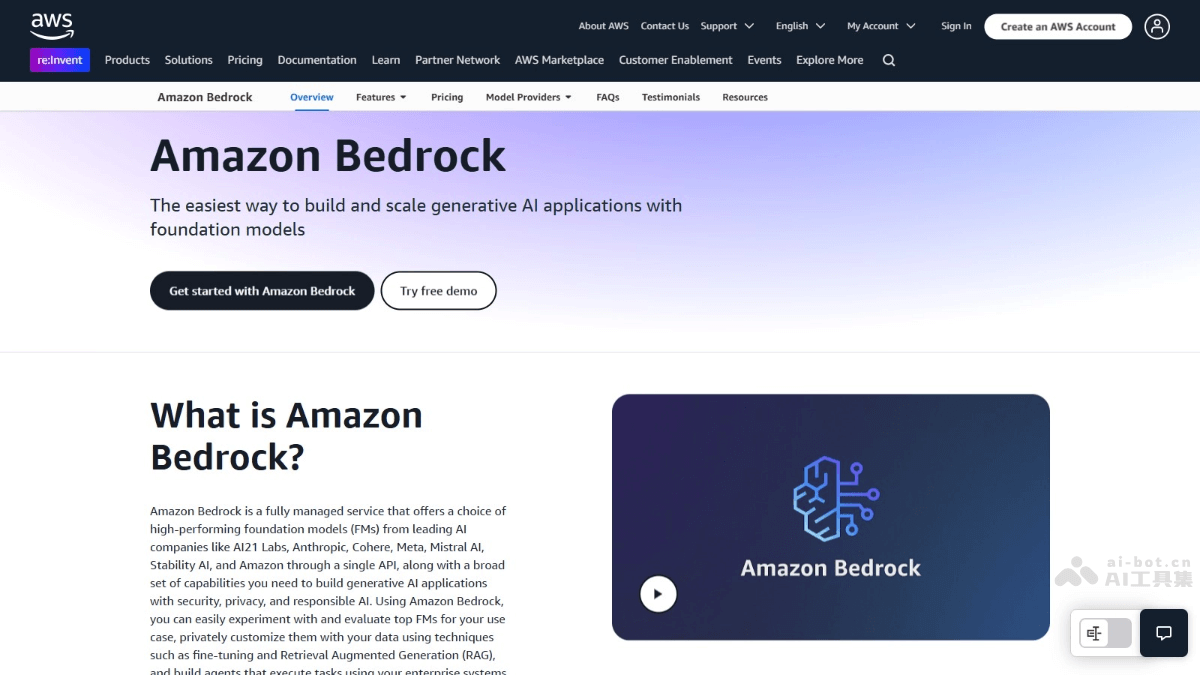
Main features of Amazon Bedrock
- Foundation model access: Access high-performance foundation models provided by multiple AI companies through a single API, adapting to different business needs.
- Model fine-tuning and customization: Fine-tune models using an enterprise's own data to achieve differentiated and personalized user experiences.
- Retrieval-augmented generation (RAG): Use Amazon Bedrock knowledge bases to automatically execute RAG workflows and provide more relevant and accurate model responses.
- Agent building: Create agents that perform multi-step tasks using enterprise systems and data sources to improve automation.
- Automated reasoning checks: Automatically verify the accuracy of AI model responses, generate auditable output, and prevent AI hallucination issues.
- Multi-agent collaboration: Coordinate multiple agents working in parallel to improve the efficiency and speed of solving complex tasks.
- Model distillation: Train smaller, more efficient models based on extracting knowledge from large models to improve performance and reduce costs.
Amazon Bedrock official website address
- Official website address:aws.amazon.com/cn/bedrock
Amazon Bedrock use cases
- Text generation: Create new original content, such as blog posts, social media posts, and webpage materials.
- Virtual assistants: Build assistants that can understand user requests, automatically break down tasks, participate in conversations, and collect information and take actions to fulfill requests.
- Text and image search: Search and synthesize relevant information, answer questions, and provide suggestions based on large amounts of text and image data.
- Text summarization: Obtain concise summaries of long documents and quickly and effectively extract important information.
- Image generation: Quickly create realistic and visually appealing images for advertising campaigns, websites, presentations, and more.