
What is Amadeus Code
Amadeus Code is based on AI technologymusic creation tool. It generates musical elements such as melodies and chord progressions based on AI algorithms, helping users quickly create draft songs and spark creative inspiration. Amadeus Code supports free use of basic features, including exploring new chord progressions, generating MIDI files, etc., and supports importing into a digital audio workstation (DAW) for further refinement. Amadeus Code helps music creators break through creative blocks, cross style and genre limitations, and easily create personalized musical works.
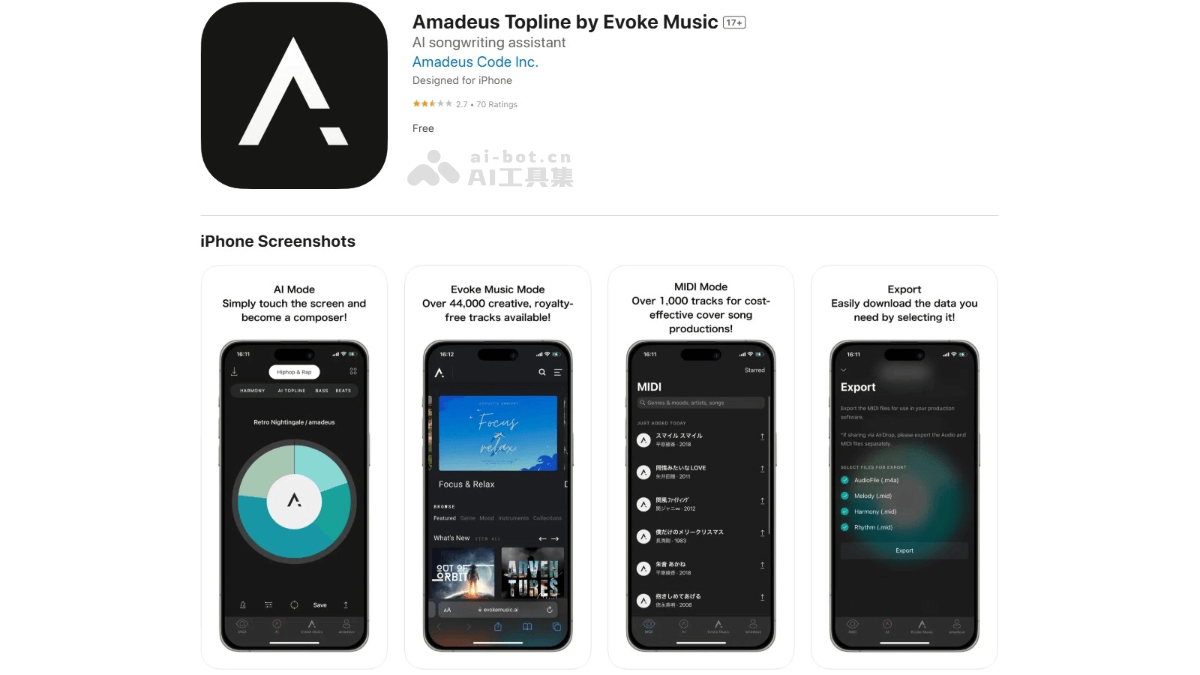
Main features of Amadeus Code
- AI-driven music creation: Users tap the screen, and AI automatically generates melodies and chord progressions, without the need for complex music theory knowledge.
- Diverse styles: The generated melodies and chords span multiple styles and genres, suitable for different types of music creation needs.
- Draft song creation: Users can freely create unlimited draft songs anytime, anywhere.
- Evoke Music mode: Search and download human-made AI-created tracks, offering over 44,000 royalty-free music tracks.
- MIDI mode: Import MIDI files generated by the app into the user's preferred digital audio workstation (DAW) to continue creating.
Amadeus Code official website address
- Official website address:amadeuscode.com
Amadeus Code product pricing
- Free: Users can use all features for free during the first 14-day trial period.
- Pay as you go: $1.99, users only pay for the songs they want to save. Saved songs include audio and MIDI files.
- Premium: $9.99/month, users can save an unlimited number of songs each month, including audio and MIDI files.
Amadeus Code application scenarios
- Personal creation: Helps creators quickly generate melodies and chords, spark inspiration, and break through creative blocks.
- Team collaboration: Provides music production teams with rich AI-generated materials, helping teams brainstorm and create diverse works.
- Music education: As a teaching aid tool, it helps students practice creation and understand music theory and different styles.
- Commercial applications: Quickly generate background music for projects such as advertisements, videos, and games, and provide royalty-free music resources.
- Research experiments: Used to explore music styles, test music generation algorithms, and support music technology research.