
What is Alpamayo-R1
Alpamayo-R1 (AR1) is a vision-language-action (VLA) model introduced by NVIDIA that enhances the decision-making capability and generalization of autonomous driving through causal reasoning. The core innovations of the model include: constructing a Chain of Causality (CoC) dataset, generating high-quality reasoning trajectories through "human-machine collaboration + automatic annotation"; adopting Cosmos-Reason as the VLM backbone network, which is trained on a large number of visual question-answering samples and possesses physical common sense and embodied reasoning capabilities; designing a multi-stage training strategy that combines supervised fine-tuning and reinforcement learning to optimize reasoning quality and trajectory generation. In experiments, AR1 significantly improves planning accuracy, reduces out-of-bounds rates and near-collision rates, while maintaining a low latency of 99 milliseconds, making it suitable for real-time autonomous driving applications.
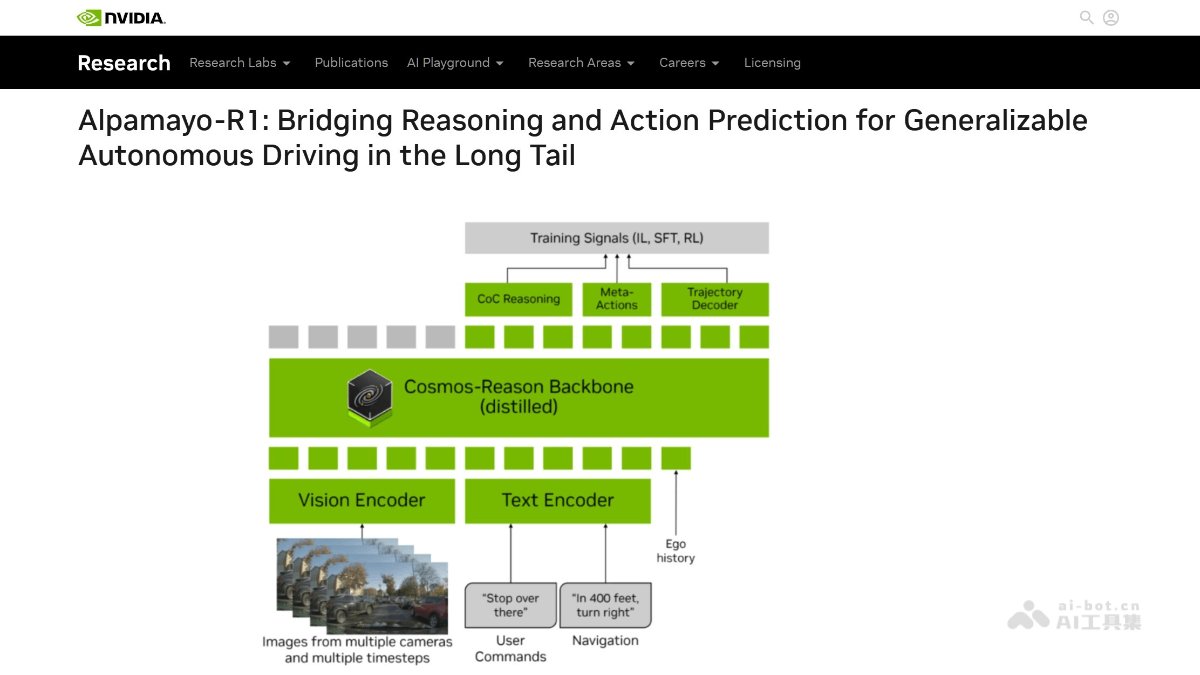
Main Features of Alpamayo-R1
-
Causal Reasoning and Trajectory Planning: By constructing a Chain of Causality (CoC) dataset, AR1 is capable of causal reasoning, generating reasoning trajectories that conform to driving logic, and improving the accuracy and generalization of decision-making.
-
Efficient Visual Encoding and Feature Extraction: Optimizes the visual encoder, improving the efficiency of feature extraction from multi-camera images by 10-20 times, significantly reducing computational resource consumption.
-
Real-Time Performance and Low Latency: The model's end-to-end inference time is only 99 milliseconds, meeting the stringent real-time requirements of autonomous driving.
-
Improved Trajectory Quality: In open-loop and closed-loop evaluations, AR1 significantly reduces off-road rates and close-contact rates, improving the smoothness and safety of trajectories.
-
Open Source to Advance the Industry: As an open-source model, AR1 lowers the barrier to autonomous driving research and development, providing strong technical support for automakers and research institutions.
Technical Principles of Alpamayo-R1
-
Chain of Causality (CoC) Dataset: Constructed through a hybrid process of "automatic annotation + human-machine collaboration", generating reasoning trajectories that are aligned with driving behavior, decision-centric, and causally related. The dataset contains three structured components: driving decisions, causal factors, and composite CoC trajectories.
-
Modular VLA Architecture: Integrates the vision-language model Cosmos-Reason, pre-trained for physical intelligence applications, and a diffusion model-based trajectory decoder, capable of generating dynamically drivable planning solutions in real time.
-
Multi-Stage Training Strategy: Employs supervised fine-tuning to stimulate the model's reasoning ability, combined with reinforcement learning, optimizing reasoning quality through feedback from a large reasoning model, while ensuring consistency between reasoning and actions.
-
Efficient Visual Encoding: Supports various efficient multi-camera tokenizers, such as the tri-plane tokenizer and Flex tokenizer, significantly reducing the number of tokens to meet real-time inference requirements.
-
Action Expert Trajectory Decoder: Based on the flow matching framework, efficiently generates continuous, multimodal trajectory planning solutions that both align with language reasoning outputs and meet real-time inference requirements.
Alpamayo-R1 Project Address
- Project Official Website:https://research.nvidia.com/publication/2025-10_alpamayo-r1
- arXiv Technical Paper:https://arxiv.org/pdf/2511.00088v1
Application Scenarios of Alpamayo-R1
-
Autonomous Driving Decision-Making and Planning: AR1 generates safe and efficient driving trajectories through causal reasoning, suitable for autonomous driving decision-making in complex traffic environments, enhancing the vehicle's autonomous decision-making capability.
-
Traffic Scenario Simulation and Testing: It can be used to build virtual traffic scenarios, simulate various driving situations, and help test the performance and safety of autonomous driving systems.
-
Intelligent Transportation System Optimization: Provide decision support for intelligent transportation systems, optimize traffic flow, reduce congestion, and improve overall traffic efficiency.
-
Vehicle Safety and Obstacle Avoidance: Through real-time trajectory planning and obstacle avoidance decisions, reduce the risk of traffic accidents and improve vehicle safety in complex environments.