
What is AIOpsLab
AIOpsLab is a prototype framework introduced by Microsoft, UC Berkeley, the University of Illinois Urbana-Champaign, Microsoft Research, and other institutions for building, evaluating, and improving AIOps agents for cloud service operations management. AIOpsLab is based on a modular design, integrating applications, workloads, and fault generators to simulate real production scenarios. AIOpsLab adopts the Agent-Cloud Interface (ACI), providing standardized APIs for agents to call, supporting the complete operations lifecycle from fault detection to root cause analysis and mitigation. The framework has powerful observability, collecting multi-level telemetry data, providing rich contextual information for evaluating AIOps tools, helping to improve the autonomy and self-healing capabilities of cloud services, and is suitable for operations at different scales and time horizons.
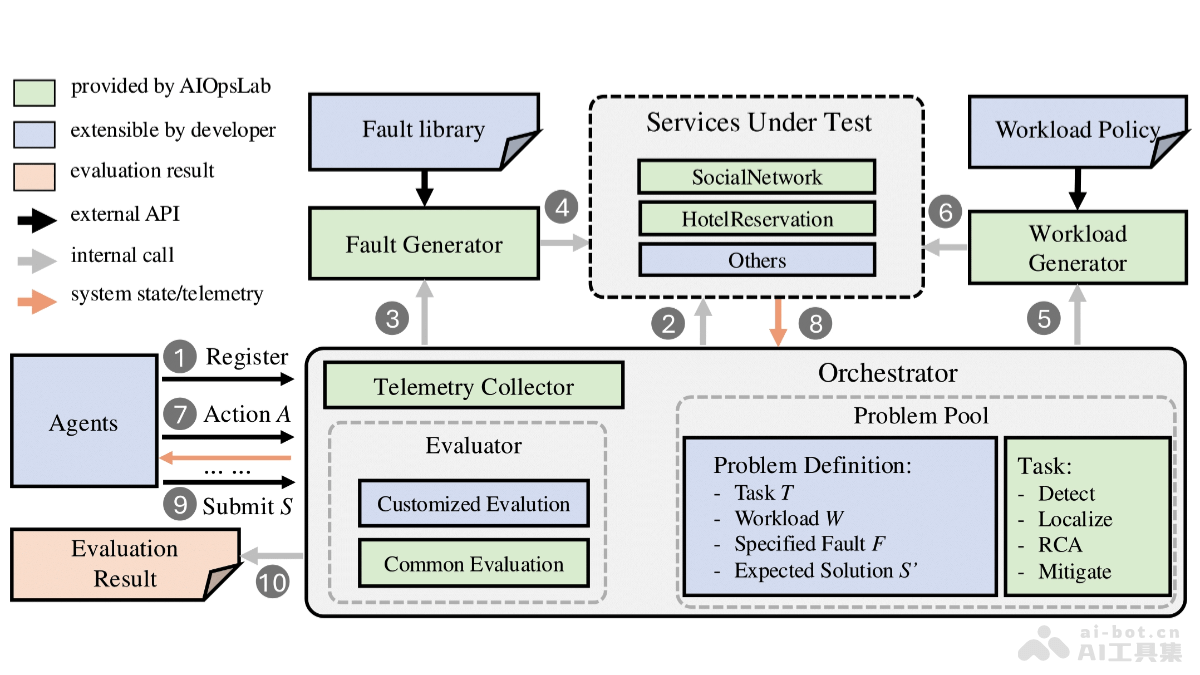
Main features of AIOpsLab
- Modular design: Based on a modular architecture, it flexibly integrates and extends different applications, workload generators, and fault generators.
- Agent-Cloud Interface (ACI): Based on ACI as the coordinator between agents and the cloud environment, it provides agents with standardized API interfaces.
- Workload and fault simulation: The framework has powerful workload generators and fault generators, capable of simulating various workload patterns and fault scenarios in real production environments.
- Comprehensive observability: Equipped with a rich observability layer, it collects multi-level telemetry data, including logs, metrics, traces, and more.
- Operations lifecycle support: The framework supports the complete lifecycle of cloud service operations, including fault detection, root cause analysis, mitigation execution, and all other stages.
Technical principles of AIOpsLab
- Orchestrator: As the core component, the orchestrator is responsible for coordinating interactions between agents and the cloud environment. It establishes sessions with agents, provides information such as problem descriptions, instructions, and available APIs, and executes corresponding operations based on agent requests. The orchestrator can invoke workload generators and fault generators to create service disruptions as benchmark testing problems.
- Service abstraction: Abstracts multiple services to simulate the diversity of production environments. Based on open-source application suites and tools such as DeathStarBench and BluePrint, it deploys and manages services based on different architectures such as microservices, serverless, and monolithic architectures.
- Workload generator: According to specifications provided by the orchestrator, the workload generator generates workload patterns that meet the requirements. It uses models trained on real production traces to generate workloads, simulating user behavior, resource consumption, and more under normal and fault scenarios, providing agents with rich testing scenarios.
- Fault generator: The fault generator is a general-purpose fault injection tool that injects faults at different system levels to simulate complex production faults. It combines application and domain knowledge to create strategies and oracles adapted to AIOps scenarios, maintaining semantic integrity and considering dependencies between cloud microservices.
- Observability layer: Based on the integration of multiple tools such as Jaeger, Filebeat, Logstash, and Prometheus, the observability layer collects system telemetry data, including traces, logs, metrics, and underlying system information.
AIOpsLab project addresses
- GitHub repository:https://github.com/microsoft/AIOpsLab/
- arXiv technical paper:https://arxiv.org/pdf/2407.12165
AIOpsLab application scenarios
- Cloud service providers:Monitor cloud infrastructure in real time, automatically detect and respond to faults, quickly locate and fix problems, reduce manual intervention, and improve service availability and customer satisfaction.
- Enterprise IT Operations: Monitor enterprise IT systems in real time, automatically detect faults and provide information, help operations teams quickly locate and resolve problems, and ensure business continuity.
- Financial Industry: Monitor trading systems in real time, provide timely warnings and handle anomalies, ensure the stable operation of trading systems, and avoid economic losses.
- Education and Research: Provide experimental environments for universities and research institutions, helping students and researchers learn AIOps technology and cloud service operations management.