
"Large Model Concepts, Technologies, and Application Practices" was produced by the Big Data Teaching Team at Xiamen University to popularize large model technology and its applications in various fields. It emphasizes its influence in the field of big data teaching. It reviews the brief history of artificial intelligence development, introduces the definition, characteristics, and classification of large models, and elaborates in detail on their applications in natural language processing,computer vision、speech recognitionand other fields, as well as their profound impact on work and life. It introduces AIGC (Artificial Intelligence Generated Content) technology, including text, images, speech,video generationandassisted programmingand other application practice cases, demonstrating the powerful capabilities of large models in content creation, intelligent office work,AI searchand other aspects. It is a comprehensive, in-depth, and easy-to-understand popular science resource on large models, suitable for readers interested in artificial intelligence and large model technology to study and reference.


Obtainthe original PPT file of "Large Model Concepts, Technologies, and Application Practices", scan the QR code to follow and reply: 20250217
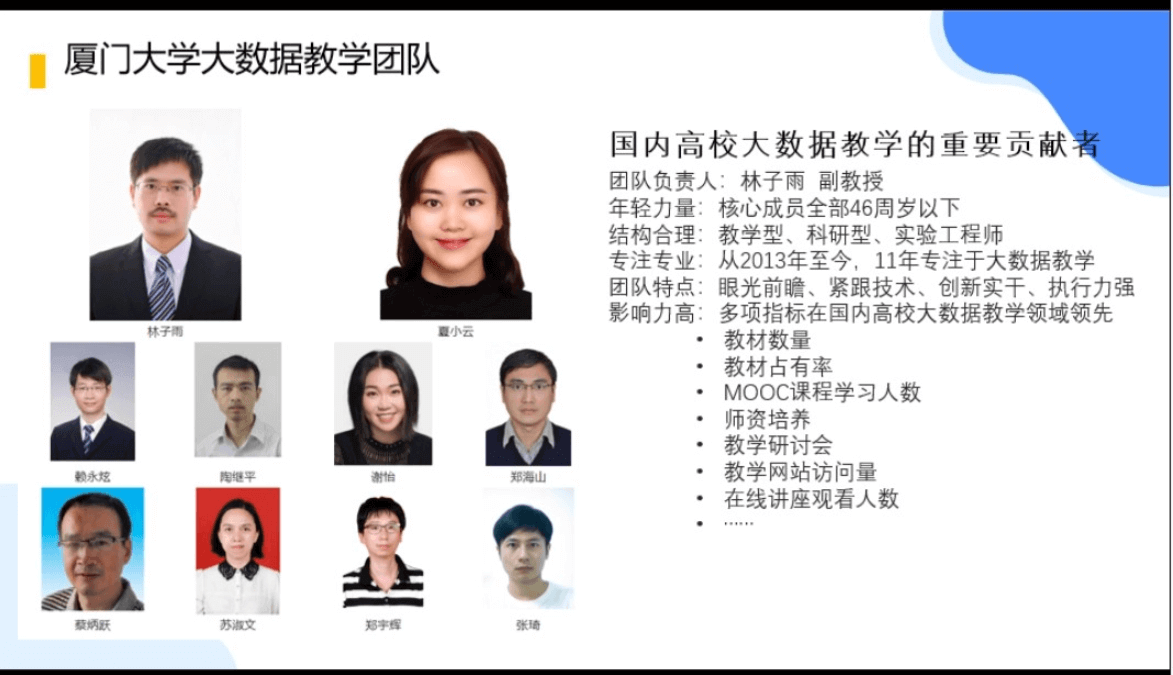
Introduction to the Big Data Teaching Team at Xiamen University
The Big Data Teaching Team at Xiamen University is an important contributor to big data teaching in domestic universities. The team is centered on Associate Professor Lin Ziyu, with members averaging under 46 years of age and a well-balanced structure, covering teaching-oriented, research-oriented, and experimental engineer roles. Since 2013, the team has focused on big data teaching, demonstrating foresight and strong execution, and has achieved remarkable results in textbook writing, MOOC courses, teacher training, and other areas.
Lin Ziyu is an associate professor in the Department of Computer Science and Technology at Xiamen University. As first author, he has written and published 15 big data series textbooks, which have been adopted by more than 1,000 universities in China. He has received multiple teaching achievement awards, been selected for several national-level teaching projects, and been honored with titles such as "Typical Application Case of the Ministry of Education National Smart Education Public Service Platform." His personal homepage provides abundant teaching resources and contact information.
The "General Course on Digital Literacy - Computer General Education in the Era of Big Data and Artificial Intelligence" written by Lin Ziyu is a textbook for first-year university students, aiming to reconstruct the knowledge system of university computer general courses and cultivate students' computational thinking, data thinking, and AI thinking. The textbook's official website provides rich resources such as lecture PPTs, MOOC videos, case videos, hands-on experiments, and teaching syllabi for teachers and students to use.
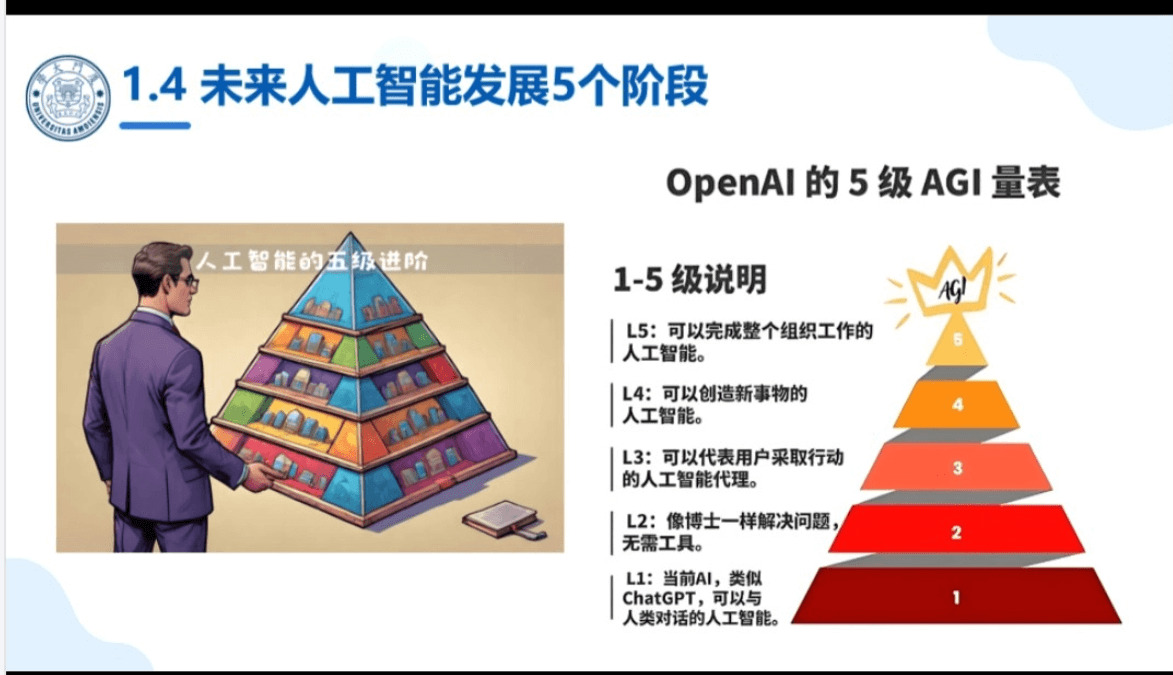
A Brief History of Artificial Intelligence Development
The development of artificial intelligence can be traced back to the proposal of the Turing Test in 1950. In 1956, the Dartmouth Conference marked the official birth of the discipline of artificial intelligence. Since then, artificial intelligence has gone through the budding period (1950-2005), the accumulation period (2006-2019), and the explosive period (2020-present). From early CNNs to the Transformer architecture, and then to the emergence of the GPT series and multimodal large models, artificial intelligence technology has continued to evolve, driving the rapid development of fields such as natural language processing and computer vision.
Artificial Intelligence Thinking
-
Understand: Master the basic principles of AI.
-
Distinguish: Clarify the differences between human capabilities and machine capabilities.
-
Collaborate: Learn to work collaboratively with AI systems to improve efficiency.
Large Models: The Frontier of Artificial Intelligence
- The Concept of Large Models
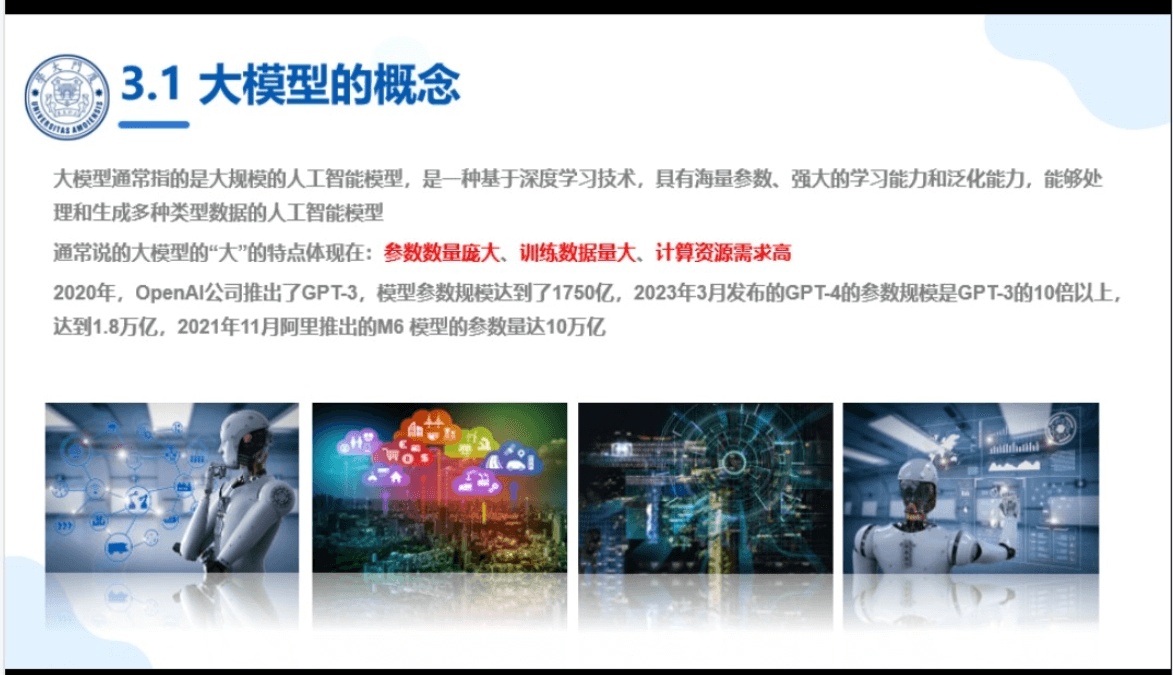
- Large models are ultra-large-scale artificial intelligence models based on deep learning technology, with massive parameters, powerful learning capabilities, and generalization capabilities. Their "large" characteristic is reflected in the enormous number of parameters, the large volume of training data, and the high demand for computing resources. For example, GPT-3 has a parameter scale of 175 billion, while GPT-4 has a parameter scale of more than 1.8 trillion.
- The Development History of Large Models: The development of large models has gone through three stages:
- Emergence Period (1950-2005): Neural network models represented by CNNs.
- Accumulation Period (2006-2019): Models represented by the Transformer architecture.
- Explosion Period (2020-present): Pre-trained large models represented by the GPT series.
- The Relationship Between Artificial Intelligence and Large Models
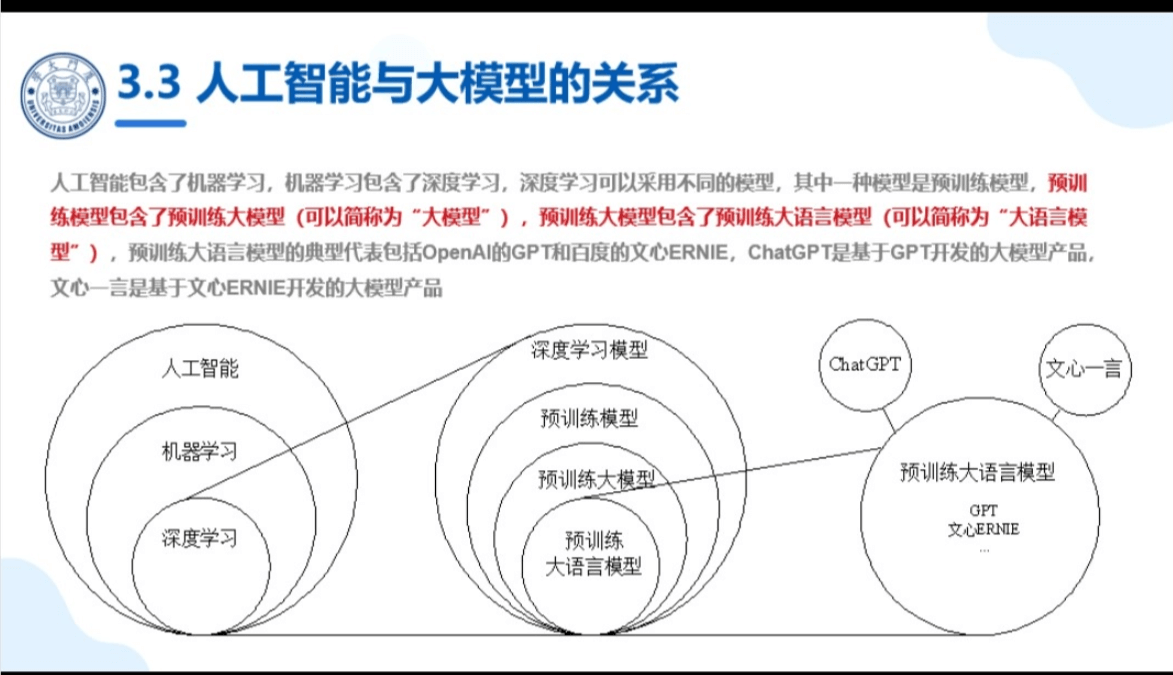
- Large models are cutting-edge technology in the field of artificial intelligence and are a type of pre-trained model. Through large-scale data training, they possess powerful language generation, logical reasoning, and multimodal processing capabilities, and are a key force driving the development of AI technology.
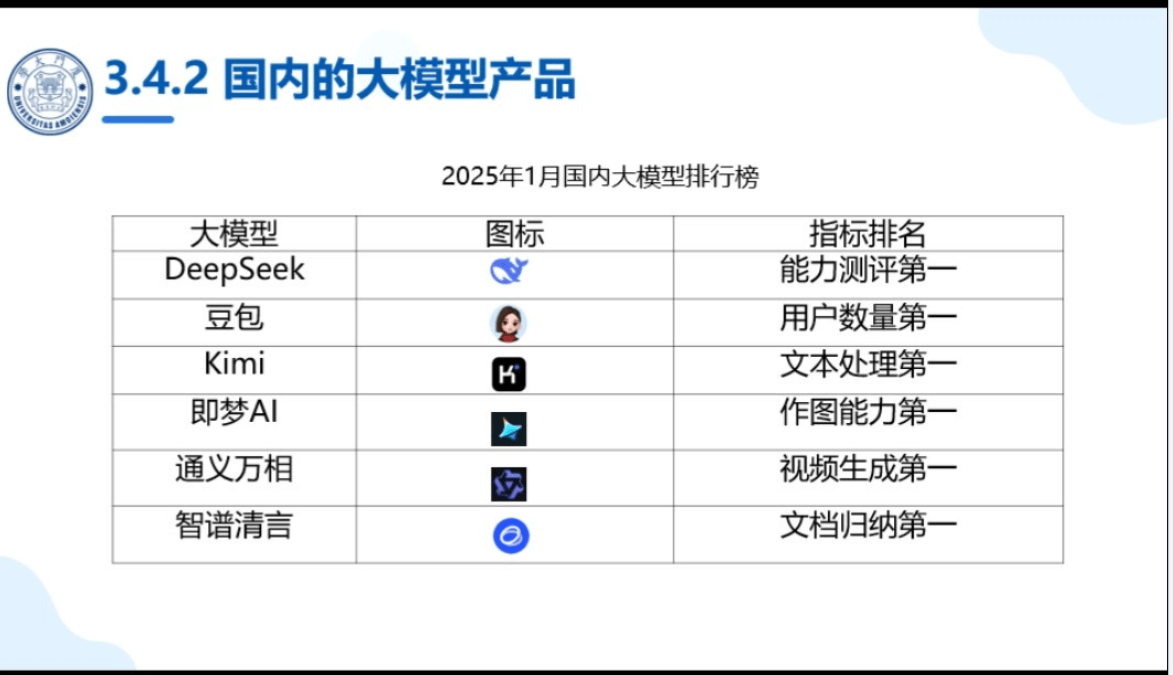
- Large Model Products: The main large model products at home and abroad include:
- Foreign Products: Such as OpenAI's ChatGPT, Gemini, and Sora, etc.
- Domestic Products: Such as DeepSeek, Tongyi Qianwen, Doubao, Wenxin Yiyan, etc.
- These products perform excellently in fields such as natural language processing, multimodal understanding, and generation, and are widely used in scenarios such as intelligent customer service, content creation, and code generation.
- Principles of Large Models
- Large models are based on the Transformer architecture and, through the encoder-decoder structure and self-attention mechanism, can process and generate natural language text. Their core capability lies in capturing the complex relationships between words and achieving efficient text generation and understanding.
- Characteristics of Large Models: Large models have the following characteristics:
- Huge Scale: An enormous number of parameters and a large model size.
- Emergent Abilities: Complex abilities demonstrated under large-scale data training.
- Multi-Task Learning: Able to handle multiple tasks and possessing generalization ability.
- Big Data Training: Requires massive data support.
- Powerful Computing Resources: Relies on hardware acceleration such as GPU/TPU.
- Transfer Learning and Pre-Training: Adapts to different tasks through pre-training and fine-tuning.
- Classification of Large Models
- According to application domains, large models can be divided into three levels: L0, L1, and L2, covering multiple fields such as natural language processing, computer vision, and speech recognition.
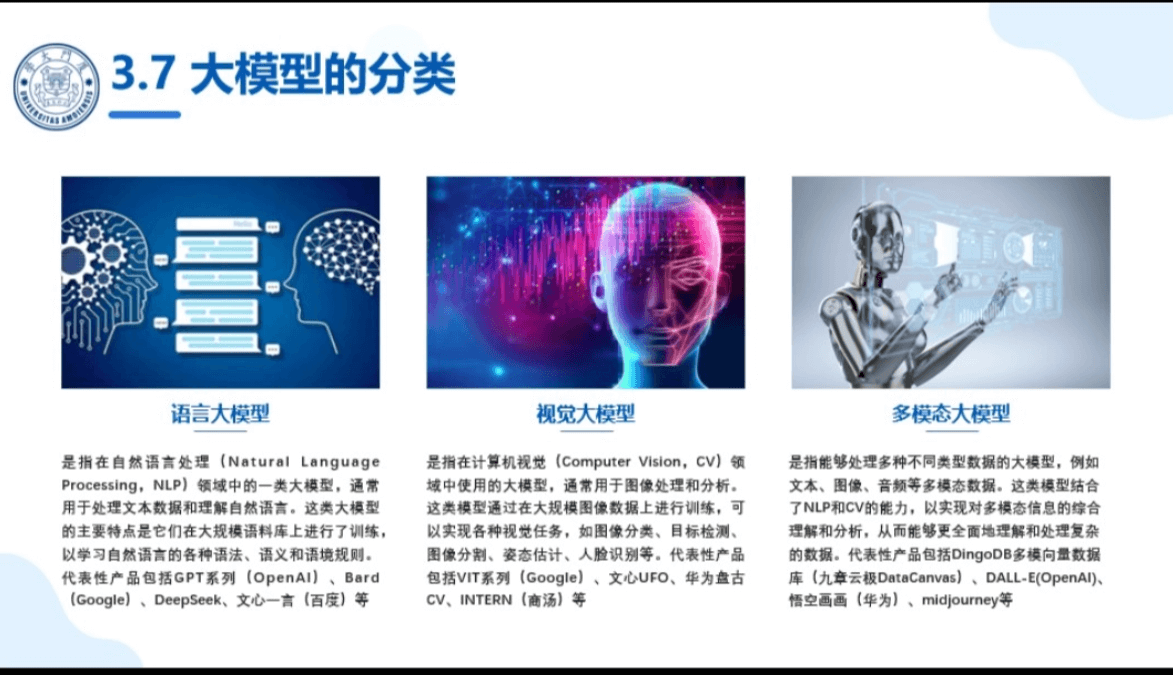
- Application Fields of Large Models: Large models are widely used in many fields, including but not limited to:
- Natural Language Processing: Text generation, translation, question-answering systems, etc.
- Computer Vision: Image classification, object detection, medical image analysis, etc.
- Speech Recognition: Speech synthesis, speech translation, etc.
- Recommendation Systems: Personalized recommendations, advertising placement, etc.
- Healthcare: Auxiliary diagnosis, drug development, etc.
- Financial risk control: Risk assessment, fraud detection, etc.
- The Impact of Large Models on Work and Life: Large models have had a profound impact on work and life:
- Work: Improved work efficiency and driven the development of automated office work and intelligent customer service.
- Life: Changed the way content is consumed and provided personalized services.
- Local Deployment of Large Models
- This introduces the advantages of local deployment of large models, including data privacy protection, avoiding usage restrictions, customization flexibility, cost optimization, and efficient offline use. Using Ollama and DeepSeek R1 as examples, it demonstrates the specific methods of local deployment.
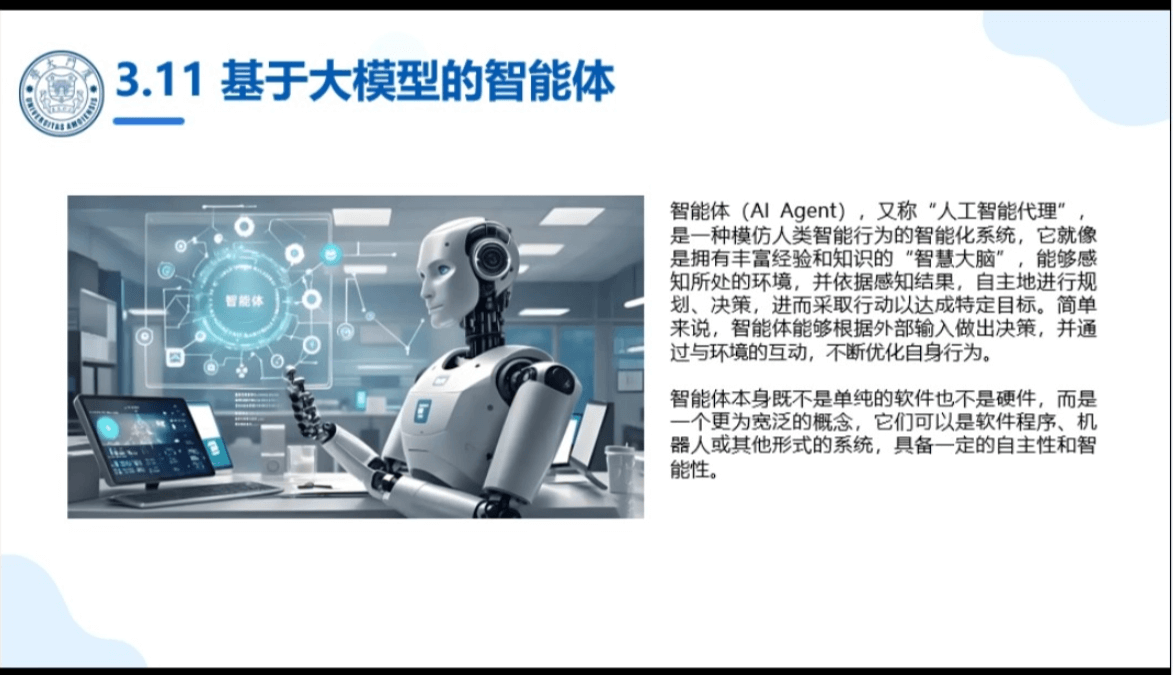
- Intelligent Agents Based on Large Models
- Intelligent agents based on large models can simulate human intelligent behavior and possess autonomy and interactivity. For example, OpenAI's Operator and Deep Research can complete complex tasks and provide efficient, personalized services.
AIGC Applications and Practice
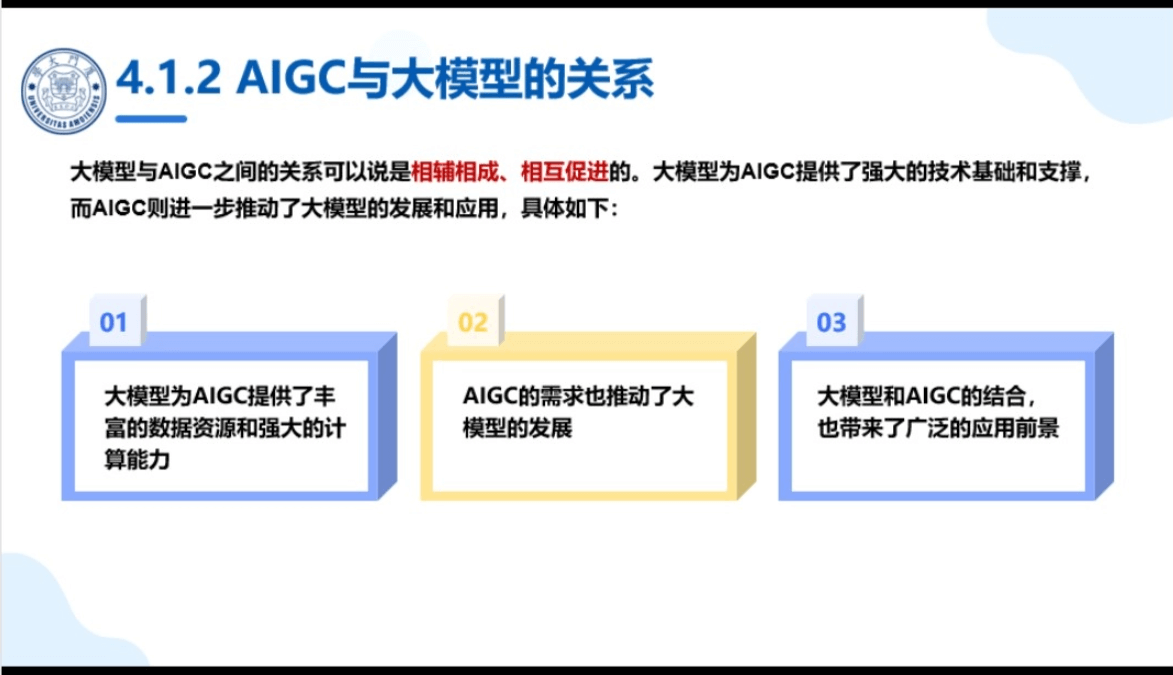
- Overview of AIGC
- AIGC (Artificial Intelligence Generated Content) is a new way to use AI technology to generate text, images, audio, video, and other content. Based on technologies such as generative adversarial networks (GANs) and pre-trained models, it can generate high-quality content according to user input and is widely used in creative design, education, entertainment, and other fields.
- Practical Applications of Text-Based AIGC
- This introduces the usage methods and techniques of text generation tools (such as DeepSeek and Wenxin Yiyan). These tools can generate articles, poems, code, etc. according to user prompts, and support multi-turn dialogue and document processing functions.
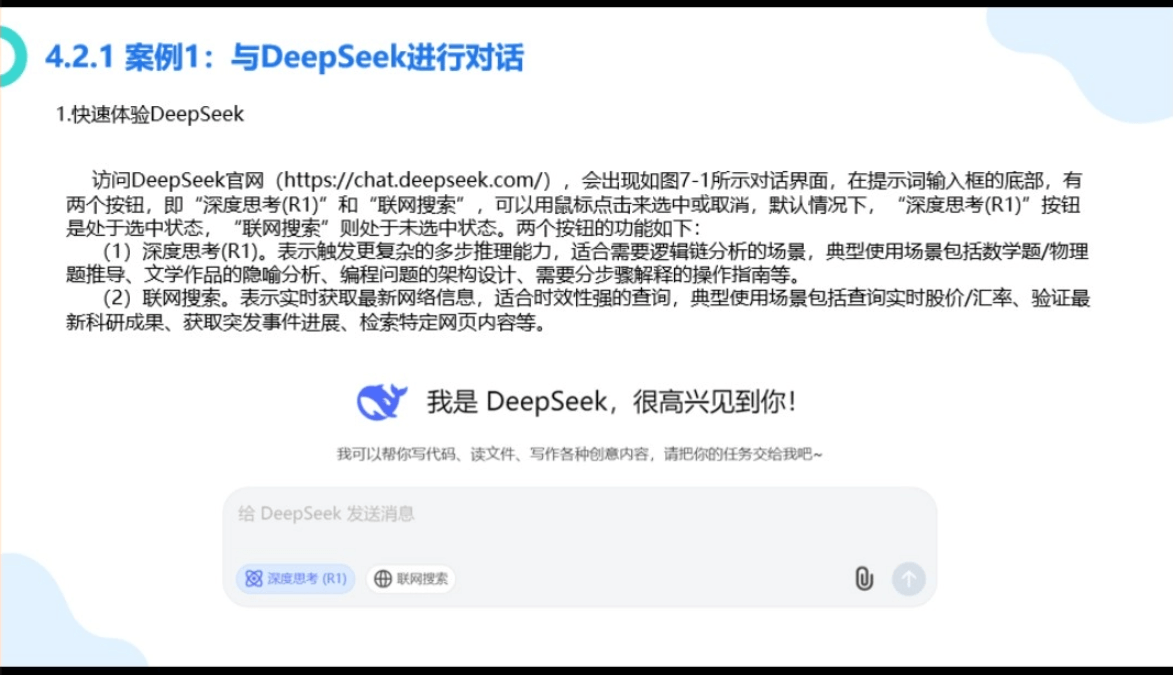
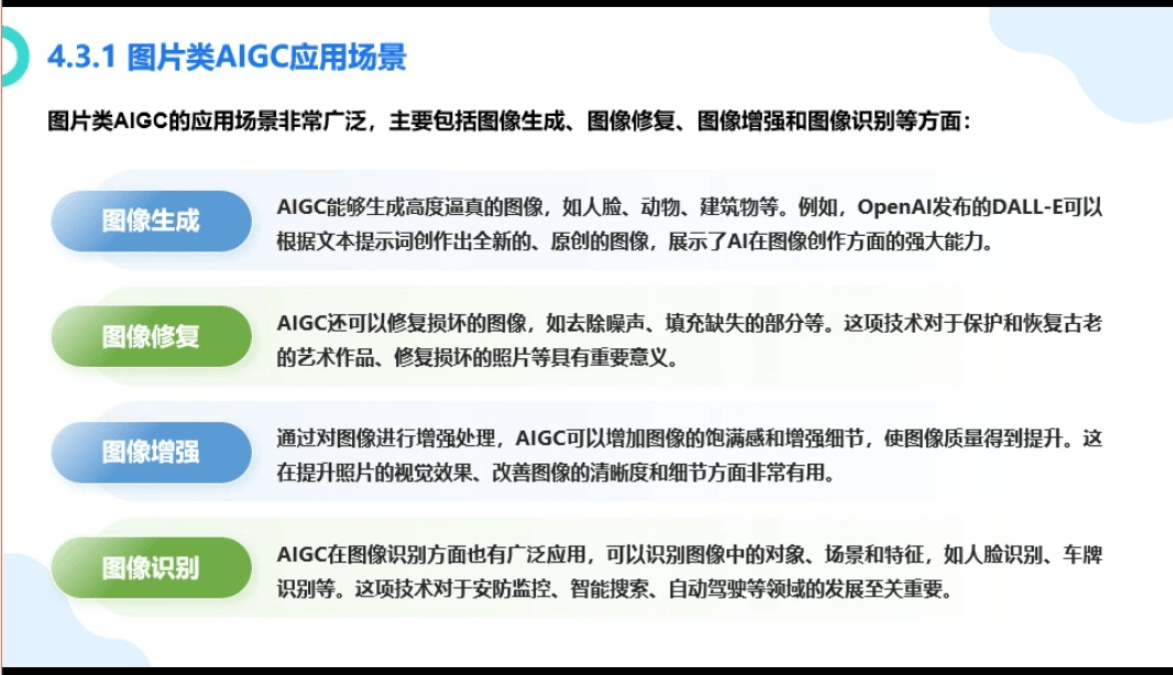
- Practical Applications of Image-Based AIGC
- Image-based AIGC uses deep learning to generate images, with application scenarios including image generation, restoration, and style transfer. Taking Baidu Wenxin Yige as an example, it demonstrates how to generate high-quality images by inputting prompt words.
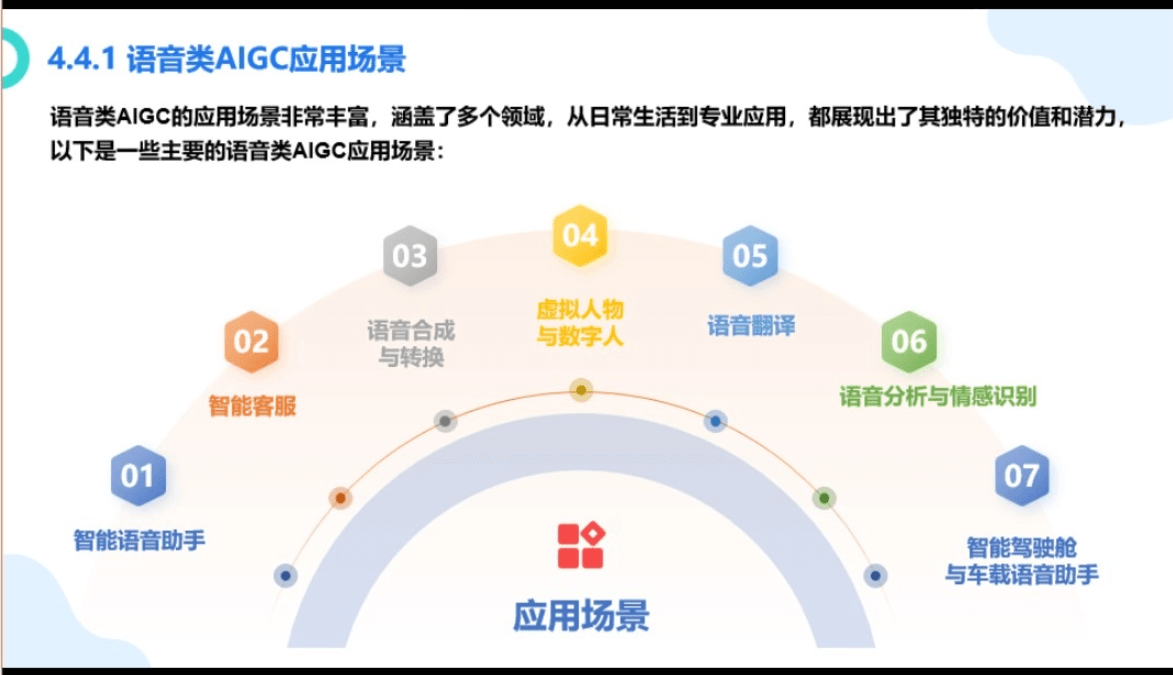
- Practical Applications of Voice-Based AIGC
- Voice-based AIGC can achieve functions such as speech recognition, speech synthesis, and sentiment analysis, and is widely used in intelligent voice assistants and customer service. Taking Doubao and iFlytek Smart as examples, it demonstrates the usage methods of voice-based AIGC.
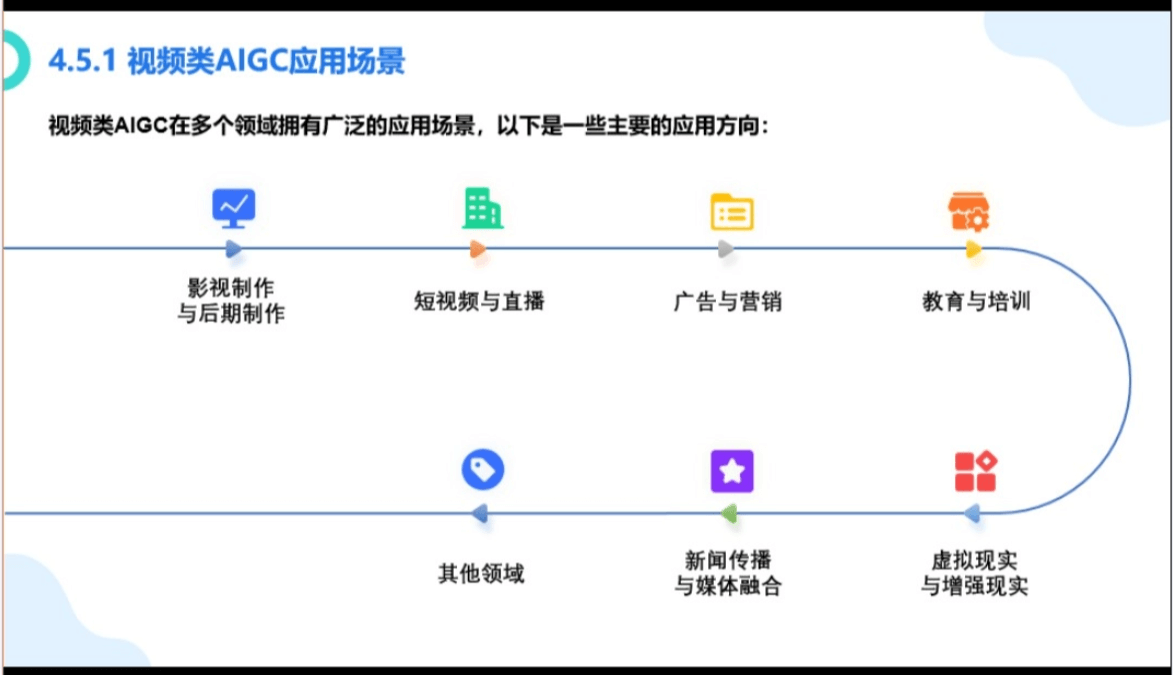
- Practical Applications of Video-Based AIGC
- Video-based AIGC can generate video content based on text or images, with application scenarios including advertising production, film and television special effects, etc. Taking Tencent Zhiying as an example, it demonstrates how to generate digital human broadcast videos.
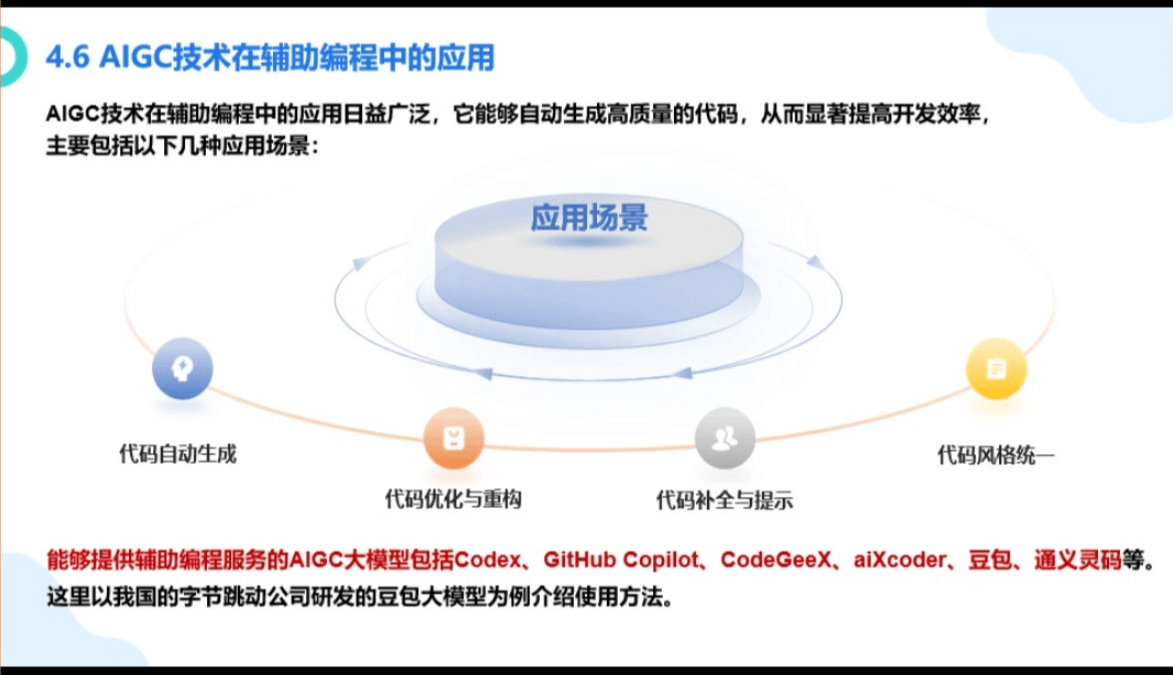
- Application of AIGC in Assisted Programming
- AIGC can automatically generate code and improve programming efficiency. Taking Doubao as an example, it demonstrates how to generate Python code through AI.
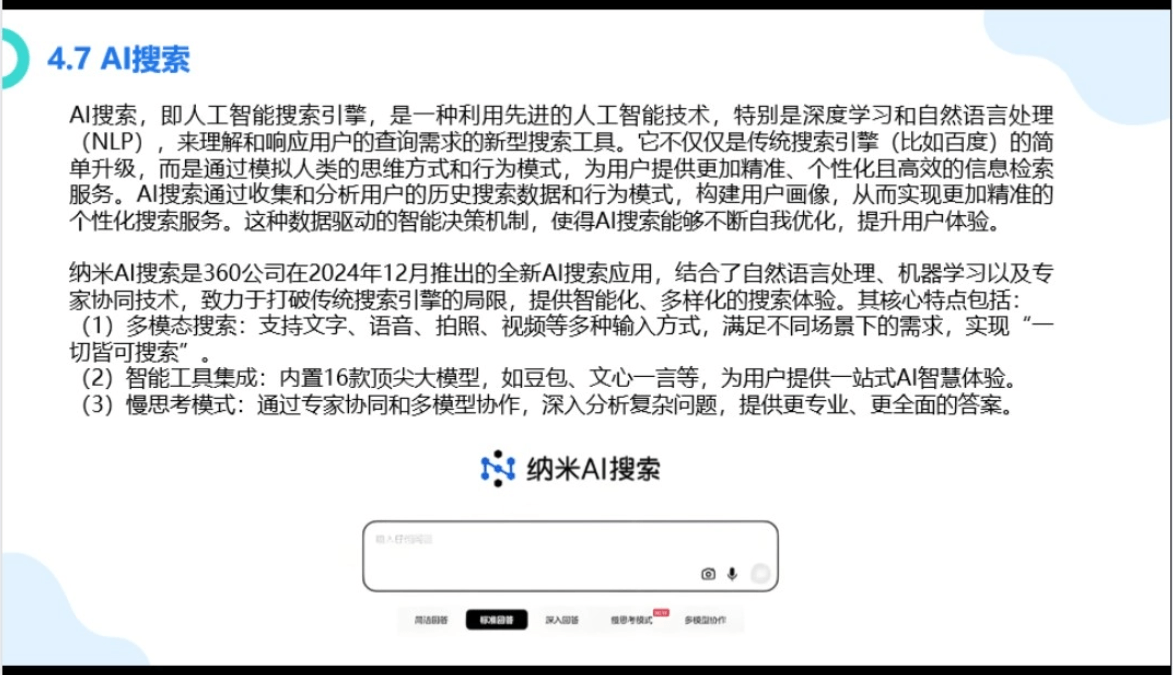
- AI Search
- AI search uses natural language processing and machine learning technologies to provide more accurate search results. Taking 360's Nami AI Search as an example, it demonstrates its features of multimodal search and intelligent tool integration.
- AI Smart Office
- AI smart office improves office efficiency through functions such as document processing, data analysis, and intelligent assistants. For example, AI can generate document drafts, automatically format, summarize document content, and assist with data analysis.
Obtainthe original PPT file of "Concepts, Technologies, and Application Practice of Large Models", scan the QR code to follow and reply: 20250217