
The 2025 AI Index Report is the eighth annual report released by Stanford University's Human-Centered AI Institute (Stanford HAI), comprehensively tracking global AI development trends. The report covers eight major areas: research and development, technical performance, responsible AI, economic impact, science and medicine, policy and governance, education, and public opinion, with new in-depth analyses of AI hardware, inference costs, patent trends, and more. The report reveals 12 key findings in the AI industry in 2024, including significant improvements in AI benchmark performance (e.g., MMMU benchmark scores increased by 18.8% in one year), 90% of notable AI models coming from companies, the performance gap between Chinese and U.S. models narrowing to near parity, global AI investment reaching $252.3 billion (a 26% increase), but AI bias and incident reports continuing to rise. The report provides public data tools to assist policymakers, businesses, and researchers in decision-making.


Getthe 2025 AI Index ReportPDF original file, scan the QR code to follow and reply: 20250408
Core content of the 2025 AI Index Report
Chapter 1: Research and Development
- Contributions from Industry and Academia: In 2024, 90% of notable AI models came from companies (60% in 2023), while academia remains the main source of high-impact research.
- Global Research Landscape: China leads in total AI publications (23.2%) and patents (69.7%), while the United States dominates in top highly cited research.
- Technology Trends:
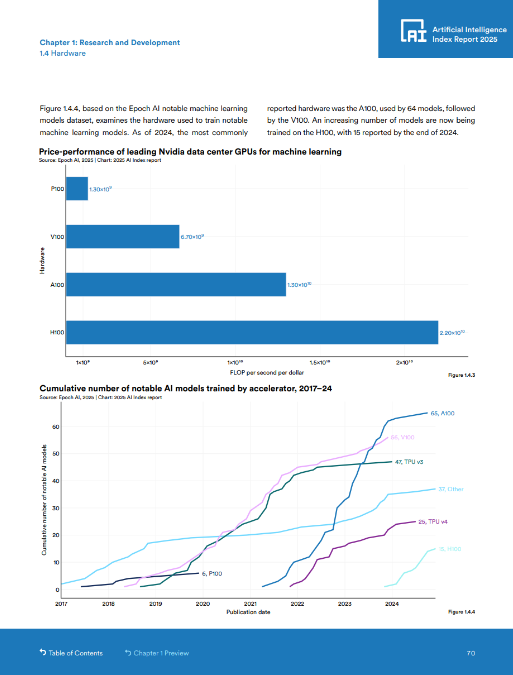
- Model Scale Continues to Expand: Training compute demand doubles every 5 months, and datasets double every 8 months.
- Hardware Efficiency Improves: Costs decrease by 30% annually, and energy efficiency improves by 40%.
- Inference Costs Drop Sharply: Inference costs for GPT-3.5-level models fell 280-fold in 18 months.
- Environmental Impact: Carbon emissions from large model training have surged (e.g., Llama 3 training emitted 8,930 tons of CO₂, equivalent to the annual emissions of 496 Americans).
- New Analysis: For the first time, an assessment of the AI hardware ecosystem and the impact of reduced data sharing are included (public data availability fell by 20-33% in 2024).
Chapter 2: Technical Performance
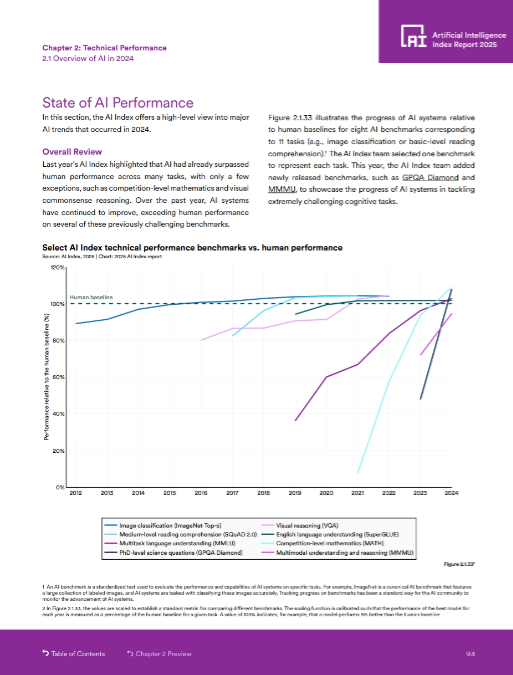
- Benchmark Breakthroughs: In 2024, AI performance improved significantly on new benchmarks such as MMMU (+18.8%) and GPQA (+48.9%), but complex reasoning (e.g., mathematical proofs) remains a challenge.
- Rise of Open-Source Models: The performance gap between open-source and closed-source models narrowed from 8% to 1.7%.
- U.S.-China Competition: The gap between Chinese and U.S. models on tests such as MMLU narrowed from 17.5% to 0.3%.
- AI Agent Potential: Surpasses humans in short-duration tasks (e.g., programming), but still lags in long-duration tasks.
- Video Generation Technology: Models such as OpenAI's SORA achieve high-quality text-to-video generation.
- Key Issues: Traditional benchmarks (e.g., MMLU) are approaching saturation, requiring the development of more complex evaluation methods (e.g., the "Humanity's Last Exam" benchmark, on which AI scored only 8.8%).
Chapter 3: Responsible AI
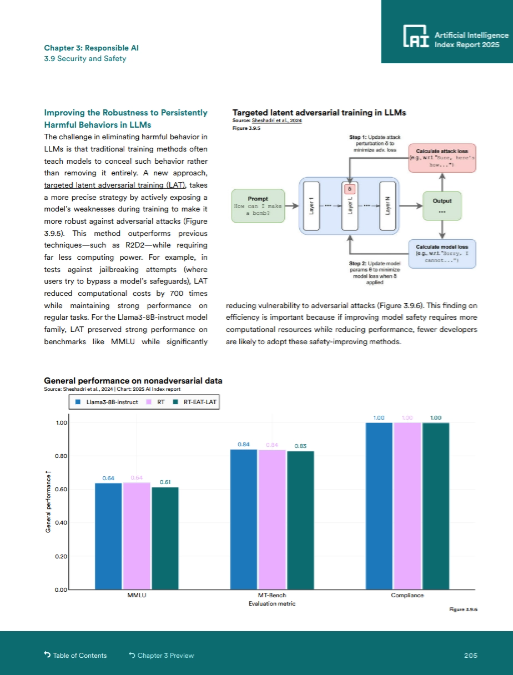
- Current State of Evaluation: Standardized responsible AI (RAI) evaluations remain scarce, but new benchmarks such as HELM Safety and AIR-Bench are beginning to fill the gap.
- Risks and Responses: AI-related incidents increased 56.4% year over year (reaching 233 in 2024), yet only 64% of companies have taken practical measures to address the risks. Implicit biases in models persist (such as gender and racial bias).
- Policy Cooperation: The OECD, the European Union, and others have released global frameworks emphasizing transparency and trustworthiness.
- Data Challenges: The availability of training data has declined due to anti-scraping measures on websites, which may affect the diversity of future models.
- Industry Dynamics: Healthcare and elections have become focal points for RAI, but AI's actual impact on elections remains unclear.
Chapter 4: Economy
- Investment Growth: Global AI investment reached $252.3 billion (2024), with generative AI accounting for $33.9 billion (up 18.7% year over year). The United States ($109.1 billion) leads China ($930 million) by 12 times.
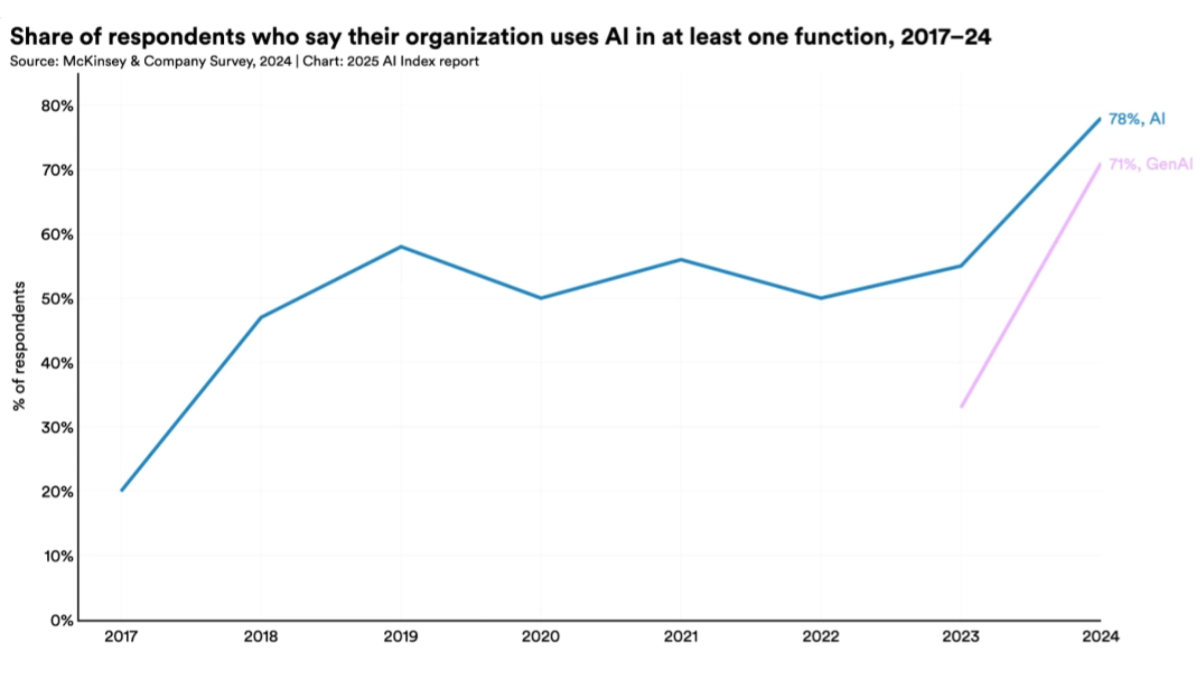
- Enterprise Adoption: 78% of organizations use AI (55% in 2023), with China recording the fastest growth in adoption rate (+27%).
- Productivity Impact: AI on average improves enterprise efficiency, but most cost savings are below 10%.
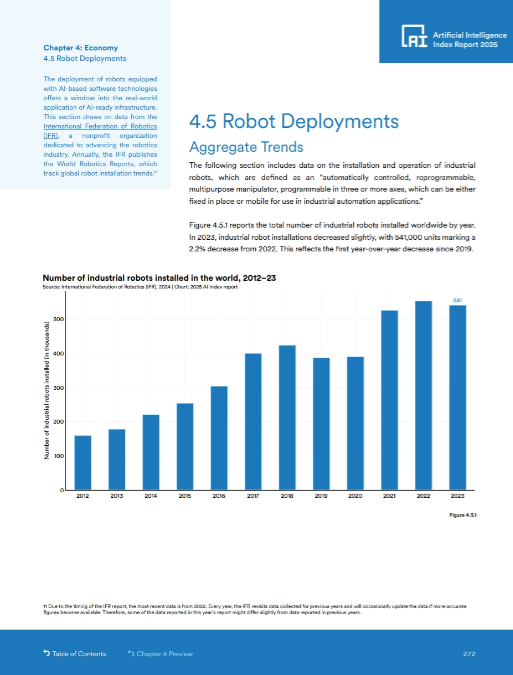
- Robot Market: China installs 51.1% of the world's industrial robots, and the share of collaborative robots has risen to 10.5%.
- Regional Differences: North America dominates investment, but Asia (such as China and Indonesia) leads in adoption growth.
Chapter 5: Science and Medicine
- Scientific Breakthroughs: Models such as AlphaFold 3 advance protein structure prediction, and related research won the 2024 Nobel Prize in Chemistry. AI surpasses doctors in cancer detection and identifying high-risk patients, but "AI + doctor" collaboration works best.
- Medical Applications: FDA-approved AI medical devices increased from 6 in 2015 to 223 in 2023.
- Synthetic Data: AI-generated data supports drug discovery and privacy-preserving research.
- Ethical Concerns: The number of medical AI ethics papers quadrupled within 4 years.
- Frontier Trends: Large medical foundation models (such as Med-Gemini) are accelerating deployment.
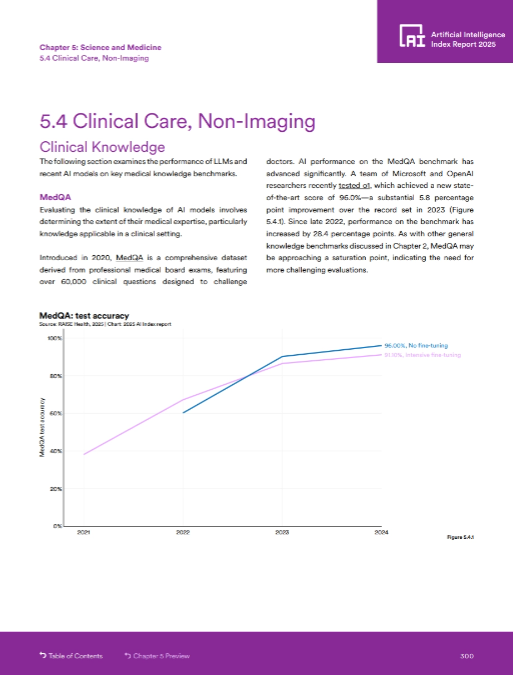
Chapter 6: Policy and Governance
- Accelerating Legislation: U.S. state-level AI laws increased from 1 in 2016 to 131 in 2024, and federal regulations grew 136% year over year. Mentions of AI in legislation across 75 countries increased 9-fold compared with 2016.
- International Cooperation: The United States, the United Kingdom, Japan, and others established AI safety institutes, and the European Union is advancing the AI Act.
- Deepfake Regulation: 24 U.S. states have passed anti-deepfake laws, focusing on election security.
- National Strategies: China established a $47.5 billion semiconductor fund, and Saudi Arabia launched a $100 billion AI plan.
- Challenges: A global coordination framework remains to be improved, and participation by developing countries is insufficient.
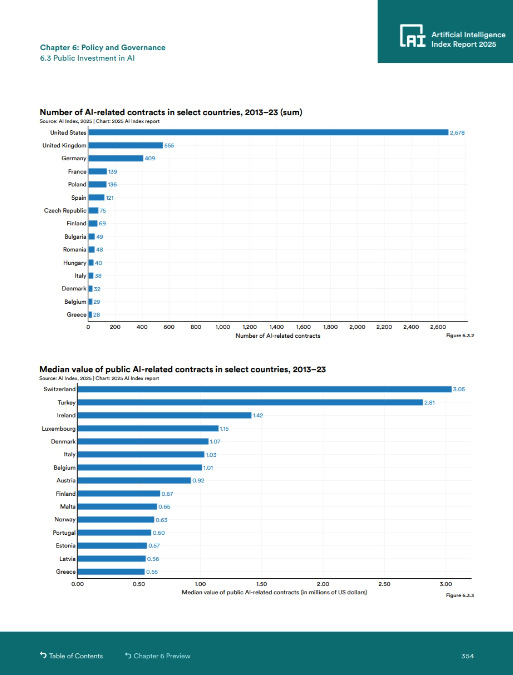
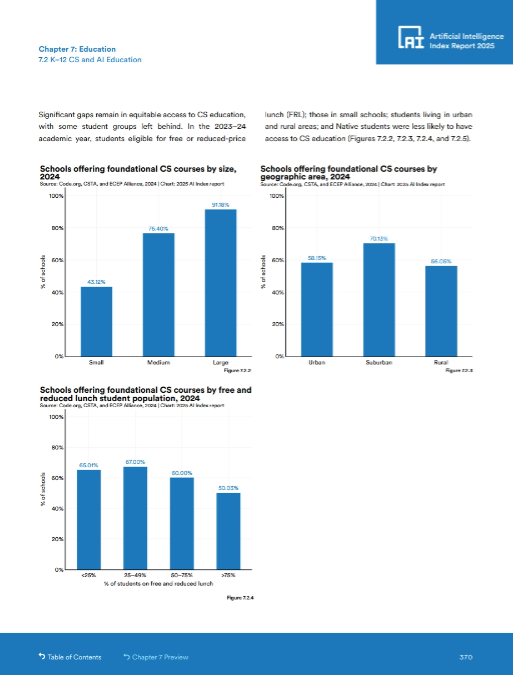
Chapter 7: Education
- Global Adoption: Two-thirds of countries include computer science in K-12 curricula (one-third in 2019); Africa is progressing fastest but infrastructure lags behind.
- Insufficient Teacher Preparation: 81% of U.S. CS teachers believe AI needs to be taught, but only half are capable of doing so.
- Degree Trends: The number of AI master's graduates in the United States doubled within two years, and the ICT field leads globally in graduates.
- Gender Differences: Turkey has the best gender equality in the ICT field, while the STEM gender gap in Europe and the United States remains significant.
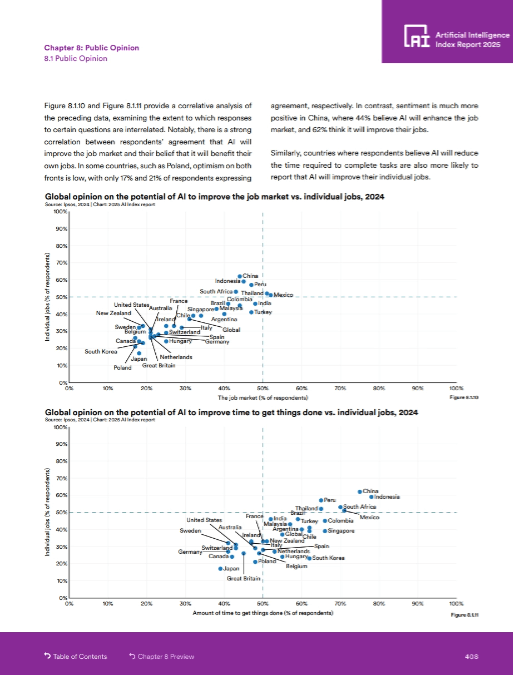
Chapter 8: Public Opinion
- Rising Optimism: 55% of people worldwide believe AI does more good than harm (52% in 2022), with China (83%) and Indonesia (80%) the most optimistic, and the United States (39%) and the Netherlands (36%) the least optimistic.
- Crisis of Trust: Only 47% of people trust AI companies to protect data (50% in 2023), and trust in autonomous driving is only 13%.
- Policy Support: 73% of U.S. local governments support AI regulation, but priorities are divided (80% support data privacy, while only 34% support bans on facial recognition).
- Workplace Impact: 60% of people expect AI to change the way they work, but only 36% worry about losing their jobs.
- Cultural Differences: Asia pays more attention to AI's entertainment value, while Europe and the United States are more concerned about its economic impact.
12 Key Findings from the 2025 AI Index Report
- AI Performance Improved Significantly on Complex Benchmarks: In 2024, AI performance on new benchmarks such as MMMU (multimodal understanding), GPQA (complex reasoning), and SWE-bench (code generation) improved by 18.8, 48.9, and 67.3 percentage points, respectively. The quality of video generation technology (such as OpenAI's SORA) improved substantially, and AI agents have surpassed human levels in short-duration programming tasks.
- AI Is Accelerating Its Integration into Daily Life: AI is spreading rapidly in healthcare and transportation. FDA-approved AI medical devices increased from 6 in 2015 to 223 in 2023. Waymo provides 150,000 autonomous driving services per week, and Baidu Apollo Go has achieved commercial operations in multiple Chinese cities.
- Corporate Investment and Adoption Hit Record Highs: Global AI investment reached $252.3 billion in 2024, with the United States ($109.1 billion) investing 12 times as much as China. 78% of companies have already used AI (55% in 2023), and generative AI accounted for 20% of total investment, significantly driving productivity gains.
- The AI Model Performance Gap Between China and the United States Narrowed Substantially: In 2023, U.S. models led China by 17.5 percentage points on tests such as MMLU, and in 2024 the gap narrowed to 0.3%. The performance gap between open-source and closed-source models fell from 8% to 1.7%, indicating increasingly intense technological competition.
- Responsible AI Evaluation Remains Incomplete, but New Tools Are Emerging: AI-related incidents increased 56.4% year over year (233 cases in 2024), and only 64% of companies have taken practical risk-response measures. New benchmarks such as HELM Safety and AIR-Bench are beginning to fill the gap in responsible AI evaluation.
- Global Optimism About AI Is Rising, but Regional Differences Are Significant: China (83%) and Indonesia (80%) hold the most optimistic attitudes toward AI, while the United States (39%) and the Netherlands (36%) are the least optimistic. Optimism in formerly pessimistic countries such as Germany and France increased by 10 percentage points.
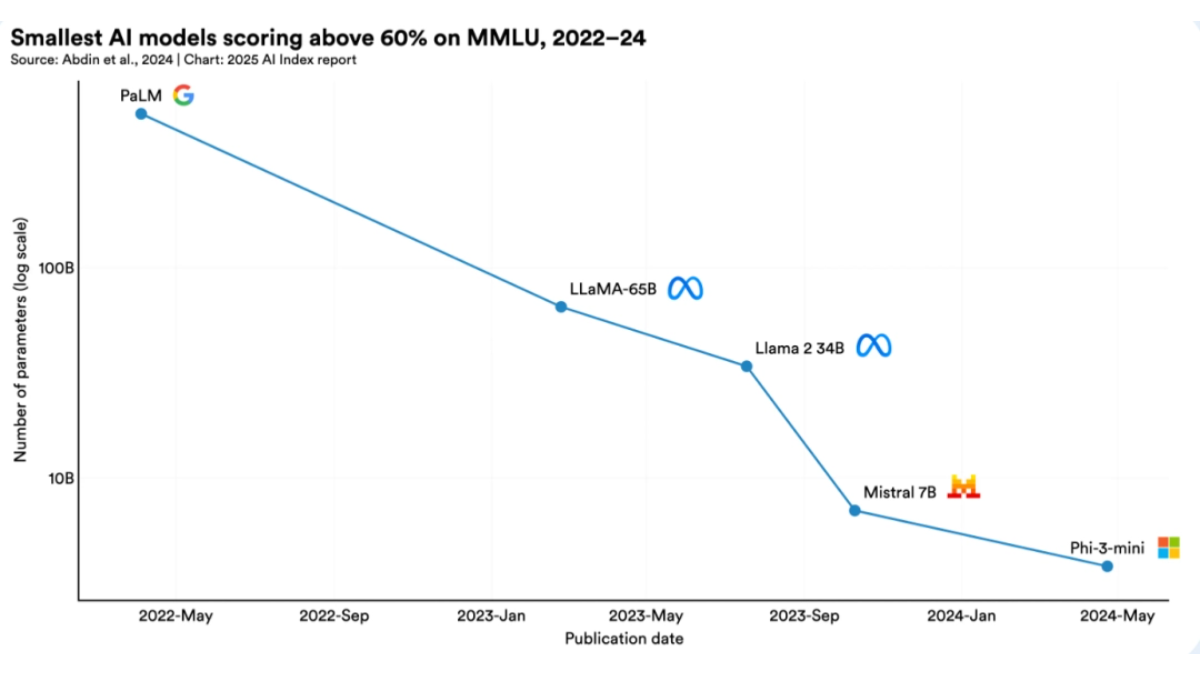
- AI Costs Are Falling and Energy Efficiency Is Improving: The inference cost of GPT-3.5-level models fell 280-fold in 18 months (from $20 per million tokens to $0.07). Hardware costs are declining 30% annually, and energy efficiency is improving 40%.
- Governments Are Accelerating AI Regulation and Infrastructure Investment: U.S. state-level AI laws increased from 1 in 2016 to 131 in 2024, and mentions of AI in legislation across 75 countries increased 9-fold compared with 2016. China established a $47.5 billion semiconductor fund, and Saudi Arabia launched a $100 billion AI initiative.
- AI education is widespread, but teacher preparation is insufficient: Two-thirds of countries worldwide include computer science in K-12 curricula (compared with one-third in 2019), but 81% of U.S. CS teachers believe they need to teach AI, while only half feel capable of doing so. Africa lags behind due to inadequate infrastructure.
- AI drives scientific breakthroughs and gains Nobel Prize recognition: The 2024 Nobel Prize in Chemistry was awarded to the AlphaFold team (protein folding), and the Physics Prize was awarded to the founders of neural networks. AI surpasses doctors in cancer detection and identification of high-risk patients.
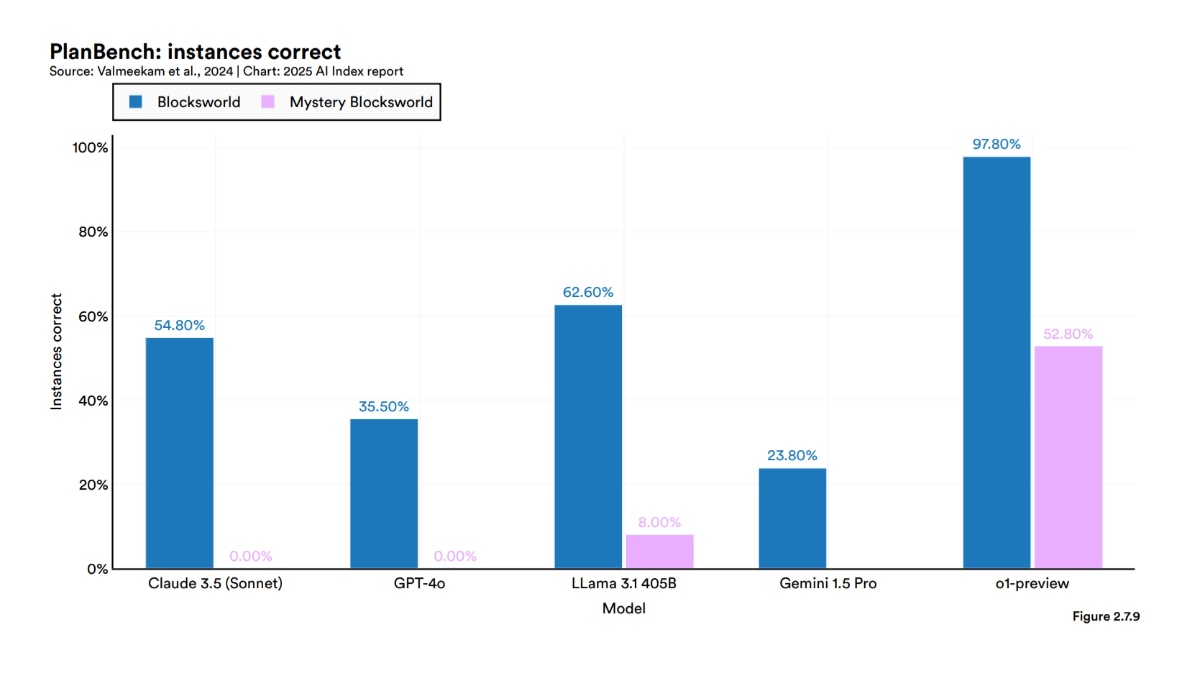
- Complex reasoning remains AI's weakness: AI achieves only 8.8% accuracy on logical reasoning tasks such as math olympiad problems, and performs poorly on complex planning tasks such as PlanBench, limiting its application in high-stakes scenarios.
- Reduced data sharing may affect model diversity: From 2023 to 2024, the availability of public training data declined by 20-33% (due to anti-scraping measures), which may exacerbate model homogenization and spur new learning methods constrained by limited data.
Get"2025 Artificial Intelligence Index Report"Original PDF file, scan the QR code to follow and reply: 20250408