
Tsinghua University "AI-Enabled Education College Entrance Examination Application Tool Usage Guide", based on AI technology to solve complex decision-making problems in college entrance examination application. The report systematically analyzes the core challenges of application, including information overload, multi-objective trade-offs, and psychological pressure, and proposes AI-enabled solutions. The content covers basic knowledge of application, advanced strategies, AI-assisted solutions for ten typical scenarios, and a tool usage guide. The report emphasizes the role of AI in information integration, personalized recommendations, risk assessment, and other aspects, helping candidates make scientific decisions. The report summarizes common misconceptions (such as score-only thinking, ignoring fit, etc.) and countermeasures, discusses the evolution of AI technology from toolization to intelligent agents, and provides methodological support for complex decision-making problems. Combining theory and practice, the report provides candidates and parents with a data-driven application system, helping to achieve more scientific and more personalized academic planning.


To obtain the original PDF file of Tsinghua University's "AI-Enabled Education College Entrance Examination Application Tool Usage Guide", scan the QR code to follow and reply: 20250619
College Entrance Examination Application Basic Knowledge Introductory Section
- Application Basic Knowledge (1)
- Batches and timing:Analyze the characteristics and application strategies of early admission, undergraduate, and junior college batches.
- Application Basic Knowledge (2)
- Application model:The core mechanism of parallel applications, and an overview of application models and quantities across provinces.
- Application Basic Knowledge (3)
- Key decision points:Admission rules, application ranking logic, adjustment strategies, etc.
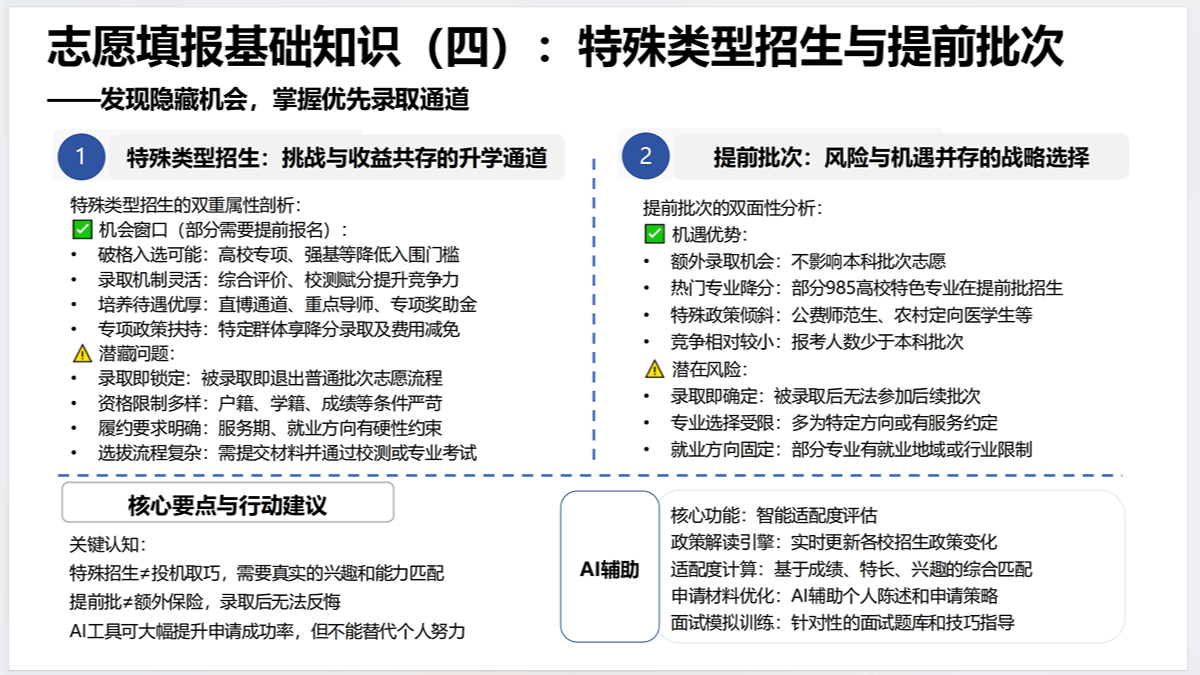
- Application Basic Knowledge (4)
- Special-type admissions and early batches:Opportunities and risks of special admissions such as the Strong Foundation Plan and comprehensive evaluation.
From "Novice" to "Expert" in Application - Advanced Section
- Stage 1: Know yourself. Establish an evaluation system for interest preferences, ability strengths, and value orientation.
- Stage 2: Understand universities and majors. Three-dimensional university evaluation system, five-level progressive method for major selection.
- Stage 3: Positioning and matching. Rank analysis, admission probability models, and application of deep search functions.
- Stage 4: Formulate application strategy. Application ranking, gradient design, risk assessment, and contingency plans.
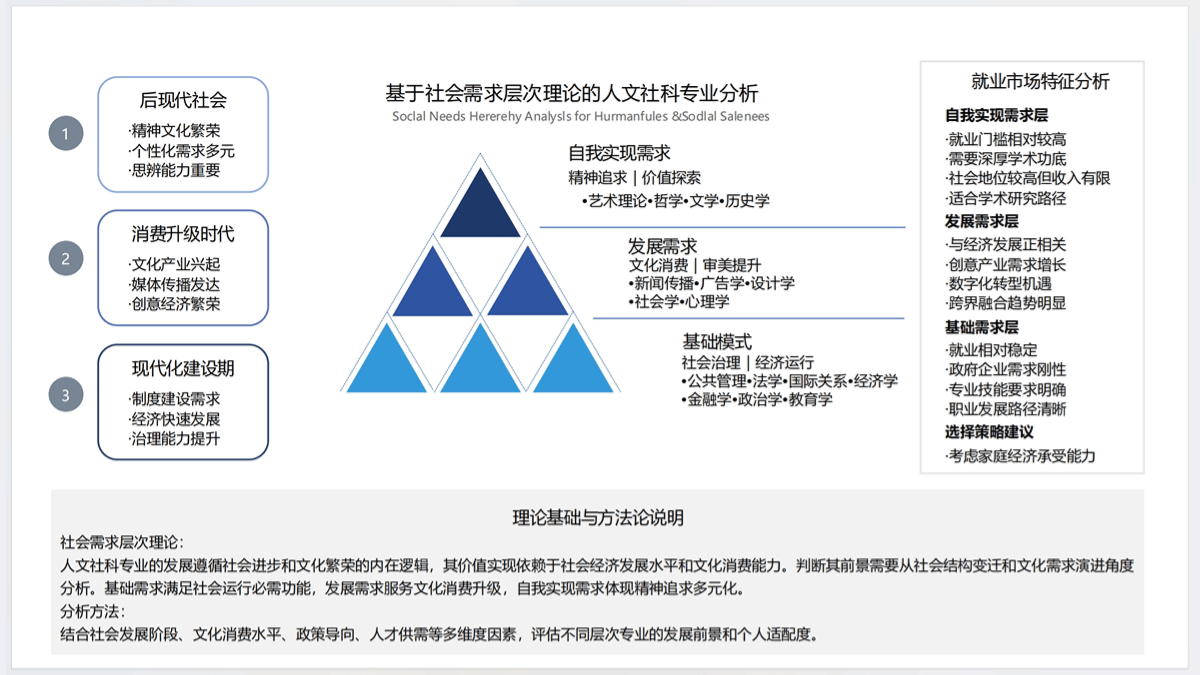
AI-Assisted Solutions for Ten Typical Application Needs - Scenario Section
- Scenario 1: "Optimal university + major" selection for high-scoring candidates. Three major decision traps and AI solutions.
- Scenario 2: "University-major balance" selection for mid-scoring candidates. Tiered decision strategies and core needs.
- Scenario 3: "Safety-net admission + future development" planning for low-scoring candidates. Dual-track parallel strategy and practical solutions.
- Scenario 4: "Self-exploration + major matching" for candidates confused about majors. Triple dilemma and core needs.
- Scenario 5: Candidates from remote areas - how to break through information barriers. Fourfold information barrier breakthrough strategies.
- Scenario 6: The "Nearby Quality" Strategy for Regionally Restricted Candidates. Three-Ring Optimization Strategy and Core Needs.
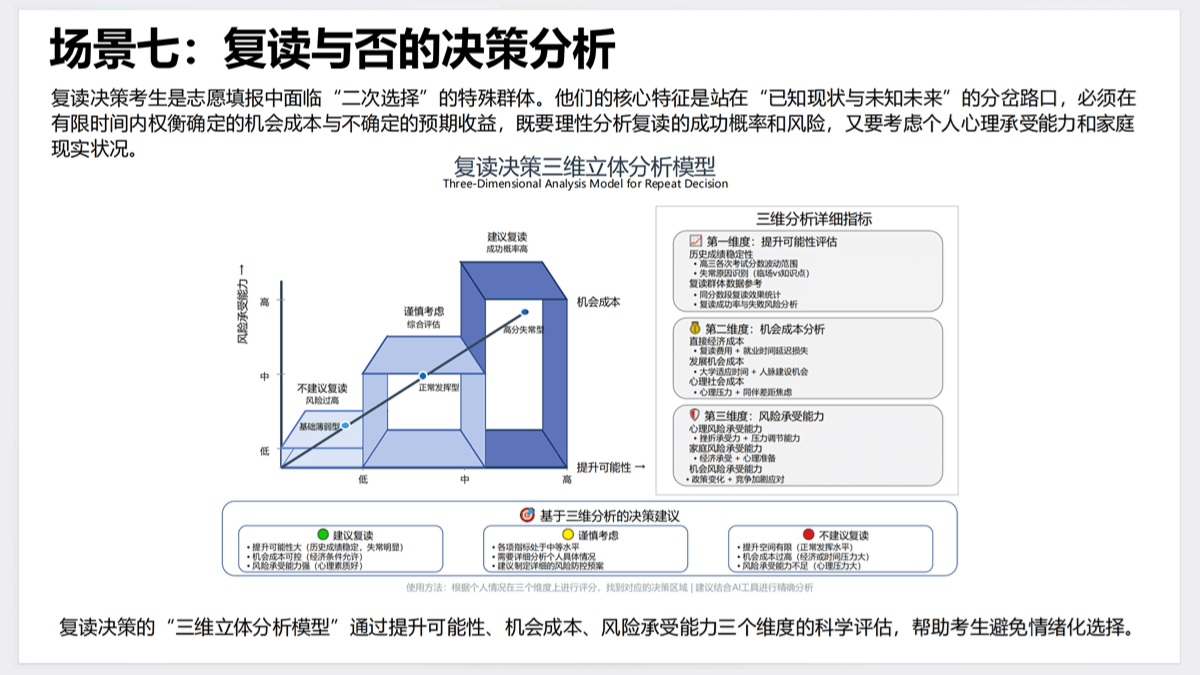
- Scenario 7: Decision Analysis on Whether to Repeat a Year. Three-Dimensional Analysis Model and Core Needs.
- Scenario 8: The "Major First" Strategy for Employment-Oriented Candidates. Four-Layer Screening Comparison Table and Core Needs.
- Scenario 9: The "Undergraduate-Graduate Alignment" Strategy for Candidates Planning for Graduate Entrance Exams. Two-Stage Planning Comparison Table and Core Needs.
- Scenario 10: The "Practical Education" Strategy for Innovation and Entrepreneurship-Oriented Candidates. Major Selection Strategies for Different Entrepreneurial Directions.
Practical Guide to Using College Entrance Examination Application Tools
- Application Report: Intelligent Decision Support from a Multidimensional Perspective. Generate Personalized College Application Plans.
- Full-Process Tool: Decision Support from Complex Question Inquiry to Application Report Output. Core Demands and Tool Support for Users at Different Stages.
- In-Depth College Entrance Examination Search: Intelligent Answers to Complex, Personalized, and Open-Ended Questions. Intelligent Answers and Usage Techniques for Three Types of Questions.
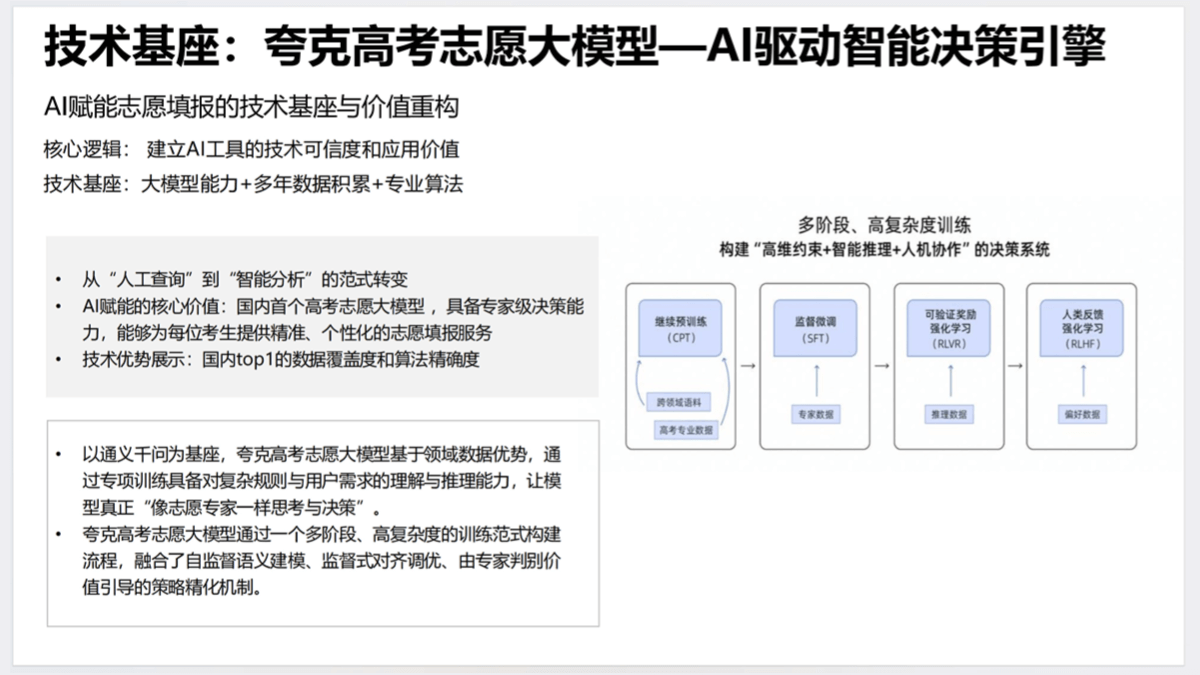
- Technology Foundation: Quark College Entrance Examination Application Large Model AI-Driven Intelligent Decision Engine. Technical Logic and Advantages of AI-Empowered College Application.
- Quark College Entrance Examination Knowledge Base: Intelligent Retrieval and Precise Acquisition of Authoritative Data. Four-Level Query Functions and Practical Methods.
- Expert Resources: Effective Combination of AI Assistance + Expert Teacher Guidance. Livestream Content System and Learning Techniques.
Common Misconceptions and Solutions in College Application
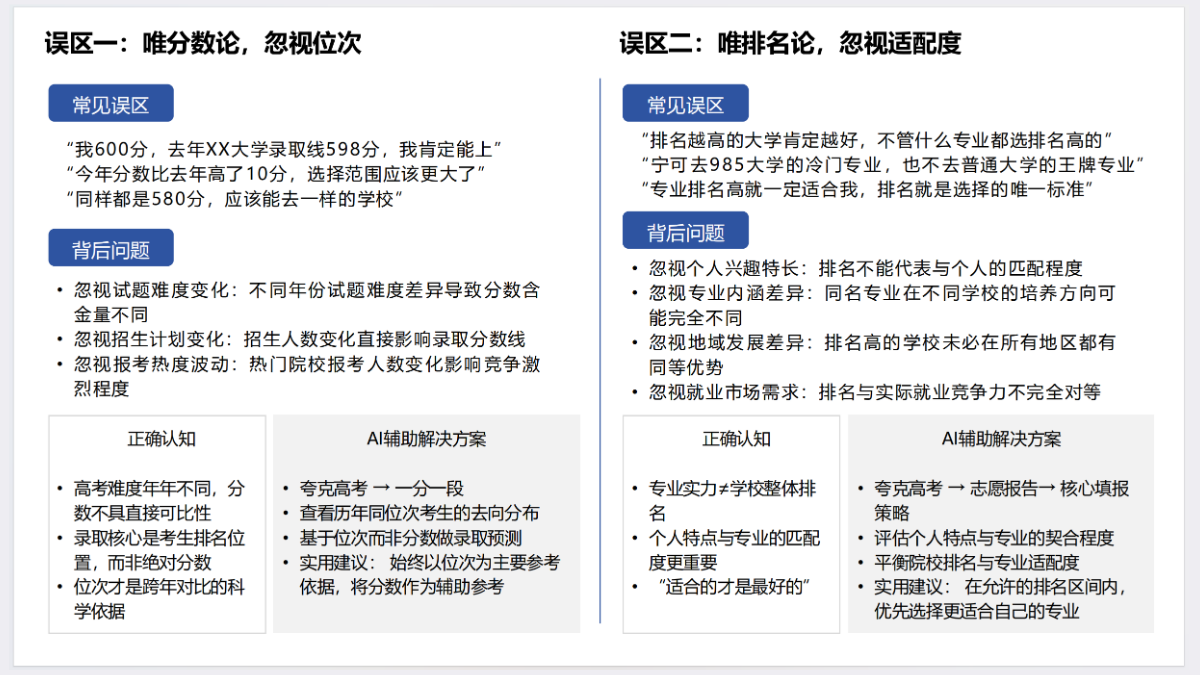
- Misconception 1: Score-Only Thinking, Ignoring Ranking. Ranking is more scientific than score.
- Misconception 2: Ranking-Only Thinking, Ignoring Fit. The match between the individual and the major is more important.
- Misconception 3: Popularity-Only Thinking, Ignoring Development Potential. Major popularity is cyclical.
- Misconception 4: Emphasizing School Over Major or Major Over School. Both school and major need to be considered comprehensively.
- Misconception 5: No Gradation in College Application. The necessity of a reasonable mix of reach, match, and safety schools.
- Misconception 6: Parents Completely Replacing the Child in Decision-Making. Students should be the decision-making subject.
- Misconception 7: Ignoring the Impact of Regional Factors. The impact of region on internships, employment, and networks.
- Misconception 8: Over-Reliance on Others' Advice. Independent judgment and multi-party verification are needed.
- Misconception 9: Ignoring Opportunities to Change Majors and Pursue Double Degrees. Policy utilization and path planning.
- Misconception 10: Ignoring Important Information in Admission Regulations. The importance of admission rules and details.
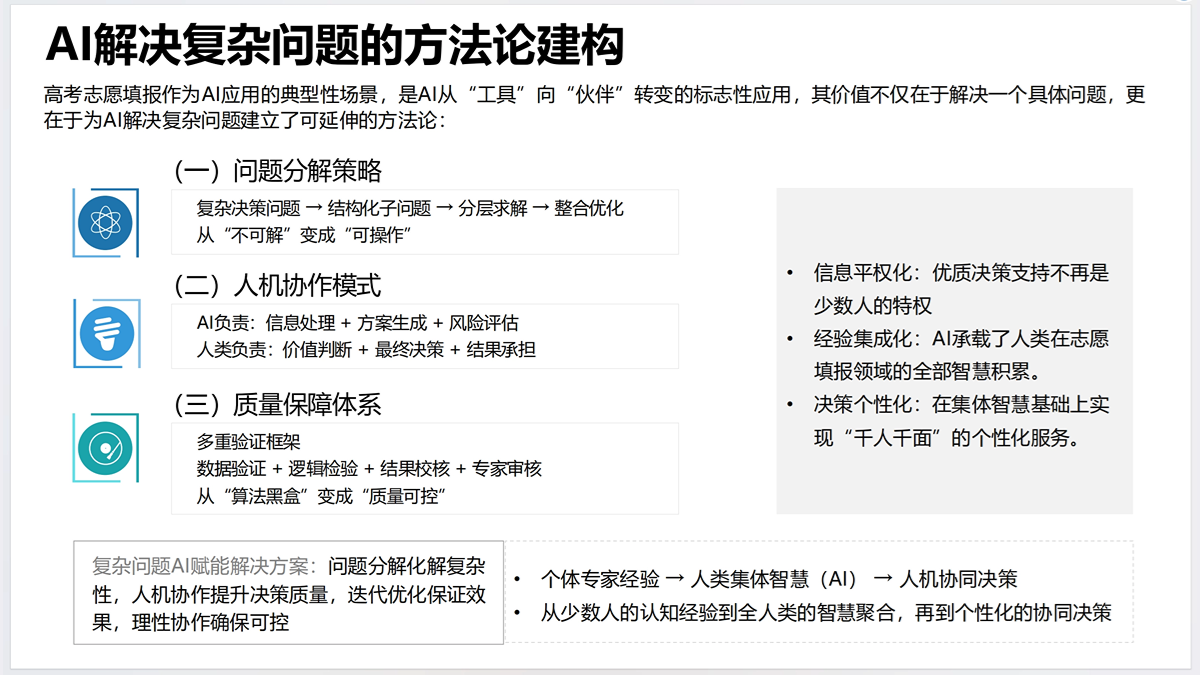
College Application: A Typical Sample of Complex Decision-Making Problems
- Building a Methodology for AI to Solve Complex Problems:
- Problem Decomposition Strategy:Break down complex decisions into structured sub-problems, solve them in layers, then integrate and optimize.
- Human-Machine Collaboration Model:
- AI is responsible for: Information processing, plan generation, risk assessment.
- Humans are responsible for: value judgments, final decisions, and bearing the consequences.
- Quality assurance system: Ensure decision reliability based on data verification, logical validation, result checking, and expert review.
- Human-machine collaborative decision-making model: In college entrance examination application, humans are always the subject of decision-making and need to comprehensively consider national development needs, social realities, and personal talents and strengths.
- Decisions and the future: Application opens up infinite future possibilities. Cherish choices, think independently, believe in yourself, treat difficulties as steps, work hard in the present, and embrace a wonderful future.
Get the Tsinghua University "AI-Enabled Education: A Guide to Using College Entrance Examination Application Tools" PDF original file, scan the code to follow and reply: 20250619