
The Deloitte AI Institute's "AI Case Selection" report introduces real-world application cases of artificial intelligence (AI) in six major industries and their business value. The report outlines six ways AI creates value, including reducing costs, accelerating execution, reducing complexity, transforming interaction methods, driving innovation, and strengthening trust. It provides a detailed analysis of typical AI application scenarios in fields such as the consumer industry, energy/resources/industrials, financial services, government/public services, life sciences/health management, and technology/media/telecommunications (TMT), such as logistics optimization, predictive maintenance, fraud detection, precision medicine, etc., and lists emerging technology trends (such as autonomous driving, digital twins, biometric payments, etc.). It emphasizes that AI must shift from small-scale pilots to large-scale deployment to unlock maximum value, and recommends that enterprises formulate clear AI strategies and data governance frameworks. Deloitte calls on all industries to seize AI opportunities and achieve competitive advantage based on human-machine collaboration.

To obtain the PDF original file of the Deloitte AI Institute's "AI Case Selection", scan the QR code to follow and reply: 20250614
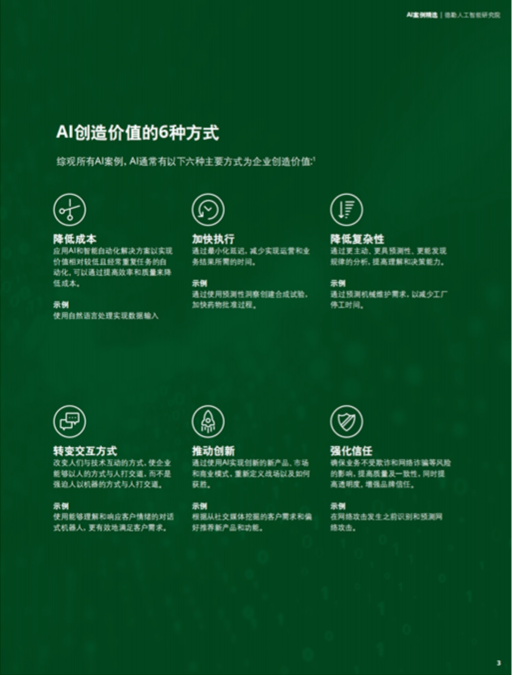
6 ways AI creates value:
- Reduce costs: Improve efficiency based on automating repetitive tasks, such as natural language processing for data entry.
- Accelerate execution: Reduce delays, such as predictive insights accelerating drug approval.
- Reduce complexity: Optimize decisions through predictive analytics, such as predicting mechanical maintenance needs.
- Transform interaction methods: Improve human-machine interaction, such as emotion-aware conversational robots.
- Drive innovation: Mine data to develop new products, such as social media-driven product recommendations.
- Strengthen trust: Prevent risks, such as identifying cyberattacks in advance.
Consumer industry
- Consumer industry AI profile: Consumer industry enterprises are actively exploring AI applications, but face issues such as data quality, organizational structure, and talent shortages, resulting in large differences in AI application and maturity. Enterprises need to solve problems such as data inconsistency and poor quality, achieve integration of business and technology, build trust, and deploy AI at scale. AI systems will become more autonomous, changing methods such as cargo transportation and employee management, and improving enterprise operational efficiency and customer experience.
- Cases:
- Fleet network optimization: AI optimizes logistics routes and reduces empty vehicle rates.
- Connect with customers: Personalized customer service, such as intelligent chatbots.
- Product classification optimization: AI predicts demand and optimizes inventory.
- Digital call center: Natural language processing improves customer satisfaction.
- Emerging cases: Autonomous stores, fashion technology (3D scanning to match clothing), health monitoring wearable devices.

Energy, Resources & Industrials (ER&I)
- Energy, Resources & Industrials AI profile: AI applications in the ER&I field are not sufficiently widespread and mature, mainly concentrated in small-scale pilots and proof-of-concept stages, and face challenges in data acquisition and integration. Enterprises need to establish professional AI teams, coordinate AI activities, formulate strategies and roadmaps, and focus on areas such as machine maintenance, customer interaction, and responding to extreme events.
- Cases:
-
Predictive machine maintenance: AI analyzes IoT sensor data, predicts machine failures, optimizes maintenance schedules, and reduces downtime and maintenance costs.
-
Edge AI: Uses edge computing and AI technologies to process data at the network edge, improving data security, reducing costs, and accelerating decision-making.
-
On-site sensor data analysis: AI analyzes on-site sensor data in real time, monitors production assets, evaluates exploration opportunities, and improves monitoring and forecasting capabilities.
-
On-site workforce support and safety: AI provides information support to on-site workers through natural language processing and machine learning, improving work efficiency and safety.
-
Utility service outage prediction: AI predicts energy demand and outage times, proactively alerts customers, optimizes customer service, and reduces operations and maintenance costs.
-
- Emerging cases: Digital twin factories, algorithmic supply chain planning, virtual factory operators.

Financial Services Industry (FSI)
- Financial Services Industry AI Profile: Most FSI companies are in the early stages of AI adoption and investment and need to move from pilot projects to large-scale deployment and build enterprise-level AI capabilities. AI will be widely used to improve customer experience, automate key processes, drive industry convergence, and break down departmental silos, enhancing enterprise competitiveness.
- Cases:
-
Bank fraud analysis: AI monitors transactions in real time, identifies suspicious activity, reduces fraud losses, and increases customer trust.
-
Conversational AI: AI-driven chatbots and virtual assistants provide personalized financial services, automate debt collection activities, and enhance customer experience.
-
360° customer experience: AI analyzes customer data, provides personalized recommendations, predicts customer churn, optimizes marketing strategies, and increases customer engagement.
-
Insurance underwriting: AI automates the underwriting process, simplifies risk assessment, improves efficiency, and reduces costs.
-
Trading operations automation: AI and machine learning automate trade reconciliation and exception handling, improving efficiency and reducing errors.
-
- Emerging cases: Biometric payments (smile-to-pay), behavior-based insurance pricing, real estate valuation AI.

Government and Public Services (GPS)
- Government and Public Services AI Profile: AI applications in government agencies vary by institution and face legal, risk, and budget constraints, requiring cautious advancement within legal and ethical frameworks. AI will be widely used in social policy formulation, healthcare, legal judgment, and other areas, improving the efficiency and quality of public services.
- Cases:
-
Claims processing back-office automation: AI uses robotic process automation, natural language processing, and computer vision to accelerate the processing of written materials and improve efficiency.
-
Population risk support: AI predicts the risks of social problems, provides data support for policy formulation, and optimizes the allocation of social resources.
-
Biomedical data science: AI analyzes biomedical data, accelerates medical research and drug discovery, and improves healthcare efficiency.
-
Benefits administration: AI optimizes benefit plans, provides personalized recommendations, and improves employee satisfaction and the efficiency of benefit expenditures.
-
Health and Environmental Prediction: AI predicts disease outbreaks and climate change impacts, supporting public health and environmental protection decisions.
-
- Emerging Cases: AI military strategy simulation, smart city asset management, legal judgment prediction.

Life Sciences and Health Management
-
Life Sciences and Healthcare AI Profile:AI applications in the life sciences and healthcare sector are in their early stages, mainly focusing on management tasks and process automation, and facing challenges in data acquisition and integration.AI will be widely applied in drug discovery, precision medicine, patient experience enhancement, and other fields, driving the personalization and intelligence of healthcare.
- Cases:
-
Digital Data Flow for Clinical Trials: AI automates clinical trial data management, improving efficiency, reducing costs, and accelerating the drug approval process.
-
Pharmaceutical Intelligence: AI analyzes manufacturing data, predicts production deviations, and improves product quality and yield.
-
Omnichannel Engagement in Pharmaceutical Marketing: AI optimizes marketing strategies, predicts customer interaction methods, and improves marketing return on investment.
-
Voice of Patient Insights: AI analyzes patient feedback, provides product improvement suggestions, and enhances customer satisfaction.
-
Proactive Risk and Compliance: AI monitors compliance risks in real time, provides improvement suggestions, and reduces compliance costs.
-
- Emerging Cases: Synthetic biology, virtual drug discovery, wearable health monitoring.

Technology, Media, and Telecommunications (TMT)
- Technology, Media, and Telecommunications AI Profile: AI applications in the TMT sector vary by industry. Telecom companies have relatively mature AI applications, while the media and telecommunications fields need to further expand AI applications. AI will be widely applied in smart factories, digital supply chains, customer interaction, and other fields, improving operational efficiency and customer experience.
- Cases:
-
Smart Factories and Digital Supply Networks: AI optimizes production processes, improves asset efficiency, reduces costs, and improves environmental sustainability.
-
Direct Consumer Engagement: AI improves customer satisfaction and retention through automated customer interaction and personalized services.
-
Digital Contact Centers: AI builds efficient voice virtual assistants, improves the call center experience, and reduces manual intervention.
-
Detecting False Media Content: AI detects deepfakes and false media content, limiting the spread of misinformation.
-
Customer Data Monetization: AI analyzes customer data, provides personalized services, and enhances customer value.
-
- Emerging Cases: Real-time language translation, video content analysis, emotion-monitoring advertising.

Conclusion
- Core Viewpoint: AI needs to shift from small-scale pilots to large-scale deployment to unlock real value.
- Recommendations: Combine industry characteristics and formulate a clear AI strategy and data governance framework.

Get Deloitte AI Institute's "AI Case Selection"PDF Original File, scan the QR code to follow and reply: 20250614