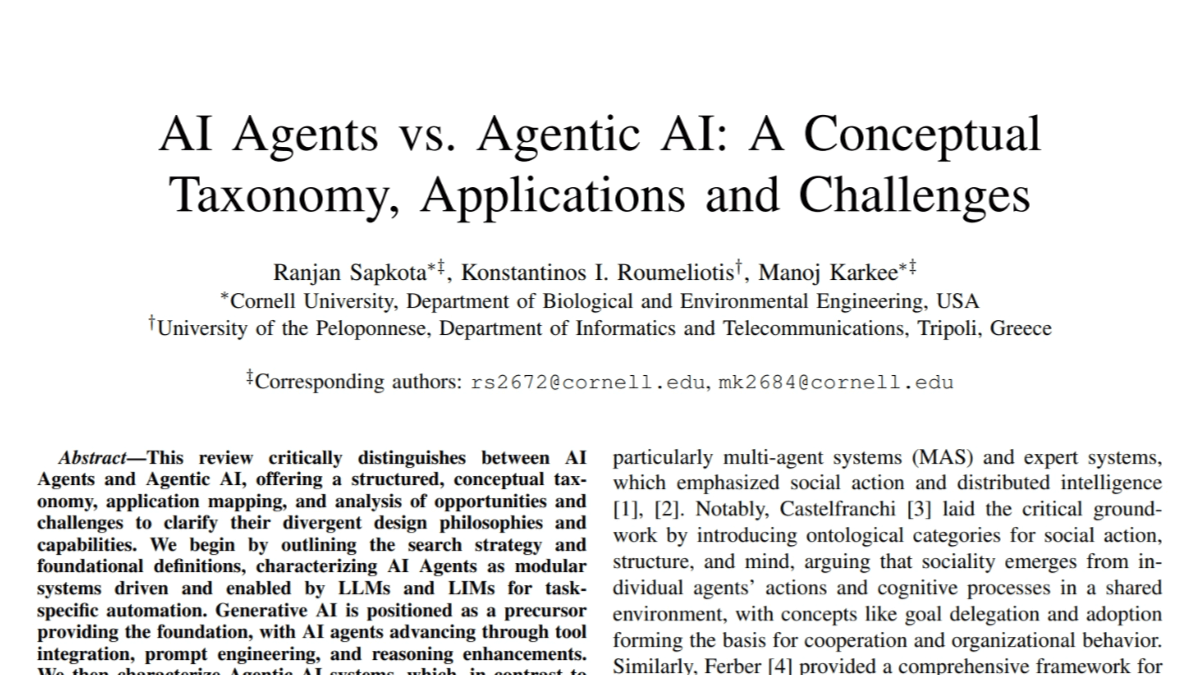
"AI Agents vs. Agentic AI: Conceptual Classification, Applications, and Challenges" was launched by a research team from Cornell University and other universities in the United States. It provides an in-depth analysis of the easily confused core concepts of AI Agents and Agentic AI, and explores the bottlenecks and solutions in the development of agent technology.
To address the above challenges, developers have introduced a variety of technical means. For example, RAG (Retrieval-Augmented Generation) technology can reduce hallucination issues; causal modeling can improve reasoning capabilities; multi-agent memory architectures (such as vector memory) enhance the efficiency of information sharing; stronger planning mechanisms (such as Tree of Thoughts) can optimize multi-step decision-making. These technologies will help drive breakthroughs in agent technology.
AI Agents will gradually evolve into agents with "proactive intelligence" based on modular design and enhanced intelligent capabilities, enabling autonomous planning and decision-making. The multi-agent collaboration framework of Agentic AI will further mature, forming "system intelligence" with a high degree of organizational capability, bringing new opportunities and breakthroughs for the development of AI.
Core Concepts
AI Agents: AI Agents are autonomous software systems based on AI technology that independently perceive, decide, and execute tasks in a specific environment. Core features include:
- Autonomous operation: AI Agents complete tasks independently and do not require real-time human supervision. They support automatically starting work, making decisions based on built-in intelligent algorithms, and achieving 24/7 uninterrupted operation.
- Clear goals: Each AI Agent works around a specific goal. It breaks large tasks into small steps, intelligently arranges the execution order, and continuously evaluates the quality of completion.
- Environmental perception: AI Agents can understand multiple types of information such as text, speech, and images. They adjust their working methods according to real-time conditions and connect with other systems for collaborative work.
- Continuous improvement: AI Agents learn from experience in each task and optimize themselves based on analysis of successful and failed cases. They remember user preferences, automatically adjust their working methods, and become increasingly intelligent with use in services such as recommendation systems.
Agentic AI: Unlike AI Agent, Agentic AI is a new type of intelligent architecture, referring to an intelligent system composed of multiple AI Agents based on collaboration mechanisms, with advanced capabilities for handling complex tasks. Core features include:
- Multi-agent collaboration architecture: Multiple specialized Agents divide work and cooperate, achieving efficient execution of complex tasks based on intelligent communication mechanisms.
- Advanced task planning capability: It has the ability to recursively decompose tasks, perform multi-path reasoning, and dynamically adjust to handle complex problems.
- Distributed memory system: It combines globally shared memory with individual专属 memory, supporting cross-agent knowledge invocation and storage.
- Meta-agent coordination mechanism: Based on central scheduling, quality monitoring, and secure sandboxes, it ensures the reliability and security of multi-Agent collaboration.
- Self-evolution capability: Agents share experience and optimize collaboration strategies, driving continuous improvement in the overall system performance.
Based on a smart home system case study, the research team explained the difference between AI Agent and Agentic AI.
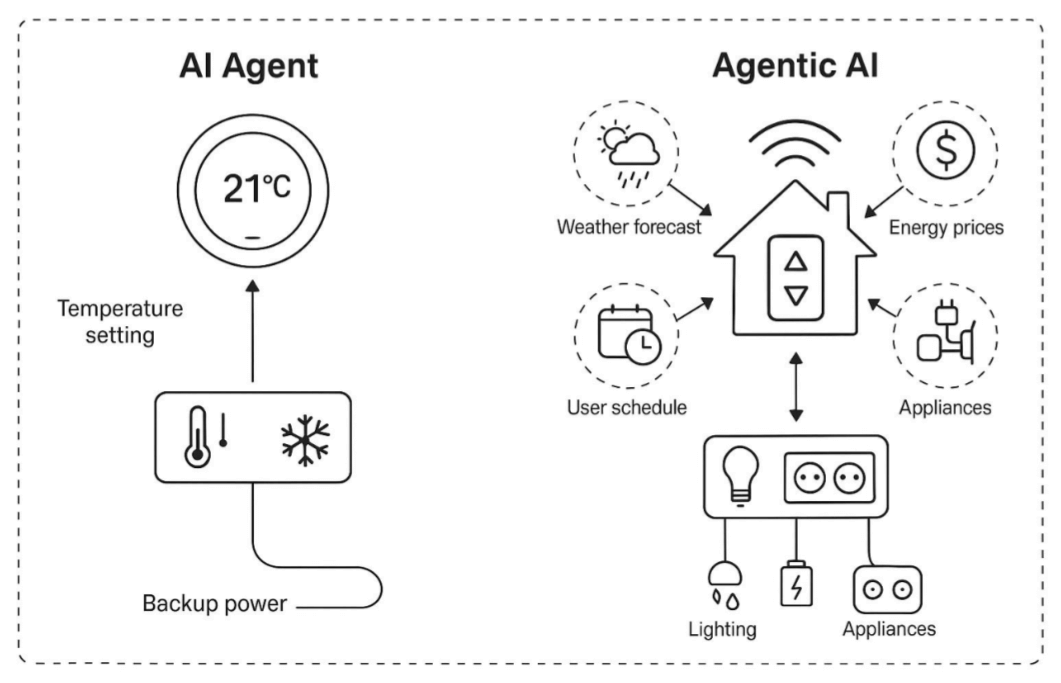
This comparison chart vividly presents the evolution of AI technology from a single function to system intelligence: the AI Agent on the left (such as a smart thermostat) represents a basic intelligent unit, focusing on independently executing specific tasks (such as temperature regulation), with limited self-learning and rule-based response capabilities; the Agentic AI system on the right builds a multi-agent collaborative network (integrating modules such as weather forecasting, energy management, and security) and, based on real-time data sharing and dynamic decision-making, achieves cross-domain collaborative optimization (such as automatically adjusting the home environment by combining electricity prices and weather forecasts). The essential difference between the two is that the former is a "function executor," while the latter is a "system decision-maker," marking AI's leap from an isolated tool to an ecological hub with organization-level intelligence, providing a key technological paradigm for addressing complex scenarios (such as smart cities and the industrial Internet of Things).
Application Fields
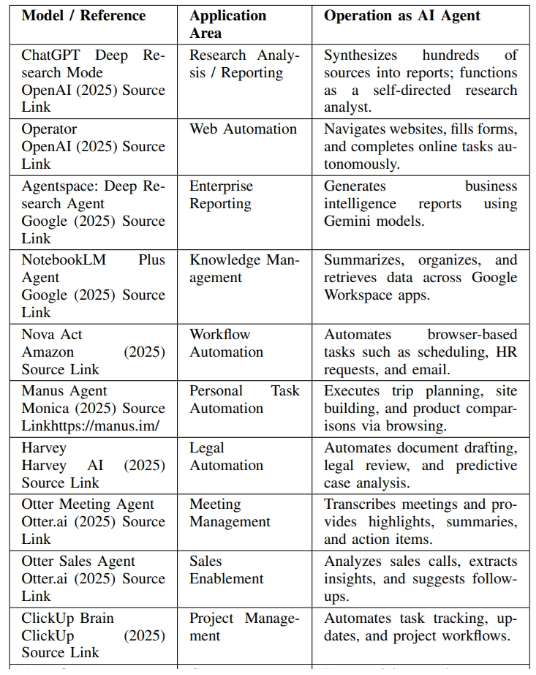
AI Agent Application Fields:
- Customer Service Automation: Intelligent customer service systems can quickly and accurately answer common questions based on preset rules and user input, improving customer satisfaction.
- Scheduling: Automatically analyze the user's schedule, reasonably arrange meetings and activities, and avoid time conflicts.
- Data Summarization: Automatically extract and summarize key information from large amounts of data, and generate concise reports.
- Email Filtering: Automatically classify and prioritize to help users manage high-volume email.
- Personalized Content Recommendation: Recommend personalized content, such as news, music, videos, and more, based on user behavior and preferences.
- Automated Document Processing: Automatically extract and process information from documents, and generate summaries or reports.
Agentic AI Application Fields:
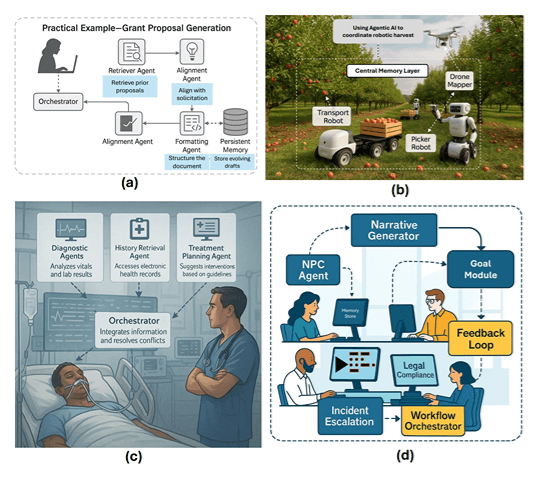
- Research Automation: Automate scientific research processes, including literature retrieval, experimental design, data analysis, and more.
- Robot Coordination: Coordinate multi-robot systems to complete complex tasks, such as logistics delivery, environmental monitoring, and more.
- Medical Decision Support: Provide services such as medical diagnosis, treatment plan recommendations, and patient monitoring.
- Intelligent Transportation Systems: Optimize traffic flow and manage the coordination and scheduling of autonomous vehicles.
- Supply Chain Management: Optimize resource allocation, logistics scheduling, and inventory management in the supply chain.
- Intelligent Energy Management: Optimize energy consumption and manage smart grids and distributed energy resources.
Challenges Faced
AI Agents: Inherits the shortcomings of large models (hallucinations, shallow reasoning) and lacks long-term memory and goal proactivity. This is specifically manifested in the following aspects:
- Lack of Causal Understanding: AI Agents have difficulty distinguishing correlation from causation, leading to poor performance when facing new situations.
- Inherent Limitations of LLMs: Such as hallucination issues, prompt sensitivity, shallow reasoning, knowledge cutoff dates, and bias issues, generating inaccurate information and affecting reliability.
- Incomplete Agent Attributes: AI Agents' insufficient autonomy, lack of proactivity, and weak social capabilities limit their application scope and functions.
- Lack of Long-Term Memory: It is difficult to carry out multi-step planning and handle task failures, limiting adaptability in complex environments.
Agentic AI: Multi-agent error propagation, lack of unified standards, security and ethical risks. Specifically manifested in the following aspects:
- Error propagation: The erroneous output of a single Agent will be amplified across multiple layers based on the collaboration chain, contaminating the decision-making of the entire system.
- System stability: The dynamic game among multiple Agents easily leads to decision oscillation, and the task success rate decreases significantly as the number of Agents increases.
- Protocol fragmentation: Different frameworks use independent communication protocols (such as gRPC/JSON-RPC), resulting in poor cross-platform interoperability.
- Verification difficulty: The number of multi-Agent interaction paths grows explosively, and existing testing tools can only verify simple collaboration chains.
- Scaling bottleneck: Collaboration efficiency drops sharply when there are more than 7 Agents, and hardware performance becomes a hard constraint for large-scale deployment.
Technical solutions
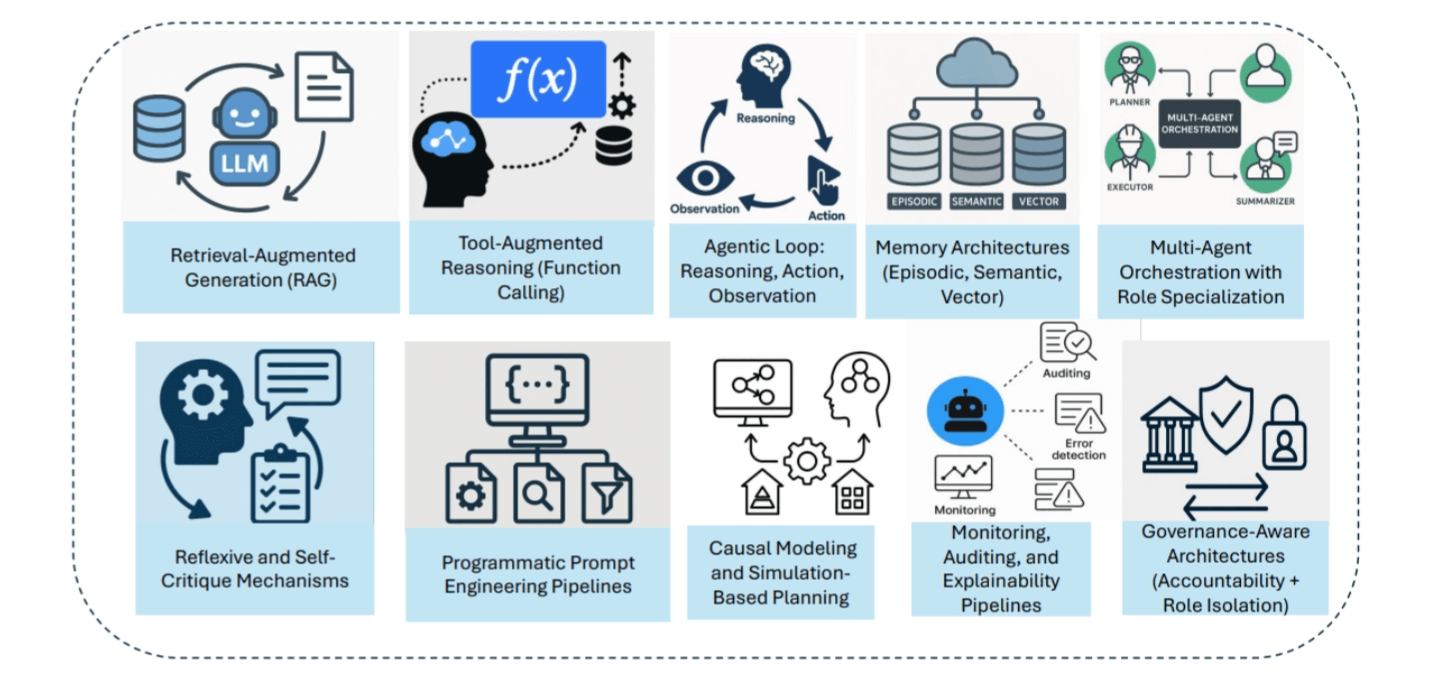
Top 10 solutions to the diverse problems faced by AI Agents and Agentic AI:
- Retrieval-Augmented Generation (RAG): Based on real-time retrieval from external knowledge bases, it provides agents with fact-checking capabilities and reduces hallucinated output (such as a customer service Agent calling the latest product database to respond).
- Tool-augmented reasoning: Grants agents API calling permissions (such as querying weather/stock prices), expanding the boundaries of their problem-solving capabilities (such as an investment Agent automatically obtaining financial data to assist decision-making).
- Agent behavior loop: Establishes a closed-loop mechanism of "reasoning-action-observation" (such as a writing Agent first making an outline and then generating it section by section), improving the rigor of decision-making.
- Layered memory architecture: Uses a three-layer storage system of episodic memory (short-term conversation) + semantic memory (long-term knowledge) + vector memory (fast retrieval).
- Role-based multi-Agent orchestration: Division of labor like company departments (such as MetaGPT's CEO/CTO roles), improving collaboration efficiency based on specialization.
- Self-critique mechanism: Sets up verification Agents (such as an auditor role) to cross-check outputs, reducing the risk of error propagation.
- Programmatic prompt engineering: Uses templated prompts (such as "You are a senior doctor") to standardize Agent behavior and reduce randomness.
- Causal modeling: Builds causal graphs to distinguish correlation (such as "cough-cold") from causation, enhancing the credibility of reasoning.
- Explainability pipeline: Records complete decision logs (such as AutoGen's conversation history), supporting fault backtracking and responsibility tracing.
- Governance-aware architecture: Implements sandbox isolation (such as transaction limits for financial Agents) and RBAC permission control to ensure system security.
Future development directions
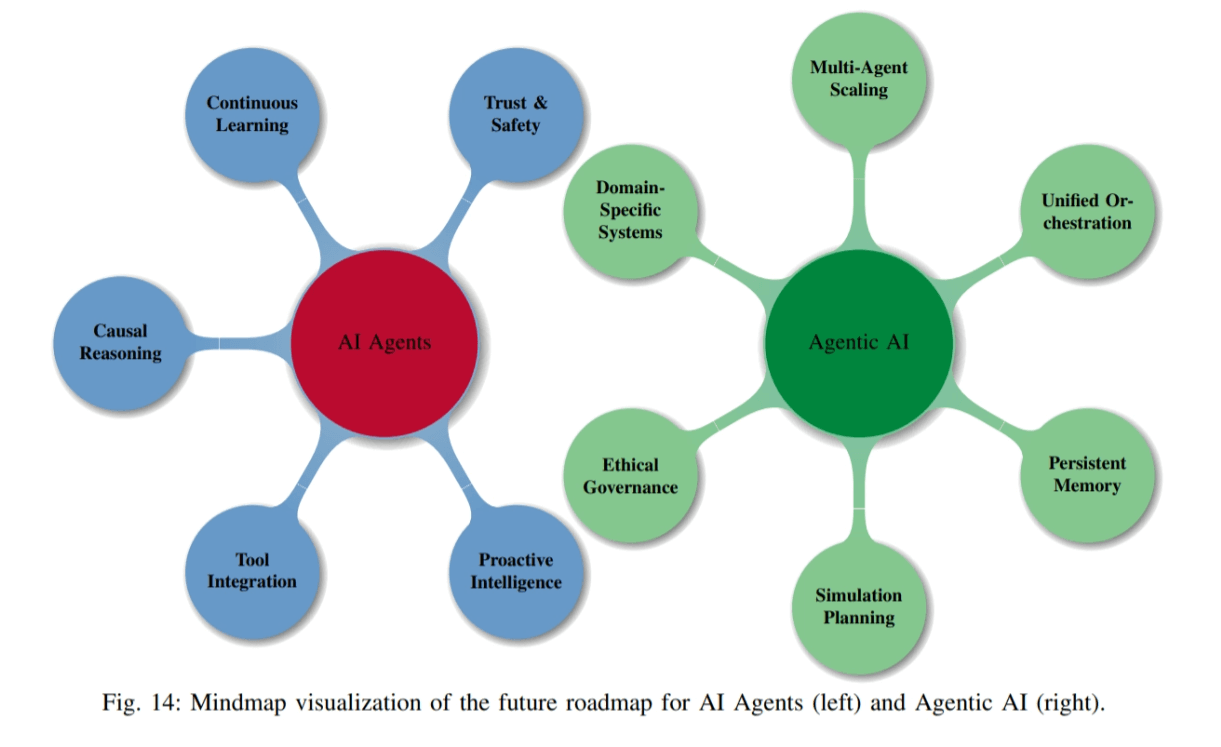
AI Agents: From passive response to proactive intelligence (Proactive Intelligence).
- Autonomous decision-making: No longer limited to simple task execution, it proactively reasons based on context and goals and autonomously plans action paths (such as an intelligent assistant proactively reminding about meetings and preparing materials).
- Tool Integration: Deeply combines external APIs, databases, and physical devices (such as a robot calling an industry knowledge base or controlling a robotic arm), expanding capability boundaries.
- Causal Reasoning: Goes beyond correlation analysis to understand "why," improving decision reliability (such as a medical diagnosis Agent distinguishing causal chains of symptoms).
- Continuous Learning: Based on online learning and feedback optimization (such as recommendation systems adapting to user preferences in real time), achieve long-term performance improvement.
- Trust & Safety: Introduce explainability, audit logs, and value alignment mechanisms to ensure that AI behavior is ethical and controllable.
Agentic AI: From single agents to Systemic Intelligence.
- Multi-Agent Scaling: Build large-scale collaborative networks (such as thousands of Agents in urban traffic management collaboratively optimizing traffic lights).
- Unified Orchestration: Develop standardized communication protocols and scheduling frameworks (similar to what Kubernetes is to containers) to achieve cross-platform Agent collaboration.
- Persistent Memory: Support long-term knowledge retention (such as a scientific research Agent system accumulating the history of research in a field), avoiding repeated learning.
- Simulation Planning: Rehearse decisions in virtual environments (such as autonomous driving Agents testing extreme scenarios through digital twins) to reduce real-world risks.
- Ethical Governance: Establish accountability tracing mechanisms for multi-Agent systems (such as blockchain-based evidence preservation) to ensure compliance with laws and social norms.