

GLM-4.7 Less than two days after release, X has been flooded with hands-on tests.
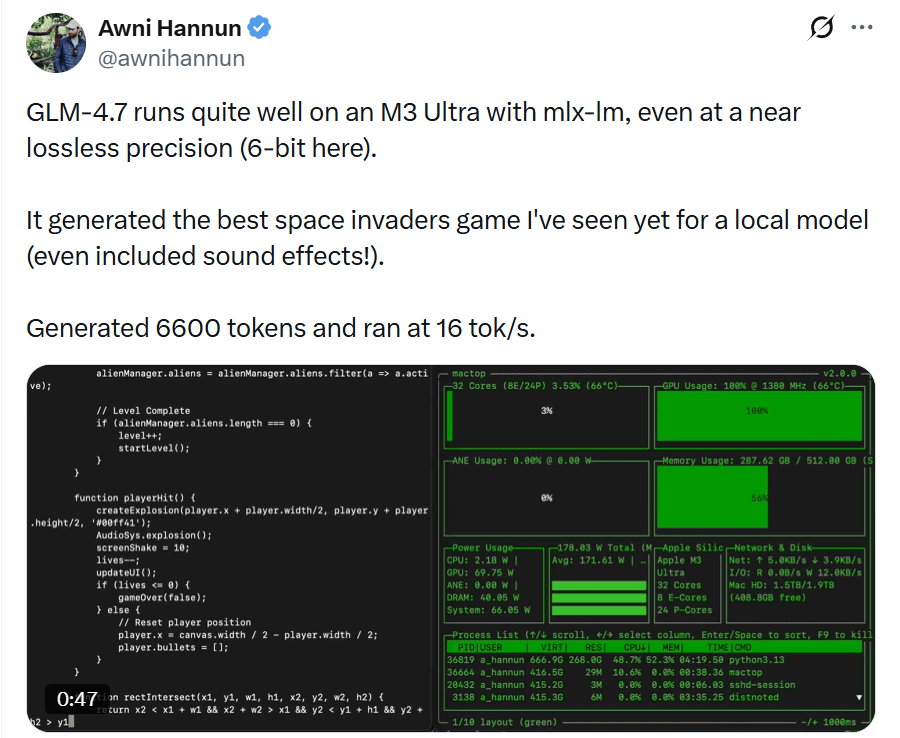
Someone used a simple game screen recording to generate a complete, playable mini-game with sound effects in just a few minutes. The whole process generated about 6600 tokens, at a steady speed of 16 tok/s, and generating a mini-game took less than 7 minutes!
It's not just mini-games. In more complex scenarios such as tool calling and Agent tasks, GLM-4.7's feedback is equally good: it can get all tool calls right in a single conversation~
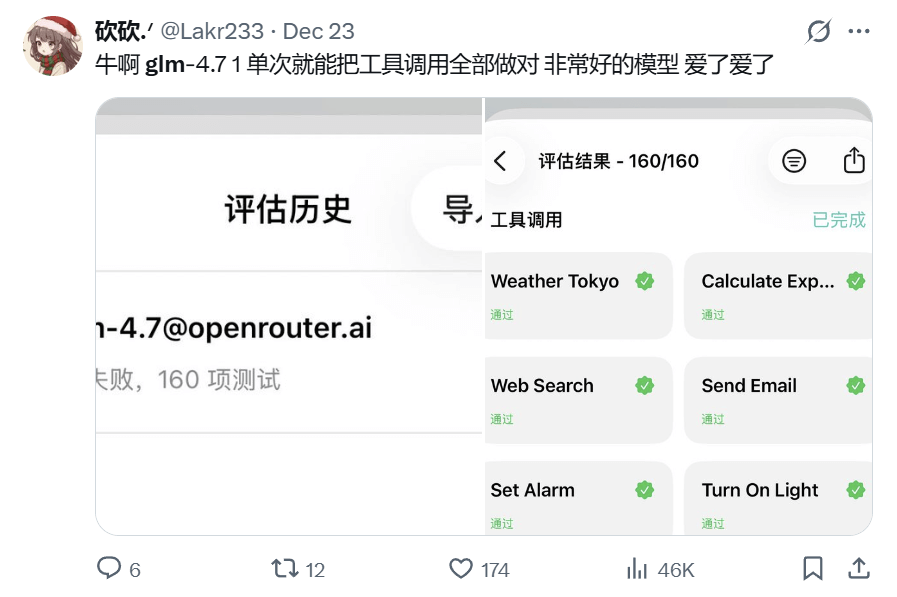
From this feedback, we can intuitively see: GLM-4.7 is not just better at generation, butmore likely to complete the entire task in one go, with much less need for human fallback。
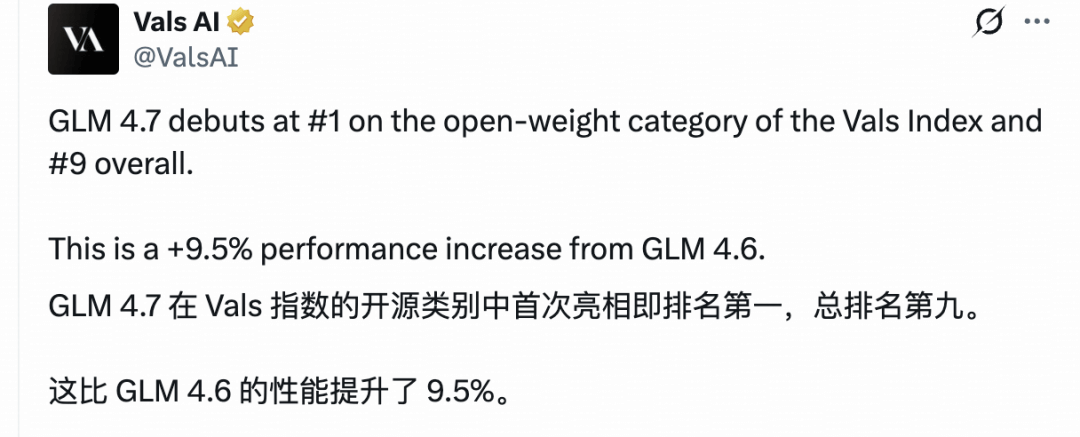
GLM-4.7 has focused on strengthening its Coding、Agent and Reasoning capabilities, reaching a score of 84.9 on LiveCodeBench V6, with coding capability surpassing Sonnet 4.5 to become the latest open-source SOTA. It scored 42.8 on HLE, 38% higher than GLM-4.6, surpassing GPT-5.1.
In today's article, we will also conduct hands-on tests and experiences from multiple dimensions.
01. Firsthand Hands-On Test: GLM-4.7 Comprehensive Upgrade
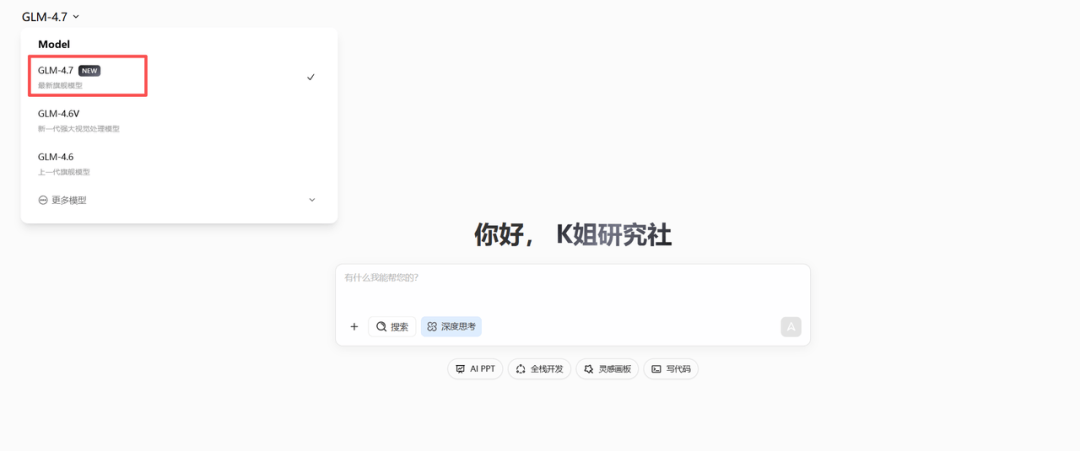
Currently, GLM-4.7 has been launched on Z.ai,BigModel and other platforms. We can experience it by selecting GLM-4.7 in the model selector in the upper left corner.
Website:https://chat.z.ai
case1 Generate PPT with One Sentence
As the end of the year approaches, this is also the time when demand for PPTs is highest. We tried making one:
Select the AI PPT function below the input box and enter the following prompt:
Introduce the Forbidden City.
GLM-4.7 first conducted multi-dimensional searches to understand the Forbidden City's basic information, historical background, architectural features, and main attractions.
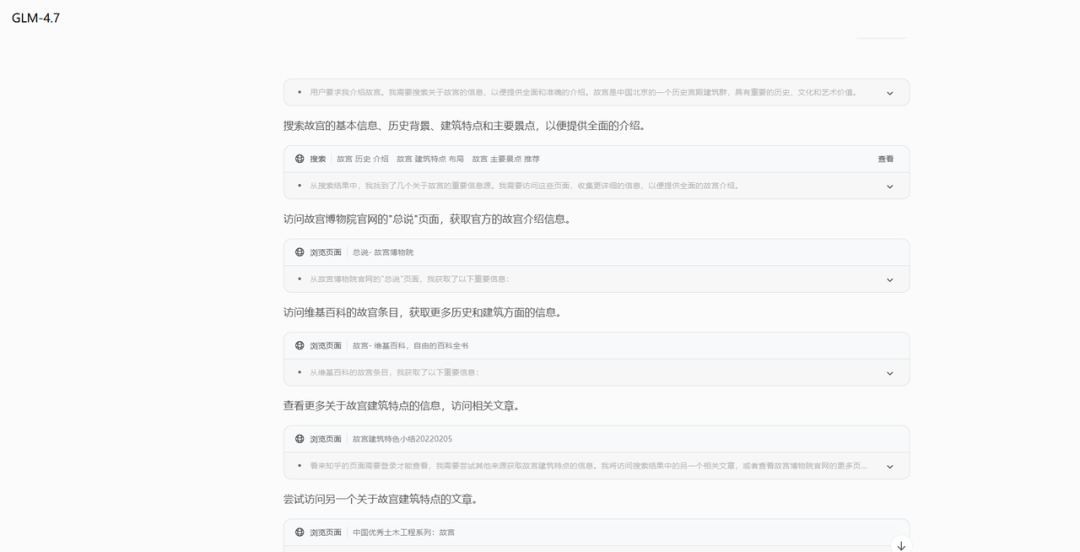
On this basis, GLM-4.7 will continue to dig deeper into the materials,not relying on a single piece of content, but verifying information through cross-reading, such as the official website of the Palace Museum, Wikipedia, articles related to the Forbidden City, and so on.
At the same time,GLM-4.7 will also search for relevant images simultaneously to prepare for later page illustrations。
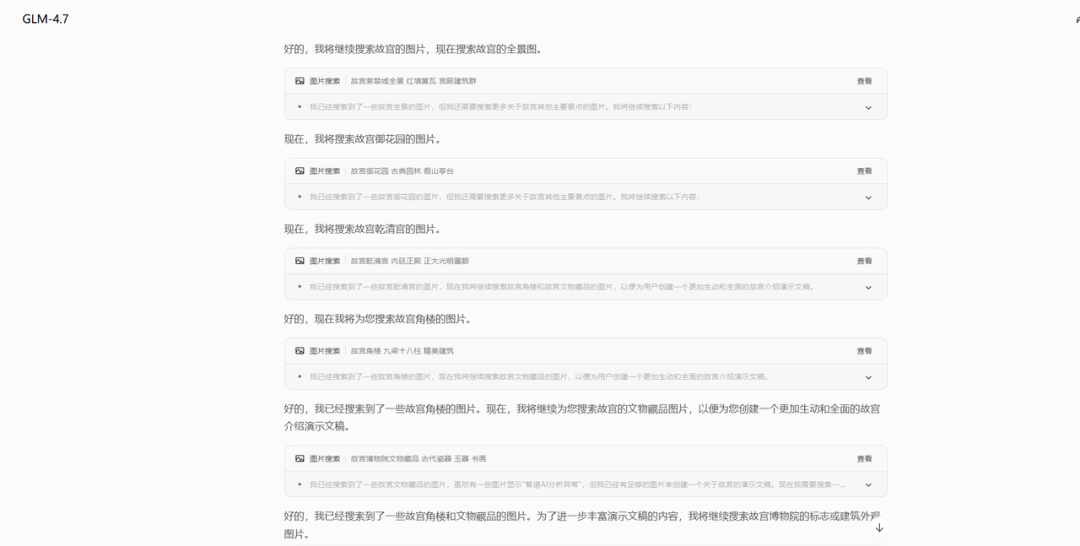
The entire process is actually very close to our daily PPT workflow: first research materials, then sort out the framework, and finally make the PPT.
The difference is,these preparatory tasks that originally took us several hours to complete were finished by GLM-4.7 in two minutes。
First, let's look at the overall overview:

The overall content logic is very clear. It starts with the history and background of the Forbidden City, then gradually unfolds architectural features, main attractions, and cultural relics and collections with one key point per page, and finally naturally transitions to the key points for booking a visit. The logic is very smooth.
For the design, it chose a classical and elegant style, which fits well with the cultural characteristics of the Forbidden City.
The final generated PPT looks like this:
Key information points are sufficiently provided, but each page still leaves some space, making it convenient to add cases or personal understanding during presentation. The page layout is clear, and the visual focus basically falls on the title and core information. It is also paired with images to assist understanding. Overall, it is very good.
What should be discussed on each page, where images are suitable, and where emphasis is needed are all arranged for you by GLM-4.7. This is the most reassuring part of using AI to make PPTs.
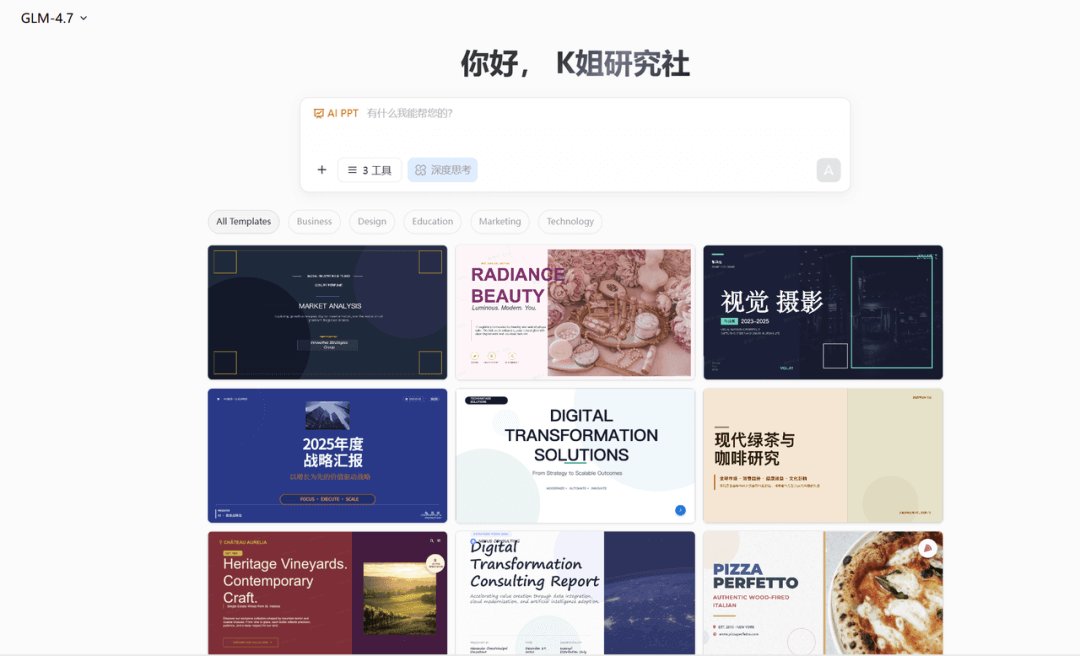
GLM-4.7 not only improves aesthetics, but also presets some PPT templates, such as business, design, education, marketing, and technology. As long as we choose the right scenario, the results will not be bad.
case2 PPT Design Templates
Many people use AI to make PPTs and get stuck at the prompt stage. If you want a high-end, controllable result, the prompt often has to be written in great detail, no less difficult than writing a paper.
The solution z.ai offers is very direct: it provides templates for some common scenarios, such as business, design, education, marketing, and technology. As long as we choose the right scenario, the result won't be bad.
For example, I asked GLM-4.7 to first write us a text script for a SpongeBob year-end summary, and we'll try generating a PPT based on the text script.
Prompt: Please organize the year-end work summary content I provide into a year-end summary PPT for company management, with a clear structure, highlighting core achievements, personal value, and next year's plan. A total of 10 pages.

Text script
Let's take a look at the generated result:
The overall layout is very design-oriented, simple, good-looking, and clearly arranged. Looking at the content handling, GLM-4.7 completely distills based on the original document content, placing core achievements in the most prominent positions. The data presentation is eye-catching and direct, and the content has a strong sense of hierarchy.

We don't need to understand design terminology, don't need to know layout, and don't need to repeatedly agonize over which paragraphs in the document should be deleted or kept. GLM-4.7 will automatically judge for you.
GLM-4.7 does not rigidly apply templates, but rather, based on the content, fine-tunes the layout and visual focus on the basis of professional templates。
Of course, it doesn't mean no manual intervention is needed at all. For example, in the layout of page 7, when the information is slightly concentrated, some content is not fully displayed. We can directly click Edit in the upper right corner of the page and let AI fine-tune it.
Prompt: Page 7, fully display the title, move modules 01, 02, and 03 overall appropriately upward, appropriately adjust the module heights so they are fully displayed on the page, and arrange them neatly.
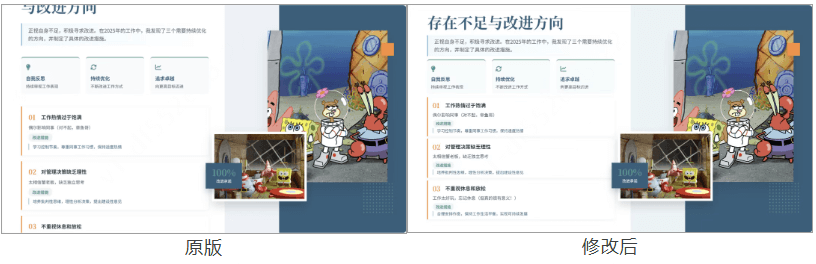
GLM-4.7 will adjust the code for this page, and within less than 2 minutes we can see the adjusted result. The content remains unchanged, but the overall hierarchy is clearer.
Whether it's changing text, adding a page, deleting content, or readjusting and reordering the key points of a certain page, all of it can be handled by GLM-4.7. There's no need for repeated manual operations; just state your requirements clearly。
Generating PPTs is already very smooth. Let's try writing code again.
case3 Interactive webpage
PPT is suitable for on-stage presentations, but in reality, many reports are not at the meeting venue; more often they are viewed online and forwarded. In this case, webpages are more suitable than PPTs in terms of display and interaction.
We'll upload a table of AI industry development data and use it to try making a report.
Prompt: Based on the uploaded data information, try to directly generate a dynamic webpage for reporting.
Requirements:
1. Tech-style data dashboard, dark data narrative + neon information highlights;
2. Provide clear and explicit analytical conclusions;
3. The page has visual hierarchy: primary color + accent color, with key data highlighted;
4. Rich chart forms (trend / distribution / comparison / ranking, no fewer than 6);
5. Key indicators highlighted with numeric animation;
6. The style is concise but focused, avoiding the same color across the whole page, suitable for scrolling and screen projection.
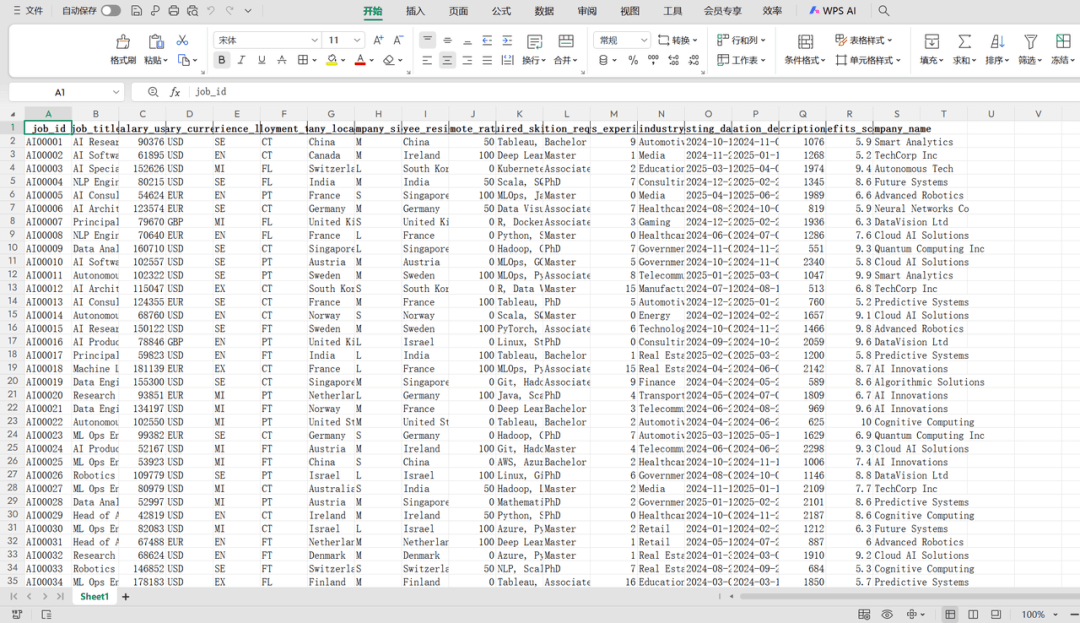
Table screenshot
The final generated webpage looks like this:
GLM-4.7 does not stop at data visualization, but provides clear analytical conclusions, telling uswhat these data mean, rather than only being responsible for showing what the data is. Key data is presented through animations, which can quickly grab attention.
case4 Event Poster
The most intuitive change in GLM-4.7 is actually its aesthetics. For example, we tried generating an event preview.
Prompt: Design a promotional poster, tech feel × milk tea brand co-branded style. The image should be a bright and lively commercial poster design, with the overall color tone mainly strawberry red, cream white, and light pink, accented with a small amount of neon blue tech light effects. The content is: If you are using Bigmodel.cn's Coding Plan, in Claude Code and other programming tools, enter the passcode: Auntie help me! to receive a voucher for the new Shanghai Auntie 'QQ Berry Milk Tea', which can be used after logging into the Shanghai Auntie mini program.

GLM-4.7 correctly searched for and used the real visual features of Shanghai Auntie and 'QQ Berry Milk Tea', from the brand logo and cup shape to the strawberry-based color scheme, all with a strong sense of realism.
Even though the event information was not short, GLM-4.7 did not cram all the text into the image, but insteadcaptured the true core information, and the layout is also very clear: the main visual focuses on the new milk tea and the co-branding relationship, the middle section uses a terminal window to reinforce the metaphor of 'programmer operation', and below there is also a reminder of how to use it.
This is precisely the most important part of GLM-4.7's aesthetic upgrade—not just being better at drawing, but being better at making design judgments, knowing what should be seen.
Easter egg:Zhipu really prepared milk tea for everyone, friends who are using GLM Coding Plan should go claim it~

case5 Mini Game
Prompt: Develop a rhythm game.
Mini games are different from the previous PPTs and web pages. They not only display results, but also requirecontinuous response to user behavior. Whether the rhythm matches, whether operations have feedback, and whether the boundaries between failure and success are clear all directly affect the experience.
The mini game generated by GLM-4.7 has complete logic and clear rules, and can be played as soon as it is opened. The appearance of notes, rhythm judgment, and score feedback are all done very well, which shows that GLM-4.7 is not simply piecing together functions, but organizing code according to gameplay logic. This is quite impressive.
case6 Full-Stack Development
However, a simple mini game is still not enough to truly reach the upper limit of its coding ability. So next, we raised the difficulty by another order of magnitude and directly had it develop a real project with complete business logic: a second-hand goods trading platform.
Prompt: Develop a second-hand goods trading website, including a frontend and a backend management system. Users can browse, search for products, and place orders. The backend management system can manage products, ship orders, and provide data statistics.
This time, GLM-4.7 also took only a few minutes to complete the development of the entire project.
Frontend:
On the homepage, the product list, category filtering, search, product cards… these key paths are already working, and the page hierarchy is very clear.
but clearly organizes the page structure according tothe real transaction process: first browse → then filter → view details → add to cart → place order → enter shipping information. The operation flow is very smooth.
For a real transaction system, the frontend is only the entrance. What truly determines whether it is a 'project-level system' is whether the backend exists, and whether the backend can take over products, orders, and status changes.
Next, let's take a look at the backend management system generated by GLM-4.7:
Core metrics such as data statistics, product management, and order management are all very clear. In the backend management system, we can add, delete, modify, and query products, and we can also view real-time data and shipping status. The overall functionality is practical and comprehensive.
02. About GLM-4.7's AMA
The Z.AI research lab hosted a dedicated AMA on Reddit (Ask Me Anything), where core members of the GLM-4.7 R&D team answered questions online. Below are some of the questions and replies that received relatively high attention in the AMA:
Q: After the company goes public, will you continue to release model weights?
A: Yes. The GLM team will continue to advance research toward artificial general intelligence (AGI) and continue to contribute to the open-source community.
From the team's attitude, GLM-4.7 is a line that Z.AI will continue to iterate on. Open source is also not a阶段性 strategy for them, but is regarded as a long-term investment together with model capabilities and ecosystem building. For people who truly intend to use the model in projects, or even in production environments, this is far more important than benchmark scores themselves.
Q: Can we expect you to launch a model specifically for programming?
A: We do not plan to release a separate pure programming model. We believe that code, Agent, and reasoning capabilities complement each other within a single model. For example, harder programming tasks often require a lot of reasoning, and stable Agent execution also requires strong programming skills. Therefore, we focus on building a unified model that is strong in all of these aspects.
This answer also exactly explains the most obvious impression the previous hands-on tests gave me: GLM-4.7 is not particularly strong in just one capability, but is stronger in overall coordination. The team clearly polishes Coding, Agent, and Reasoning as a whole, just like a large wooden bucket. What really determines how much water it can hold is not how tall any single plank is, but whether there are any obvious shortcomings overall.
Q: Does Interleaved Thinking work well on the OpenAI Chat Completions API?
A: We have made Interleaved Thinking compatible with the Chat Completion API. Just remember to pass back "reasoning_content" in each historical message. In this way, the performance is the same.
We have also introduced a "Preserved Thinking" feature. When enabled, even the thinking content from previous user turns will not be discarded. This is very helpful for maintaining consistency in programming Agent scenarios. For details, please refer to our blog.
Preserved Thinking is actually solving a stability problem. Many Agent task failures are not because the model's reasoning ability is poor, but because it loses previous thinking in long workflows.
The significance of Preserved Thinking is that it prevents the model from easily losing contextual judgment in multi-turn conversations, thereby maintaining behavioral consistency. This is also why, in actual use, GLM-4.7 performs more steadily in long tasks.
Q: What was the most unexpected challenge during training? How did you solve it?
A: Since GLM-4.7 is mainly improved through post-training, for me, the biggest unexpected challenge is the "release recipe," that is, how to train a final model that is ready for release.
In practice, for different domains, different teams usually have their own data and SFT(Supervised Fine-Tuning) / RL (Reinforcement Learning) recipe. When we tried to integrate everything together for an official release, it was difficult to combine these capabilities without compromising other aspects.
Our solution was: carefully adjusting the data mix, identifying and removing data that conflicts with other data, and conducting a large number of ablation experiments. On the RL side, we even adopted an approach similar to LoRA to protect other capabilities while improving a certain target skill. All of these adjustments were guided by large-scale evaluations.
This also explains why the improvements in GLM-4.7 are not simply about pushing a single capability to the extreme, but rather about repeatedly making trade-offs among different capabilities and trying to avoid harming one another as much as possible. In other words, GLM-4.7 is solving the problem of overall usability, rather than pursuing a single-point breakthrough.
If you are also interested in the capability boundaries and design trade-offs of GLM-4.7, you might want to check out the existing discussions in the AMA comment section. You can learn a lot of first-hand information, and you can also add your own questions and join the conversation~
03. Some sharing
GLM-4.7 is clearly better adapted to real usage scenarios. The generated PPTs are more stable in the 16:9 widescreen ratio, and the combination of content and visuals is noticeably more mature, making the overall result closer to a ready-to-use state.
GLM-4.7's Coding, Reasoning, and Agent capabilities work together stably in the same task. It will first understand the goal, then break down the steps, and then complete them step by step.
This means that GLM-4.7 can already deliver tasks completely. For expression-oriented work content such as PPTs and web pages, almost no human intervention is needed; simple interactions and basic prototypes will no longer be a technical threshold.
What will truly be scarce in the future is not a particular skill, but knowing what to do, judging what is worth doing, and how to actually put the results to use.
The technical threshold is declining, while judgment and decision-making ability are quietly rising in value.
Original link:Flooded by GLM-4.7, is it really that strong?