
Friends, I recently discovered an open-source gem that is super suitable for individual developers.
In the past, doing full-stack development required writing APIs, connecting to databases, deploying servers, and also configuring a bunch of files and adjusting various environment variables. It was painfully troublesome.
Now, all this work can be completely handed over to AI.
KuaFu Technology released and open-sourced it yesterdayChina's first AI-native backend-as-a-service platform AipexBase, which can provide complete backend functionality, such as data storage, authentication, third-party integration, context management, and other features all automatically encapsulated by the platform, through the frontend SDK or MCP for one-click invocation.
It is especially friendly to beginners. Without understanding complex backend logic, you can still easily build a usable application.
01. How to use
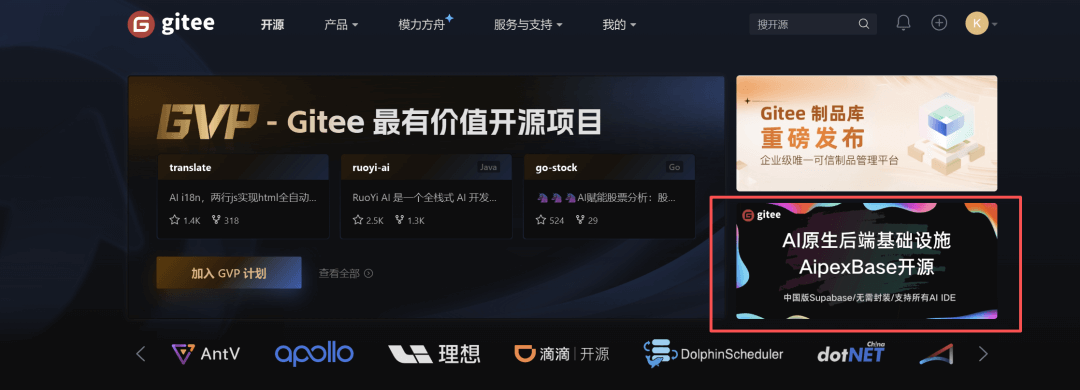
We enter Gitee official website, and find in the open-source projects AipexBase。
Project address:https://gitee.com/kuafuai/aipexbase
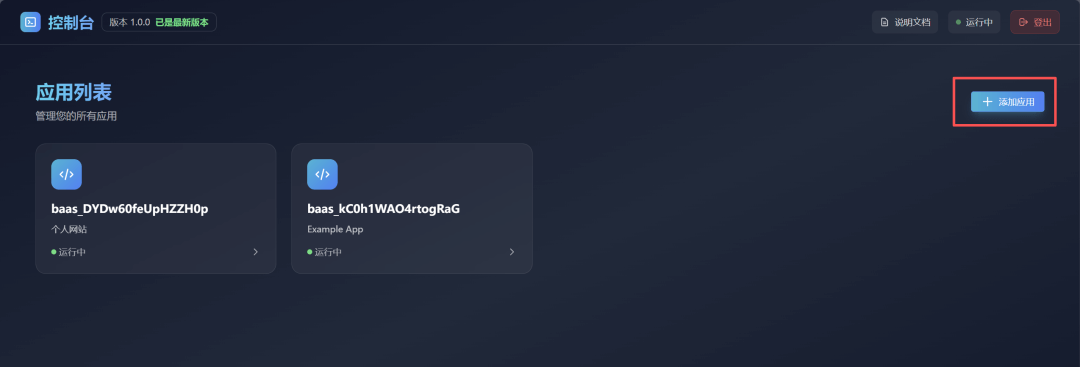
We add an application on AipexBase.
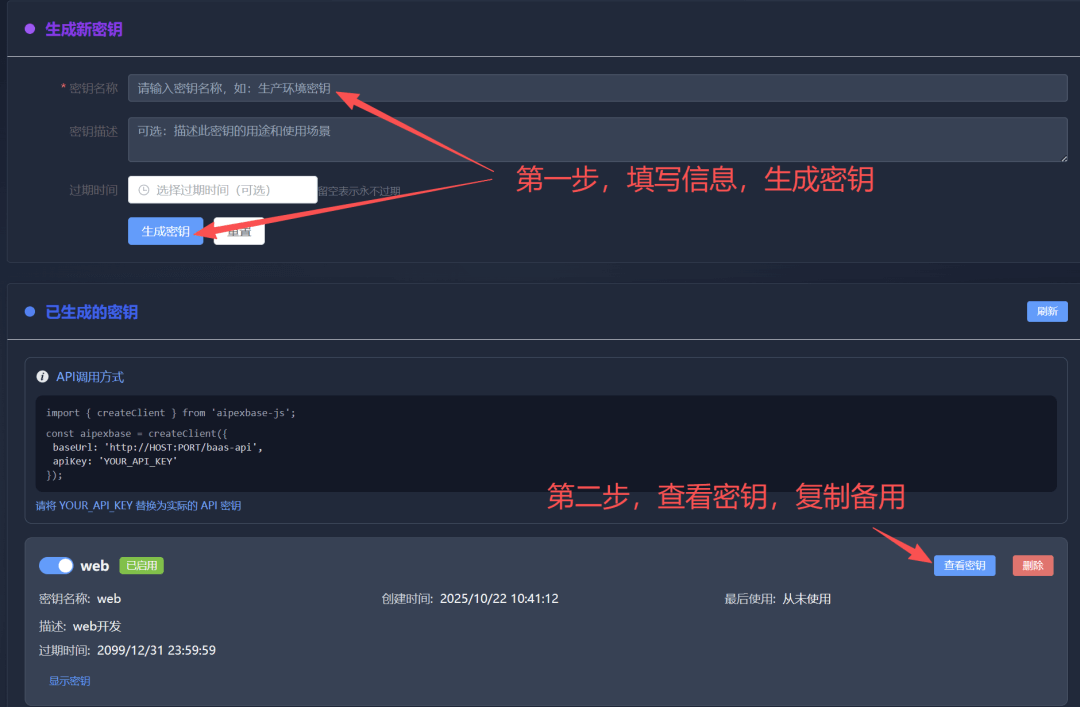
In the created application, follow the prompts to create an API key.
We open any AI IDE,TRAE, Cursor, and VS Code are all compatible,AipexBase supports all AI IDEs。
Here we use TRAE, and enter the following code in the agent to manually add AipexBase's MCP.
{
“mcpServers”: {
“baas-mcp-server”: {
“url”: “http://124.71.176.202/mcp/sse?token=YOUR_API_KEY”,
“disabled”: false
}
}
}
Note: replace YOUR_API_KEY in the code with the real API KEY
02. Run full stack with one sentence
We return to TRAE's chat interface. You only need to describe the business logic, and the agent can directly call AipexBase's backend capabilities.
Prompt: I want to make a personal blog website. I want to use vue3 + js + vite for project construction. You can use various third-party components to optimize the overall effect of the project. Please do not add escape symbols in the parameters.
The specific functions of the application are as follows:
1. User authentication module: support user registration and login functions. Support WeChat authorized login or QQ email login
2. Homepage display: after the user logs in and enters the homepage, the personal homepage content must be displayed immediately. There are three option buttons in the upper left of the page, corresponding to three pages: Home, Personal Information, and Interaction Management.
3. Personal homepage page:
-Display the introduction of "K姐研究社"
-Historical articles of K姐研究社
-User avatar, nickname;
4. Article detail page:
-Display the full text of the article;
-Display the user avatar, nickname, and comment interaction content; and provide an "Edit Comment" button for the user's own comments.
5. Personal information: you can view and modify basic personal information (avatar, nickname, email, mobile phone number, signature, etc.).
6. Account settings: support operations such as changing the password and logging out.
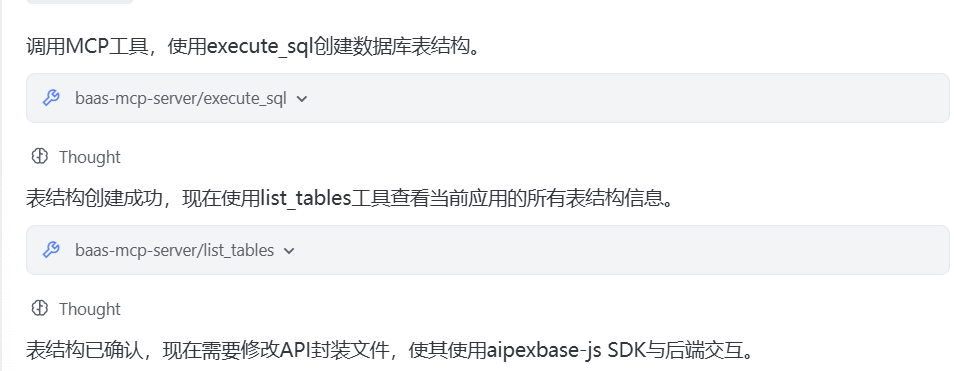
After entering the requirement description in TRAE, the system automatically generated a complete frontend project structure. For the backend part, it directly called AipexBase MCP, and could directly execute table creation, table queries, and SQL operations. The database can be built in just a few minutes.
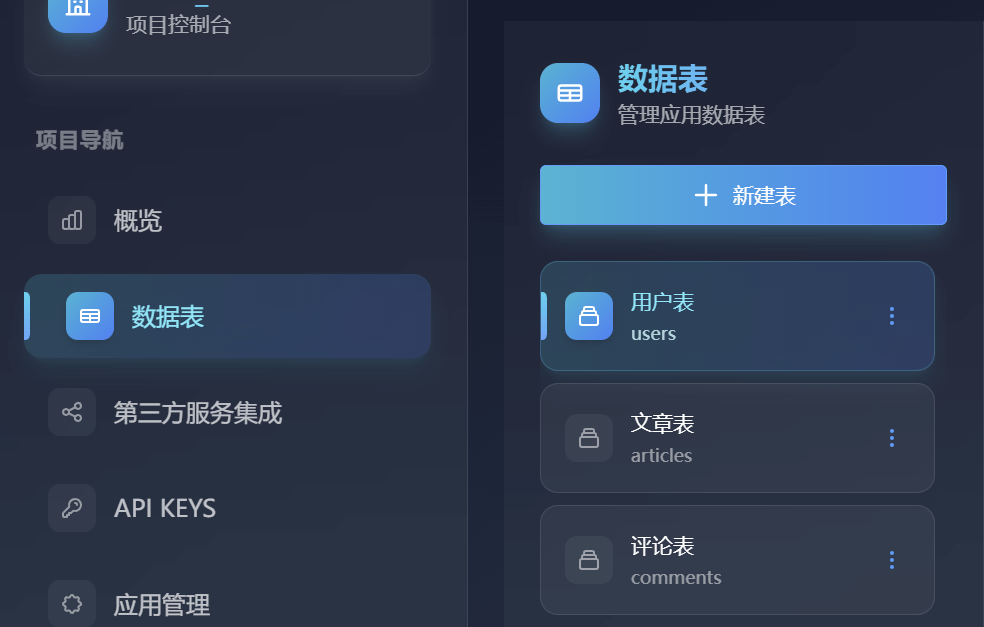
Go to the AipexBase platform to verify. Sure enough, the data tables have been automatically created.
On the preview page, we can experience the registration, login, and logout functions:
AipexBase is almost imperceptible to integrate on the backend. I do not need to manually configure the database connection, nor do I need to write backend APIs.
After logging in, the Token is managed automatically, and I don't need to write any storage or retrieval logic. Refreshing the page won't log me out, and logging out will automatically clear it.
For developers, with a single call from the frontend, AipexBase does everything the backend should do—this is a tangible efficiency improvement.
Prompt: Clicking an article card takes you to the article page, displaying the full article; at the bottom of the article there is a comment section.
Use MCP to implement the following features:
After commenting, the comment section displays the commenting user's avatar, nickname, comment interaction content, and comment time;
The comment section has an edit button, allowing users to edit and delete their own comments.
Login status is automatically recognized, and comment information can only be edited and deleted by the person themselves. Although still in a local environment, you can already see backend data being written normally.
With a single call from the frontend, AipexBase runs the entire chained CRUD and authentication of the comment section.
03. AipexBase Core Highlights
When it comes to Backend as a Service (BaaS), many people are familiar with it, such as Google's Firebase and the open-source Supabase, which are almost the default choices for developers.
For this very reason, this field has long been dominated by foreign platforms. Access is restricted, the ecosystem is incompatible, and privacy and data security are controlled by others. Moreover, they all more or less require manual involvement.
Against this backdrop, AipexBase emerged—domestically developed, open-source, and AI-native! AipexBase fully takes into account the usage environment of domestic developers, from database compatibility to deployment methods, from cloud vendors to network access, with almost no barriers.
China's first open-source AI-native BaaS platform
AipexBase positions itself as China's first AI-native BaaS platform, which means domestic developers finally have an underlying option that does not rely on overseas nodes and is not blocked by the Great Firewall. More importantly, it is open-source, transparent, and supports local deployment, making it more reassuring to use.
AI-native architecture
AipexBase is designed for AI applications from the ground up, natively compatible with MCP and the AI Coding model. Once the frontend logic is written, models and agents can directly call the backend. With one sentence in your AI IDE, you can get complex features like data storage, authentication, third-party integration, and context management done, truly achieving an "AI-integrated" development experience.
Friendly compatibility with the domestic ecosystem
Another highlight is its comprehensive compatibility with the domestic ecosystem. Whether you use domestic clouds, localization, or private deployment, AipexBase can adapt seamlessly. AipexBase natively supports domestic systems such as Feishu, DingTalk, WeCom, and HarmonyOS, and can both deeply integrate with the AI toolchain and truly land in the actual scenarios of Chinese developers.
04. Some Sharing
In the past, building a complete application required understanding databases, writing APIs, configuring servers, and deploying environments. Now, with Vibe Coding + AipexBase, one person can independently complete full-stack development.
AI is no longer just a tool that executes commands, but a co-creator working alongside you. You describe the business logic, and AipexBase generates the backend for you; you design the interactions, and AipexBase automatically handles data and authentication. All this complex, tedious work that requires repeated debugging is covered by AipexBase.
The boundaries of full-stack are being reshaped, and the line between frontend and backend is blurring.
AI's relationship to people is also shifting from tool to collaborator.
The meaning of technology has never been to replace people, but to allow people to create more freely.
Original link:China's first open-source "Chinese version of Supabase", AipexBase is here!