
The "Enterprise-Grade AI Agent Industry Implementation Research Report" is jointly released by Tencent Cloud, Tencent Research Institute, and the internationally authoritative research institution Gartner. The report deeply explores the industry implementation of enterprise-grade AI agents. It introduces the transformation of AI agents from "auxiliary tools" to "autonomous productivity" and elaborates in detail on the definition, forms, and capability levels of AI agents. Through the "AI Agent Scenario Compass" and the "Top 100 Scenarios," the report sorts out the current application status of AI agents across various industries. It analyzes the technical challenges in AI agent implementation, such as training and inference costs, model performance, and security protection, and proposes corresponding solutions. The report presents pioneering practical cases from multiple industries, looks ahead to future development trends of AI agents, and emphasizes the important role of AI agents in driving enterprise intelligent transformation.

Get the "Enterprise-Grade AI Agent Industry Implementation Research Report" original PDF report file. Scan the QR code to follow and reply: 20250929
Introduction
The report points out that artificial intelligence is ushering in an important turning point, transforming from "auxiliary tools" to "autonomous productivity." As the core of this transformation, AI agents can autonomously understand goals, plan paths, invoke tools, and interact with the physical or digital world. In the future, enterprise operations personnel will be able to express strategic goals through natural language, and "virtual teams" composed of AI agents will autonomously collaborate to complete tasks such as market analysis, advertising placement, and data analysis. This transformation will reshape the boundaries of human-machine collaboration and drive a revolution in productivity.
AI Agent Concepts
- Definition and Forms
- Narrowly Defined AI Agents: Emphasize autonomous learning and optimization, with native tool invocation and closed-loop task execution capabilities. Core features include autonomous planning and feedback adjustment, enabling task completion without continuous human intervention.
- Broadly Defined AI Agent Systems: More inclusive, relying on preset rules and achieving tasks through workflows and tool collaboration. The core feature is executing predefined tasks and relying on prompts for decision-making.
- Capability Definition and Classification
- Core Requirements: AI agents need to be "capable of working, implementable, and combat-ready," and capability definition and classification must rely on a verifiable evaluation system.
- Evaluation System: Divided into model foundational capability testing, general task testing, and end-to-end task testing in specific domains. Evaluation methods include final output evaluation, intermediate process evaluation, and relative evaluation.
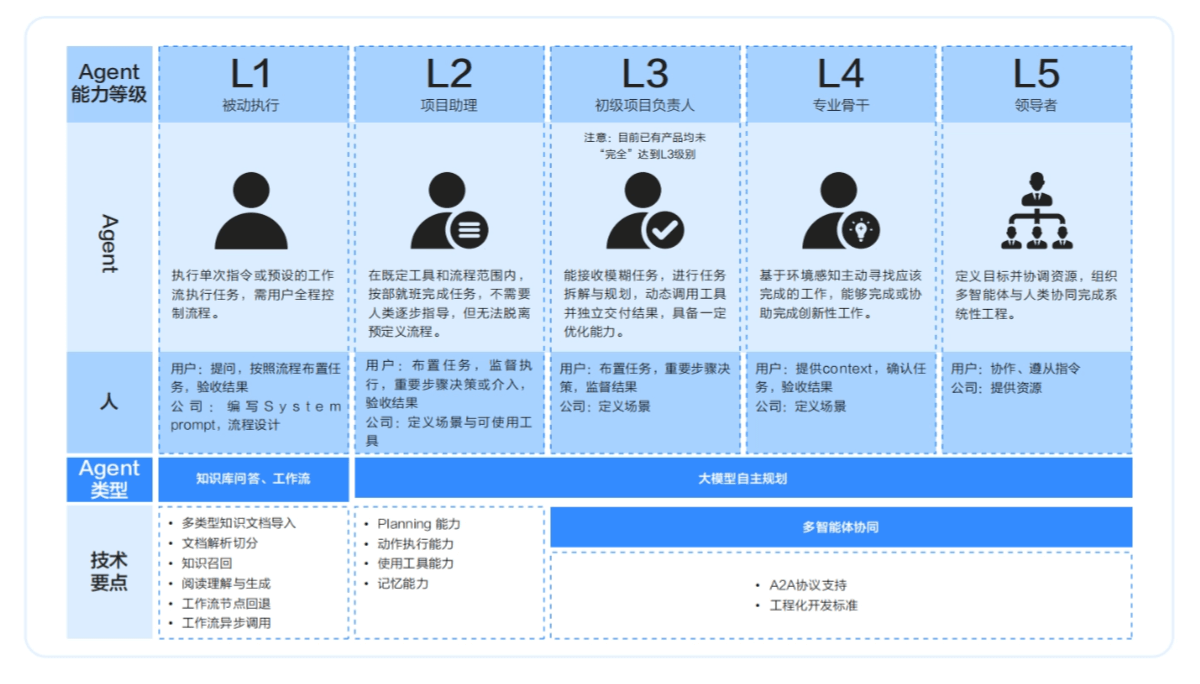
- Capability Levels: From L1 (basic response and process execution) to L5 (organization and leadership). Each level corresponds to different task execution methods and technical points; for example, L1 mainly relies on knowledge base Q&A and workflows, while L3 begins to have autonomous planning and optimization capabilities.
AI Agent Scenario Overview
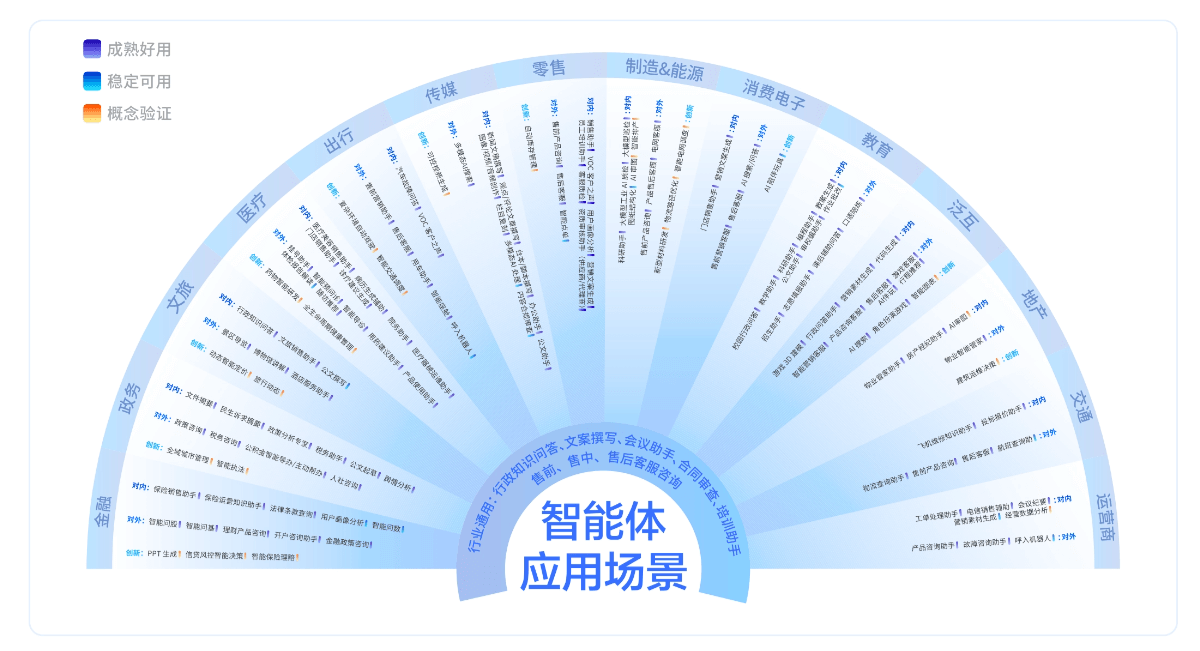
- AI Agent Scenario Compass: The report proposes the "AI Agent Scenario Compass," which divides four quadrants through two coordinate axes (task complexity and dependence on autonomous planning): efficient assistant, execution expert, decision-making expert, and all-around expert. Each quadrant represents different types of AI agent application scenarios, with maturity ranging from proof of concept to stable availability.
- Top 100 AI Agent Scenarios: The report sorts out over a hundred AI agent application scenarios across 14 industries, including finance, retail, culture and tourism, education, and healthcare, providing intuitive reference for enterprises. The scenarios cover a wide range of applications from simple task automation to complex project management.
Analysis of Agent Technology/Product Solutions
- Technical Challenges
-
Training and Inference Costs: The training and inference of large models have extremely high resource demands, resulting in persistently high costs. The "tidal effect" of business workloads makes traditional static computing power deployment models difficult to adapt, further exacerbating resource waste and cost issues.
-
Model Performance: General-purpose large models have limitations when handling professional knowledge in specific domains and are prone to "hallucination" issues, which may lead to erroneous decisions and dangerous behavior in scenarios requiring autonomous task execution.
-
Security Protection: Agent applications introduce new security risks, such as prompt injection, sensitive information leakage, and inappropriate API calls. The massive amounts of sensitive data processed and stored by agents face risks of data misuse, privacy leakage, and regulatory non-compliance.
-
Data Governance: Enterprise internal data generally suffers from issues such as uneven quality, inconsistent formats, missing information, and logical conflicts, forming "data silos" that need to be broken down. This causes contradictions when agents integrate data from different departments, affecting the accuracy of their decisions.
-
Business Process Coupling: Agents need to be deeply integrated with enterprises' existing complex systems, but there are many obstacles in the technical coupling between legacy systems and the process coupling of human-machine collaboration.
-
- Solutions
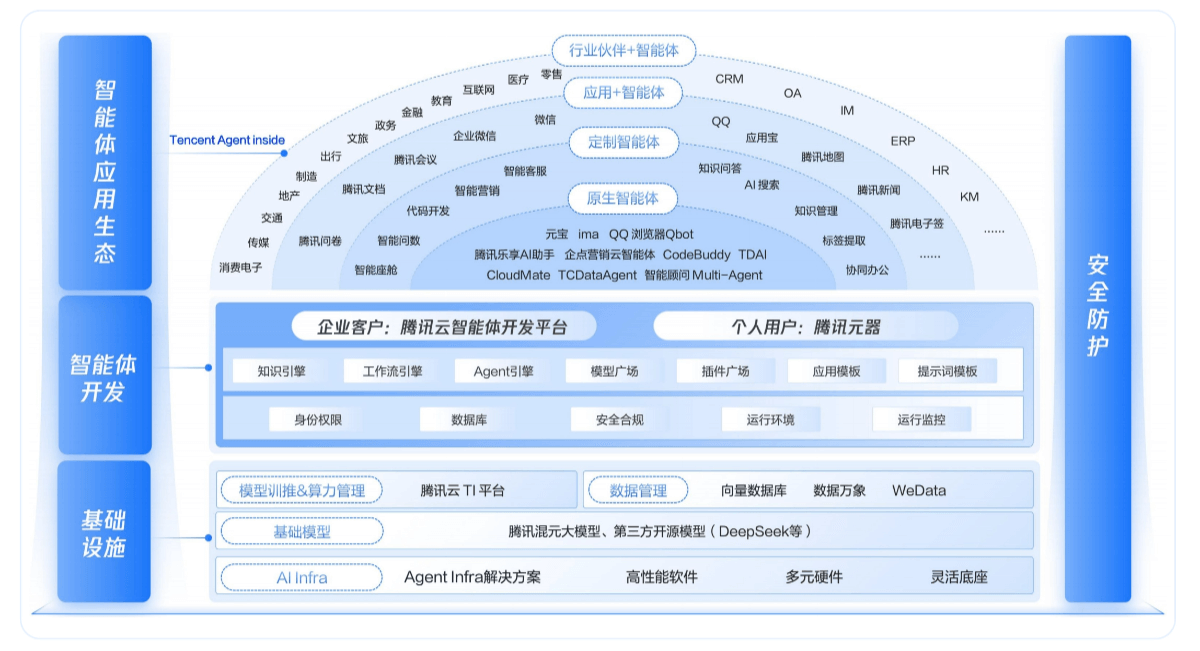
- Tencent Cloud Agent Strategic Panorama: The Tencent Cloud Agent Strategic Panorama integrates agent applications, development platforms, and infrastructure to provide full-chain solutions, helping enterprises efficiently build and optimize agent systems and promoting intelligent transformation.
- Tencent Cloud Product Solutions: Specific technical optimization focuses on key areas such as communication, scheduling, models, security, data governance, and knowledge parsing, improving agent performance and reliability through advanced technical means and providing support for enterprise application implementation.
Agent Pioneer Practices
The report lists pioneer practice cases from multiple industries, demonstrating the application effects of agents in actual business scenarios:
- Culture and Tourism: Huazhu Group created a 7×24-hour "all-around hotel butler" to enhance the customer service experience.
- Healthcare: Mindray × Tencent Cloud's "Qiyuan" large model reshapes the paradigm of critical care diagnosis and treatment, improving medical efficiency.
- Travel: FAW Toyota uses a large model to create an expert-level automotive service intelligent customer service, optimizing the user experience.
- Retail: Yili Group uses agents to create a new intelligent shopping guide experience, activating new momentum for omnichannel marketing.
- Finance: Soochow Life's agent technology helps intelligent upgrading of the full-cycle insurance service system.
- Internet: Tongcheng DeepTrip intelligent assistant uses AI to redefine the travel experience.
- Education: Kaoshibao uses AI large models to unlock a new paradigm for precision learning.
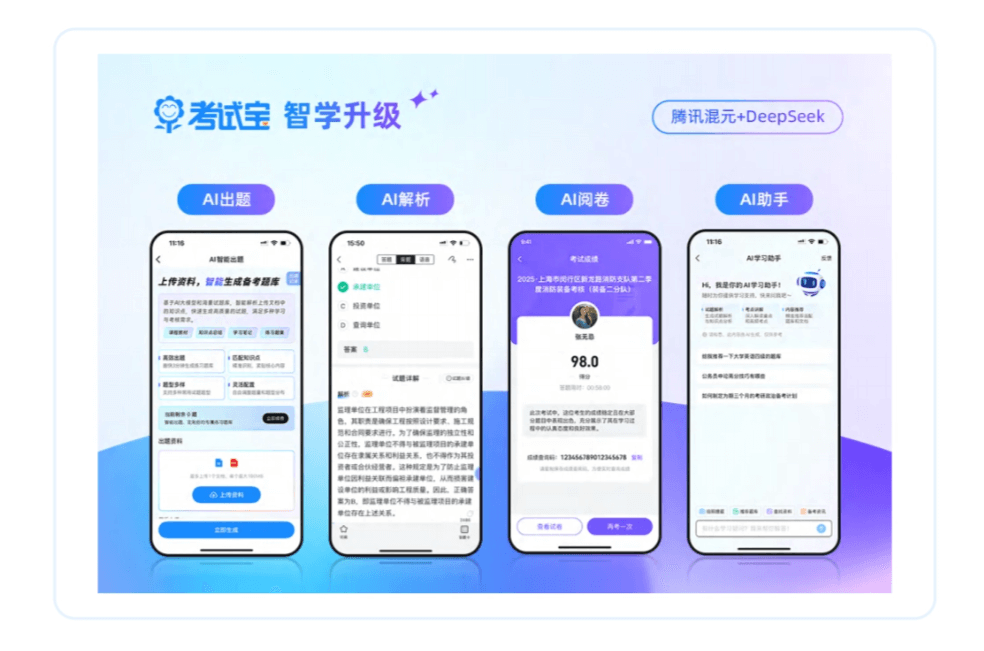
- Government Affairs: Handan Provident Fund pioneered the country's "chat while handling" digital counter, reshaping a new experience for provident fund services.
- Manufacturing: Yunda Energy Technology Group uses agent technology to improve the manufacturing and delivery efficiency of wind power equipment.
- Energy: Wuhuan Group uses AI to reshape engineering management and empower new quality productive forces.
- Real Estate: Country Garden Services builds the "Yiwen" AI customer service robot to empower employees with a leap in efficiency.
- Logistics: DHL uses agents to rebuild cross-border intelligent customer service, achieving both improved efficiency and compliance.
- Gaming: Giant Network's game "Space Kill" introduces AI agents, innovating gameplay.
- Mental Health: Tencent Cloud helps Xinyan Group build AI emotional companionship services.
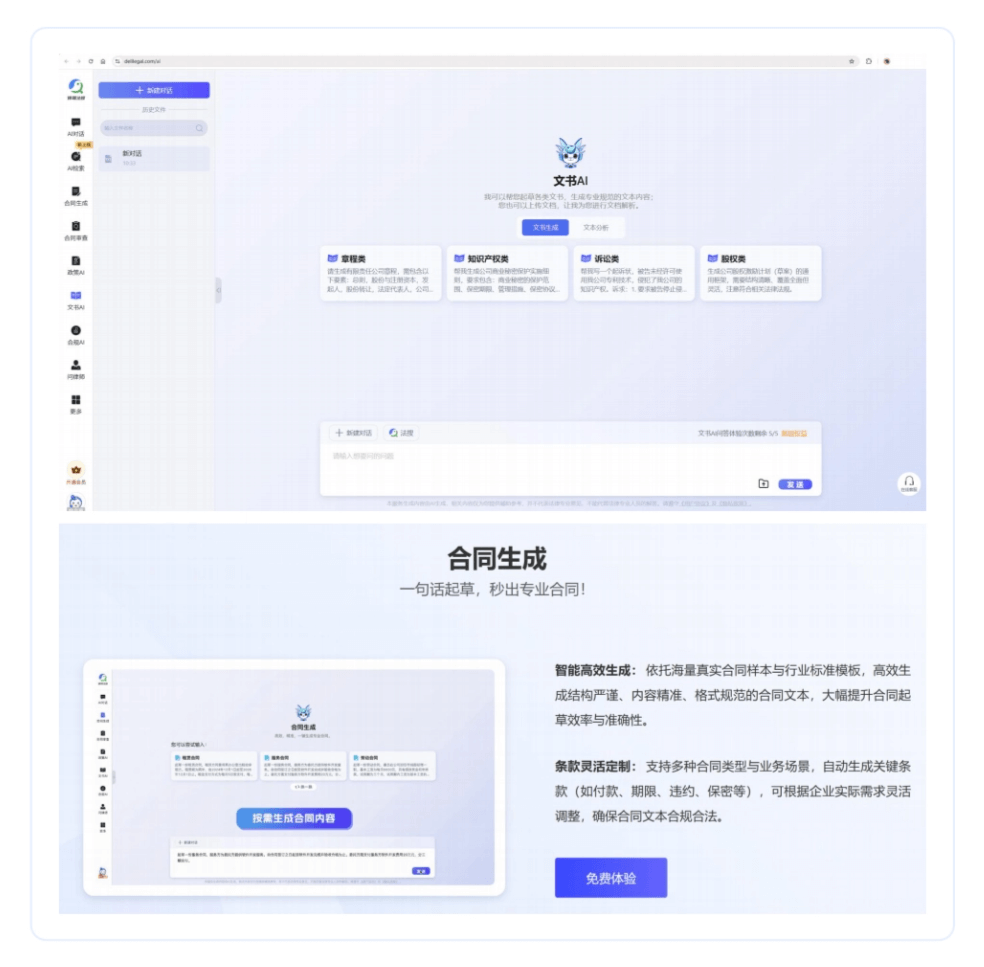
- Legal: Deli Technology builds an AI legal assistant to reshape a new paradigm for corporate legal services.
Outlook for Agent Development
The report predicts that agents will move from single, static applications to new dynamic, ubiquitous, and embodied forms, driving paradigm shifts in society and business:
- Intelligent Collaboration: From individual operations to swarm intelligence, achieving multi-agent collaboration and cross-organizational agent collaboration.
- Perception and Reasoning: Through multimodal models and world models, achieve more advanced reasoning and intrinsic understanding of the world.
- Execution and Application: The ubiquity and embodiment of agents will extend capabilities into the physical world and integrate into various hardware terminals.
Conclusion
Agents are evolving from "assistive tools" to "autonomous productivity," and will profoundly affect corporate operations, organizational forms, and even social structures. By building full-stack capabilities from the technology foundation to industry applications, Tencent Cloud helps enterprises advance agent development in stages and sustainably, realizing intelligent transformation from "pilot validation" to "ecosystem integration."

Get the "Enterprise-Level Agent Industry Implementation Research Report" report PDF original file. Scan the QR code to follow and reply: 20250929