
The "Enterprise AI Application Construction Guide" comprehensively explains the construction methods and technical system for enterprise-level AI applications. The content covers the evolution of AI application architecture (from dialogue and RAG to workflow and Agent patterns), and provides in-depth analysis of core infrastructure such as the delivery process, MaaS, memory management, the MCP protocol, AI gateways, and sandbox isolation, with a focus on new types of risks such as prompt injection, tool security, and identity authentication, as well as their protection strategies. Combining Alibaba's internal practices, the guide provides developers with full-chain guidance from R&D to operations and maintenance, helping to efficiently and securely achieve AI application implementation and innovation.

Get the "Enterprise AI Application Construction Guide》report PDF original file. Scan the QR code to follow and reply: 20250922
Introduction
Based on Alibaba's internal AI application R&D experience, combined with business research and open-source progress, this article provides an in-depth analysis of the architectural patterns, delivery differences, infrastructure support, and security challenges of AI application R&D. Starting from the most complex Agent pattern architecture, it discusses the differences between AI applications and traditional applications in the R&D and delivery stages, including issues such as model switching and upgrades and capability evaluation. It focuses on introducing the infrastructure that supports AI application R&D, such as MaaS, MCP tools, Sandbox technology, and the observation and evaluation of the R&D and operations lifecycle. It analyzes the new security challenges brought by AI to applications, such as prompt injection, tool usage security, Sandbox isolation, and identity and authorization systems, providing readers with practical experience and in-depth insights into AI application R&D.
AI Application Architecture
-
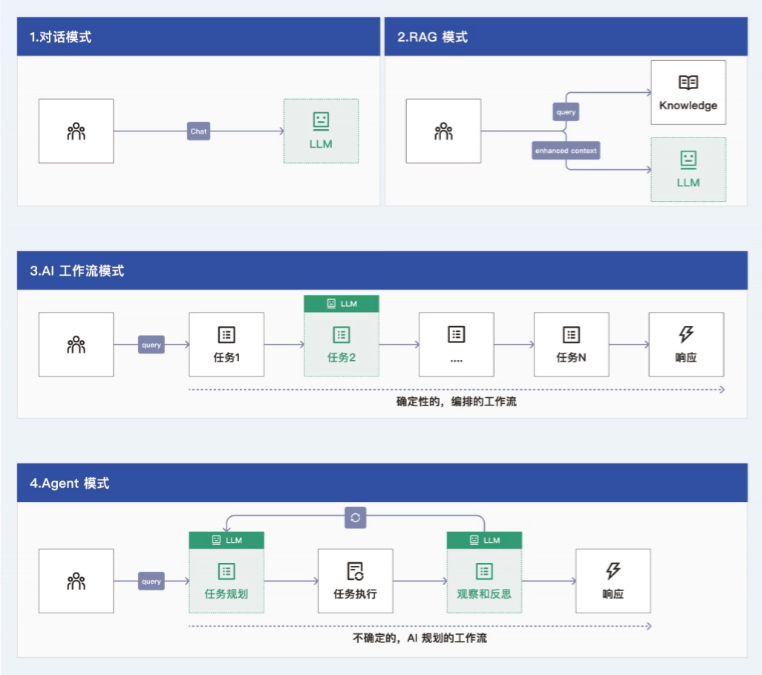
Development history: From the simple dialogue pattern, to the RAG pattern with vector retrieval and recall capabilities, to the AI workflow pattern in which developers orchestrate workflows and use models to drive key nodes, and then to the Agent pattern in which the model itself plans the process.
-
Agent pattern architecture:
-
User interaction module: Receives user requests, collects contextual data, and converts them into model requests.
-
Core LLM module: Responsible for task planning and short-term memory storage, generating task plans and executing them.
-
Environment module: As the task execution site, usually an isolated sandbox environment, it executes tasks and collects environmental information.
-
Planning, task execution, perception, and reflection loop: Adjusts the plan according to execution results and cycles multiple times to achieve the goal.
-
Memory module: When tasks are complex and the context is too long, a long-term memory module is introduced to finely compress memory to retain key information.
-
AI Application Delivery
-
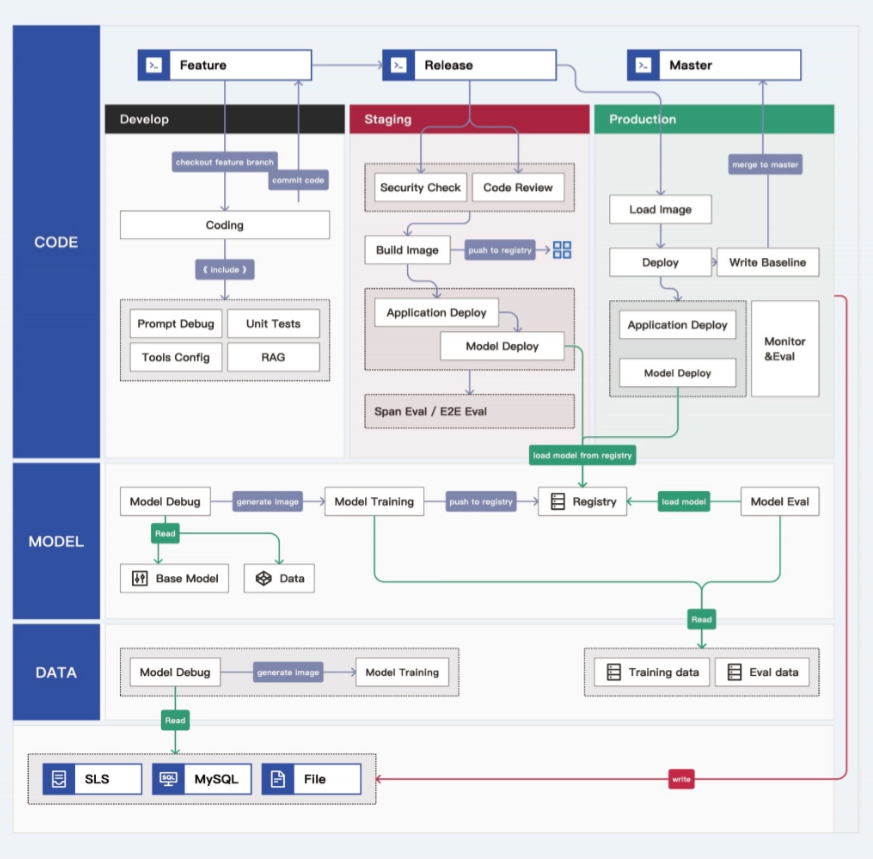
Characteristics: Compared with traditional application CI/CD, AI application CI/CD faces multi-dimensional supply chain management, requires probabilistic testing strategies, adopts complex cyclic processes, and requires multi-level monitoring of AI-specific issues such as model performance changes.
-
Model and framework selection: Select foundation models and frameworks based on multiple dimensions such as quality, cost, expense, and compliance. For example, general dialogue scenarios can choose GPT-4, code generation can choose Qwen-Coder, and enterprises considering compliance can choose private deployment of open-source models. During the application update and iteration process, model switching and related work are required.
-
Core process: AI applications have complex dependencies and require coordinated delivery of code, models, and data. It is recommended to use environment isolation, dividing into three stages: development, integration, and production, with each environment having different permission controls and stability requirements.
AI Application R&D Infrastructure
-
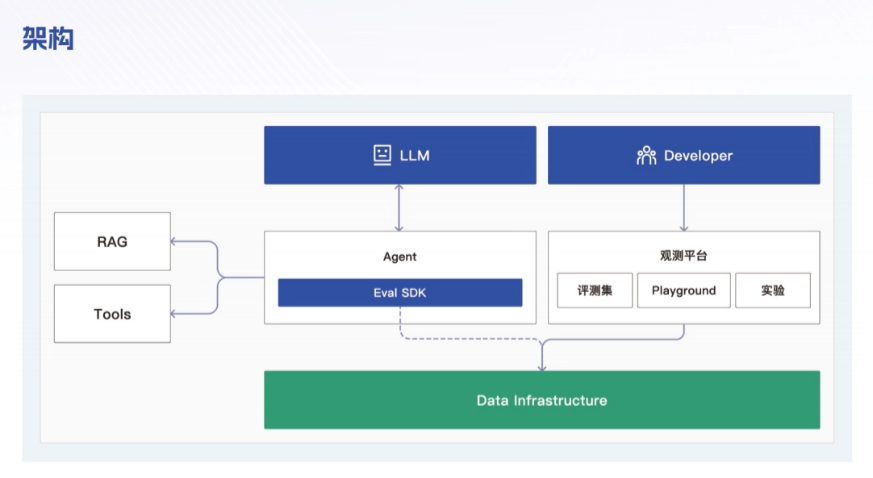
MaaS (Model as a Service): Provide AI models with different task-handling capabilities to users in the form of services. Users can quickly apply model inference capabilities through SDKs/APIs, reducing the complexity of building AI applications.
-
Memory: Enable AI applications to remember previous interaction content, maintaining consistency and coherence in long-term interactions.
-
MCP (Model Context Protocol): Enable large language models to connect to external data sources and tools in a standardized way, allowing the models to deliver greater value, such as incorporating external tools like web search, datasets, and APIs.
-
AI Gateway: Based on the two core scenarios of model access + API provisioning, through design principles such as protocol abstraction and unified governance, it brings "any model" and "any business API" into a unified control plane, solving the MxN repeated construction problem and enabling rapid iteration to coexist with enterprise-grade stability.
-
Sandbox: Provide a reliable and secure environment for Agents to plan and execute tasks, supporting code generation and execution, browser-use, and local MCP Tools, etc.
-
AI Observability: By obtaining OpenTelemetry data reported by users, it clearly displays the entire process from user input to final output and records metadata of key nodes, providing developers with a basis for debugging and serving as the data foundation for evaluation, analysis, and optimization.
-
AI Evaluation: Traditional software testing methods are inadequate for AI applications. A brand-new AI application evaluation system needs to be established to ensure AI applications are trustworthy, high-quality, and capable of sustainable evolution, transforming uncertainty into certain business value.
AI Application Security
-
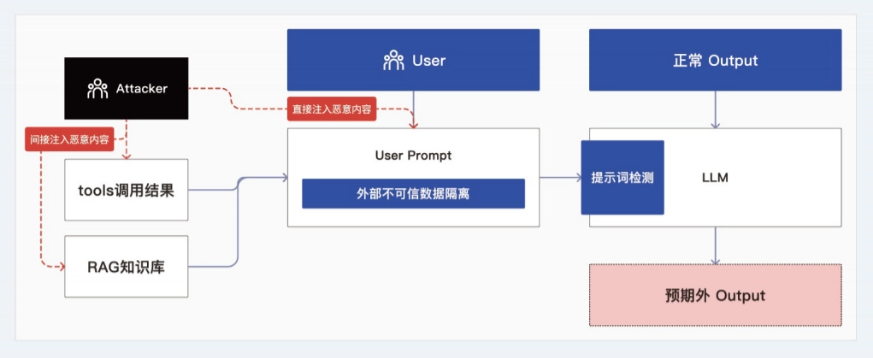
Application Security Risks and Protection: Agent applications face new security challenges such as prompt injection, logic errors, and harmful user requests. Security issues have evolved from single-point vulnerabilities into systemic risks, requiring multi-layered defense in depth and a dedicated security governance system.
-
Tools Usage Security: High-risk Tools must run in a controlled environment completely isolated from the host logic and subject to fine-grained auditing, limiting the scope of impact.
-
Identity and Authorization: Authentication and authorization in AI scenarios differ from traditional ones and require more flexible and reliable security protocols to prevent risks such as permission leakage, unauthorized access, and data security.
-
Large Model Supply Chain Security Protection: Prevent training datasets, model weights, dependency components, delivery channels, and other links from being maliciously tampered with or implanted with "backdoors," which could cause models to go live with defects and threaten business security.
Summary
With the rise of large models, Alibaba's AI R&D ecosystem is thriving. The number of active Python developers has grown by 33% over the past year, mainly for work such as data processing, model training, and AI application R&D. In 2025, the first year of AI application development, large amounts of capital investment have driven the rapid development of AI applications. Related R&D models and application architectures are also continuously maturing, and new AI application middleware is gradually emerging, allowing developers to focus more on innovation. Based on the continuous improvement of AI model capabilities and the trend of context engineering becoming an industry consensus, this article presents a guide to help developers quickly build AI applications and realize their innovation dreams.
Get the《Enterprise AI Application Building Guide》report original PDF file. Scan the QR code to follow and reply: 20250922