
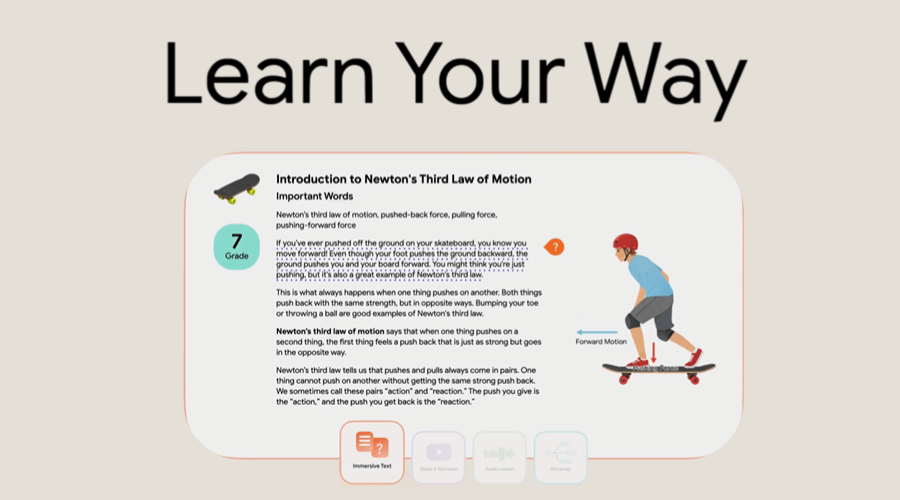
The era of AI customizing education for everyone has arrived.
Yesterday, Google launched its latest educational tool Learn Your Way , using AI to turn textbooks into multimodal content,and adding interaction and quizzes to every part of learning, so everyone can have a learning process better suited to themselves.
Limited by production costs, ordinary textbooks struggle to provide diverse, customized content; whether or not you have a foundation, you read on at the same pace.
Learn Your Way, however, uses AI capabilities to combine students' interests and learning progress, truly achieving tailored instruction.
The results are also clear: in Google's effectiveness study, students who learned with Learn Your Way scored 11% higher on long-term memory tests than students who used a standard digital reader (ordinary e-book/PDF textbook).
01. Reshaping Textbooks with Generative AI
Q1: What is Learn Your Way?
In one sentence, Learn Your Way is a personalized learning tool built by Google with generative AI, turning uniform textbook content into personalized learning materials that fit each person's situation. That is:
turning "a thousand people reading one book" into "each person having their own book," and it can also expose knowledge gaps.
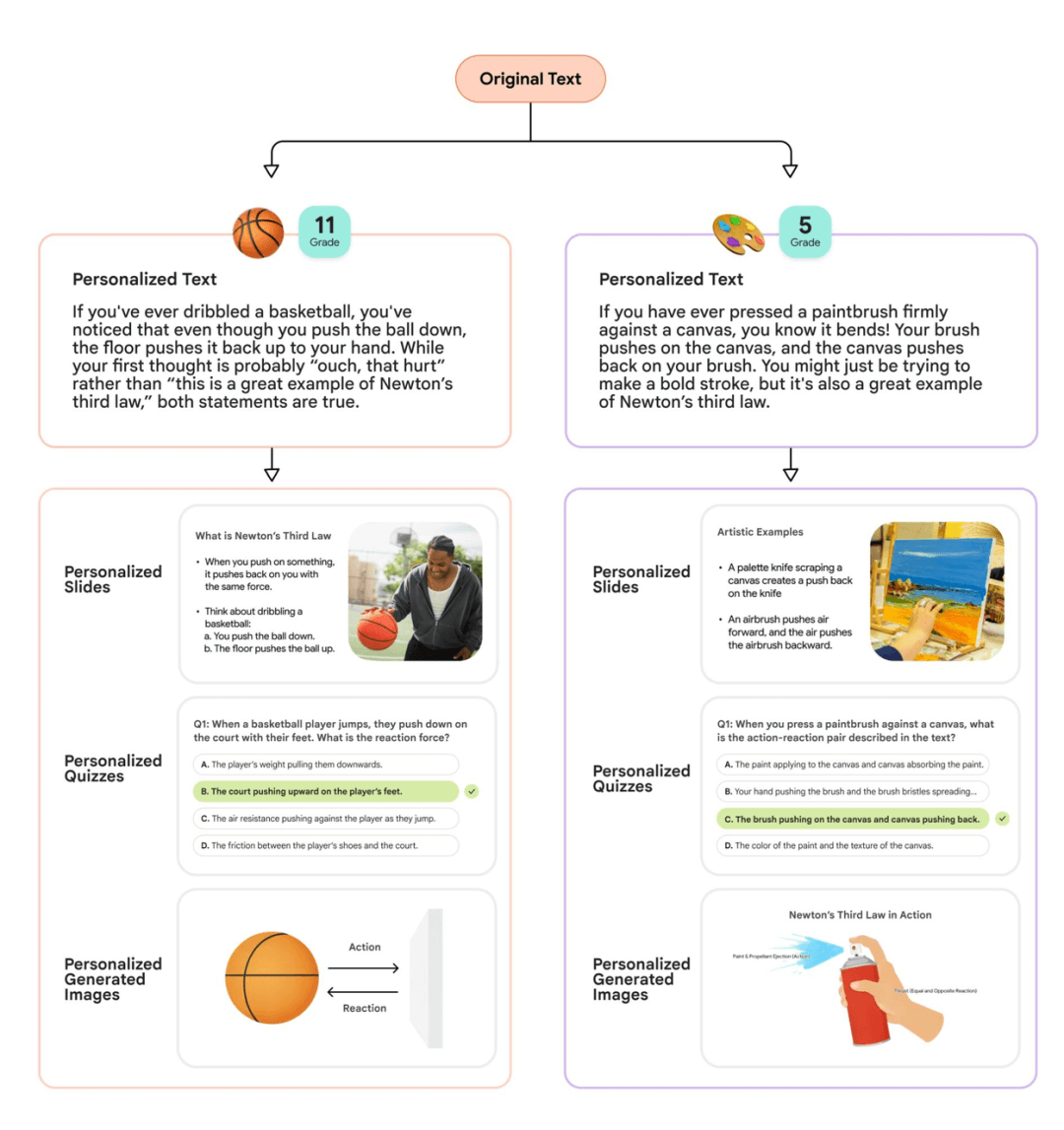
(Personalized descriptions of Newton's laws for different students)
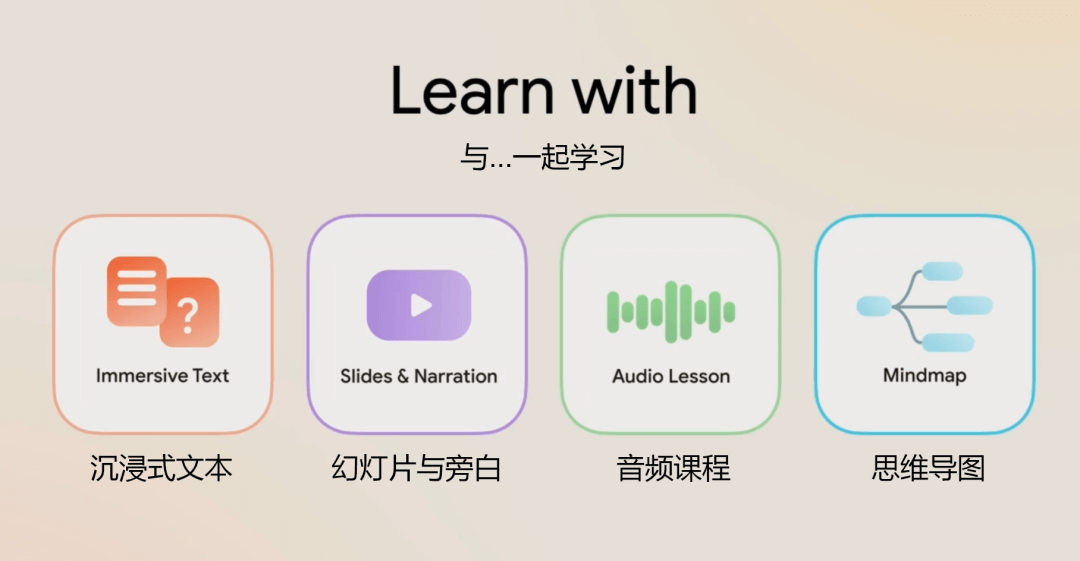
Learn Your Way breaks down and reconstructs textbook content into the following forms:
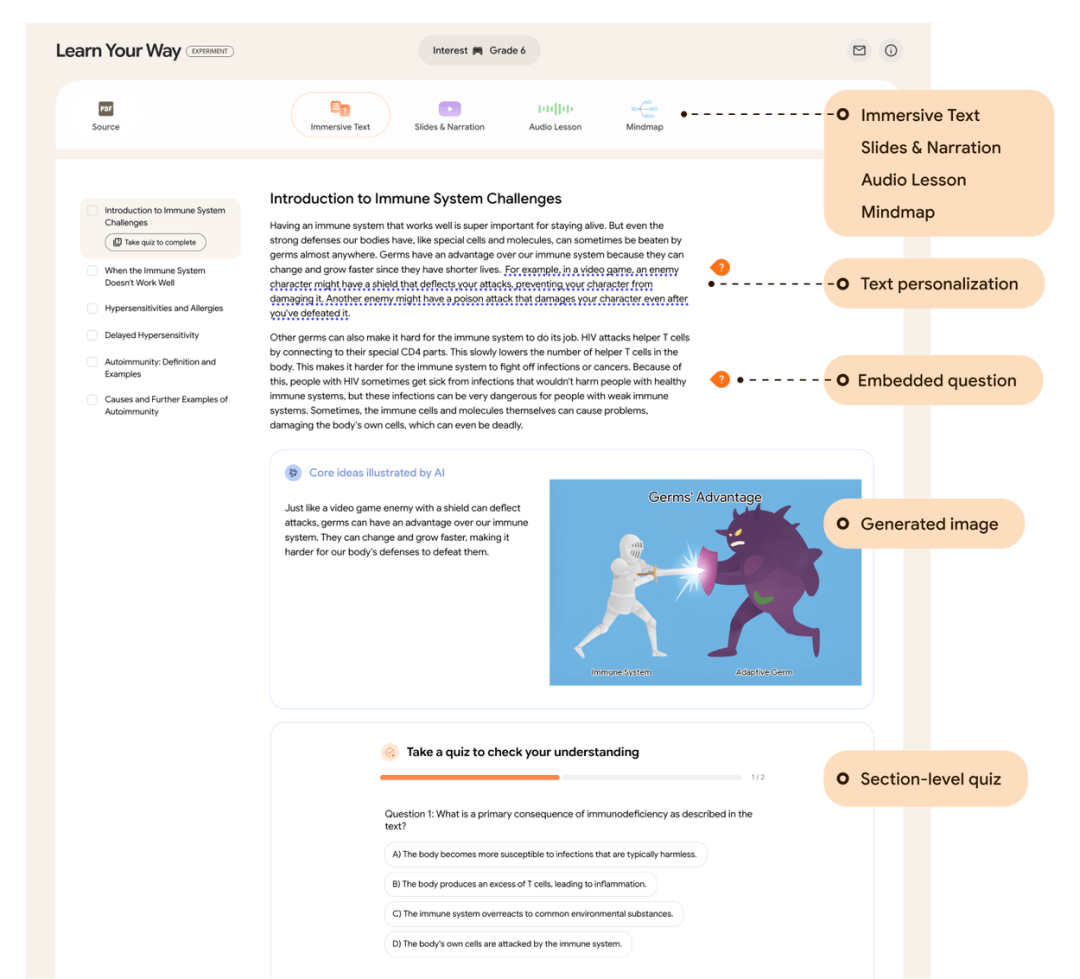
- Immersive text: divides content into easy-to-understand chunks, paired with generated images and embedded questions. It turns passive reading of text into an active multimodal experience consistent with learning science.
- Section quizzes: supports interactive self-testing, promotes active learning, and can expose knowledge gaps.
- Slides and narration: provides classroom-lecture-like slides covering all the original material, including interactive elements such as fill-in-the-blank questions, with narration.
- Audio lessons: AI-simulated teacher-student dialogue, with visual aids, recreating real learning interaction. For example, when a student expresses a misunderstanding, the teacher clarifies it promptly.
- Mind maps: organizes knowledge in a hierarchical structure; students can zoom to switch between the overall overview and details.
(Multimodal presentation formats)
In this way, different students can freely choose the way they prefer to learn.
This content is also adjustedto personalize it based on the student's grade level and interests, with quizzes providing real-time feedback and guiding students to revisit weak areas.
Q2: How does Learn Your Way work?
Google's Learn Your Way project uses generative AI technology, based on the LearnLM model, to enhance the learning experience in two ways:
- multimodal presentation of content;
- grounding personalization in practice.
Traditional textbook learning is monotonous; Learn Your Way uses the Gemini 2.5 Pro model to generate content, combines specialized fine-tuned models to generate illustrations, and uses multi-step AI workflows, so that "seeing," "listening," and "interacting" happen together during learning, enhancing understanding and memory.
Starting from a PDF textbook, Learn Your Way first adjusts the content to suit the student's grade level, then replaces generic content with interest-related examples:
For example, for a student who likes music learning about vibration, AI can switch to "how guitar strings produce sound"; a student who likes cars might see "the vibration produced when an engine is running."
Q3: Is Learn Your Way really effective?
Learn You Way retains the original knowledge structure and only makes personalized adjustments to examples and presentation formats, ensuring the accuracy of the teaching materials.
To evaluate the teaching performance of Learn You Way, the Google Learn Your Way team converted textbook materials from ten different sources into three different personalized settings. The content covered various subjects from history to physics.
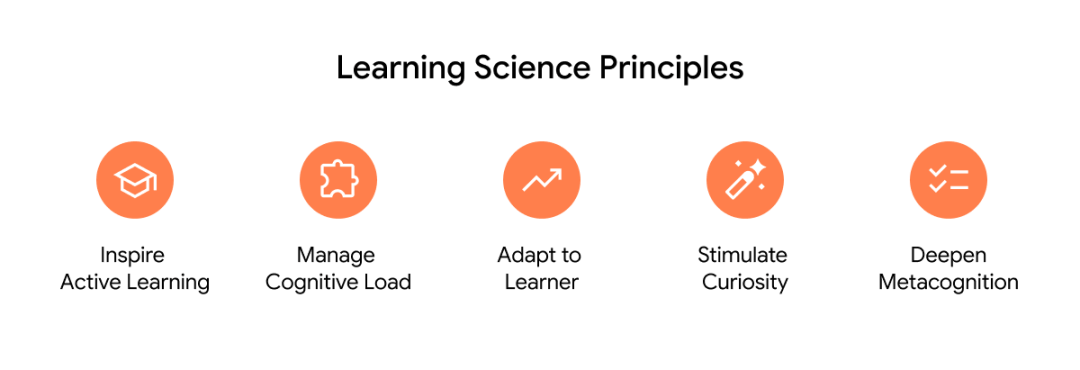
(Top teaching principles guiding Google's development of new learning capabilities and experience evaluation)
Three teaching subject experts evaluated the converted materials according to teaching standards such as accuracy, coverage, and the LearnLM learning science principles.
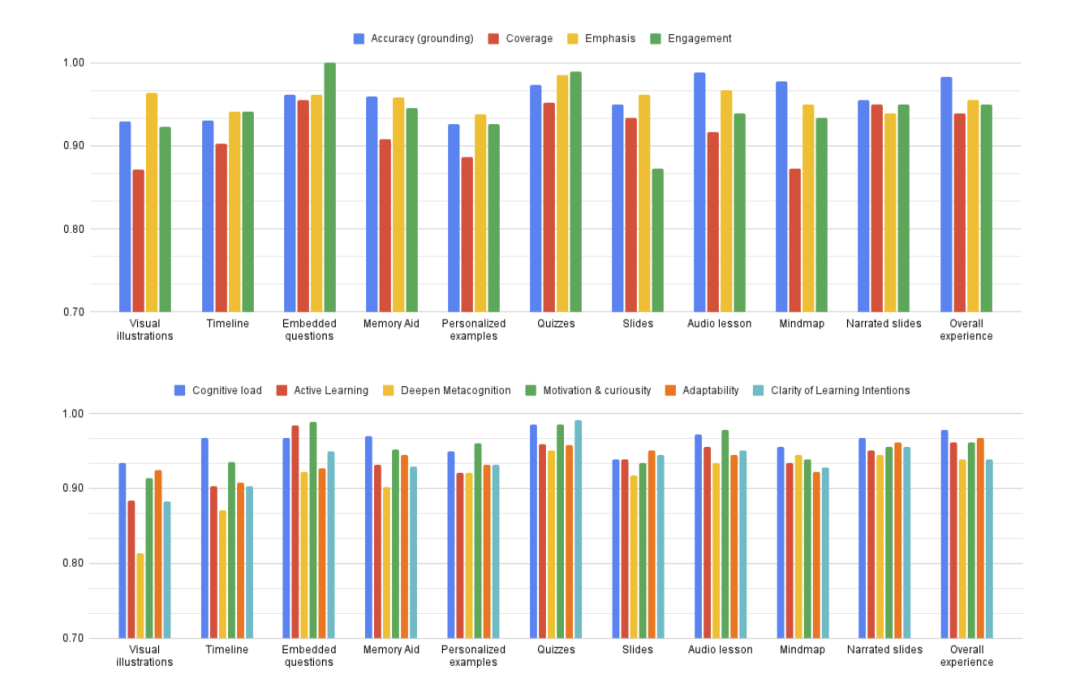
(Expert ratings)
The results showed that based on various teaching standards, the content was evaluated by experts, with average ratings above 0.85 (out of 1.0).
Google also conducted a randomized controlled experiment, randomly dividing 60 students with similar reading levels into two groups. One group studied with Learn Your Way, and the other group used ordinary digital textbooks, with a study duration of within 40 minutes.
Tests were conducted immediately after learning and again 3 to 5 days later. The results showed:
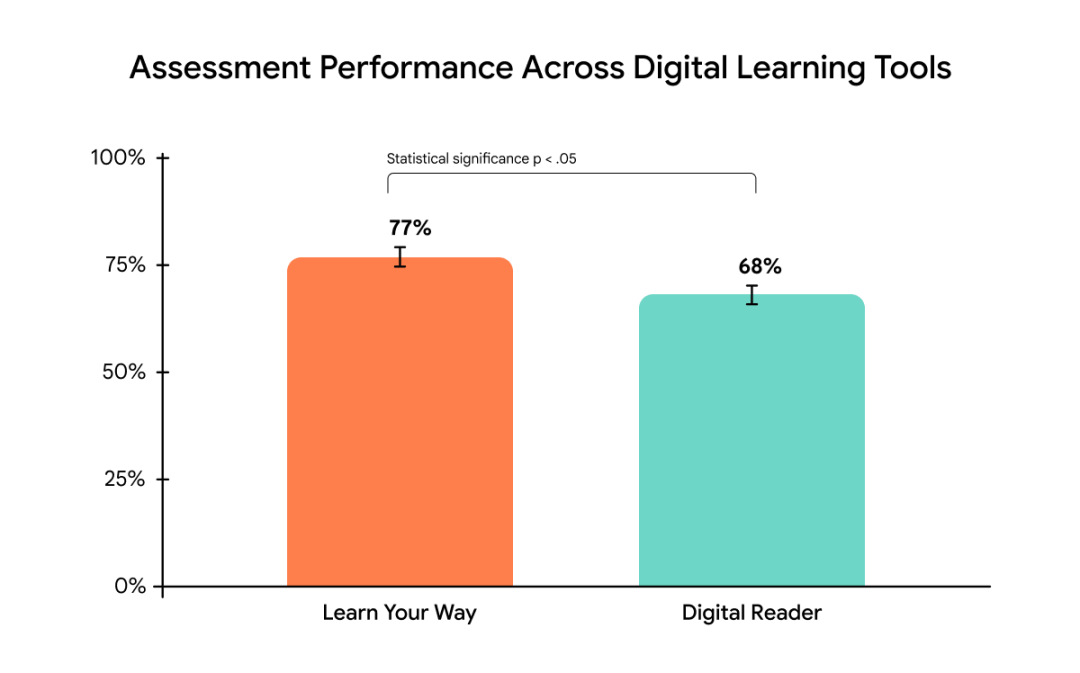
(Average scores in immediate assessment)
Students who used Learn Your Waylearned more effectively, with a 9% higher accuracy rate in the immediate test after learning;
Students who used Learn Your Wayhad better long-term memory retention, with an 11% higher accuracy rate for Learn Your Way in the memory assessment 3-5 days later;
Not only did they score better, but students in the Learn Your Way group generally reported that this AI toolmade learning more interesting, easier to understand, and they were willing to continue using it。
Q4: How to use Learn Your Way?
Currently, Learn Your Way is already available on Google Labs .
Friends can view official examples and apply for beta testing experience here.
Address:https://learnyourway.withgoogle.com/
02. Learning scenario examples Customize teaching materials with Learn Your Way
For example, we set the roles as a middle school student and an undergraduate respectively, while learning an introduction to anatomy and its research fields.
Learn Your Way will adjust the learning content to the grade level we select, combine personal interests, and present it in multiple forms, including text, mind maps, audio courses, interactive quizzes, etc., thereby providing real-time feedback and content personalization.
For a 7th-grade middle school student interested in food and an undergraduate interested in games, the customized teaching content provided by Learn Your Way is as follows:
Middle school student teaching case address:
https://learnyourway.withgoogle.com/scopes/rJ13oFrj
Undergraduate teaching case address:
https://learnyourway.withgoogle.com/scopes/L1yh30cO
It can be seen that although the content is roughly the same, the undergraduate learning content is more rich and in-depth.
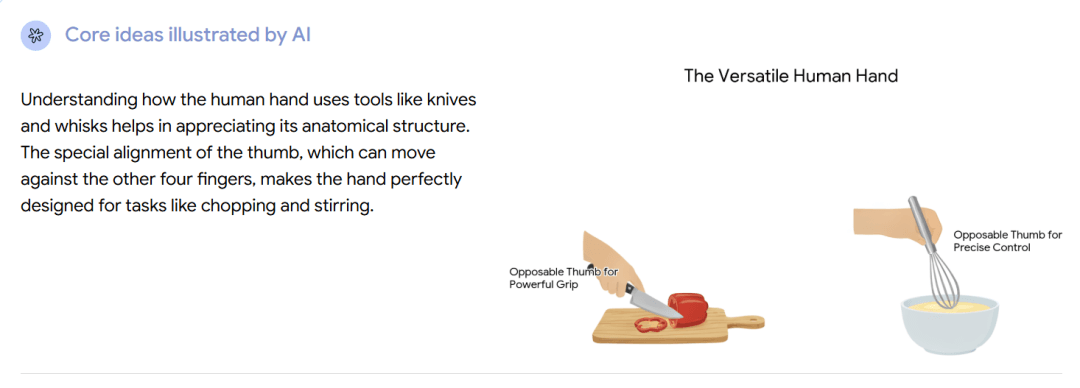
(Case seen by middle school student)
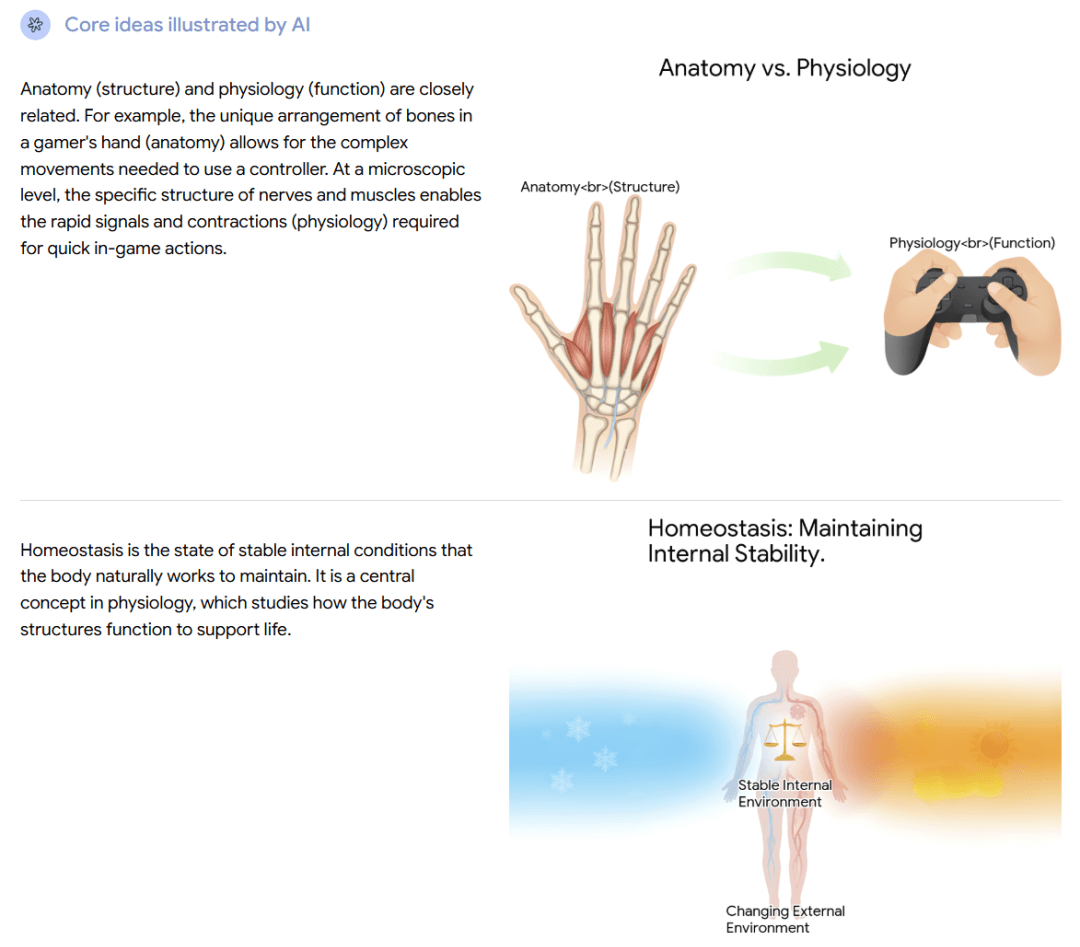
(Case seen by undergraduate)
The interpreted cases will alsocombine their respective interests. For example, Learn Your Way recommends that the middle school student interested in food learn about the basic structure of the hand by observing the use of kitchen utensils such as knives and egg beaters.
To explain the relationship between anatomy and physiology to undergraduates, Learn Your Way will cite the hand bone arrangement of gamers and gaming scenarios.
03. Some sharing
I think Learn Your Way is a great project, and I look forward to having such a guiding "AI" while learning new things, helping me understand and learn in various forms, and occasionally testing me to check the quality of my learning.
The value of Learn Your Way lies in helping different people find their own pace. After all, good educationhas never been about making everyone take the same path, but about helping each person find the path that suits them best。
For Google, Learn Your Way is only the starting point. In the future, what it wants to do is not just interact, but continuously adjust content based on each person's progress, truly achieving dynamic learning. Behind this, it will still be based on teaching principles to verify how much AI can improve learning efficiency.
For the education industry, this may be the most thorough transformation in decades.
Not only will students' way of learning change because of this, but the role of teachers will also change accordingly. They will no longer simply explain knowledge, but help students choose suitable learning paths and monitor the quality of students' learning;
Of course, there is still a long way to go. Cost, cultural differences, and textbook standards are all real issues. But at least one thing is certain - the way we learn is being rewritten. Thick textbooks may still exist for a long time, but they are no longer the only answer.
Original link:Google launches "Learn Your Way," using AI to redefine textbooks