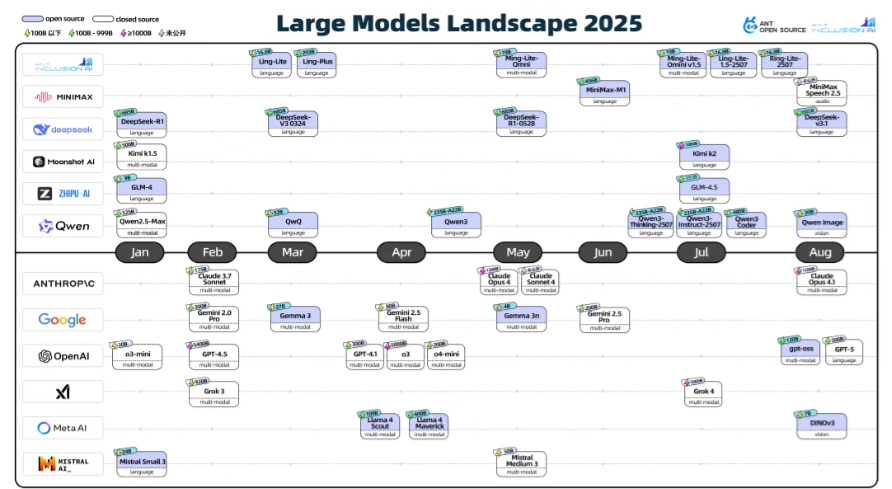
'The Landscape and Trends of Large Model Open Source Development' is a report launched by Ant Group's Open Source Technology Committee, providing insights into the current state and future trends of the large model open source development ecosystem based on community data. The report presents the distribution of large model open source projects through a landscape map; from version 1.0 to version 2.0, the number of projects and the division of domains have become more refined, reflecting the rapid development of the ecosystem. The report analyzes technical keywords, active projects, license changes, etc., revealing the growth trends in areas such as AI Coding and Model Serving. The report explores project turnover and ecosystem dynamics, as well as the distribution of global developers in the large model development ecosystem, providing references for developers and enterprises to help them grasp the context and trends of large model open source development.
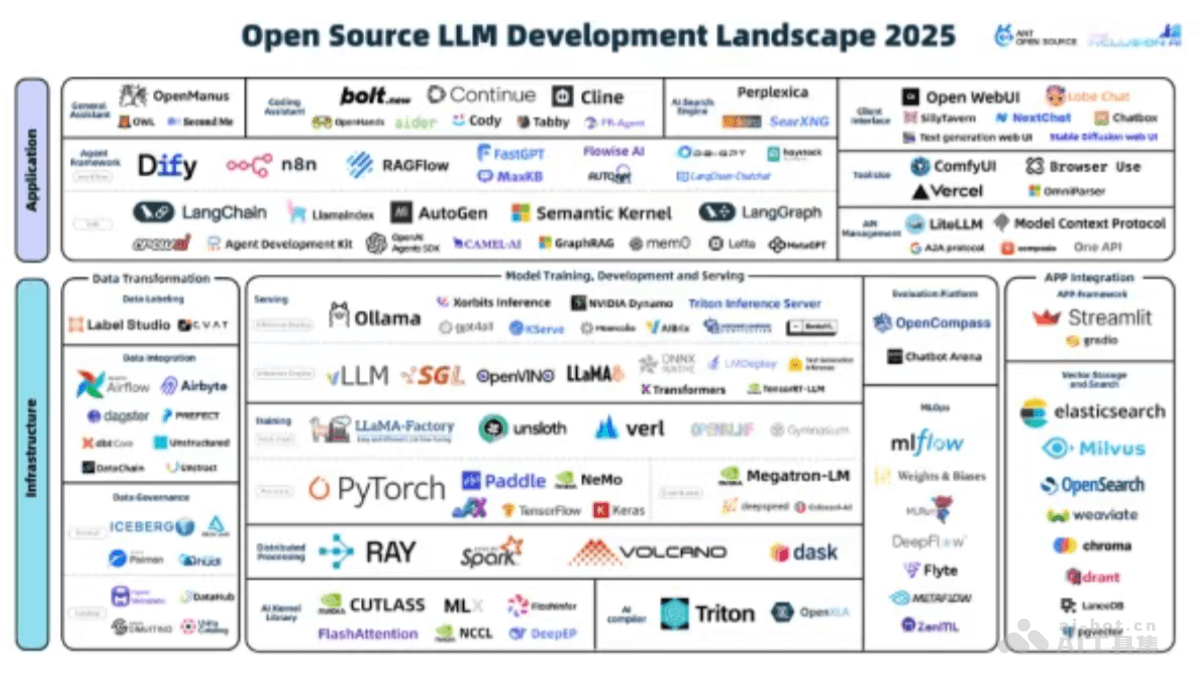
The Landscape of the Large Model Open Source Development Ecosystem
- Iterative Updates of the Landscape Map
-
Version 1.0 was released in the first half of 2025, including 135 projects across 19 technical domains, drawn using a seed-project multi-hop search method, with a certain degree of randomness.
-
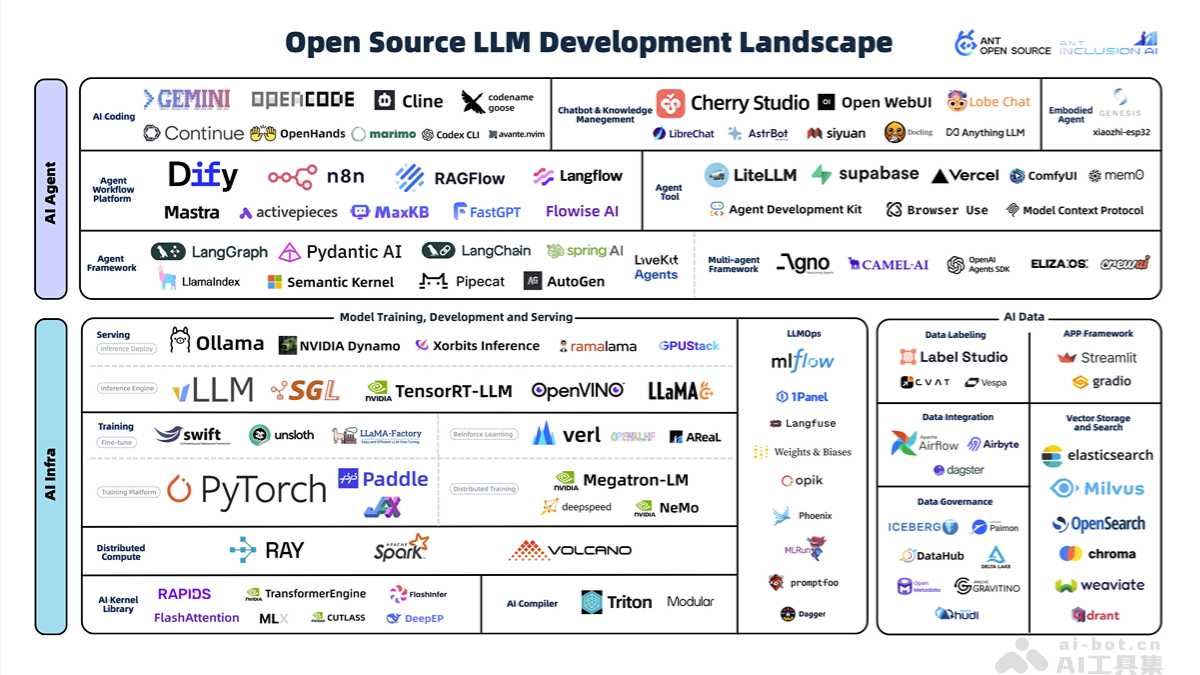
Version 2.0 was released in August 2025, using the OpenRank algorithm to directly screen GitHub projects, including 114 top projects distributed across 22 technical domains, with the threshold raised to OpenRank 50.
-
- Project Turnover and Ecosystem Dynamics
-
Version 2.0 added 39 projects, accounting for 35%, mostly recently created and highly followed; 60 projects were removed, mostly due to insufficient activity or failure to meet the new standards.
-
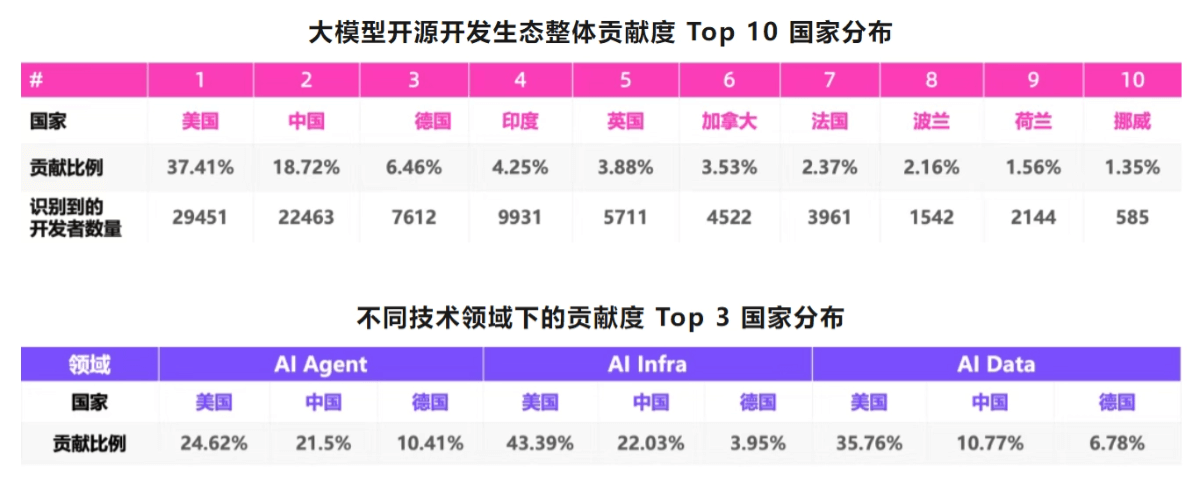
These projects attract 366,521 developers worldwide, with the United States accounting for 24% and China accounting for 18%, demonstrating the dominance of China and the United States in the large model ecosystem.
-
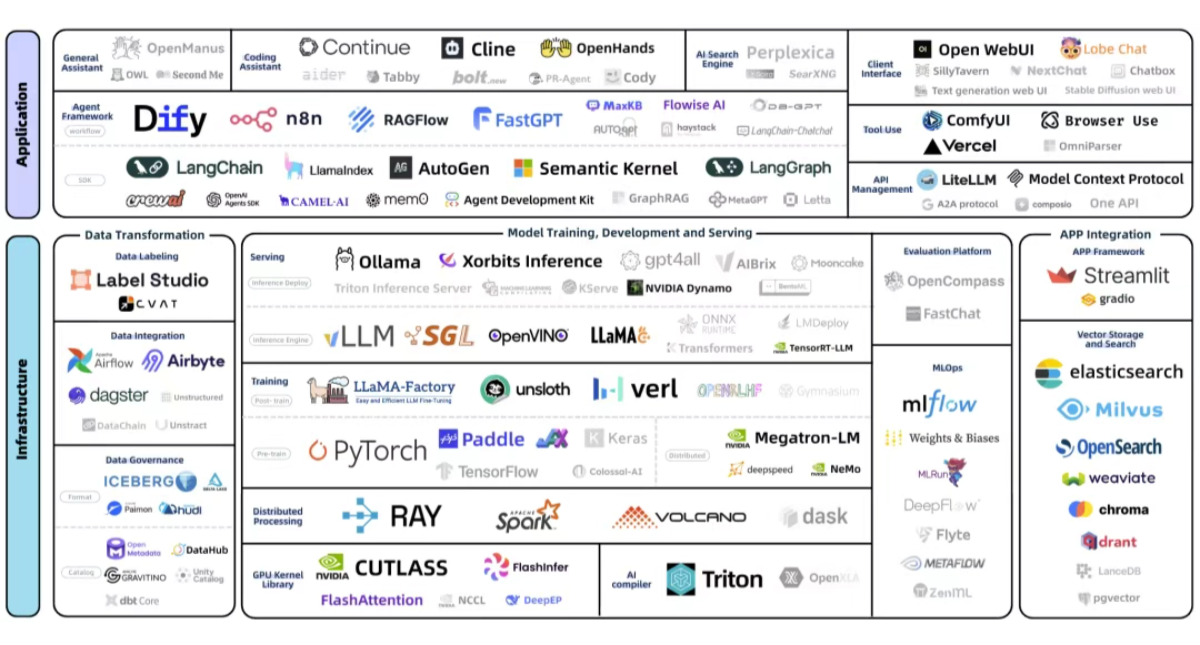
- Composition and Significance of the Landscape Map: The landscape map is divided into two major directions, AI Infra and AI Agent, and uses the OpenRank algorithm to measure project influence, providing a scientific basis.
From Ecosystem Landscape to Technology Trends
- Keywords of the Large Model Development Ecosystem: Through text analysis of project descriptions and tags, high-frequency keywords such as AI, LLM, Agent, and Data are extracted, producing a word cloud that reflects the core technical directions of the large model ecosystem.
- Analysis of Active Projects:
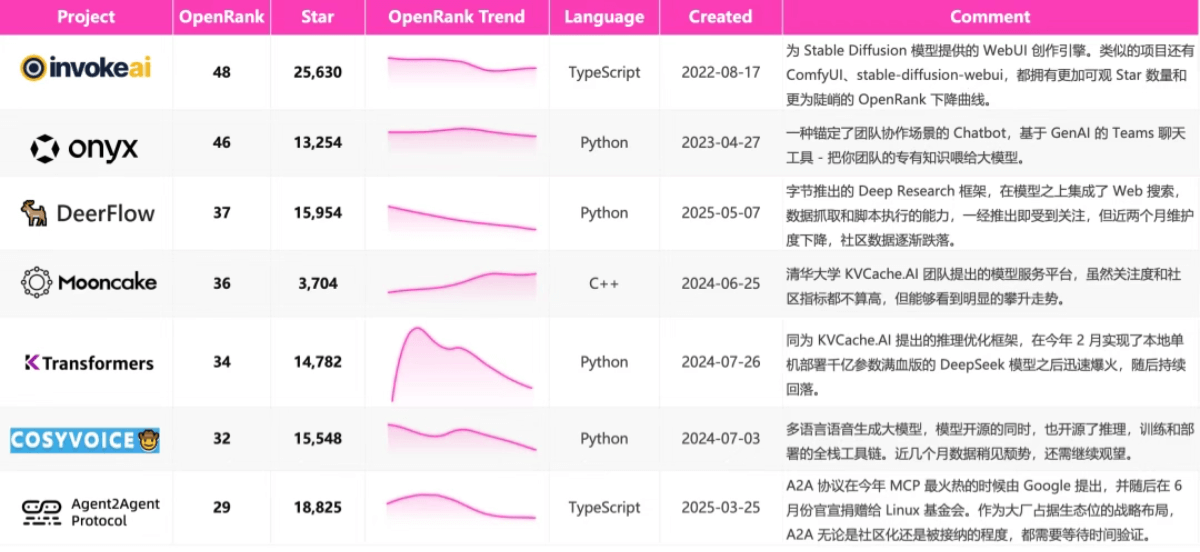
- The top 10 projects by OpenRank cover the complete chain of the model ecosystem, with Python dominating infrastructure and TypeScript ruling the application layer.
- Some projects adopt non-traditional open source licenses to protect commercial interests, making the definition of 'open source' increasingly ambiguous。
- Development Trends in Technical Domains: AI Coding, Model Serving, and LLMOps show明显的 growth, while the Agent Framework and AI Data domains show a declining trend.
- Projects on the Periphery: The article focuses on some open source projects that have not entered the landscape map but have potential.
Portrait of Global Developer Distribution in the Large Model Ecosystem
In the global large model development ecosystem, the developer distribution shows that the United States and China occupy dominant positions, accounting for 24% and 18% respectively, indicating that the two countries have significant influence and activity in the field of large model technology. European countries such as Germany and India have relatively high participation, though there is still a gap compared with China and the United States. Overall, it presents a global developer distribution pattern dominated by China and the United States with participation from multiple countries.
From 1.0 to 2.0, Changes and Constants in 100 Days
- Adjustments to the Overall Ecosystem Structure and Domains: From 1.0 to 2.0, the ecosystem structure and domain division have become more refined, with specific new categories such as 'AI Infra', 'AI Agent', and 'AI Data' added.
- Projects That Dropped Out: Some once-popular projects such as Manus and NextChat have gradually faded from view due to insufficient maintenance or being replaced.
- The decade-long decline of former giant TensorFlow: Since its open-source release in 2015, TensorFlow has gradually been overtaken by PyTorch and has declined due to a lack of backward compatibility and complex migration tools.
- Newly emerging projects: Projects related to new fields such as AI Coding and embodied intelligence have emerged, and the Infra field has consolidated into LLMOps, covering operations across the full model lifecycle.
- Top 10 Most Active Open Source Projects Among Newly Emerging Projects: Among newly emerging projects, Gemini CLI, Cherry Studio, and others have performed outstandingly, ranking in the top 10 active projects.
- "Up and Down" on the Landscape: From February to August, projects such as TensorRT-LLM and Dynamo saw significant OpenRank growth, while projects such as LangChain and Codex saw significant declines.
Special Insights
- Model Serving: Model serving connects AI infrastructure and the application layer. Projects such as vLLM and SGLang improve inference performance, Ollama and others promote local deployment, and NVIDIA Dynamo expands cluster inference.
- AI Coding: AI Coding has evolved from single code completion to multimodal support. Tools such as Gemini CLI and OpenCode improve development efficiency and have huge commercialization potential.
- AI Agent: In 2025, AI applications are being implemented. Frameworks such as LangChain are losing momentum, while new projects such as Mem0 and Dify focus on different parts and drive the development of Agent systems.

Extra Chapter: The Full Landscape of the Large Model Ecosystem
It sorts out the release timeline of large models from mainstream domestic and international vendors from January 2025 to the present, with detailed annotations of key information such as each model's parameters and modalities, intuitively showing the current competitive landscape in the large model field. Through analysis, the article points out that China's open-source large models are flourishing, while top foreign model vendors mostly take the closed-source route, and emphasizes technical trends such as model parameter scaling, reinforcement learning improving reasoning capabilities, and multimodal models becoming mainstream.