
The AI Agents Illustrated Guide is written by Avi Chawla and Akshay Pachaar and helps readers understand and build AI Agents. It provides a detailed introduction to the definition of AI Agents, their differences from LLMs and RAG, and the six basic elements of building AI Agents (role-playing, focus tasks, tool use, cooperation, guardrails, and memory). It explores five design patterns and five levels of AI Agents, and provides multiple practical project cases, such as Agentic RAG, Voice RAG Agent, Multi-Agent Flight Search, etc., covering the tech stack, workflows, and code examples. This guide is a practical handbook for professionals in the AI field and is suitable for readers who want to gain an in-depth understanding and application of AI Agents.

Get the "AI Agents Illustrated Guide" report PDF original file. Scan the QR code to follow and reply: 20250914
Introduction to AI Agents
-
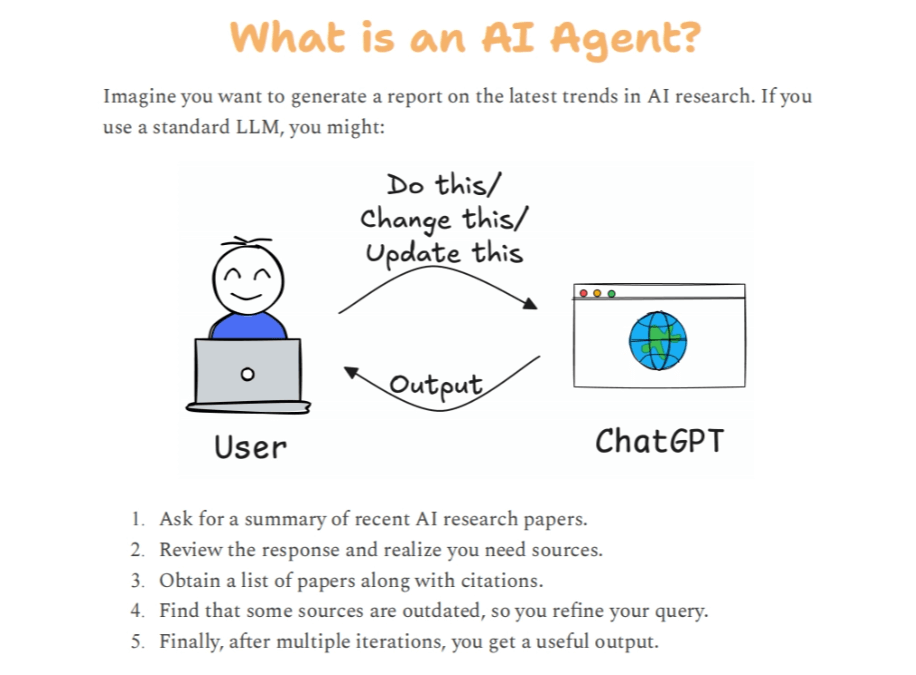
Definition: AI Agents are autonomous systems that can independently reason, think, plan, extract information from relevant sources, take actions, and self-correct when necessary.
-
Differences from LLMs (Large Language Models) and RAG (Retrieval-Augmented Generation):
-
LLM: Models like GPT-4 are trained on large amounts of text data and can reason, generate, and summarize, but are limited to their training data.
-
RAG: By retrieving external documents (such as vector databases, search engines, etc.) and inputting them into the LLM as context, the LLM's capabilities are enhanced.
-
AI Agents: On top of the LLM, autonomy is added to decide which steps to take, such as calling tools, searching the web, summarizing, or storing information.
-
Six Basic Elements of Building AI Agents
-
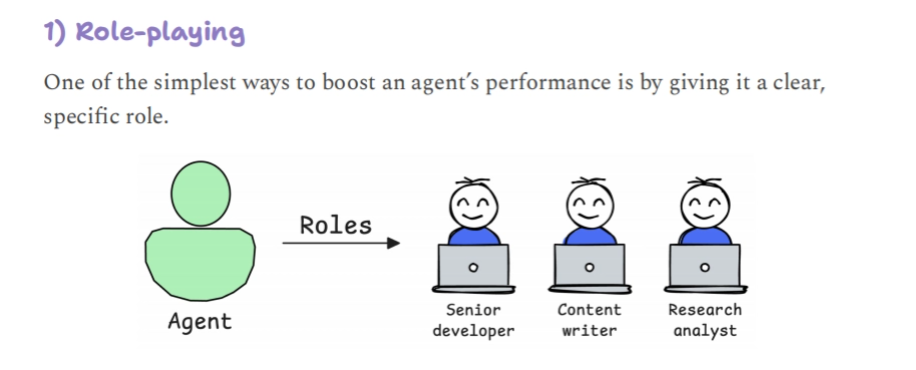
Role-playing: Assign clear, specific roles to AI Agents to improve their performance. For example, defining the AI as a "senior contract lawyer" makes its answers more legally precise.
-
Focus/Tasks: Focusing on specific tasks can reduce hallucinations and improve performance. Use multiple specialized Agents and avoid making one AI Agent do too many things.
-
Tools: AI Agents become smarter by using tools. Tools support Agents in searching the web, retrieving structured information from APIs and databases, executing code, etc.
-
Cooperation: Multi-Agent systems work best through cooperation and exchanging feedback. For example, in a financial analysis system, one Agent collects data, another assesses risk, a third formulates strategy, and a fourth writes the report.
-
Guardrails: Restrict the Agent's behavior to ensure it stays on the right track. For example, limiting tool use, setting validation checkpoints, establishing fallback mechanisms, etc.
-
Memory: Memory is a key component of AI Agents, supporting Agents in remembering past interactions, improving over time, and creating more coherent conversations.
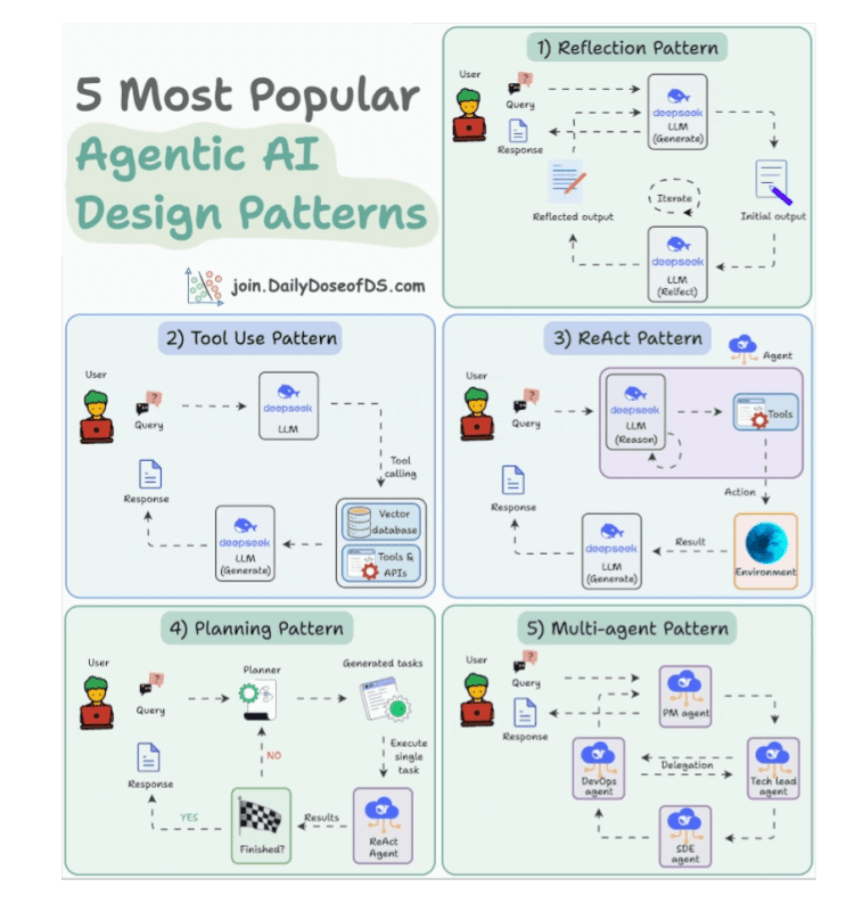
Five Design Patterns of AI Agents
-
Reflection Pattern: The AI reviews its own work, finds errors, and iterates until it produces the final response.
-
Tool Use Pattern: The AI obtains more information by querying vector databases, executing Python scripts, calling APIs, etc.
-
ReAct (Reason and Act) Pattern: The Agent reflects after generating output and uses tools to interact with the world. It cycles between thinking, acting, and observing until it finds a solution.
-
Planning Pattern: AI creates a roadmap, breaks down tasks, and outlines goals to solve problems more effectively.
-
Multi-Agent Pattern: Multiple Agents work collaboratively, each with a specific role and task, to jointly achieve the final result.
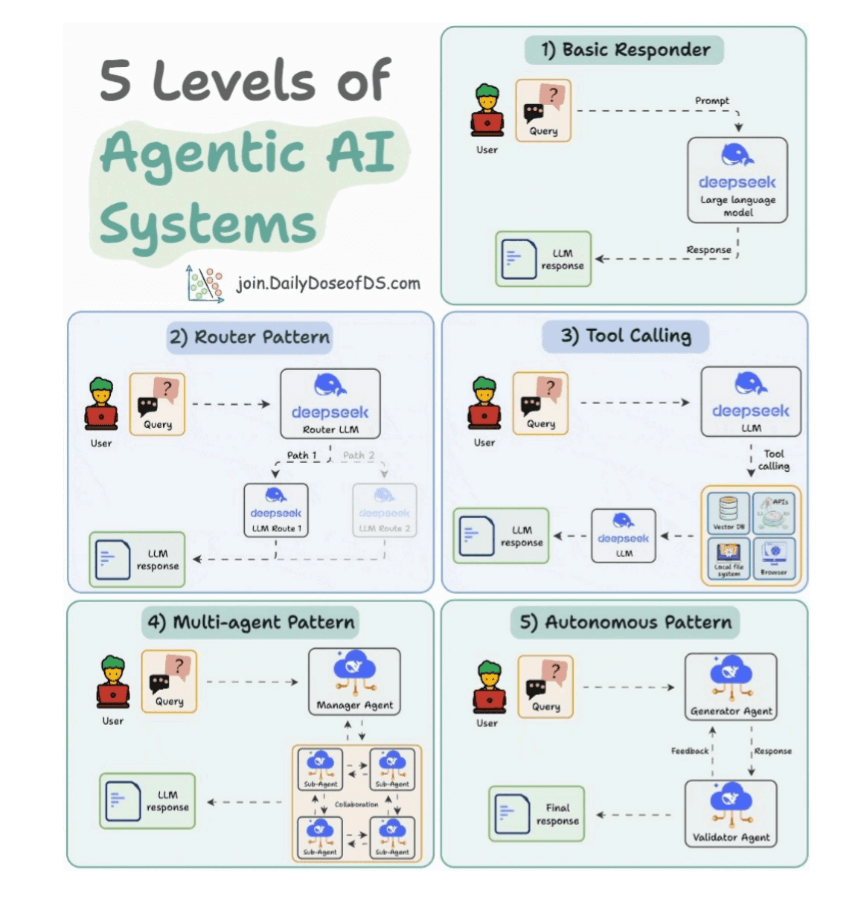
Five-Level Agent System
-
Basic Responder: Humans guide the entire process; the LLM is simply a general-purpose responder that receives input and produces output.
-
Router Pattern: Humans define the paths/functions that exist in the process, and the LLM decides which path can be taken.
-
Tool Calling: Humans define the set of tools the LLM can access, and the LLM decides when to use them and which parameters to use.
-
Multi-Agent Pattern: A managing Agent coordinates multiple sub-Agents and decides the next action.
-
Autonomous Pattern: The LLM independently generates and executes new code, effectively acting as an independent AI developer.
12 AI Agents Project Cases
-
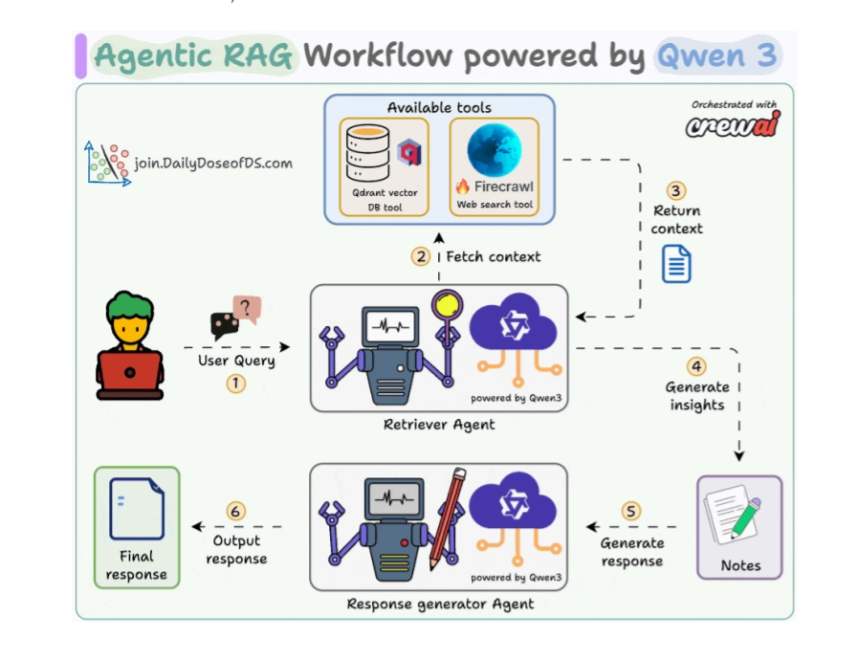
Agentic RAG: Build a RAG pipeline with the ability to dynamically retrieve context from different sources.
-
Voice RAG Agent: Build an AI application with real-time voice interaction.
-
Multi-Agent Flight Search: A flight search pipeline that parses natural language queries and retrieves real-time results from Kayak.
-
Financial Analyst: An AI Agent that retrieves, analyzes, and generates insights on stock market trends from Cursor or Claude.
-
Brand Monitoring System: A multi-Agent brand monitoring application that scrapes web mentions and generates insights about a company.
-
Multi-Agent Hotel Finder: Parses travel queries, retrieves real-time flight and hotel data from Kayak, and summarizes the best options.
-
Multi-Agent Deep Researcher: Build a 100% local alternative to ChatGPT's deep research feature.
-
AI Agent with Human Memory: Build an AI Agent with human memory to solve problems in production.
-
Multi-Agent Book Writer: Build an Agentic workflow that generates a 20,000-word book from a 3-5 word book topic.
-
Multi-Agent Content Creation System: Build an Agentic workflow that converts any URL into social media posts and automatically schedules them through Typefully.
-
Documentation Writing Process: Build an Agentic workflow that generates complete project documentation from a GitHub repository URL.
-
News Generator: Build an AI news generator that converts user queries into carefully written news articles.
Get the "AI Agents Illustrated Guide" report PDF original file. Scan the QR code to follow and reply: 20250914