
"Staying ahead in the age of AI" is an AI leadership guide launched by OpenAI, designed to help business leaders maintain a competitive edge in the AI era. The guide points out that AI technology is developing rapidly, with the speed of model releases, cost reductions, and enterprise adoption far exceeding the past. Based on OpenAI's collaboration experience with multiple companies, the report proposes five core principles: Align, Activate, Amplify, Accelerate, and Govern. The principles cover multiple aspects, from strategy formulation to employee training, from sharing success stories to rapid project advancement and responsible AI use, providing enterprises with a clear action framework and practical advice to stand out in the AI wave.

Get the OpenAI "Staying Ahead in the Age of AI" report PDF original file. Scan the QR code to follow and reply: 20250904
Background
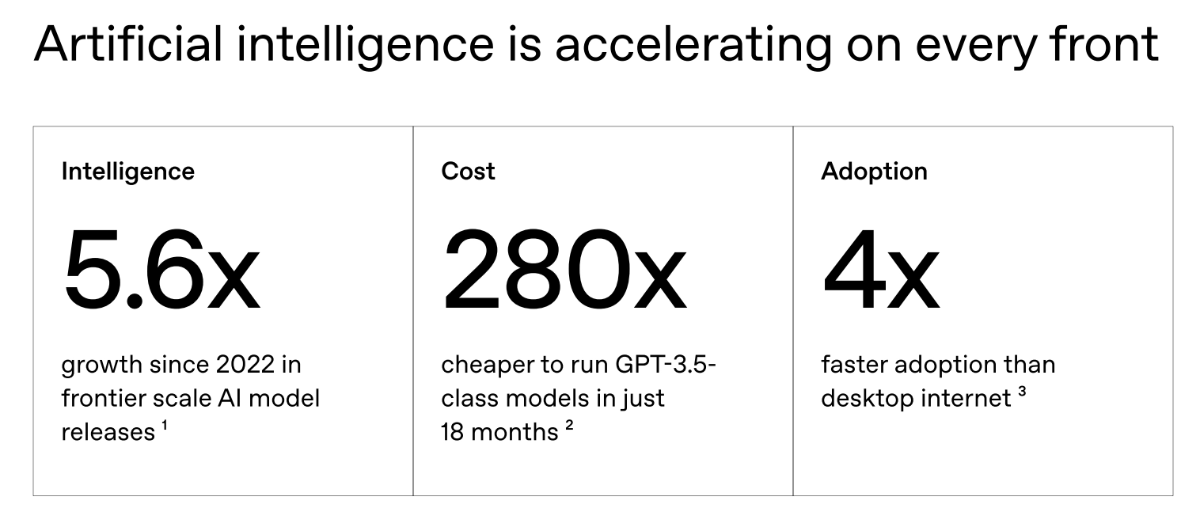
OpenAI points out the current state of AI development:
- The number of top-tier AI large model releases is 5.6 times higher.
- In just a year and a half, the cost of GPT-3.5-level models has dropped 280 times.
- The speed of AI adoption is a full 4 times faster than the adoption of computers and internet access back then.
The reality presents a split situation. Boston Consulting Group found that companies that act quickly have revenue growth 1.5 times that of their peers. A McKinsey survey shows that nearly half of employees feel no one is teaching or guiding them, and they are afraid or unable to use AI tools. AI creates opportunities and also brings anxiety. Based on collaboration experience with companies such as Estée Lauder, Notion, San Antonio Spurs,BBVA, OpenAI summarized five core principles.
Five Core Principles
Align: Unify thinking and build consensus
- Executives tell the story : The company's management must personally step up and explain clearly to all employees in plain language why AI is so important to the company's future. Is it because competitors have already fully adopted it? Or because customer demands have changed? Or because the old ways of making money no longer work? When employees hear a well-thought-out "why," they feel more secure.
- Set company-wide AI goals : Just having ideas is not enough; there must be a goal everyone can understand. There are many types of goals, such as developing new use cases, tracking usage frequency, encouraging more experimentation, etc. The key is to write the goals into the company's plans and KPI assessments, and repeatedly communicate them in all-hands meetings and company weekly reports.
- Leaders lead by using it : Leaders lead by using it, mainly to "demystify" it for everyone, letting them know AI is not mysterious. When employees see the CFO using AI to analyze markets and look at customer data, their doubts and fears will be greatly reduced.
- Department heads implement specifically : Department heads should regularly hold small meetings with their teams, and in the meetings, do not talk about vague strategy; discuss practical matters. For example, "Our department can use AI for these things," "Where else do you think it can be used?"
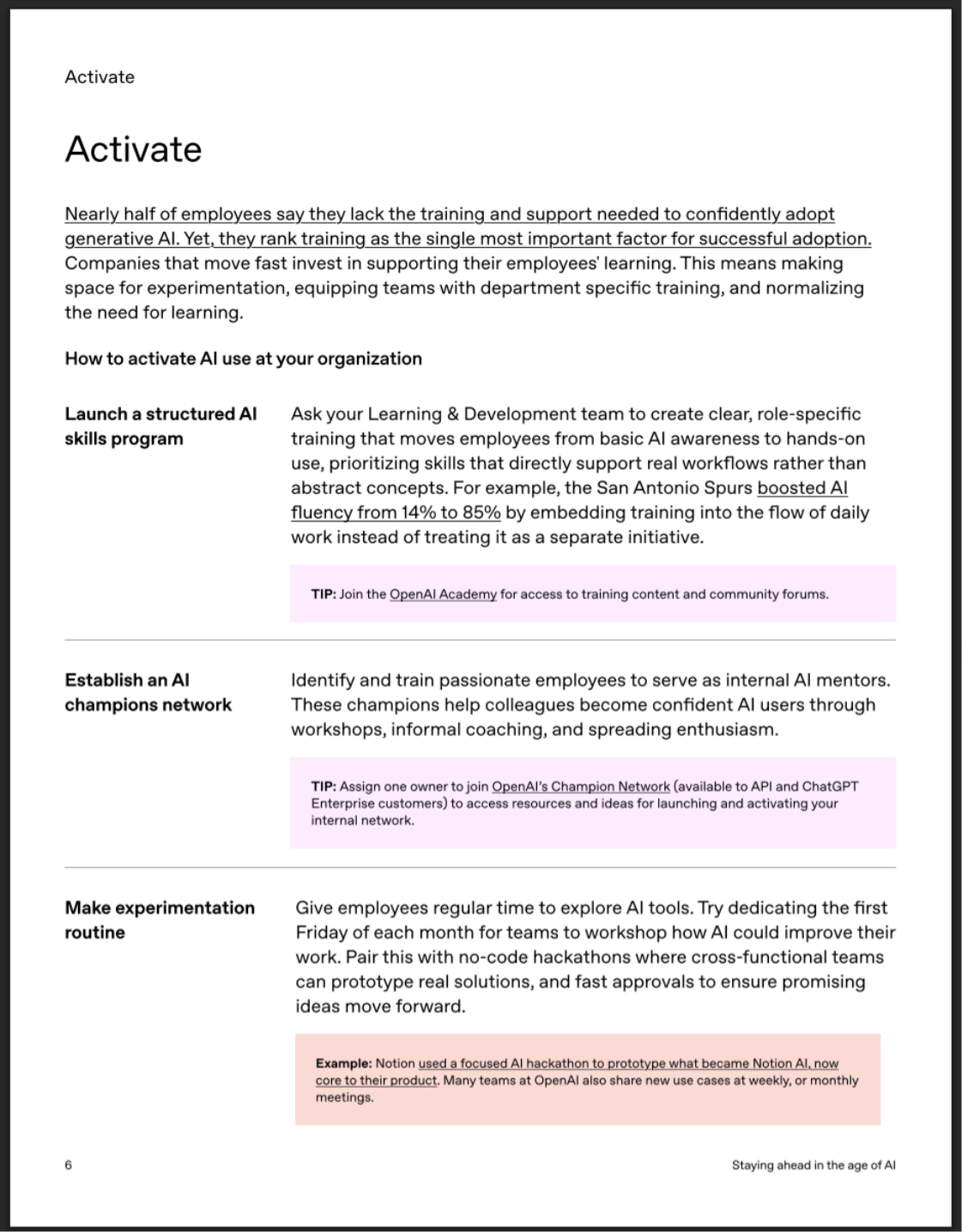
Activate: Empower employees and inspire motivation
- Set up proper AI training : The company's HR department should take the lead in designing a training curriculum that matches job roles. The goal of the course is to take employees from understanding what AI is to being able to use it proficiently in their own work.
- Find a group of "AI enthusiasts" : There are always some people in a company who are particularly interested in AI themselves. These people need to be identified and given more in-depth training so they can become the company's internal "AI teachers".
- Make "giving it a try" the norm : Innovation comes from trial and error. A company must create an environment where employees can safely experiment and make mistakes. For example, set aside fixed time, such as the first Friday of every month as "AI Friday", when everyone puts down their work and focuses on how to use AI to improve work; hold small competitions and organize no-code Hackathons, letting people from different departments team up and quickly turn AI ideas into prototypes using ready-made tools.
- Link AI contributions to promotions and salary increases : A company should clearly connect how well AI is used with employees' performance and development. For example, when setting work goals, add AI-related tasks for people in different roles; when promoting people or giving bonuses, specifically mention the person's contributions in AI.
Amplify: Share experience, spread results
- Build a unified AI knowledge base : Find a place that everyone can easily access, such as an internal shared document system, and put everything related to AI there. The knowledge base includes training materials and videos, schedules and results of various competitions, the company's rules and safety manuals for using AI, useful cases and Prompt templates, etc.
- Keep sharing success stories : Influence spreads through stories. A company needs to keep telling AI success cases internally, just like doing external publicity and public relations. There are many forms, such as regular AI briefings, internal sharing sessions, a fixed segment in all-hands meetings, etc.
- Build some active internal communities : A formal knowledge base alone is not enough; there needs to be a place for everyone to chat freely. Create some AI communication groups in the company's chat software, or set up a cross-department "AI group", so everyone can exchange ideas at any time.
- Praise more within teams too : In addition to company-level publicity, managers of each team should often praise good AI work in their own department meetings. Recognition from one's direct leader sends a strong signal.
Accelerate: Optimize processes, iterate quickly
- Let everyone easily access tools and data : System infrastructure not keeping up is a major problem for many companies using AI today. More and more companies are starting to give employees greater power, letting employees recommend and choose AI tools they find useful themselves, which speeds up productivity much faster.
- Establish a clear AI project application and evaluation process : A company needs to design a simple, transparent process. Let teams easily submit AI project ideas, get feedback quickly, and clearly know how the company evaluates ideas.
- Set up a cross-department "AI committee" that can make decisions : To break down walls between departments, a company needs a cross-department leadership group with enough power. The leadership group is led by executives, with members from technology, legal, business, and data departments. Its main job is not to manage things, but to "open the way".
- Let teams that make money have money to keep spending : The most direct method is rewards. If a team uses AI to save the company money or improve efficiency, give part of the saved resources back to that team, so employees have money and time to do more new experiments.
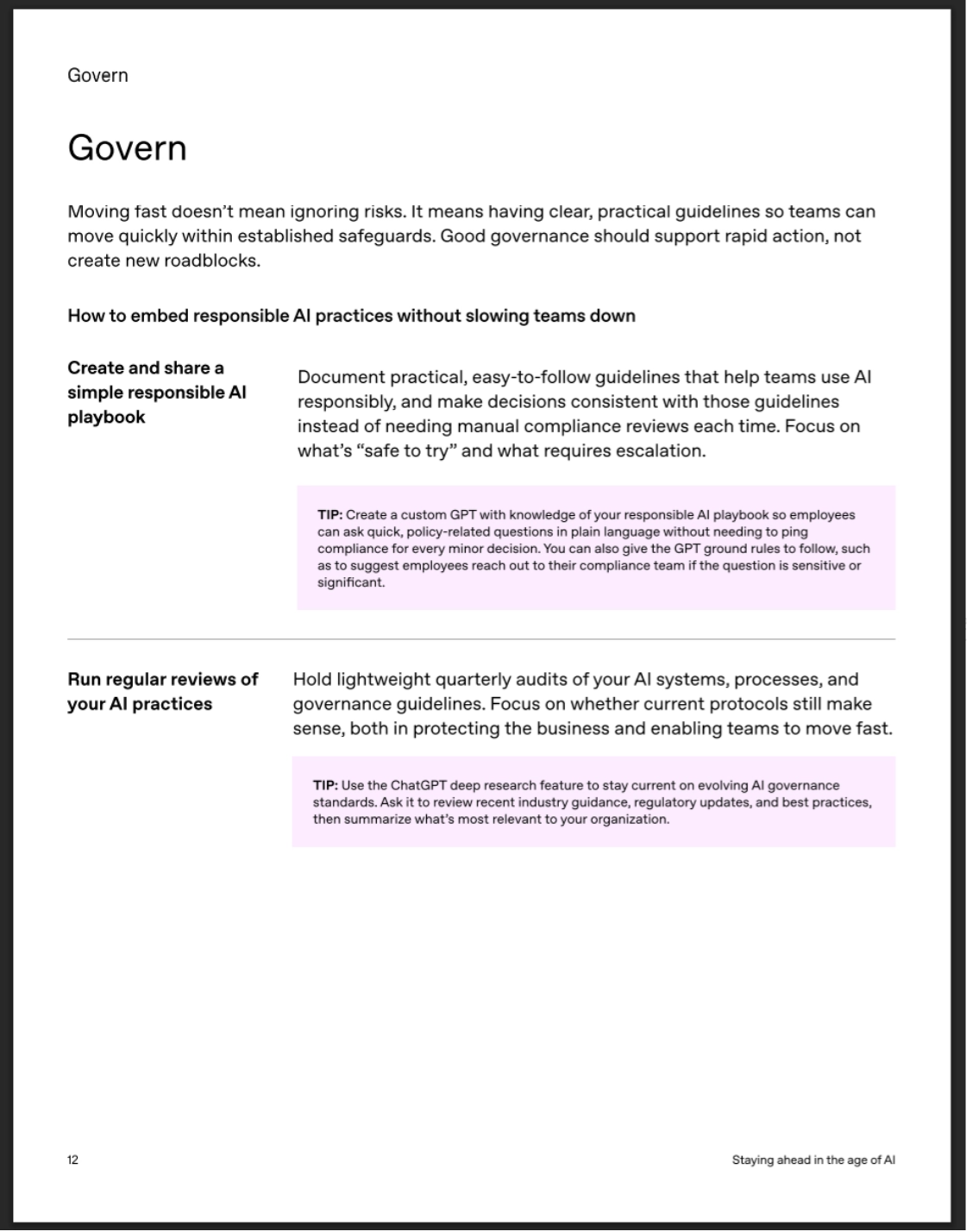
Govern: Regulate development, move forward steadily
- Write a simple and easy-to-understand "AI Safety Manual" : The company needs to turn complex regulations into a set of action guidelines that ordinary employees can understand and execute. The core of the manual is to make clear which things can be tried with confidence and which things need to be reported upward. When handling most daily work, everyone does not need to go to the legal or compliance department every time, and efficiency naturally improves.
- Regularly review and update AI rules : Management rules cannot remain unchanged. Every quarter, the company conducts a small-scale review to see whether the current systems, processes, and rules are still appropriate. During the review, two aspects should be examined: on the one hand, whether the rules have protected the company; on the other hand, whether they have inadvertently slowed down the pace of innovation.
Summary
The core idea of the entire guide is to use AI well; technical issues are secondary, and the key is organizational and cultural issues. This set of action guidelines launched by OpenAI is a complete corporate transformation methodology. It describes what an ideal "AI company" should look like. From the top level to lower levels, goals are aligned; from individuals to teams, skills match; from individual cases to systems, experience is shared; from ideas to implementation, processes are smooth; from innovation to operations, risks are controllable. If an enterprise wants to win in the AI transformation, it cannot merely treat AI as yet another new tool; it must truly treat AI as an entirely new way of working.
Get the OpenAI 《Staying Ahead in the AI Era》 report PDF original file. Scan the QR code to follow and reply: 20250904