
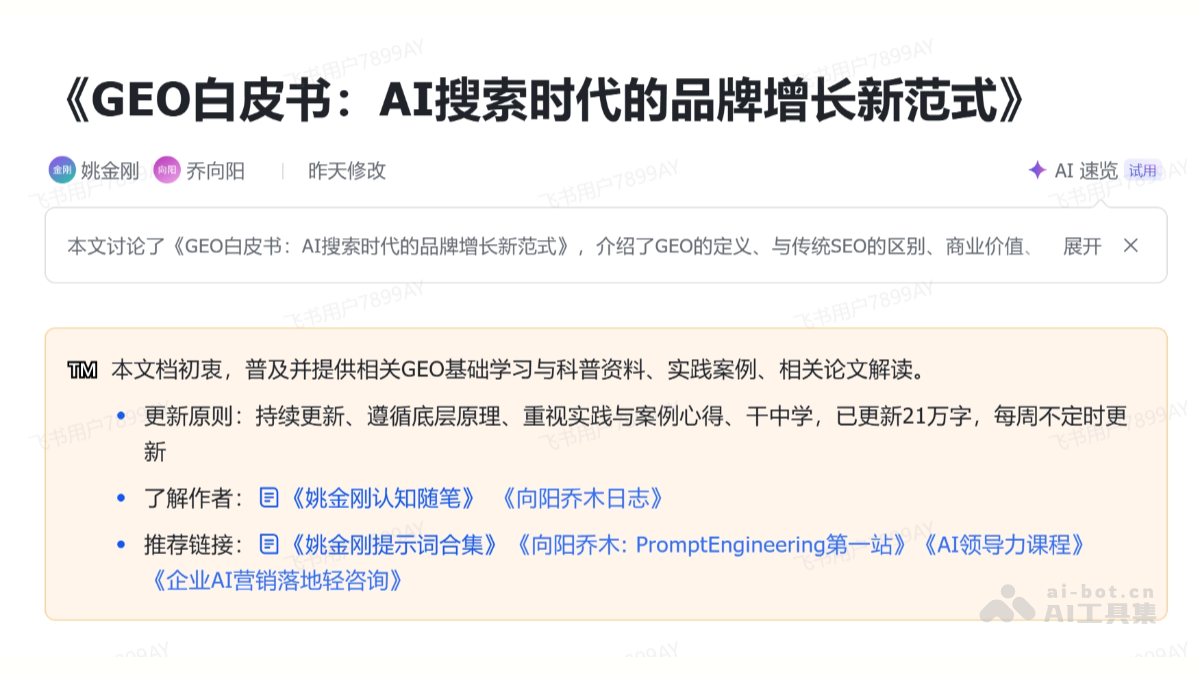
GEO White Paper: A New Paradigm for Brand Growth in the AI Search Era popularizes GEO-related knowledge, covering foundational learning, introductory materials, practical cases, and paper interpretations, following principles such as continuous updating and focusing on underlying principles and practice. The content uses a learning guide as its framework and unfolds in five parts: the first part explains the fundamentals and background of GEO, including its definition and comparison with traditional SEO; the second part reveals GEO methods, involving core technologies; the third part focuses on GEO content, discussing key points such as authority; the fourth part answers questions across multiple dimensions through Q&A; the fifth part collects related papers, providing comprehensive reference for GEO learning. The white paper offers new ideas for enterprise marketing in the AI search era, helping enterprises precisely reach users and enhance brand influence, and is an important reference for enterprises responding to the AI search transformation.
Main Content of the White Paper
Fundamentals of GEO
- Definition and Core Goals of GEO
GEO, or Generative Engine Optimization, mainly involves content optimization for AI answer engines. Its core goal is to make content fit the crawling and understanding logic of AI answer engines, increasing the chance of being selected, and thereby using AI-generated answers to precisely deliver brand information, product value, and more to target users, enhancing brand exposure and influence. For example, when a user asks an AI search tool for purchasing advice on a certain type of product, brand content optimized through GEO is more likely to appear in the answer provided by the AI.
- Comparison Between GEO and Traditional SEO
| Comparison Dimension | Traditional SEO | GEO |
|---|---|---|
| Core Goal | Improve a webpage's ranking in search engine results pages, attracting users to click through to the webpage to obtain information | Enable content to be directly integrated by AI answer engines into generated answers, without users needing to jump to a webpage |
| Optimization Target | Search engine algorithms, focusing on factors such as keyword ranking, number of backlinks, and webpage authority | Content understanding and generation algorithms of AI answer engines, with greater emphasis on the authority, accuracy, and degree of structure of content |
| User Reach Path | User searches → views search results → clicks a link → enters the webpage to view content | User searches → AI directly generates an answer containing the target content → user directly obtains information |
| Content Presentation Form | A complete webpage, including various elements such as title, body text, images, and navigation | Fragmented, high-value core information, such as key knowledge points, solutions, and core product advantages |
- Commercial Value and Trends of GEO
At a time when AI search is becoming increasingly widespread, the commercial value of GEO is becoming more prominent, helping brands seize the important traffic entrance of AI answer engines. When users search for related content, optimized brand content can be displayed preferentially and obtain more traffic. At the same time, it reduces the cost for users to obtain information and enhances users' favorability toward the brand. In the long run, continuously producing high-quality GEO content helps brands establish an authoritative image in AI answer engines and accumulate brand awareness and trust. With the continuous development of AI technology, GEO will play an even more critical role in future commercial activities.
- Industry Impact and Challenges
The rise of GEO brings new opportunities and challenges to various industries. On the one hand, it drives an overall improvement in industry content quality, prompting brands to provide more authoritative and accurate content; for small and medium-sized brands, it further offers the opportunity to quickly gain exposure through high-quality content. On the other hand, the opacity of AI answer engine algorithms means optimization efforts require continuous experimentation and exploration; if many brands adopt similar GEO strategies, it can easily lead to content homogenization, making it difficult to form a differentiated competitive advantage.
GEO Method Analysis
- Core Technology Revealed
When AI answer engines operate, they first crawl content through crawler technology, tending to crawl information from authoritative sources (such as official websites and well-known industry platforms) and with clear formats (such as structured documents and content presented in bullet points). Next, they use natural language processing (NLP) technology to analyze the content, extract core information, and judge accuracy and relevance. Based on "priority rules," they filter content and integrate content that is highly authoritative, accurate, and aligned with user needs into generated answers. When conducting GEO optimization, users should focus on improving the crawlability, understandability, and quality of content.
- The AI Answer Generation Process
AI answer generation includes three stages: information integration, logical organization, and language generation. In the information integration stage, AI filters relevant information based on the user's search keywords, and content that is authoritative, accurate, and relevant is prioritized. In the logical organization stage, AI sorts the information according to the logic of user needs. In the language generation stage, AI transforms the organized information into a natural and fluent answer, and concise and precise content is more likely to be cited or rewritten. To better integrate content into AI answers, it is necessary to improve adaptability in these three stages.
- Legal and Ethical Considerations
When implementing a GEO strategy, legal regulations and ethical standards must be strictly observed. Legally, attention must be paid to copyright protection; one must not plagiarize or misappropriate others' content, and sources must be cited when quoting; content involving brand promotion and product marketing must comply with the requirements of the Advertising Law, and must not use absolute wording or engage in false advertising. Ethically, one must not generate low-quality or repetitive content merely to be selected by AI, thereby interfering with the accuracy of AI answers; content must be truthful and objective, respect user rights, and especially in special fields such as healthcare, ensure the professionalism and safety of information.
GEO Content Creation
- Authority and E-E-A-T
E-E-A-T is an important framework for evaluating content quality and is equally applicable to GEO. E (Experience) represents experience, and creators should preferably have practical experience in the relevant field; E (Expertise) indicates professionalism, and content should reflect professional knowledge; A (Authoritativeness) refers to authority, and content sources should be reliable; T (Trustworthiness) is credibility, and content should have a factual basis. Methods for improving content E-E-A-T include adding creator introductions, citing authoritative sources, and including real cases.
- Content Structure and Format
To make it easy for AI to understand content, attention must be paid to structure and format when creating it. Titles should clearly include core keywords and clarify the content topic. Organize content using bullet points and avoid piling up large blocks of text. Highlight key information through bolding, underlining, and similar methods, and do not over-decorate. Maintain consistent formatting to reduce factors that interfere with AI's understanding of the content.
- Content Differentiation Strategy
Among the many GEO content pieces, achieving differentiation can enhance competitiveness. Start with angle differentiation by choosing niche but valuable content angles; try format differentiation by adopting new content formats favored by AI, such as flowcharts and comparison tables; or provide value differentiation by sharing exclusive information, such as practical summarized tips and internal data statistics on industry trends.
GEO Q&A
- Basic Cognition: “Do all industries need to do GEO?” “Will GEO replace traditional SEO?”;
- Methodology and Practice: “How do you determine whether content has been indexed by AI?” “How should content update frequency be set?”;
- Technology and Tools: “Which GEO tools are suitable for beginners?” “Can people with no technical background do GEO?”;
- Effects and Measurement: “What metrics are used to measure GEO effects?” “How long until effects can be seen?”;
- Challenges and Misconceptions: “How do you respond to AI algorithm opacity?” “Which content optimization misconceptions should be avoided?”;
- Future Trends: “How will GEO technology develop?” “What are the industry application directions?”.
GEO Papers
Using the core paper “GEO: Generative Engine Optimization” as an entry point, interpret the underlying logic of GEO, for example: the essence of GEO is “human-machine collaboration” (AI needs high-quality human content as material), “semantic relevance is more important than keyword matching” (AI places more emphasis on content fitting user needs rather than keyword stuffing), and “brand information consistency supports long-term authority” (consistent content across multiple platforms can enhance AI’s trust in a brand), providing theoretical reference for in-depth researchers.
Key content extraction from the whitepaper: 10 core points you must master
- The Core of GEO: “Getting content into AI answers,” rather than “getting web pages to rank at the top of search results”;
- Core Differences from Traditional SEO: The optimization target changes from “search engine algorithms” to “AI content understanding/generation algorithms,” and user reach changes from “jumping to web pages” to “directly reading AI answers”;
- Core of Commercial Value: Seize the AI search traffic entrance, reduce users’ decision-making costs, and accumulate brand authority over the long term;
- Three Major Preferences in AI Content Selection: Authoritative sources, clear structure, and high-quality information;
- E-E-A-T : The core standard for content authority; all four elements are indispensable;
- Content Structuring Is Key to AI Adaptation: Use bullet points, headings, highlight key points, and unify the format;
- Differentiation Is Key to Breaking Through in GEO Content: Find differences in angle, format, and value;
- Three Metrics for Measuring Effects: Exposure (number of times cited by AI), conversion rate (guiding user behavior), and authority (frequency of being cited/preferentially selected);
- Low Practical Threshold for Beginners: No complex technology is needed; mastering the principles of “authority – structure – differentiation” is enough to get started;
- Long-Term Trends: GEO will deeply integrate with brand marketing, technology will become more adaptable to vertical industries, and services will become more lightweight.
Whitepaper address
- Address:https://yaojingang.feishu.cn/docx/Jv85dXAeZoKJ7exJi4Yc4Edrnhf
Target audience for the whitepaper
- Corporate decision-makers and managers: They need to understand the current state of the GEO industry and its core technologies in order to formulate strategic decisions for their companies, accurately position themselves in the complex AI ecosystem, and achieve sustainable growth.
- Marketing personnel: Master practical GEO optimization methods to optimize content expression, enable AI to proactively recommend corporate content, precisely reach users in AI dialogue scenarios such as WeChat, Douyin, and Zhihu, and enhance brand influence and marketing effectiveness.
- Small and medium-sized enterprise practitioners: Small and medium-sized enterprises have limited budgets and lack technical resources. The information on lightweight GEO services provided in the whitepaper can help users quickly validate GEO results at a relatively low cost and explore development paths suitable for themselves.
- Industry researchers: With the whitepaper's in-depth analysis of the GEO industry, understand industry trends, technological development trends, and the situation of market participants, providing reference basis for research.