
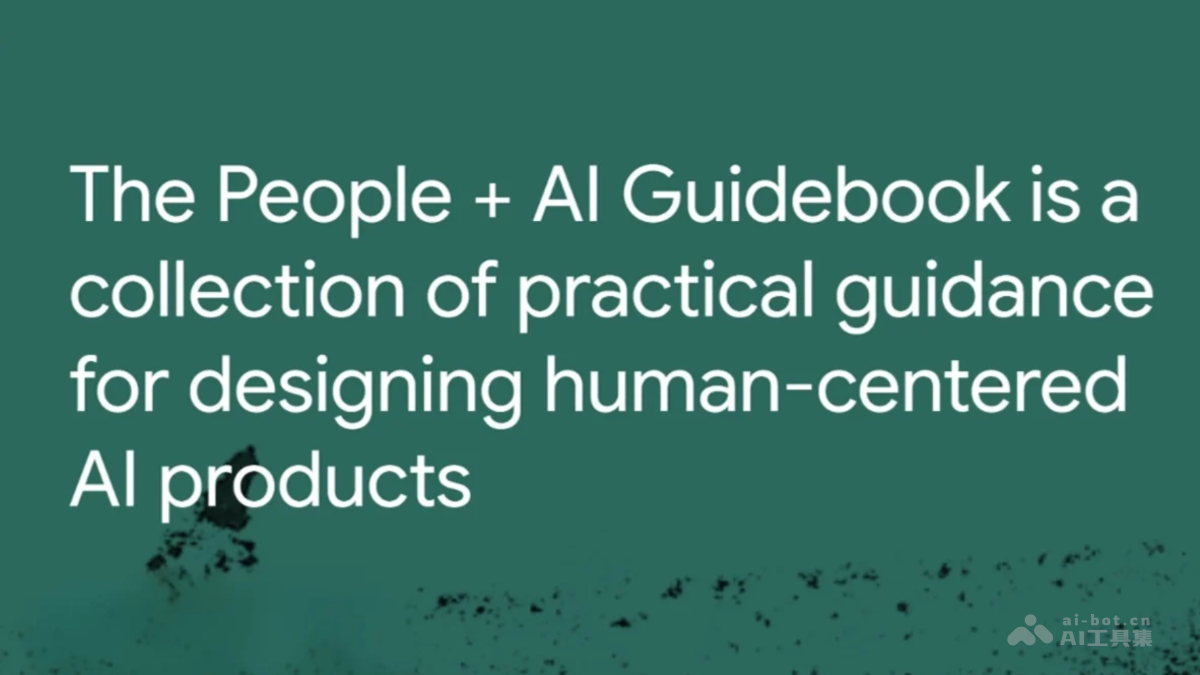
"The People + AI Guidebook" is launched by Google to help designers and developers create human-centered AI product development. The guide systematically provides methodologies across six core dimensions, from defining user needs and managing mental models to building trust and handling errors, complete with specific design patterns, workshop plans, and real-world case studies. "The People + AI Guidebook" helps teams balance technical capability with user experience, providing practical tools validated through Google products, helping developers build reliable, transparent, and collaborative AI systems. It is an authoritative reference framework in the field of AI product design.
Core Content
The foundation of "The People + AI Guidebook" is a philosophical shift: the goal of AI products is not to pursue higher accuracy or faster speed, but to augment human capabilities and serve human needs. The guide emphasizes that AI systems are partners "dancing with people." The focus of design is on how to make the collaborative relationship natural, trustworthy, and efficient.
Six Core Dimensions
- User Needs and Defining Success: Emphasizes the importance of deeply understanding users' real needs, not just focusing on technical implementation. Provides methods for translating user goals into measurable metrics, helping teams establish dual success criteria that balance technical efficacy and user experience. Through a clear definition of success, it ensures product development is always oriented toward user value.
- Mental Models and Expectations: Explores how users understand how AI systems work, and how design can guide the formation of accurate expectations. Provides specific strategies for managing user expectations, ensuring consistency between system capabilities and user perceptions, which helps reduce user confusion and improve product usability.
- Trust and Explanation: Focuses on how to build user trust through transparency and explainability design. Provides a multi-level explanation framework that lets users understand system decisions and maintain confidence in the technology. These design principles are crucial for building trustworthy AI systems.
- Errors and Graceful Degradation: Explores the inevitability of AI system errors and how to turn errors into positive experiences. Provides a complete strategy from error prevention to recovery, ensuring the system handles failures gracefully. Through carefully designed fault-tolerance mechanisms, it maintains continuity in user experience.
- Data Collection: Discusses the importance and methods of high-quality data collection, covering the entire process from data acquisition to quality assessment. Emphasizes data ethics and privacy protection, ensuring responsible data practices, and helping teams build a reliable data foundation.
- Feedback and Control: Explores how to design effective user feedback mechanisms so that users can influence and improve system performance. Provides practical solutions for finding the best balance between automation and user control, giving users appropriate control and enhancing product interactivity.
Core Highlights and Features
- Highly Practical: The guide provides specific design patterns, such as how to display confidence levels and how to design feedback buttons, which designers can directly reference.
- Rich Supporting Resources: Includes a glossary (to unify team language), workshop guides (to help teams collaborate and implement), and case studies (showing how Google products apply these principles), forming a three-dimensional learning ecosystem.
- Forward-Looking and Authoritative: The guidebook originates from Google's years of frontline practice and research, and embodies industry leaders' thinking on "responsible AI" and "human-centered AI," offering high reference value.
Official website address of "The People + AI Guidebook"
https://pair.withgoogle.com/guidebook/
Summary
"The People + AI Guidebook" provides a complete methodological system for AI product development, helping teams create intelligent products that are both technologically advanced and human-centered. This guidebook is an important bridge connecting technological innovation and user experience, and is worthy of in-depth study and application by all AI product developers. By putting its principles and methods into practice, teams can build more responsible and more trustworthy AI systems.