
Alibaba's "New Paradigm of AI Application (AI Agent) Development" is a guiding document on AI application development. It provides a detailed introduction to the development models, architecture design, core components of AI Agents, and how they integrate with large language models (LLMs). The document emphasizes the evolution of AI Agents from traditional tools to intelligent partners, enabling automated execution of complex tasks based on LLM reasoning capabilities and tool invocation. The article explores the construction of enterprise-level MCP services, the choice of development paths for AI applications, and the application of cloud-native technologies in AI applications. "New Paradigm of AI Application (AI Agent) Development" provides best practices for technologies such as Function Compute and cloud-native API gateways in AI Agent development, helping enterprise developers better understand and apply AI technologies and driving intelligent business transformation.

Get Alibaba's "New Paradigm of AI Agent Development Collection" PDF original file, scan the QR code to follow and reply: 20250722
Overview of AI Applications
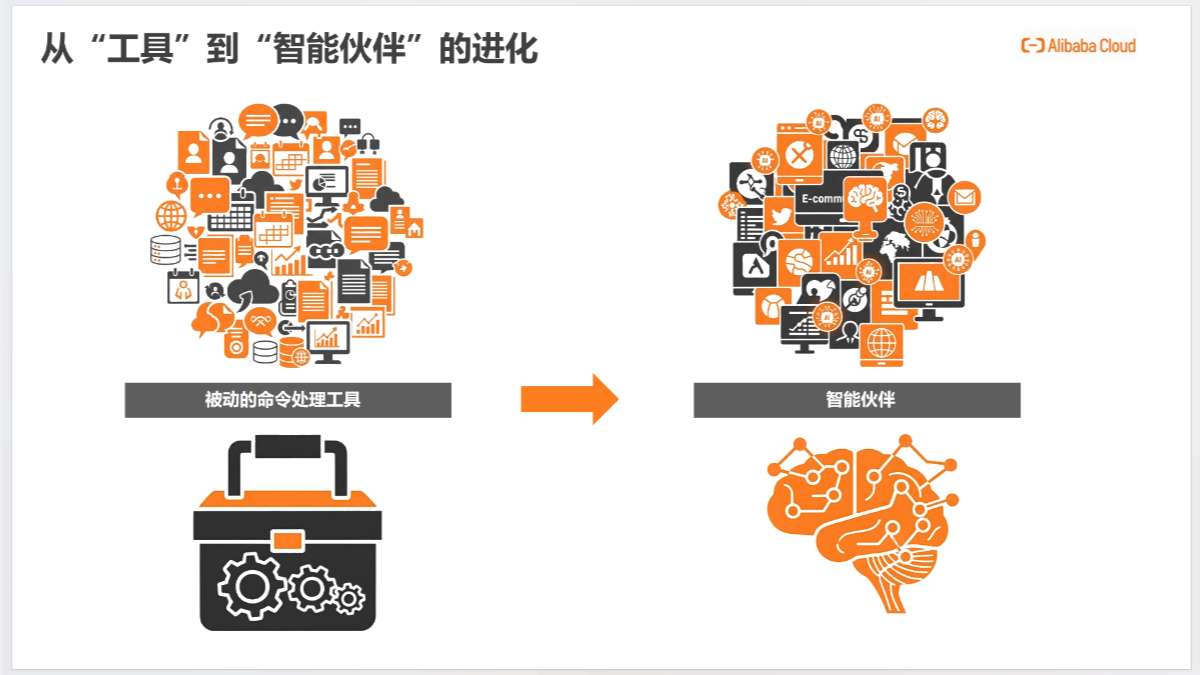
- Evolution from "Tools" to "Intelligent Partners": AI applications have evolved from tools that passively execute commands into intelligent partners capable of interacting with the environment, understanding intent, and self-improving.
- The Dual-Engine Model of AI Agent + LLM: LLM serves as the "brain" responsible for thinking, while AI Agent serves as the "hands and feet" responsible for execution, and the two work in coordination.
- MCP Services as the Core of Enterprise Capabilities: MCP services standardize multi-party collaborative relationships, solve the pain points of building AI Agent skill systems, and enable rapid integration.
- Two Paths to Building AI Applications: Brand-New Development vs. Existing System Transformation: Brand-new development is suitable for disruptive innovation, while existing system transformation is suitable for embedding AI capabilities into existing businesses.
Overview of AI Agent
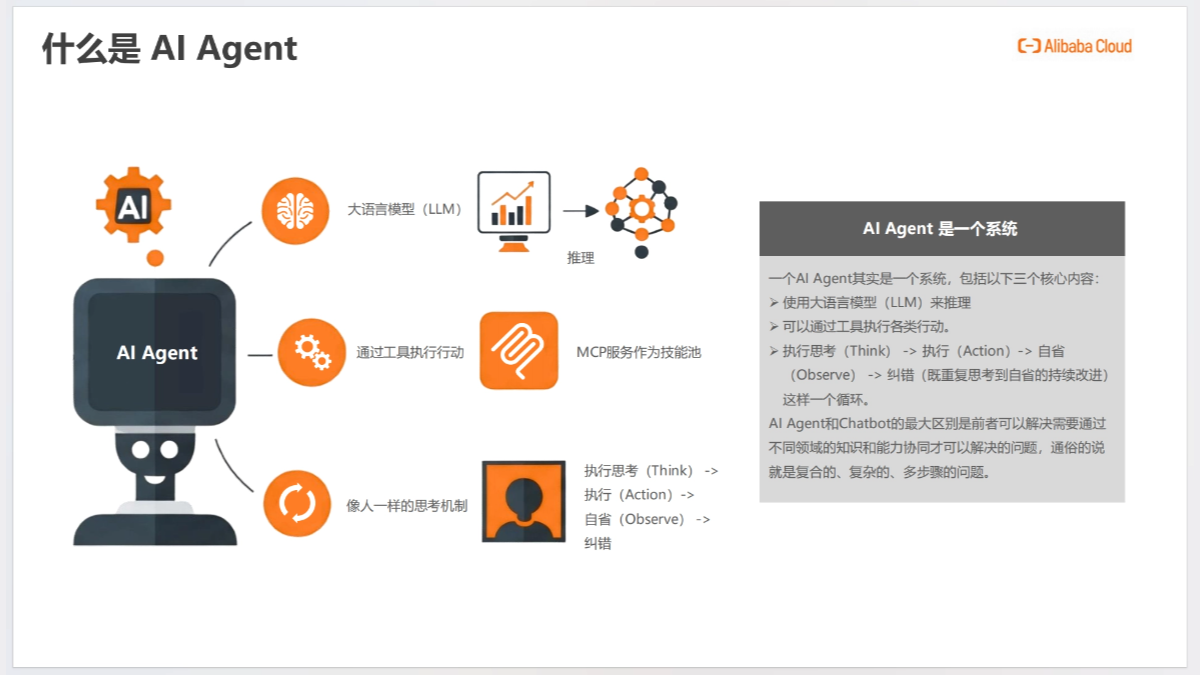
- What Is an AI Agent: An AI Agent is an intelligent system that reasons through large language models, executes actions, and continuously self-reflects and corrects errors, enabling it to solve complex problems.
- Core Components of AI Applications: An AI Agent consists of LLM reasoning, tool execution, and a self-reflection loop, enabling it to solve complex problems.
- The ReAct Mode of AI Agent Reasoning: An AI Agent completes tasks through analysis, reasoning, action, observation, and self-reflection.
- AI Agent Construction Modes and AI Agent Types: Construction modes include coding-based and low-code-based; types include foundation model assistance, standalone products, and assistance for existing businesses.
- Core Issues in Building AI Agents: How to build an enterprise-level MCP management system and choose an appropriate runtime are key.
Overview of Function Compute FC
-
What Is Alibaba Cloud Function Compute FC: Function Compute is an event-driven fully managed compute service. Users do not need to manage infrastructure and use resources on demand.
-
Function Compute FC Is the Connector for Cloud Products: Through the event-driven model, Function Compute can connect multiple cloud products and implement automated processes.
-
Function Compute FC Trigger Types: It supports bidirectional integration, unidirectional integration, and cloud product event triggers to meet different business needs.
-
Function Compute FC Is the Adhesive Between Cloud Products: It provides native triggers for multiple cloud products, helping users quickly build linked processes.
-
Customer Cases: Showcases application cases of Function Compute in different business scenarios.
-
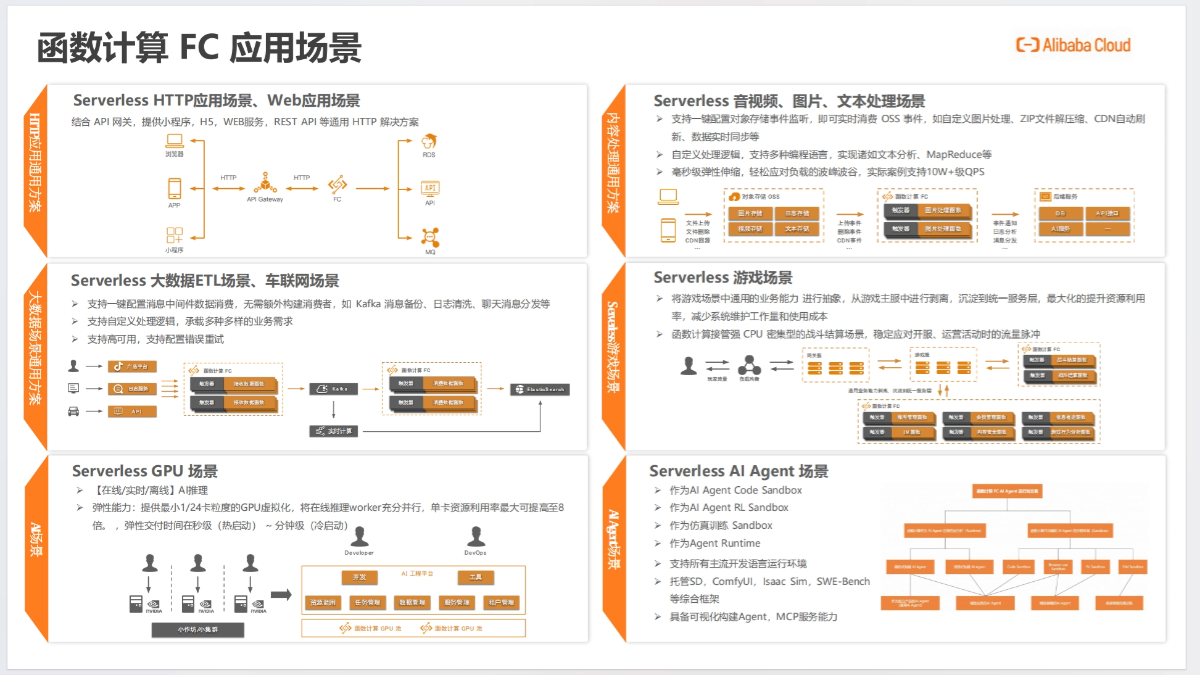
Function Compute FC Application Scenarios: Introduces the specific applications of Function Compute in scenarios such as HTTP applications, content processing, big data, gaming, and AI.
Function Compute FC as the AI Agent Runtime
-
Function Compute FC Supports the AI Agent Solution Topology Diagram: Shows the overall architecture of Function Compute as the AI Agent runtime.
-
Function Compute as a Computing Resource for Running AI Agents – Coding Style: Function Compute provides a highly elastic and highly secure runtime environment and supports multiple languages and frameworks.
-
Two Types: AI Agents running on Function Compute include two types: user-defined and framework-developed.
-
Advantages and Features: Function Compute supports trigger mechanisms, request-based scaling, dynamic storage mounting, etc., improving resource utilization and flexibility.
-
Building a Chat AI Agent with Function Compute: Solves issues such as execution environment interaction, dependency package uncertainty, and file information path uncertainty.
-
Function Compute FC + CloudFlow Visual Construction of AI Agents: Quickly build AI Agents through visual tools, supporting multiple scheduling schemes.
-
AIStudio Console: Provides a platform for visually building AI Agents, supporting functions such as project management and process orchestration.
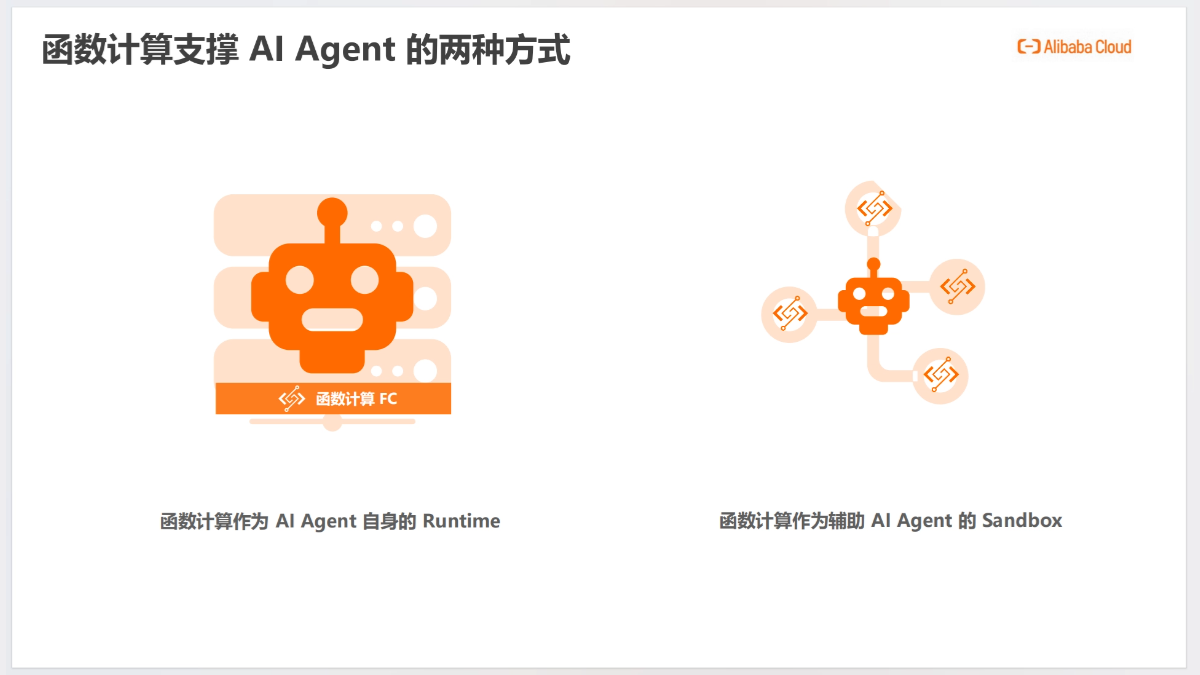
Function Compute FC as an AI Agent Sandbox
-
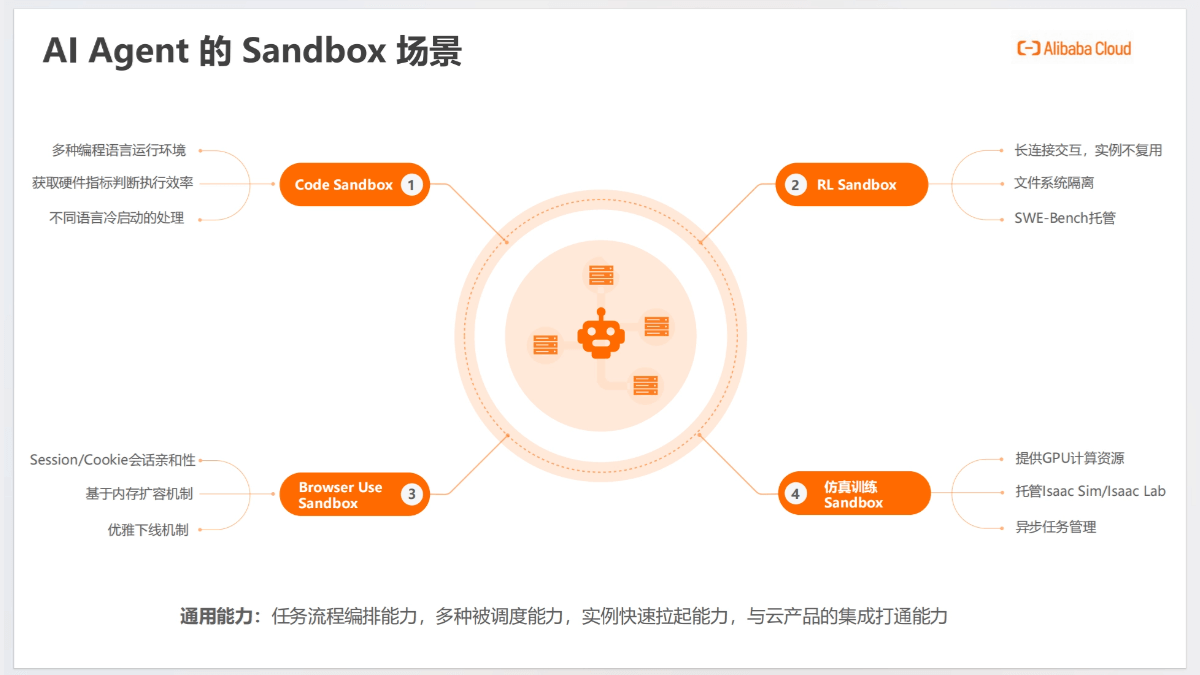
AI Agent Sandbox Scenarios: Introduces different scenarios such as Code Sandbox, Browser Use Sandbox, RL Sandbox, and Sim Sandbox.
-
Code Sandbox: Used to assist in training the coding capabilities of foundation models and support real-time display of users' coding tasks.
-
Advantages of Code Sandbox on FC: Supports runtime environments for multiple programming languages and provides hardware metrics and multi-threaded execution capabilities.
-
Browser Use Sandbox: Used for online search and assisted data collection, supporting Session/Cookie affinity and memory-based scaling.
-
Advantages of Browser Use Sandbox on FC: Supports session affinity, optimizes cold start, and solves latency issues.
-
RL Sandbox: Used for targeted reinforcement learning of LLMs or AI Agent algorithms.
-
Advantages of RL Sandbox on FC: Provides security, high efficiency, and reproducibility, and supports GPU computing resources.
-
Sim Sandbox: Used for embodied intelligence simulation training and supports multiple GPU card types.
-
Advantages of Sim Sandbox on FC: Supports the Isaac Sim/Isaac Lab environment and has asynchronous task management and simulation training capabilities.
Introduction to Cloud Native API Gateway & AI Gateway
-
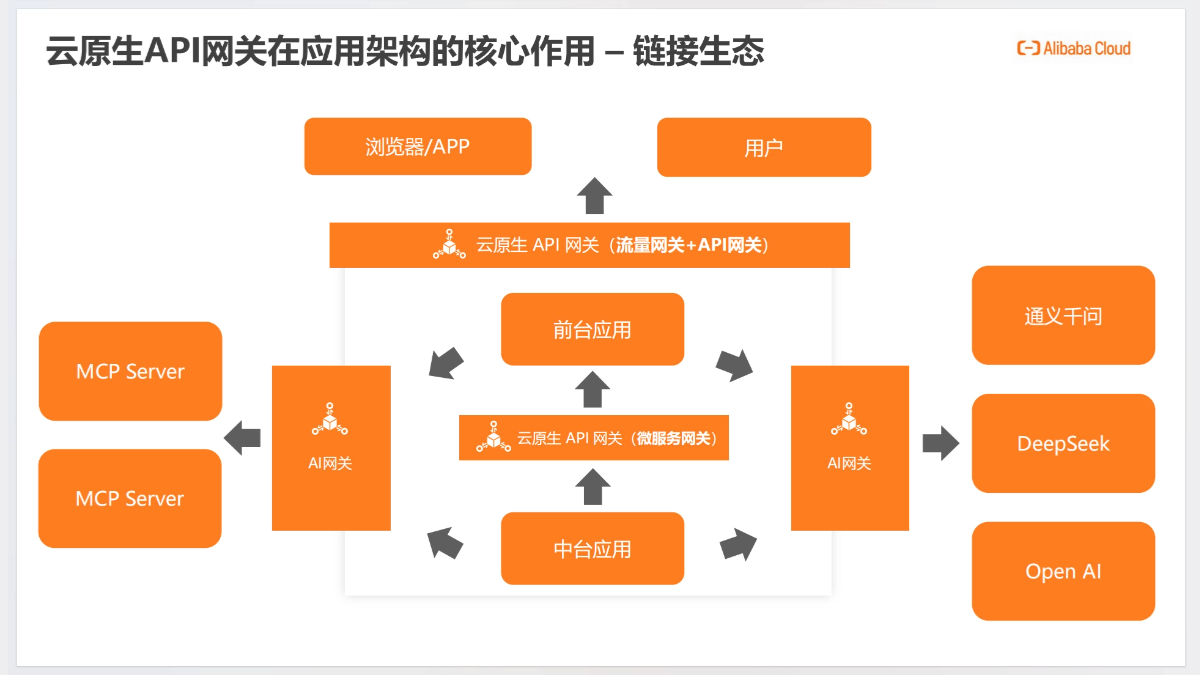
Introduction to Cloud Native API Gateway: Cloud Native API Gateway integrates multiple gateway functions and supports unified east-west and north-south traffic management.
-
The Core Role of Cloud Native API Gateway in Application Architecture – Connecting the Ecosystem: As a traffic gateway and API gateway, it connects different applications and services.
-
Cloud Native API Gateway – Traffic Gateway: Provides functions such as security protection, traffic protection, and service governance to ensure traffic stability.
-
Cloud Native API Gateway – API Gateway: Supports the API First development model and provides functions such as API protection and monetization.
-
Cloud-native API Gateway – Internal Practice: Practice cases within Alibaba Group, demonstrating its stability and performance.
Best Practices for AI Gateway Proxying LLM
- Problems Customers Inevitably Encounter in LLM Production Projects: Customers face multiple challenges in LLM production projects, including high hardware costs, model hallucinations, single-model risks, compliance audits, performance bottlenecks, and API Key quota limits.
-
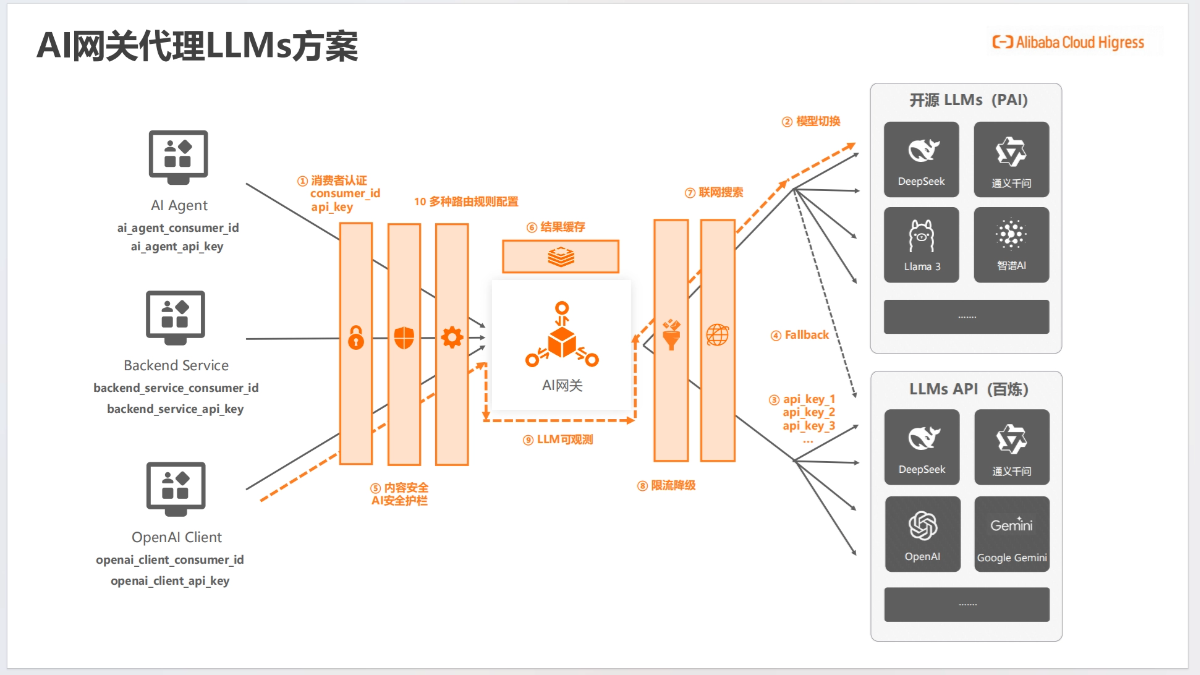
AI Gateway Proxying LLMs Solution: Implementing multi-model routing, switching, rate limiting and degradation, and other capabilities through the AI gateway.
-
Core Benefits of the Cloud-native API Gateway Proxying LLMs Solution: It solves issues such as cost balance, model hallucinations, and multi-model switching.
-
Best Practices for AI Gateway Proxying LLM: It provides solutions to issues such as consumer management, high availability of model services, and QPS/Token limits of closed-source models.
MCP Overview
-
What Is MCP: MCP is a standardized protocol used to connect LLMs with external data sources and tools.
-
Standardization: MCP simplifies the integration of different data sources and tools by standardizing the way LLMs access external data.
-
Modularity: MCP promotes modular design, allowing different components to be independently developed and maintained.
-
Scalability: MCP makes it easy to add new data sources or tools without major modifications to existing systems.
-
Security: MCP provides structured access patterns, ensuring that data interactions are secure and controlled.
-
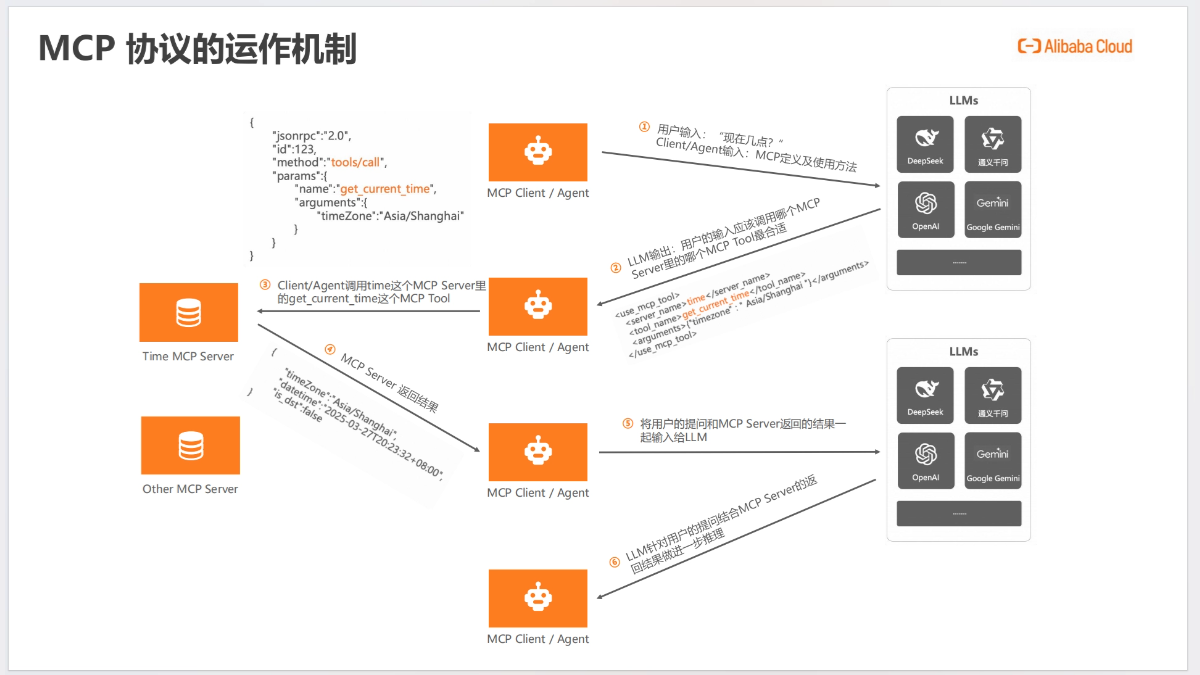
How the MCP Protocol Works: It describes processes such as user input, LLM reasoning, and Client/Agent calling the MCP Server.
-
Differences Between MCP and Function Calling: MCP is a general protocol-layer standard, while Function Calling is a proprietary capability provided by large model vendors.
-
The Essence and Challenges of MCP: The essence of MCP is the combination of system prompts and collaborative relationships, and it faces challenges such as system prompt management, security, and conversion of existing business systems.
Best Practices for AI Gateway Proxying MCP Services
-
AI Gateway – MCP Functional Architecture: Introduces the MCP functional architecture of the AI gateway, including built-in MCP Server, third-party services, enterprise services, etc.
-
Zero-code Transformation of Traditional Business into MCP Server – Scenario 1: Through the AI gateway, traditional business is transformed into an MCP Server with zero code, enabling rapid protocol conversion.
-
Solving Customer Pain Points: It solves the pain points customers face when developing AI applications or AI-enhancing existing business systems.
-
Rapid Protocol Conversion: Through the gateway, traditional services registered in Nacos are converted into MCP services, supporting multiple languages and services.
-
Definition and Features of MCP Registry: Introduces the definition and features of MCP Registry, including RESTful API, health checks, environment configuration support, etc.
-
Incremental Value of MSE Nacos as MCP Registry: MSE Nacos provides additional features, such as security management, multiple publishing methods, and multi-version management.
-
Zero-code Transformation of Traditional Business into MCP Server – Scenario 2: Through MSE Nacos dynamic service discovery and registration, achieve zero-code transformation of traditional businesses.
-
Convert SSE to Streamable HTTP: Convert the SSE protocol of the MCP paradigm to the more flexible Streamable HTTP protocol.
-
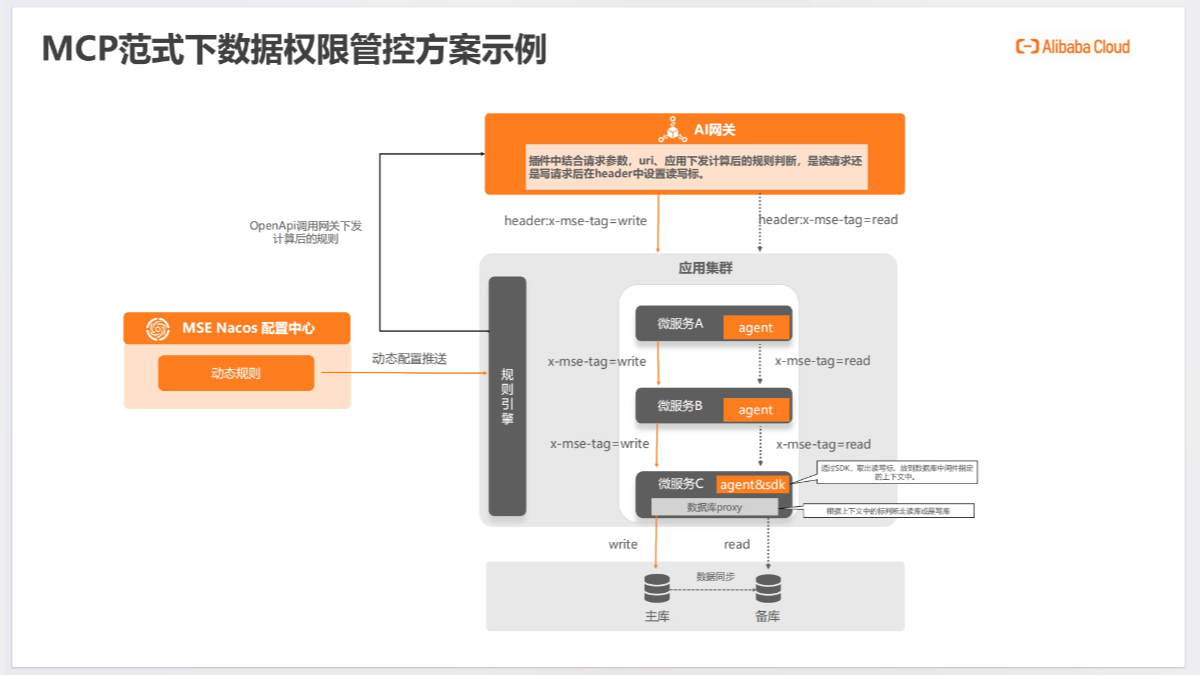
Identity authentication and permission control in MCP mode: Provide multiple authentication methods through a plugin mechanism, flexibly manage and control Client identity authentication and MCP service usage permissions.
-
Plugin mechanism for flexibly setting MCP service proxy policies: Support flexible configuration of MCP service proxy policies through a plugin mechanism, such as concurrency control, traffic control, etc.
MSE Nacos MCP Registry Best Practices
- Nacos Open Source Community Development Status: Since Nacos was open-sourced in 2018, it has gained a great deal of attention and usage, becoming the preferred service registration and configuration center in China, and is widely used by many leading enterprises.
- MSE Nacos Applicable Scenarios: MSE Nacos is applicable to various scenarios such as service management, traffic scheduling, whitelisting, and application disaster recovery, and supports unified management and control of MCP Server in microservices, high availability, frontend ecosystems, database domains, and the AI domain.
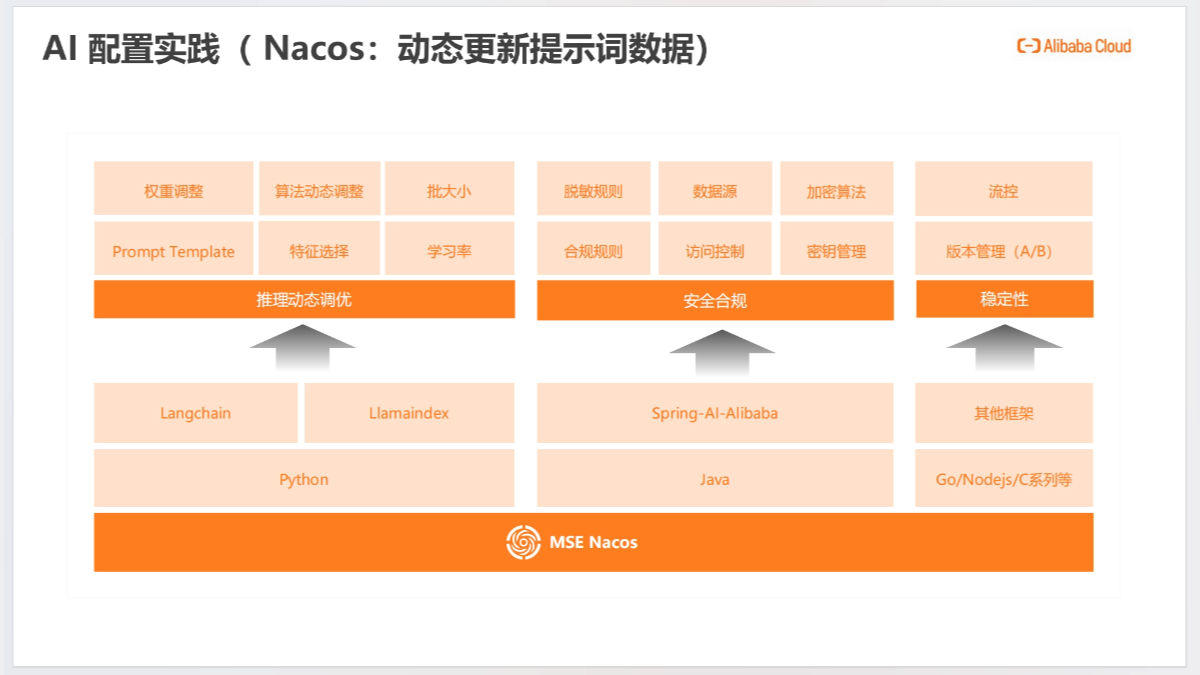
- AI Configuration Practice (Nacos: Dynamically Updating Prompt Word Data): Through MSE Nacos, dynamically update prompt word data in AI applications, supporting multiple AI frameworks and languages to meet different business needs.
- MSE Nacos 3.0 – MCP Register: MSE Nacos 3.0 provides an enterprise-grade MCP Registry, supporting service registration, discovery, health checks, security control, and other functions, and combines with the cloud-native API gateway to implement MCP protocol conversion.
- MSE Nacos 3.0 Builds an Enterprise-Grade MCP Registry: As a superset of the official MCP Registry, MSE Nacos 3.0 provides enhanced features such as private deployment, advanced retrieval, and security control, solving the problems of multi-MCP service retrieval and token consumption.
- MCP: Security Guarantees (Planned): It is planned to provide MCP marketplace proxy, MCP interaction, and MCP Server security guarantees to ensure the security of the MCP ecosystem.
- MCP Effectiveness Verification System - Planned: It is planned to build an MCP Server effectiveness verification system, realize precise trigger verification of MCP tools by Agents, and provide effectiveness display views and dynamic adjustment suggestions.
Best Practices for Building Agents Based on Function Compute FC
-
MCP Server on FC Reuses High-Performance Capabilities: Function Compute reuses the high-performance capabilities of the cloud-native API gateway, supporting high concurrency and low latency.
-
MCP Server on FC Observability System: Achieve observability of Function Compute through trace tracking, log services, etc.
-
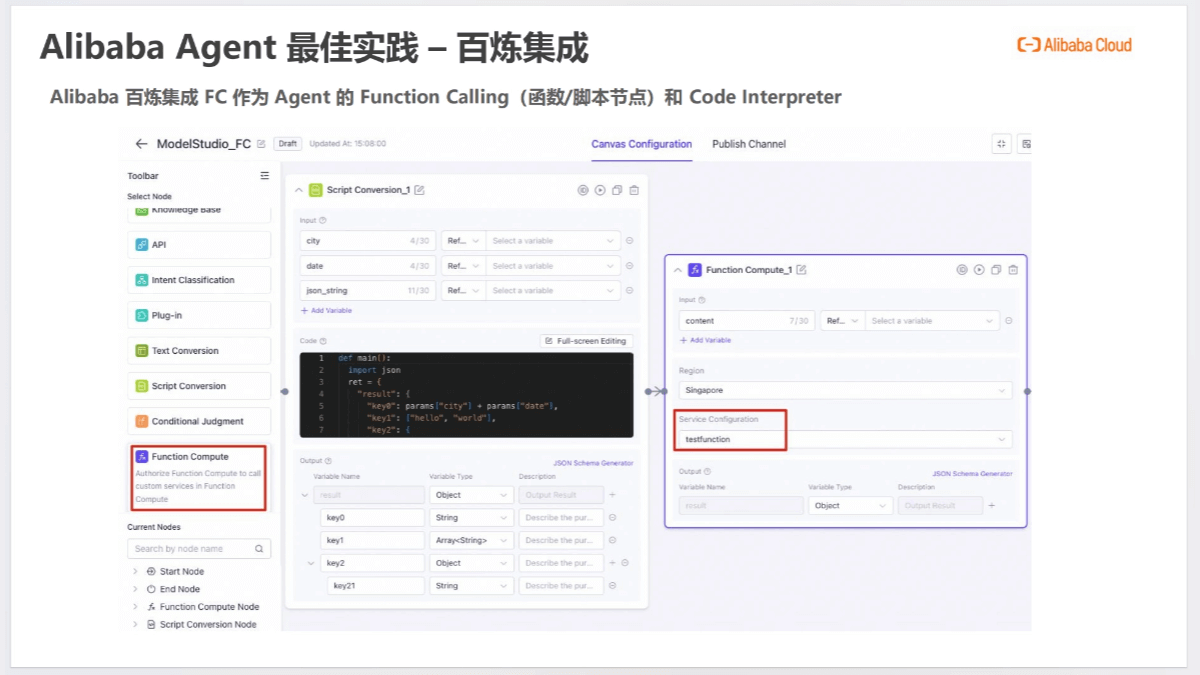
Alibaba Agent Best Practices - Bailian Integration: Demonstrates how to integrate Bailian into Function Compute to implement model invocation and task execution.
-
Alibaba Agent Best Practices - Inventory Counting Agent: Introduces the architecture and workflow of the inventory counting agent.
-
Alibaba Agent Best Practices - Video Content Recognition and Q&A Agent: Demonstrates the architecture and functions of the video content recognition and Q&A agent.
- AWS Agent Best Practices
-
AWS Bedrock Agent breaks down complex tasks into subtasks and uses Lambda as an external Function Calling tool to solve problems step by step: AWS Bedrock Agent implements step-by-step solving of complex tasks through Lambda.
-
AWS implements Agent tenant isolation through Bedrock + Lambda, with Lambda serving as the Agent's BFF and Function Calling: AWS implements tenant isolation and backend service capabilities for Agents through Bedrock and Lambda.
-
- Azure Agent Best Practices
-
Azure provides best practices for LLM Application Function Calling through OpenAI + Functions: Azure implements Function Calling for LLM Applications through OpenAI and Functions.
-
Azure implements Multi-Agent through Durable Functions orchestration, and builds Agents/Function Calling best practices based on Functions: Azure implements Multi-Agent orchestration and Agent construction through Durable Functions.
-
AI Application Observability System
-
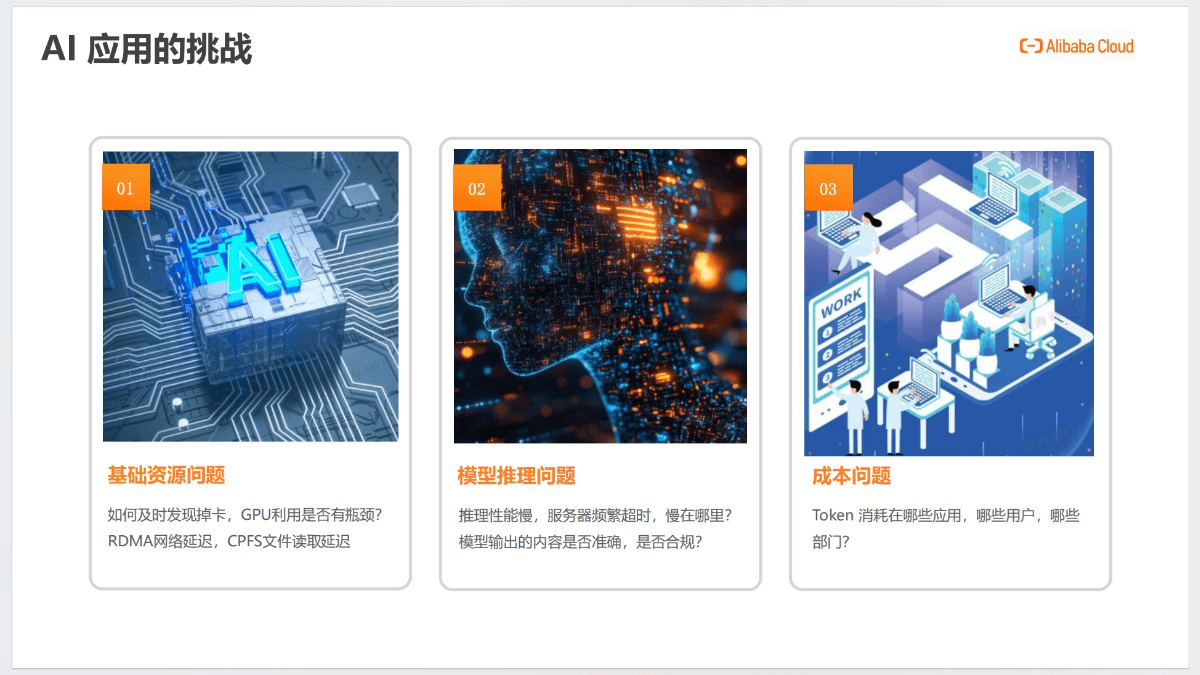
Challenges of AI Applications: AI applications face challenges in areas such as basic resources, model inference, and cost.
-
A Typical AI-Native Application Architecture and Its Observability Requirements: Introduces the AI-native application architecture and the observability requirements of each layer.
-
AI Full-Stack Unified Monitoring: Builds an AI full-stack monitoring dashboard through Prometheus to monitor model performance, token cost, and GPU resources.
-
End-to-End Diagnosis of Model Invocation: Implements full-link tracing of model invocations based on OpenTelemetry Trace.
-
Evaluation of Model Generation Results: Builds a unified log analysis platform to perform secondary evaluation and analysis on model invocation logs.
-
Tracing: End-to-End Diagnosis of Model Invocation: Records detailed information of model invocations through Trace to achieve end-to-end full-link tracing.
-
Domain-Oriented Trace Semantics for LLM Applications: Defines domain-oriented operation semantics and standardizes the storage and visualization of key content.
-
Which Metrics Need to Be Considered for LLM Application Observability?: Lists the metrics that need to be considered, such as number of empty responses, number of timeouts, TTFT, etc.
-
High-Quality Data Collection Based on OpenTelemetry: Achieves high-quality data collection through OpenTelemetry Python Agent.
-
Embracing Open Source, Tailored for Large Model Applications: Achieves observability for large model applications through open-source tools and self-developed probes.
-
Implementation Principles of Non-Intrusive Instrumentation for Python Probes: Introduces the implementation principles of non-intrusive instrumentation for Python probes.
-
Segmented Collection and Merging of LLM Spans for Streaming Scenarios: Implements segmented collection and merging for streaming data to balance performance and data analysis needs.
-
Dify Observability Best Practices: Provides recommendations for Dify production practices and observability comparisons.
-
Hands-On Observability of vLLM/SGLang Inference Performance: Troubleshoots inference performance issues through correlation between Trace and metrics.
-
Automated Evaluation of Model Generation Results Based on LLM: Automatically evaluates model generation results through LLM.
-
Evaluation of Model Generation Results: Performs secondary evaluation of the original model's Prompt/Response through a new model to improve generation results.
The Impact of the New Paradigm of AI Application Development on Enterprises
-
Serverless Practice of Amap Business Delivery Platform (API First Architecture): Demonstrates the Serverless practices and advantages of the API First architecture of Amap's business delivery platform.
-
MCP Server First: Introduces the architecture of MCP Server First and the method of building business processes with a low-code model.
Appendix: Core Advantages of the Cloud-Native API Gateway Foundation
-
Cloud-Native API Gateway – High Performance: The cloud-native API gateway outperforms Nginx Ingress in performance and supports hardware acceleration and deep tuning.
-
Cloud-Native API Gateway – High Availability (SLA: 99.999%): The cloud-native API gateway provides high availability assurance during the R&D, runtime, and change phases.
-
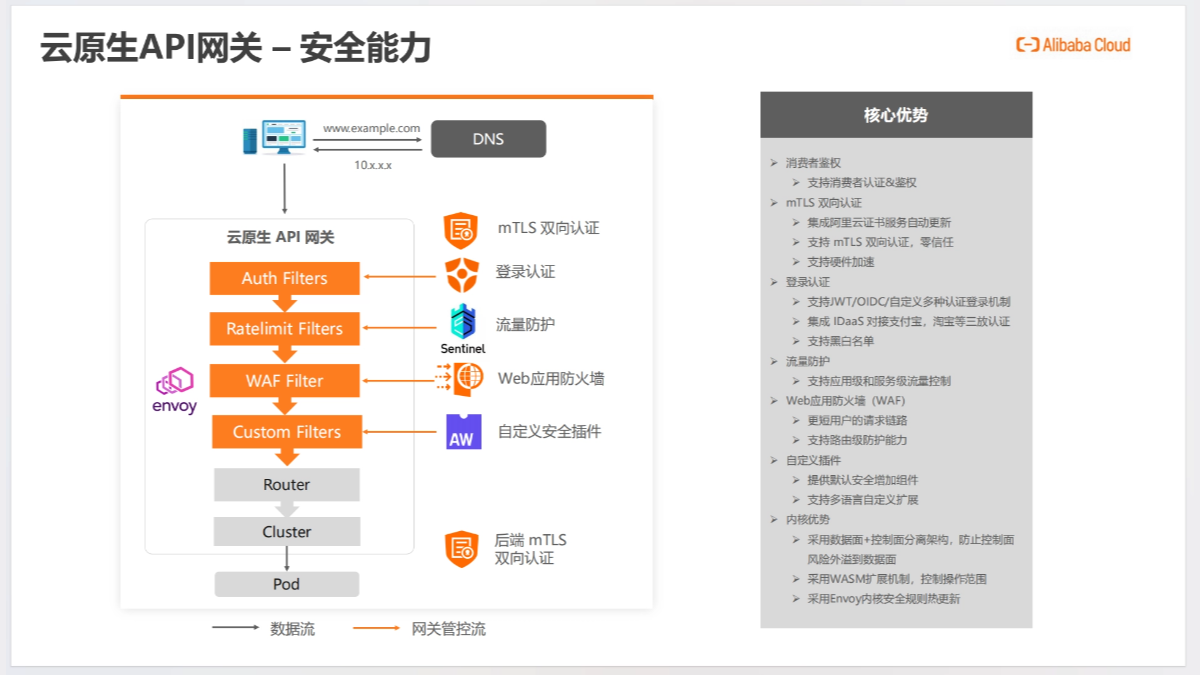
Cloud-Native API Gateway – Security Capabilities: The cloud-native API gateway provides security features such as consumer authentication, mTLS mutual authentication, login authentication, and traffic protection.
-
Cloud-Native API Gateway – Plugin Mechanism (Flexible Extension): Achieves flexible extension through the plugin mechanism and supports multiple languages and an online IDE.
Appendix: Best Practices for Traffic Gateways
-
Unified Access Layer: The unified access layer solves problems such as network unreachability, business edge deployment, and differing protocols.
-
K8s Ingress: The cloud-native API gateway supports K8s Ingress, enabling automatic service synchronization and multi-cluster reuse.
-
Full-Link Gray Release: Achieves full-link gray release through the cloud-native API gateway.
-
Same-City Multi-Active: The same-city multi-active solution achieves multi-availability-zone deployment and failover through DNS and MSE governance.
To obtain the original PDF file of Alibaba's "New Paradigm of AI Agent Development Collection", scan the QR code, follow, and reply: 20250722