
OpenAI's "AI in the Enterprise" highlights the practical applications and success stories of AI in enterprises. The document uses case studies from seven leading companies, including Morgan Stanley, Klarna, and Lowe's, to summarize seven core strategies for enterprises to effectively implement AI: starting with systematic evaluation, embedding AI into products, investing early in iteration, customizing models, empowering experts, freeing up developer resources, and setting high automation goals. OpenAI emphasizes that AI applications require an iterative development model, combining experimental thinking with rigorous evaluation and focusing on high-return scenarios. Data shows that AI significantly improves enterprise efficiency (e.g., Klarna's customer service response time reduced by 80%), customer experience (Indeed's job matching rate increased by 13%), and business value.

Get the original PDF file of OpenAI's "AI in the Enterprise", scan the QR code to follow and reply: 20250715
AI in the Enterprise
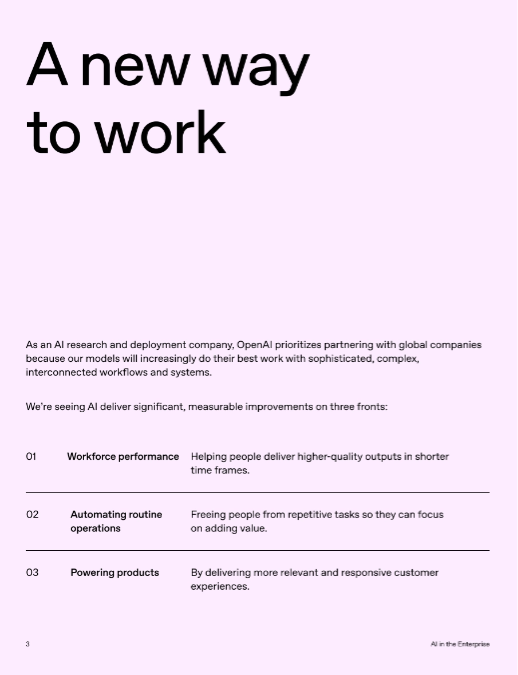
OpenAI collaborates with global companies to integrate AI into complex workflows and systems, bringing significant improvements such as enhanced work performance, process automation, and enhanced product experiences, emphasizing that successful companies view AI as a new paradigm and rapidly realize value based on an experimental mindset and iterative methods.
Three major improvement directions for AI in the enterprise:
- Enhanced work performance: Helps people deliver higher-quality work results in less time.
- Process automation: Frees people from repetitive tasks to focus on creating value.
- Enhanced product experience: Enhances products by providing more relevant experiences that are more responsive to customer needs.
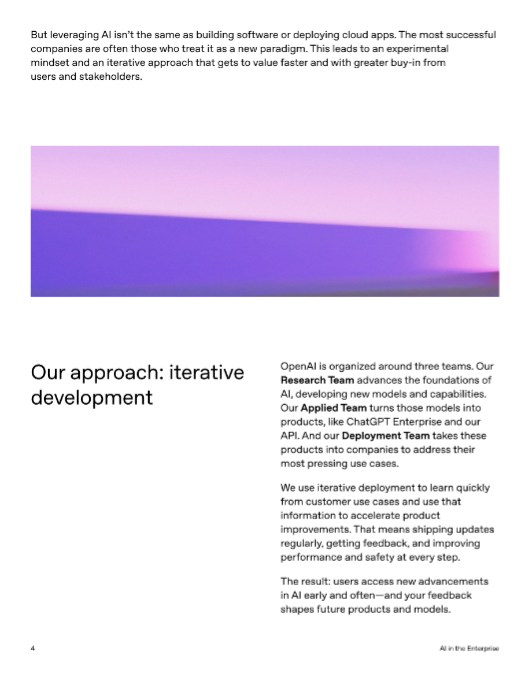
Our approach: iterative development
OpenAI operates around three teams: research, applications, and deployment. Based on iterative deployment, it quickly learns from customer use cases, accelerates product improvements, and allows users to access new AI developments earlier and more frequently, while user feedback also shapes future products and models.
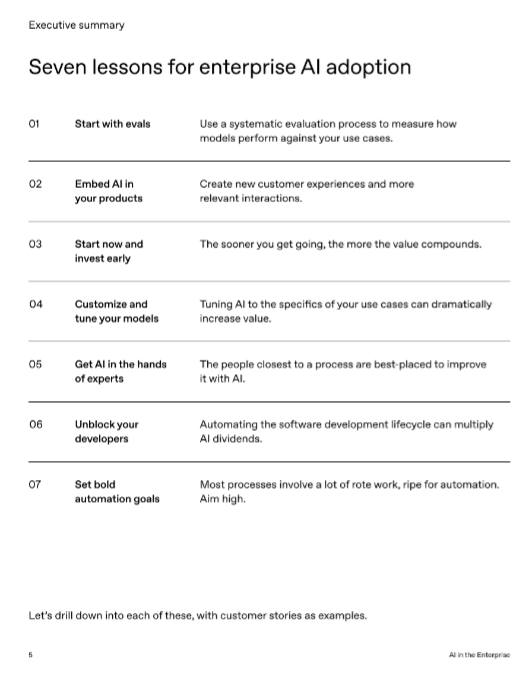
Seven lessons for enterprise AI implementation
Summarizes seven core principles, covering evaluation, product embedding, early investment, model customization, etc., supplemented by enterprise case studies to illustrate practical effects.
- Start with evaluation: Taking Morgan Stanley as an example, through a rigorous evaluation process to measure the performance of AI models in specific use cases, ensuring quality and safety, ultimately enabling 98% of advisors to use OpenAI daily, greatly improving work efficiency and client relationship maintenance capabilities.
- Embed AI into products: Taking Indeed, the world's largest job site, as an example, using GPT-4o mini to improve job matching, based on AI analysis of data and generation of natural language, providing job seekers with more humanized reasons for job recommendations, significantly increasing job applications and employer hiring success rates.
- Invest early, iterate continuously: Taking Klarna, a global payment network and shopping platform, as an example, demonstrating the early introduction of AI assistants to optimize customer service, based on continuous testing and improvement, achieving significant improvements in service efficiency, notable profit growth, and promoting widespread employee use of AI and accumulation of AI knowledge within the organization.
- Customize and fine-tune models: Taking Lowe's, a Fortune 50 home improvement company, as an example, based on fine-tuning OpenAI models, solving the problem of incomplete or inconsistent product data, improving product label accuracy and error detection capabilities, and enhancing e-commerce search functionality.
- Let experts lead AI applications: Taking global banking leader BBVA as an example, AI was given to employees to use, allowing them to discover AI-driven solutions in their respective fields, achieving efficiency improvements and process optimization across multiple departments such as credit risk assessment, legal compliance Q&A, and customer service.
- Case: BBVA Bank employees created 2,900 custom GPT tools, and the legal team handles 40,000 policy inquiries annually.
- Empowering Developers: Taking Mercado Libre, Latin America's largest e-commerce and fintech company, as an example, it introduces its collaboration with OpenAI to build the development platform layer Verdi, helping developers quickly and consistently build AI applications, accelerating AI application development, and enhancing capabilities in multiple areas such as inventory management, fraud detection, and product description customization.
- Setting Bold Automation Goals: Taking OpenAI itself as an example, it built an internal automation platform to embed AI into existing workflows, achieving a substantial improvement in the efficiency of the support team, handling a large number of tasks, and allowing employees to focus on more impactful work.
Conclusion
Emphasize the universality of enterprises using AI to achieve improvement results, and point out that successful enterprises are based on an open, experimental mindset, combined with rigorous evaluation and security safeguards, iteratively learning around high-return, low-effort use cases, and applying this learning to new areas to achieve faster and more accurate processes, more personalized customer experiences, and more valuable work.
Get the OpenAI "AI in the Enterprise" PDF original file, scan the QR code to follow and reply: 20250715