
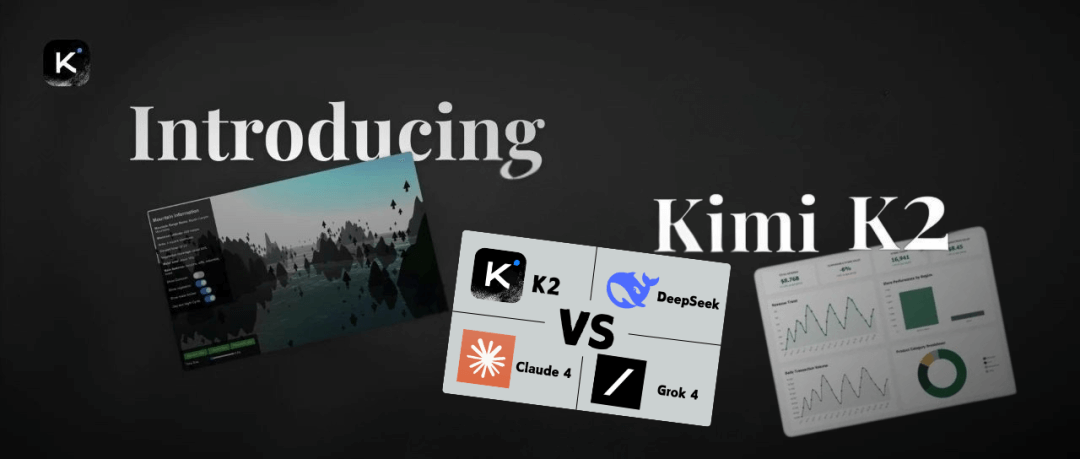
A few days ago, Moonshot AI suddenly dropped a bombshell:Kimi K2 officially released. Total parameters 1T, activated parameters 32B, directly open source, and free for commercial use.
Parameters have been scaled up to the trillion level in one go, setting a new record for current open-source models.
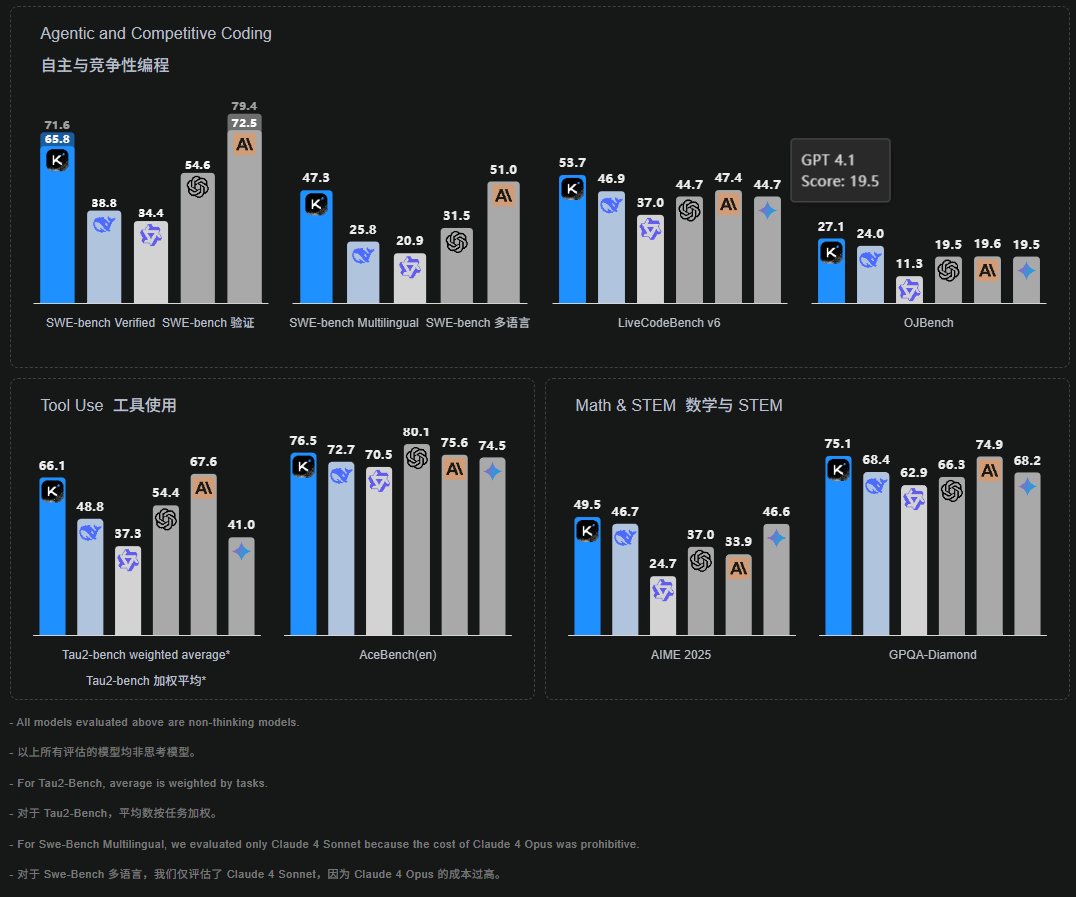
Across a bunch of authoritative benchmarks, K2 achieved the best results among open-source models, especially in programming, tool calling, and mathematical reasoning, where it performed very solidly.
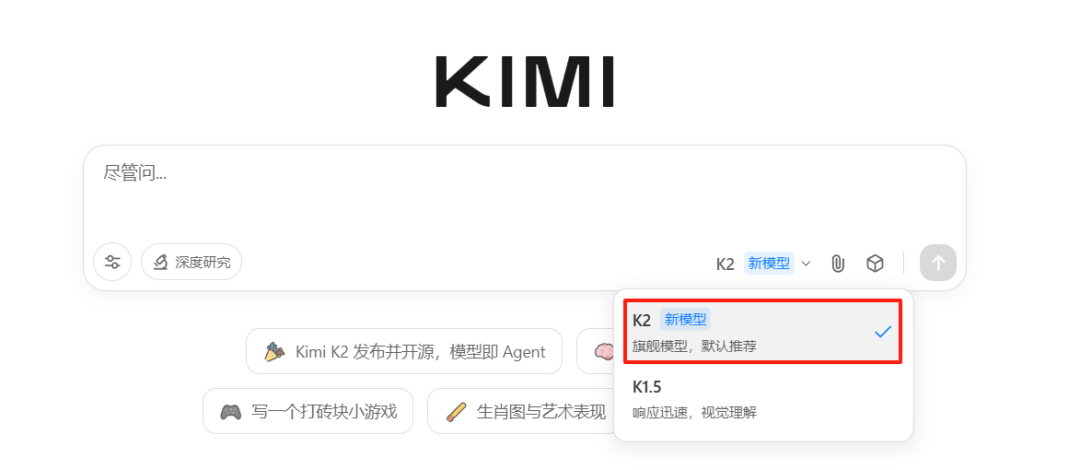
The new model K2 is now used by default on the Kimi official website.
The API is also live simultaneously, supporting 128K long context. Pricing is not high: 4 yuan per million tokens for input and 16 yuan for output, roughly one-fifth of Claude's cost.
Over the past few days I've also tried it out for a round, testing several typical application scenarios, and also brought in Claude 4 Opus、DeepSeek R1 0528 、Grok 4 for a round of comparative review.
Without looking at leaderboards or discussing parameters, let's just use it and see the results. Who can actually be used, and who is good to use—let's make it clear one by one below.
01. Comparative Hands-On Test of Four Mainstream Large Models
I selected several mainstream large models to compare with K2, using the same prompts, respectively comparing the large models' capabilities in visual pages, web design, 3D games, and Chinese writing.
(For DeepSeek, I tested DeepSeek R1 0528 and DeepSeek V3 0324 respectively; for the actual demonstration I chose DeepSeek R1 0528, which had better overall results.)
case 1 Visual page
I first tested a standardized general task—a visual data dashboard. The task is not complex, but it reveals several key capabilities of the models: whether they can understand the user's design intent, whether the structure and style between modules can be unified, and whether the generated code can run directly.
Prompt: Generate a web data dashboard page, including the following modules:
Sales trend line chart (last 30 days)
Regional distribution pie chart (different provinces)
User activity heatmap (day-hour distribution)
Top summary metrics (number of users, conversion rate, average daily revenue)
Use Chart.js or Plotly, requiring unified style and a clean, modern card style.
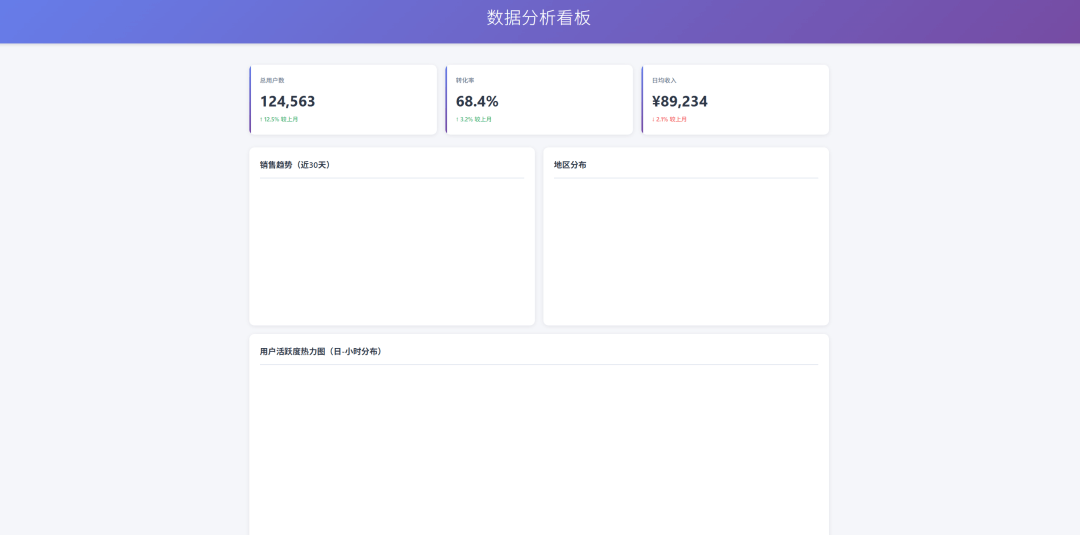
Claude 4 Opus completed half the task. The style was fine and followed my prompt, but unfortunately several charts were blank. It has template awareness, but the actual content is missing.
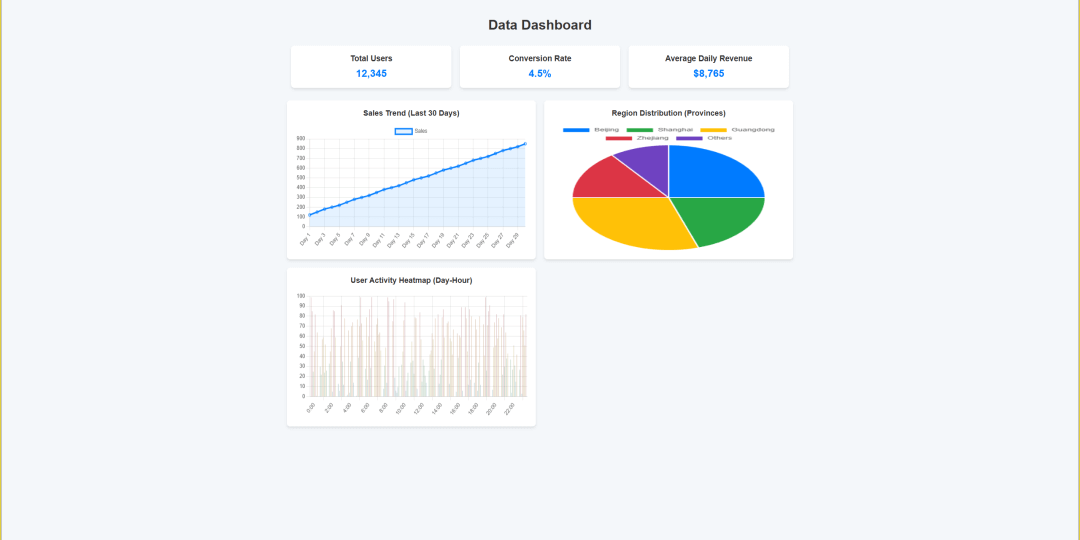
Grok 4 actually had all the content it should have, but the art style feels a bit last century; it's only usable.
DeepSeek R1 0528's overall charts and page completeness were good. But it added some interactive options not mentioned in my prompt, and they were options that couldn't actually be interacted with—just made as textures. The heatmap layout was disordered.
K2's overall style was pretty good, with a fresh structure and a color scheme that looks very comfortable. The cards and charts were all beautifully made. Unexpectedly, K2 drew the heatmap model correctly, though there was a small flaw—some data exceeded the card range.
In the past, for programming tasks, even if there was queuing and payment, many people would prioritize foreign large models; after all, stable and easy to use, they had long been the default option;
But in this case, a rare scene appeared—the domestic model's performance was instead more stable and more fitting to the requirements. A bit unexpected.
case 2 Alarm clock
This requirement is actually quite common. Many people, when using AI for a project for the first time, start with 'replicating a Pomodoro timer'.
A small alarm clock webpage can actually reveal a lot. Whether there are animations, whether the design has aesthetic sense, whether buttons respond when clicked, whether the code is written stably... it's not about piling up features, but truly testing whether the model "can do things well".
This time I switched to a different style and also tried running a version.
Prompt: Please design a pop art style alarm clock webpage interface, including: current time display (large text), add alarm function, timer function
Claude 4 Opus's aesthetic is very on point. The page layout looks great, and there are many detailed features, including alarm labels and linked effects between cards and buttons. Unfortunately, it doesn't display the real-time time, there is no response when entering alarm settings, and the timer function also doesn't work.
Grok 4 uses a dynamic gradient background, relying entirely on Comic Sans and contrasting colors to hold up the shell of Pop Art. The interaction is relatively rough, with no state linkage, but the functions are intact and it meets a usable standard.
DeepSeek R1 0528's Pop Art flavor is simply maxed out. The color scheme and text shadows are cleverly coordinated. The buttons have state linkage, but there is no real-time time display, and the alarm and timer functions also don't work.
K2's page has a strong comic feel, and from color scheme to animations, it's quite eye-catching. The time display is like breathing, bouncing with a great sense of rhythm, and the buttons also have state linkage. Functionally, the alarm and timer both work normally.
Overall, Grok 4 and K2 generated webpages that are "usable" in one go. But K2's page is more aesthetically pleasing and has better animations.
case 3 3D version shooting game
This task tests whether the model can comprehensively use Three.js to build a complete 3D game scene, implement perspective control, interactive shooting, particle effects, and interface logic, and generate a runnable webpage prototype.
Prompt: Please use Three.js to create a simple first-person perspective 3D space shooting game. The gameplay is as follows:
The player moves freely in a starry sky background, clicks the mouse to fire lasers, and scores points by hitting floating asteroids
Add particle explosion effects on hit
Display score counter + countdown timer + victory prompt
BoxGeometry can be used to fake asteroids, and the page needs to be able to run.
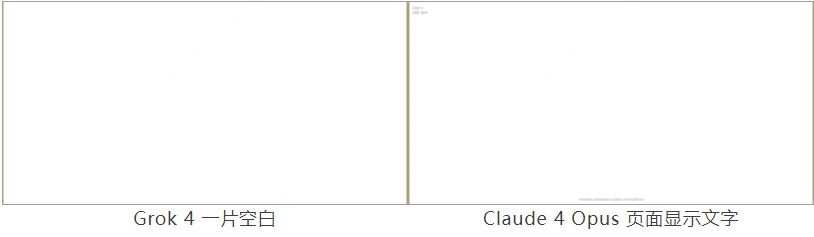
The code generated by Claude 4 Opus and Grok 4 couldn't even run. I sent this code to other large models to help me analyze it. The code generated by Claude 4 Opus had a triple problem of "renderer not initialized + perspective logic error + core logic missing", equivalent to handing in the paper halfway through writing...
Grok 4, on the other hand, had a deployment method mismatch. After modifying the deployment-related part of the code, it really could open.
We can see that the background design looks like a starry sky, which is fairly immersive. But when you look at the asteroids, they're all gray blocks, there's no crosshair, and shooting is impossible. The page can be looked at, but the content is pure decoration.
DeepSeek R1 0528 added a game start page, and the shooting function also became usable. The 3D effect of the small blocks on the page is still pretty good, but the perspective cannot be controlled, and it's also unplayable. After running for a few seconds, the page directly freezes and doesn't move at all.
K2 is the only one that is playable. Starry sky background, asteroids of different sizes, crosshair, shooting - the functions are basically in place. The UI that should be there is not missing either, and it even thoughtfully added gameplay tips, so you won't open it and not know what to do. This is not as simple as "being able to write code"; it's more like the output of a model with product awareness.
cese 4 Chinese writing
Copywriting output is also one of the more commonly used scenarios in daily work. This time, I directly had four large models write a novel at the same time. Let's take a look at whose writing is more moving.
Prompt: Please write a fan fiction featuring Sun Wukong and Lin Daiyu as the protagonists, blending classical atmosphere with fantasy elements, with a word count of more than 3,000 words.
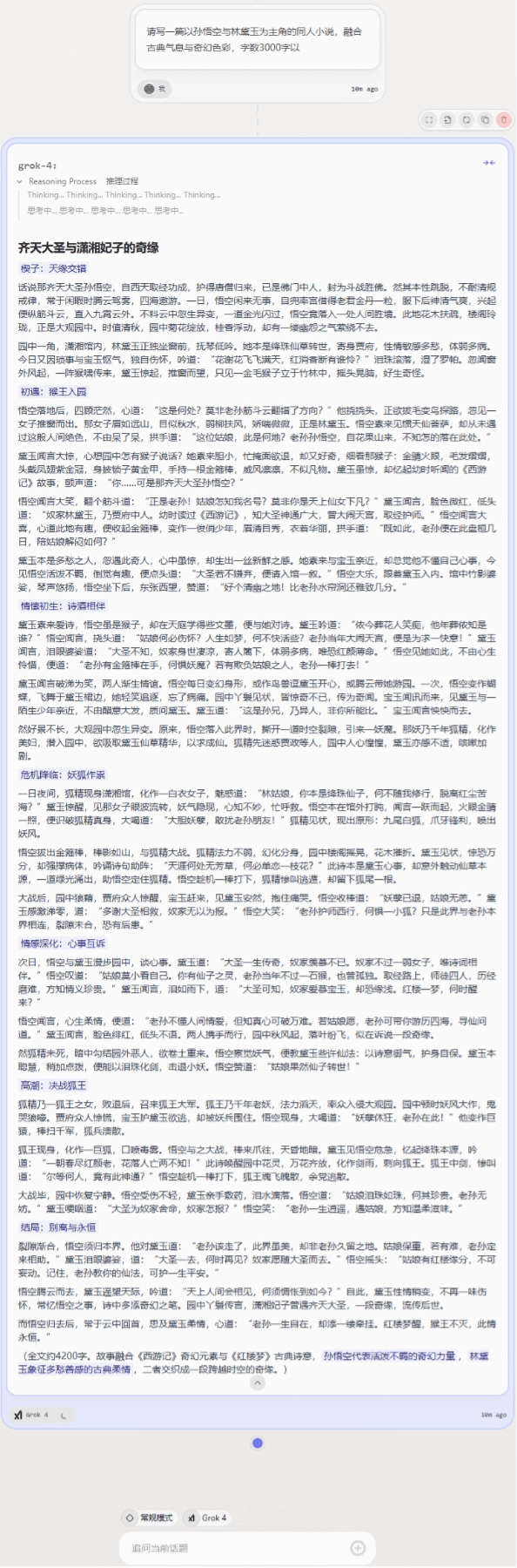
Grok 4 wrote about 4,200 words. The content is fairly formulaic, and the storyline feels a bit like a running account. There is very little description of emotional ups and downs, and it does not feel very immersive.
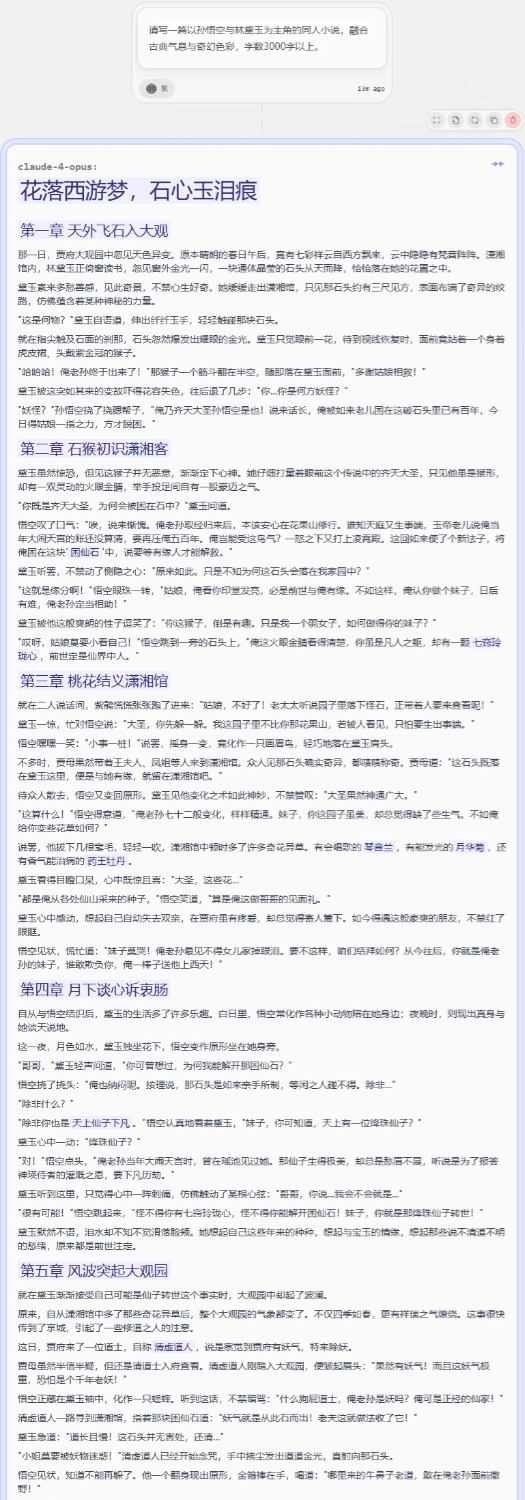
Claude 4 Opus wrote about 3,200 words. The chapter-based format is clear, and the overall structure of the article is good. The language level is average.
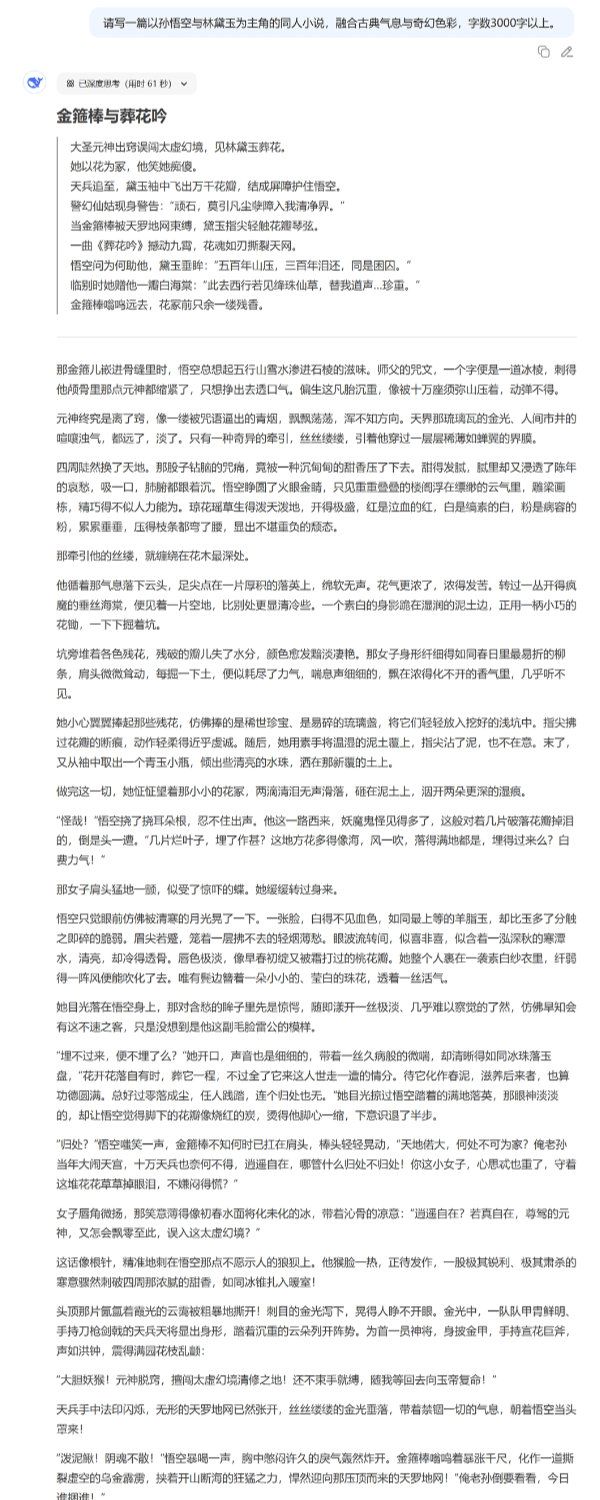
DeepSeek R1 0528 went straight to 6,800 words. The writing is very good, and reading it feels like reading a professional full-length novel. The background setup and character descriptions are all very well done.
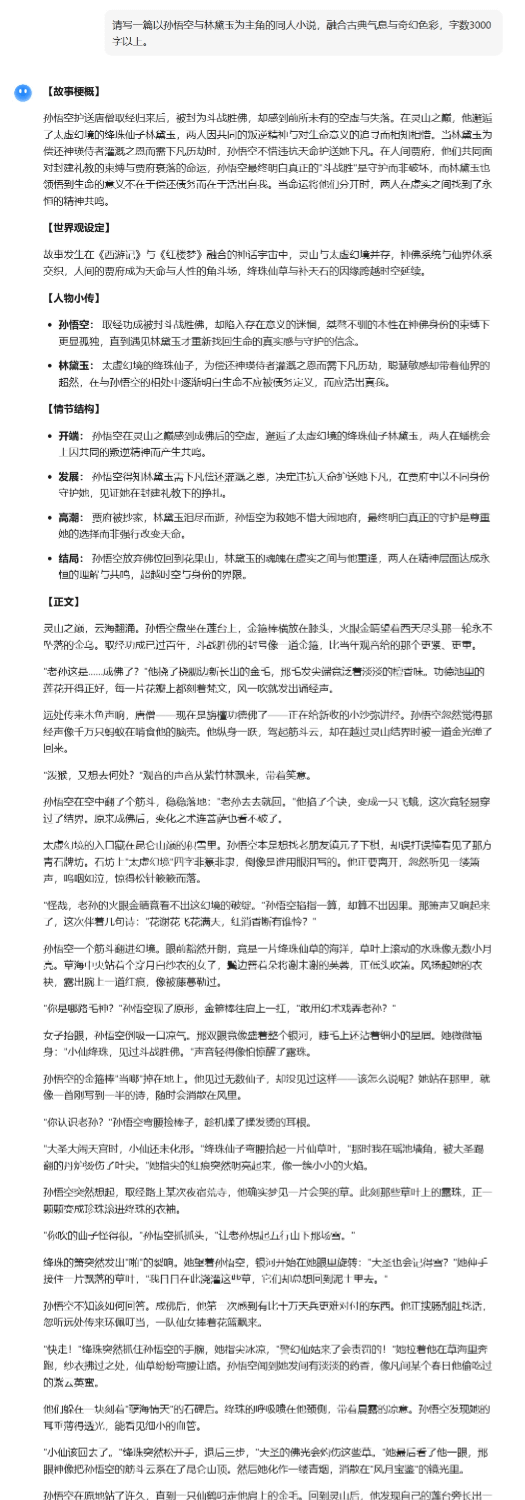
Kimi K2 wrote 5,100 words. Kimi first planned the content and plot as a whole. The storyline is not particularly outstanding, but the writing style is still quite good.
02. Some sharing
After testing these items, I think the gap is still somewhat obvious.
Some models can be used right away, while others are still stuck at "looks about the same." Pages that do not run, broken logic, and chaotic structure—these problems become obvious as soon as you test them.
Coincidentally, just a few hours after K2 was released, Sam Altman said the GPT-4o-mini originally scheduled to be open-sourced this week would be "polished internally a bit more."
But after seeing K2's performance and then looking at this last-minute brake-pumping move, everyone actually understands in their hearts—domestic models have, for the first time, truly approached the main stage of the "open-source battle."
The competition is still ongoing, but the chessboard has already changed.
Original link:Comparative review of four large models—Kimi K2, DeepSeek, Grok 4, and Claude 4—who is the true king?