
Artificial intelligence has evolved from a mere tool into a "partner" capable of deep interaction. Whether for creative writing, handling professional matters, or serving as an entertainment companion in daily life, we expect AI to communicate with us in a more human-like and context-appropriate way. This article systematically introduces to ordinary users how to guide and shape AI's personality and tone, covering everything from simple and easy "prompt engineering" techniques to deeper model customization technologies, supplemented by practical tool recommendations and effect evaluation methods, to help you unlock AI's full potential.
Basics – Efficient Communication with AI Through "Prompt Engineering"
“Prompt Engineering" is the most direct and core art of communicating with AI. It involves carefully designing the instructions (i.e., "prompts") input to AI to guide the model in generating outputs with the specific style and content we expect. It is like communicating with a knowledgeable assistant who needs clear instructions; the clearer and more specific the instructions, the more ideal the results.
Core Techniques: The "Three Axes" for Setting AI Personality and Tone
To make AI imitate a specific personality or tone, there are mainly three commonly used prompt engineering techniques:
- Technique 1: Role-playing
It is the most intuitive and effective method. By assigning AI a clear identity, its behavior and language style can be quickly framed within a specific range. AI has learned the language patterns of countless roles in its vast training data; once given a role, it will strive to imitate that role's way of thinking and speaking tone.- Example:
“请你扮演一位经验丰富的投资银行家,分析一下当前新能源汽车市场的机遇与挑战。”“现在你是一个脱口秀演员,请用幽默讽刺的口吻吐槽一下当代年轻人的‘摸鱼’文化。”
- Example:
- Technique 2: Direct Instruction
This method is simple and direct, namely explicitly requiring AI in the prompt to use a certain tone or style. It can precisely define the output length, language style, and emotional tone.- Example:
“撰写一封项目延期的道歉邮件,收件人是重要客户。请使用极其正式、诚恳且富有同情心的语气。”“用简洁、活泼、幽默的语言写一个不超过200字的产品介绍。”
- Example:
- Technique 3: Few-shot Prompting
When AI has difficulty understanding abstract style descriptions, providing one or two concrete examples (i.e., "few-shot prompting") often works wonders. AI will analyze the examples you provide and imitate their structure, word choice, and overall style to complete your task.- Example:
“我需要你模仿以下风格续写一个故事。风格范例:‘月光如水,洒在寂静的庭院里,每一片叶子都像是被镀上了一层冷霜。’ 现在,请用这种细腻、富有诗意的风格,描述一个人物在雨夜等待的场景。”
- Example:
Practical Templates: A "Universal Formula" Designed for Ordinary Users
To make prompt construction more systematic, we can follow a structured template. An excellent prompt contains the following elements:
[角色] + [任务] + [背景信息/上下文] + [语气/风格指令] + [输出格式要求]
Based on this template, specific examples are provided for three common styles:
- Formal Tone Template
- Applicable Scenarios: Business emails, academic reports, official statements, legal documents, etc.
- Template:
作为一名[你的专业领域,如“法律顾问”或“学术研究员”],请为我起草一份关于[具体主题]的[文件类型,如“声明”或“摘要”]。你需要严格遵循以下要求:1. 语气:使用专业、客观、严谨的正式书面语。2. 风格:逻辑清晰,结构完整,避免使用任何口语、俚语或情感化表达。3. 目标受众:[说明文档给谁看,如“公司法务部”]。4. 核心内容:[简述必须包含的关键信息]。 - Output Example: Based on this template, AI can generate a professional document with rigorous structure and precise wording.
- Humorous Tone Template
- Applicable Scenarios: Social media copy, marketing advertisements, stand-up comedy scripts, lighthearted blog posts, etc.
- Template:
你现在是一位才华横溢的段子手/喜剧编剧。你的任务是以一种[具体幽默风格,如“夸张的”、“自嘲的”或“冷幽默的”]风格,来谈论[某个话题]。请确保你的文案:1. 充满笑点:使用双关、比喻、反转等喜剧技巧。2. 风格鲜明:[描述你想要的幽默人设,如“一个愤世嫉俗但内心善良的吐槽者”]。3. 互动性强:在结尾处可以加上一个引人发笑的问题或互动点。 - Output Example: AI will produce text full of creativity and punchlines, possibly including unexpected metaphors and witty remarks, in line with the characteristics of social media dissemination.
- Strategic Tone Template
- Applicable Scenarios: Business decision analysis, market strategy planning, personal development advice, solutions to complex problems, etc.
- Template:
扮演一位顶级的战略顾问(例如,来自麦肯锡或波士顿咨询)。我面临一个[具体问题或决策困境]。请你为我提供一份策略分析报告。报告需要包含:1. 现状分析:客观评估当前情况的优势(Strengths)、劣势(Weaknesses)、机会(Opportunities)和威胁(Threats)。2. 策略建议:提出三条具体的、可操作的、分步骤的行动建议。3. 风险预估:指出每条建议可能伴随的潜在风险及应对预案。4. 语气风格:你的分析必须冷静、客观、有远见,并以数据和逻辑为支撑,语言极具说服力。 - Example Output: The AI will provide a structured and logically rigorous analysis report, not only stating "what to do" but also explaining "why to do it this way" and "what problems may be encountered," demonstrating deep thinking ability.
Advanced Section – Deep Customization Methods for Having a "Dedicated AI"
When we need AI to continuously and stably exhibit a certain specific personality, rather than merely temporarily playing a role in a single conversation, deeper customization techniques are required.
Beyond Prompt Engineering: Model Fine-tuning
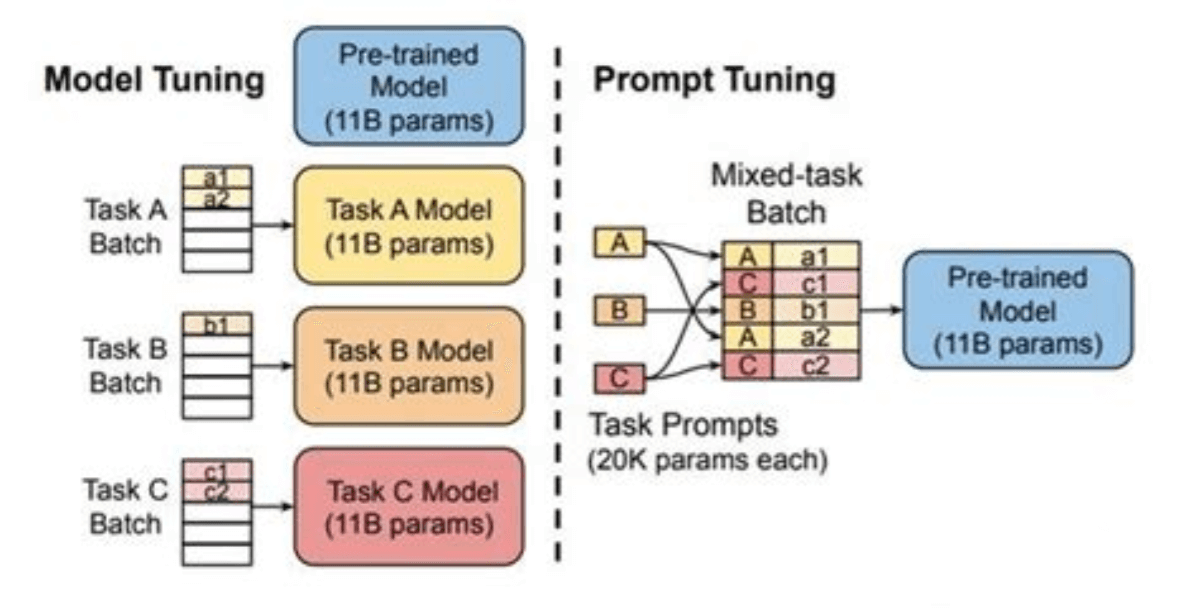
If prompt engineering is giving AI "temporary instructions," thenmodel fine-tuning(Fine-tuning) is "deep cultivation" of AI. Fine-tuning refers to using a specific, high-quality dataset to additionally train an already trained general large model (base model).
- Plain-language understanding: It is like teaching a university student who has already mastered basic language and knowledge to learn professional knowledge in a specific field (for example, law or medicine), ultimately making them an expert in that field. Through fine-tuning, we can "internalize" a personality trait into the model, making its performance more stable and natural. This method is called "personality alignment," shaping AI's unique personality characteristics.
Parameter-Efficient Fine-Tuning (PEFT): A More Lightweight "Personality Plugin" Solution
Traditional full fine-tuning requires enormous computational resources and cost. In recent years, "Parameter-Efficient Fine-Tuning" (PEFT) technology has emerged, among which the most famous is LoRA (Low-Rank Adaptation) 。
- How LoRA Works (Analogy) : Imagine that a general AI model is a thick encyclopedia, and we do not want to rewrite the entire book to teach it new knowledge. LoRA technology is like making a series of transparent "annotation stickers" for this book. Each set of stickers represents a specific personality or skill (for example, a "humorous poet" sticker or a "rigorous scientist" sticker). When we need AI to play a certain role, we only need to "stick" the corresponding sticker onto the encyclopedia. These stickers are very small and do not change the original text, but they can guide the reader (AI) to interpret the content in a completely new way.
- LoRA's Revolutionary Advantage: Personality "Pluginization":
- Efficient Training: Because only these "stickers" (that is, a small number of newly added parameters) are trained, training cost and time are greatly reduced.
- Fast Switching: We can train multiple different personality "stickers" (that is, LoRA adapters) for the same base model. In practical applications, switching AI personalities is like loading different plugins, enabling near-real-time dynamic switching without restarting or reloading the entire huge model. This greatly reduces storage requirements and the difficulty of task switching. For example, frameworks such as S-LoRA and MeteoRA are designed precisely to efficiently manage and switch these adapters.
Implementation of Personality Switching in Actual Products
The technical architecture behind integrating AI personality switching functionality in web or mobile applications is as follows:
- Front-end Interface: Users select the desired AI personality (such as "professional assistant," "creative partner," "humorous friend") through a drop-down menu or button.
- Back-end Service: The server receives the user's selection and input.
- Model Invocation and Configuration Management: Based on the user's selection, the backend dynamically loads the corresponding LoRA adapter onto the base model, or passes the persona definition as a system-level prompt to the AI model.
- Generation and Return: The AI model configured with the persona processes the user's input, generates a reply in the corresponding style, and returns it to the front-end interface.

For the user, the entire process is seamless—with just a gentle tap, they can converse with AIs of different "personalities."
Tools Section – No Coding Required, Easy to Get Started
For ordinary users without programming skills, a large number of user-friendly tools and platforms have already emerged on the market, making AI persona customization simple.
AI Tools for One-Click Tone Switching
These tools focus on text processing and allow you to convert written content into different tones, making them ideal for content creators and marketers.
- Assistr.ai: Provides an AI-driven tone conversion tool that lets users easily convert text into multiple tones such as formal, informal, or persuasive, with a friendly interface and no technical background required.
- AI Tone Changer: Focuses on tone adjustment in the content creation field, and is very friendly to non-technical users.
- AI Humanizer Pro: Powerful, it can not only change the tone and style of content (such as formal, conversational, professional), but also make the text more like something written by a human.
Platforms for Visually Customizing AI Personas
The platforms go a step further and support users in creating and customizing AI characters or digital humans with unique personalities.
- Fastlane AI: Provides a "character customization" feature that allows users to create AI interaction experiences with specific personalities and situational awareness.
- MYCharacter-GPT: Allows users to create dynamic and engaging AI characters, and even supports customization of appearance and voice.
- Digital Human Platform: Focuses on AI digital human anchors, and supports comprehensive customization of style, background, tone, as well as appearance and voice.
Low-Code/No-Code Platforms: Drag and Drop to Build Your Own AI
Low-code/no-code platforms use visual drag-and-drop interfaces to let anyone build applications like stacking blocks, including chatbots with embedded AI capabilities. They provide a high degree of flexibility, and users can achieve similar effects in the following ways:
- Custom Prompt Module: In the bot's workflow, different system-level prompts can be set to define the AI's behavior and tone in different scenarios.
- Conditional Logic Branching: Rules can be set, for example, when the user input contains "help," the AI switches to "patient customer service" mode; when the user input says "tell a joke," it switches to "humorous" mode.
How Do You Judge Whether an AI Simulation Is Good or Not?
Core Evaluation Dimensions
- Consistency : This is one of the most important metrics. A good persona simulation should maintain the coherence of its character throughout the entire conversation; it cannot be a rigorous scholar one second and then become a street thug the next. Evaluation methods include checking whether its viewpoints, memory, and language style are consistent from beginning to end.
- Style Matching : Does the text generated by the AI accurately meet the preset style requirements? For example, is the requested "humor" actually funny, and is "formal" sufficiently professional? This usually requires human scoring to judge.
- Recognizability & Believability : Can users clearly perceive the persona the AI is playing? Is its performance natural and credible, rather than a stiff, mechanical imitation? .
- Diversity : Under the premise of maintaining persona consistency, are the AI's responses rich and varied, rather than saying the same thing over and over? Metrics such as Unique-N can be used to measure the repetition of the text .
The VibeCheck study at UC Berkeley even introduced the concept of the MBTI personality test into LLM evaluation, analyzing the personality tendencies of different models across multiple dimensions such as confidence level, richness of detail, formality, and emotional tone, providing us with a more detailed evaluation perspective . Some specialized datasets such as CCD6 and ELSA have also been developed to evaluate the generation capabilities of AI under specific personalities or styles .
Future Outlook
The future of AI personality simulation is full of imaginative possibilities. The following trends can be foreseen:
- Hyper-personalization and dynamic personality: Future AI will not only play preset roles, but will also be able to learn and adapt to each user's unique preferences, forming a "dynamic personality" that grows together with the user.
- Emotional understanding and empathy: As technology advances, AI will be able to more accurately recognize and understand users' emotions and respond with empathy, becoming a true emotional companion.
- More powerful model capabilities: The next generation of models (such as the rumored GPT-5) may natively support more diverse and more stable personality modes, further lowering the threshold for ordinary users to customize them .
- Ethics and safety: With the in-depth development of AI personalities, how to ensure that their behavior conforms to moral norms and avoids malicious exploitation will become an important research topic.
Having AI simulate different personalities and tone styles is a key step from "using AI" to "collaborating with AI." For ordinary users,mastering prompt engineering is currently the method with the highest return on investment. Through "role-playing," "clear instructions," and "providing examples," anyone can immediately begin shaping their own AI. For users and developers seeking more stable and deeper customization, parameter-efficient fine-tuning techniques represented by LoRA provide an efficient, low-cost path, making the vision of "everyone can have their own AI" no longer distant. The continuously emerging user-friendly tools on the market further lower the technical threshold.