
Artificial intelligence (AI) will mainly replace jobs characterized by high repetitiveness, low skill thresholds, and standardizable workflows, such as data entry clerks, basic customer service, production line workers, some retail and sales staff, basic accounting and administrative clerks, and basic translators and content creators. In the face of the employment impact brought by AI, individuals should actively improve their skills (including AI-related skills and "human-exclusive" soft skills), cultivate innovation and creativity, learn to collaborate with AI, pay attention to industry trends and flexibly plan their careers, maintain a mindset of lifelong learning, and be courageous in exploring emerging career opportunities.
Overview of Artificial Intelligence (AI)
Basic Concepts and Definitions of AI
Artificial Intelligence (AI) is an important branch of computer science that can study and develop theories, methods, technologies, and application systems used to simulate, extend, and expand human intelligence. The core goal of AI is to enable machines to think, learn, make decisions, and solve problems like humans, and in some aspects surpass humans. AI is a comprehensive field covering multiple technologies, with a broad scope of research, including machine learning, deep learning, natural language processing, computer vision, expert systems, robotics, and more. AI systems analyze large amounts of data, learn rules and patterns from it, and use this knowledge to perform specific tasks or make predictions. AI applications have penetrated every aspect of life, from voice assistants on smartphones to recommendation algorithms, and then to self-driving cars and intelligent medical diagnosis. AI is profoundly changing the world.
How AI Is Implemented
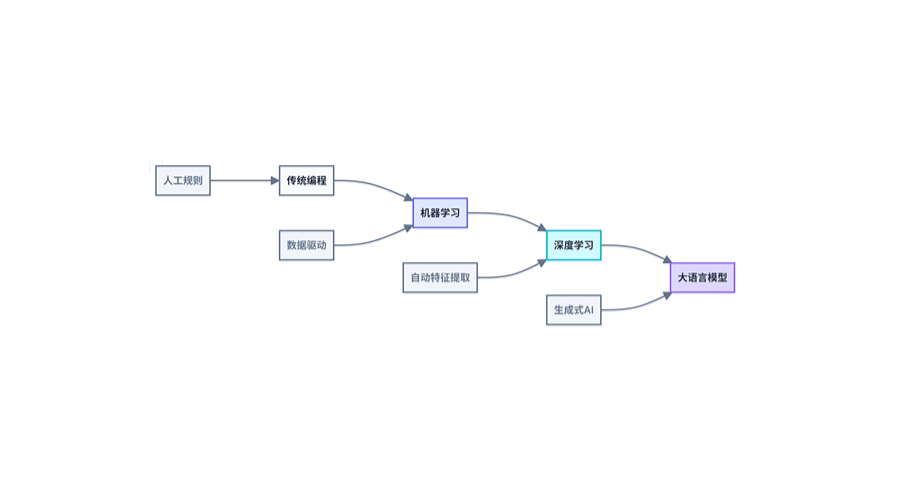
There are many ways to implement artificial intelligence. Machine Learning (ML) and Deep Learning (DL) are the most core and popular technical paths. Machine learning is a subfield of AI that gives computer systems the ability to learn from data and improve performance without explicit programming. Traditional machine learning algorithms, such as decision trees, support vector machines, and naive Bayes, rely on manually extracted features for learning and prediction. With the explosive growth of data volume and improvements in computing power, deep learning, as a branch of machine learning, has risen rapidly thanks to its powerful feature learning capability. Deep learning models, especially neural networks, can automatically learn and extract complex features from raw data, without or with only a small amount of manual feature engineering. For example, convolutional neural networks (CNNs) have achieved great success in the field of image recognition, while recurrent neural networks (RNNs) and their variants (such as LSTM and GRU) perform excellently in natural language processing and time-series data analysis. The evolution from machine learning to deep learning marks AI's transition from relying on human experience to data-driven automated learning, greatly expanding AI's application boundaries and capability ceiling.
A Brief Analysis of AI's Core Principles
The core principle of AI lies in simulating human cognitive processes, especially the abilities of learning, reasoning, and problem-solving. AI systems achieve functionality through the following steps:
- Data input: the system receives data from sensors, databases, or other sources;
- Information processing: algorithms and models are used to process and analyze the input data, extracting useful information and patterns;
- Knowledge representation: the learned knowledge and rules are stored in a way that computers can understand and operate on;
- Decision-making and action: based on existing knowledge and the current situation, decisions are made and corresponding actions are executed.
For example, in image recognition tasks, an AI system analyzes pixel data in an image, learns the features of different objects (such as edges, textures, and shapes), and determines which objects are contained in the image based on those features. In natural language processing tasks, an AI system learns from large amounts of text data to understand the meanings of words, sentence structures, and contextual relationships, and performs text generation, translation, question answering, and so on. The core of AI lies in its learning ability, that is, improving its own performance through experience (data), enabling the AI system to adapt to constantly changing environments and task requirements.
Which occupations will AI replace?
The rapid development of artificial intelligence (AI) is changing the global employment market landscape. Multiple reports from well-known consulting institutions such as McKinsey have pointed out that a large number of existing occupations will face the risk of being replaced by AI in the future. The reports predict that, under rapid automation development, as many as 800 million jobs worldwide may be replaced by machines by 2030; under relatively moderate automation development, the number of replaced jobs will reach 400 million. Specifically for China, a report by the McKinsey Global Institute predicts that about half of China's work content has the potential to be automated, making China one of the countries with the greatest automation potential in the world. Between 2030 and 2060, 50% of existing occupations worldwide will be replaced by AI, with the process about 10 years faster than expected. By 2030, automation is expected to automate 30% of most people's working time, and at least 12 million people will need to undergo career transitions.
The core logic of occupations being replaced by AI: high repetitiveness, low skill, and standardization
Based on multiple research reports and industry analyses, the core logic of occupations being replaced by AI mainly revolves around three key characteristics: high repetitiveness, low skill thresholds, and standardization.
High repetitiveness is the primary factor in AI replacing human work. For occupations whose daily work content involves a large number of repetitive and standardized tasks, such as data entry, document organization, and assembly line operations, AI systems can easily complete these tasks thanks to their tireless and highly efficient operation, and are often superior to humans in efficiency and cost.
Low skill thresholds make it easier to be replaced by AI. These positions do not require highly specialized or complex skills, and AI can quickly master the methods for executing related tasks through training on large amounts of data. For example, the information collection and organization part of accounting work has extremely high requirements for rigor. Occupations that can be standardized or are highly predictable also face higher risks. If the processes and rules of a job are fixed, or the work environment and task content are relatively stable and predictable, AI systems can more easily simulate and execute the work through programming and algorithms. A white paper by the World Economic Forum points out that routine tasks and repetitive work are most likely to be automated; for example, for occupations such as credit officers, cashiers, and clerks, as many as 81% of work tasks can be automated.
Standardizable work refers to occupations with clear processes, fixed rules, and predictable operating modes. The execution logic of this type of work is usually clearly broken down and programmed, allowing AI systems to accurately reproduce their workflows through algorithms. For example, in manufacturing, product assembly procedures follow standardized operating specifications; in the financial field, basic data entry and report generation have fixed templates and rules; in the legal industry, the review of standard contracts and the drafting of basic legal documents follow established format requirements. By learning and mastering standardized work patterns, AI systems can complete these tasks with higher efficiency and lower error rates, gradually replacing manual operations.
High-risk occupational category one: data and document processing personnel
Data and document processing personnel are an occupational group significantly impacted by AI. The core work content of such occupations, such as data entry, information extraction, document organization, and report generation, has highly repetitive and standardized characteristics, making it suitable for automation by AI technology.
In the fields of customer service and administrative support, AI-driven intelligent assistants and robotics technology can complete most of the work of secretaries and administrative assistants, such as scheduling, document organization, and email replies. For office support positions, such as secretaries and administrative assistants, the work content (about 66 million people engage in such work) can be partially or fully automated through generative AI technology. AI can handle routine tasks, such as document organization, itinerary arrangement, and data entry, simplifying cumbersome office support work.
High-Risk Occupational Category Two: Customer Service and Support Personnel
Customer service and support personnel, including positions engaged in basic consultation, problem-solving, and complaint handling, face the risk of being replaced by AI on a large scale. This mainly stems from the rapid development of AI in natural language processing (NLP) and machine learning, which enables intelligent customer service systems to simulate human dialogue and efficiently handle large volumes of customer requests. Through intelligent customer service and personalized recommendations, generative AI can replace a large amount of repetitive communication work and greatly improve customer operations efficiency. For example, AI automatically handles customer needs and provides personalized services, greatly improving efficiency. In the financial and medical fields, AI improves the level of intelligence and personalization of services in areas such as robo-advisory, risk assessment, and customer service, as well as the efficiency and quality of overall services.
High-Risk Occupational Category Three: Manufacturing and Production Line Workers
Manufacturing and production line workers are a traditional area for industrial automation and the application of AI technology, and are most directly and significantly impacted by AI. For work involving physical activities in predictable environments, such as machine installation and repair personnel, cleaners, and food preparation workers, job demand shows a declining trend. In manufacturing, assembly line workers mainly perform repetitive assembly operations, and AI-driven robots can complete the work more accurately and efficiently, reducing the demand for manual labor. As a major manufacturing country, China is accelerating the transformation and optimization of production processes by AI. A McKinsey report predicts that by 2030, machines will replace about 150 million jobs in China, with positions such as warehouse shelf workers and forklift operators being the most severely impacted.
High-Risk Occupational Category Four: Transportation and Logistics Practitioners
Practitioners in the transportation and logistics industry, including positions such as drivers and couriers that rely on driving skills, face enormous challenges brought by autonomous driving technology. AI has shown great potential in assisted driving, autonomous driving in specific scenarios (such as ports, mining areas, warehouses, and other closed environments), and logistics route optimization. For example, the emergence of automated warehousing and sorting systems puts warehouse managers and sorters at risk of being eliminated. Some of the work content of these positions, such as cargo loading, transportation, and delivery, has a certain degree of repetitiveness and predictability, and AI systems achieve efficient and safe operations through precise algorithms and sensors.
High-Risk Occupational Category Five: Retail and Sales Positions
Retail and sales positions, especially traditional cashiers, sales clerks, and some sales representatives who rely on standardized sales processes, face the risk of being replaced by AI technology. The widespread adoption of self-service technology and intelligent sales systems is the main driving factor. For example, the emergence of new retail models such as unmanned supermarkets and self-checkout counters directly reduces the demand for cashiers. AI-driven intelligent recommendation systems and chatbots can, to a certain extent, replace human sales representatives in completing tasks such as product introductions, customer inquiries, and order processing. For example, AI analyzes large amounts of data to provide information on market trends and assists in personalized recommendations.
High-Risk Occupational Category Six: Basic Accounting and Administrative Clerks
The work of basic accounting and administrative clerks contains a large amount of repetitive, process-based transactional processing, and they likewise face the risk of being replaced by AI technology. In the accounting field, tasks such as data entry, account reconciliation, invoice processing, and generation of basic financial statements are completed efficiently by AI through automated processes and precise calculations. In the work of accountants and auditors, repetitive numerical recording and review work will be replaced by AI, and AI will help auditors conduct deeper data analysis, improving audit efficiency and accuracy.
In administrative clerical work, tasks such as document management, meeting scheduling, information transmission, and basic data organization can be automated by AI-driven intelligent office systems. For example, Microsoft Office 365 embeds ChatGPT-like functionality into Word, PowerPoint, and Excel to automatically generate briefings, slides, and spreadsheets.
High-Risk Occupational Category Seven: Basic Translation and Content Generation
Basic translation and some content generation occupations face challenges due to AI's progress in natural language processing and generation. Machine translation technologies, such as Google Translate, Baidu Translate, and more advanced neural network translation models, can provide translation results in many scenarios; for standardized texts with low professional specialization, AI translation has clear advantages in efficiency and cost. The rapid development of AI translation technology has made automatic translation a reality and continues to improve translation quality.
In content generation, AI writing tools can automatically generate news reports, product descriptions, marketing copy, and even simple literary creations based on specific topics and keywords. For example, AI creates content in multiple forms such as text, images, and videos, completing creative tasks with greater speed and higher efficiency.
How should we respond to the employment impact brought by AI?
The development of artificial intelligence will have a profound impact on the job market. Some traditional positions face the risk of being replaced, while new career opportunities are also being created. Rather than waiting passively, it is better to adapt proactively, and by upgrading skills, changing mindsets, and embracing new technologies, find one's own footing and space for development in the AI era. Core strategies include continuously improving one's own skills to adapt to changing market demands, cultivating innovative thinking and creativity to engage in work that is difficult for AI to replace, learning to collaborate with AI to improve efficiency, closely monitoring industry trends and flexibly adjusting career plans, developing those "irreplaceable" soft skills, maintaining a mindset of lifelong learning, and actively exploring emerging career opportunities.
Strategy One: Upgrade Skills and Adapt to Change
In the AI era, improving personal skills to adapt to the rapidly changing demands of the job market is the primary strategy for responding to the impact. One can start from the following aspects:
Learn foundational technical knowledge, such as data analysis, programming languages (e.g., Python), machine learning fundamentals, deep learning, natural language processing, and other key technologies. These skills are the foundation for engaging in AI-related work, and can also help individuals better understand and apply AI tools, enhancing their competitiveness in their existing positions. For example, a data entry clerk can transition into a data analyst by learning data analysis tools such as SQL and Power BI, participating in more complex data processing and value extraction work.
Master the application of AI tools. There are many AI application software and platforms on the market for different fields. Learning to use these tools proficiently can significantly improve work efficiency and allow more energy to be invested in more creative and strategic work. For example, designers use AI-assisted design tools to quickly generate draft design proposals, programmers use AI code generation tools to improve coding efficiency, and marketers use AI analysis tools to optimize advertising placement strategies.
Focus on cultivating interdisciplinary capabilities. The application of AI technology is deeply integrated with specific industry knowledge, and talent with interdisciplinary backgrounds will have greater advantages. For example, in the healthcare field, medical data scientists who understand both medical knowledge and AI technology will be in high demand; in the financial field, fintech analysts who master financial business and are familiar with AI algorithms will have great prospects.
Elevate existing professional skills to a higher level. If the industry or position is not yet completely replaced by AI, raising professional skills to a level that is difficult for AI to reach is also an effective coping strategy. For example, technical workers in manufacturing learn how to operate and maintain more complex automated equipment, becoming scarce technical talent.
Strategy Two: Focus on innovation, cultivate creativity
In the AI era, cultivating creativity requires establishing systems thinking: Turn AI into a creative partner, use generative tools to expand the boundaries of thinking, while maintaining humans' unique aesthetic judgment and emotional resonance capabilities; build a cross-domain knowledge network, and discover innovation opportunities through the composite perspective of "technology + humanities." It is recommended to adopt a "input-transformation-output" closed-loop training, broadly absorb diverse knowledge, reconstruct problems using design thinking methods, verify ideas through rapid prototyping, and establish a habit of continuous iterative innovation.
True innovation competitiveness lies in the deep integration capability of "human-machine collaboration": It is necessary to make good use of AI's efficiency advantages in processing information and generating options, while also giving play to humans' unique advantages in value judgment, emotional connection, and systems thinking. For example, designers use AI to generate a hundred proposals, and ultimately rely on humanistic literacy to choose the design with the most warmth; product managers use data analysis to discover needs, and need to combine human insight to create solutions that truly touch people's hearts. This collaborative model of "AI execution + human decision-making" will become the most valuable innovation capability in the future.
Strategy Three: Learn to work collaboratively with AI
In the face of the widespread adoption of AI technology, one of the key strategies for ordinary people to enhance their competitiveness is to learn to work collaboratively with AI tools. AI tools, such as intelligent customer service systems, AI writing assistants, data analysis platforms, etc., are gradually penetrating into all walks of life, changing traditional work models. By mastering the skills to use AI tools, ordinary people can achieve significant improvements in work efficiency and gain an advantage in competition.
Understanding the boundaries of AI's capabilities is a prerequisite for achieving effective human-machine collaboration. AI excels at handling repetitive, standardized, data-driven tasks, but it still has limitations in areas requiring complex reasoning, emotional understanding, creative thinking, and ethical judgment. Individuals need to clarify which tasks can be handed over to AI and which require human leadership, and on this basis carry out reasonable task allocation and process optimization. Enterprises should actively encourage employees to learn and use AI tools, and through training and practice, help employees adapt to new ways of working to maximize the human-machine collaboration effect.
Strategy Four: Pay attention to industry trends and plan your career flexibly
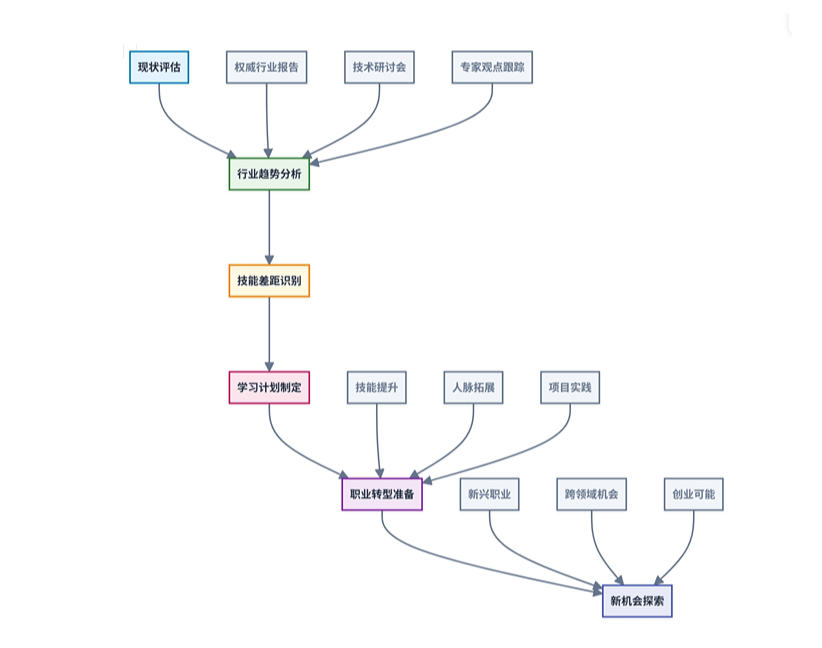
Individuals should always maintain keen insight into industry trends and technological development trends, and plan their careers flexibly. Obtain information through multiple channels, such as studying authoritative industry reports, attending industry seminars, and following the views of technology leaders. This information helps to gain a deeper understanding of the development prospects of industries and occupations, and to identify which positions may face the risk of being replaced by AI and which emerging fields will usher in development opportunities.
If you find signs that your occupation or position may be replaced by AI, you need to adjust your career plan in a timely manner and prepare in advance, such as transitioning to emerging fields or improving relevant skills. For example, traditional data entry clerks should proactively learn more advanced skills such as data analysis and data visualization, and transition toward data analyst or data scientist roles. Programmers engaged in basic programming work should think about how to improve their abilities in system architecture, algorithm design, or AI model fine-tuning, and develop toward more senior R&D positions or AI-related positions. Career planners suggest that a self-assessment and career plan adjustment can be conducted once a year to ensure that personal development direction is synchronized with market trends.
Strategy Five: Develop "irreplaceable" soft skills
OpenAI CEO Sam Altman calls on individuals to focus on cultivating "irreplaceable skills" that AI finds difficult to replicate, such as complex problem-solving ability, cross-domain collaboration ability, and strategic thinking. High-level cognitive abilities and interpersonal skills are difficult for AI to reach in the foreseeable future. For example, when facing complex business problems involving multiple factors and multiple goals, AI may be able to provide data analysis support, but final decision-making, risk assessment, and cross-department coordination and communication still require human wisdom and experience. In projects requiring deep teamwork and innovative breakthroughs, human empathy, communication skills, and collaborative spirit are key to the project's success.
Career planners emphasize that the core competitiveness in the workplace over the next five years will shift toward "soft skills" and "adaptability." Creativity and innovative thinking are difficult for AI to replace. AI can generate content, but originality and emotional expression remain exclusively human, and creative talent will turn AI tools into inspiration engines. Emotional intelligence and interpersonal collaboration skills are increasingly valued in the workplace. AI lacks empathy, the workplace values teamwork and leadership, and people with high emotional intelligence can better resolve conflicts and build efficient networks. While improving technical skills, individuals should consciously cultivate and develop "irreplaceable" soft skills, which is the key to building a personal career moat in the AI era.
Strategy Six: Explore emerging career opportunities
With the widespread adoption and application of AI technology, a series of emerging professions have arisen, such as data scientists, machine learning engineers, AI architects, AI product managers, AI trainers, prompt engineers, data annotators, intelligent operations engineers (AIOps), human-computer interaction designers, AI ethics experts, and others. These professions require practitioners to possess deep professional knowledge, be able to design, develop, maintain, and optimize AI systems and related products, or combine AI technology with the needs of specific industries.
The deep integration of AI with fields such as healthcare, finance, education, and manufacturing has given rise to a series of new career opportunities, such as medical data scientists, instructional directors, fintech analysts, intelligent automation consultants, and others. Cross-domain integrated professions require practitioners to master AI skills and understand the professional knowledge and business processes of their industry. For example, in the healthcare field, AI-assisted diagnostic systems require medical imaging AI analysts to verify and interpret results. In manufacturing, AI-driven robots and automated systems require specialized technical personnel to maintain and manage them, creating positions such as robot maintenance engineers and automated system operators. By paying attention to industry trend reports, participating in emerging technology seminars, and taking relevant skills courses, individuals can learn in advance about the skill requirements and development prospects of these emerging professions, and, in combination with their own interests and strengths, consciously carry out career planning and skill preparation in these directions. Actively embracing emerging career opportunities is an important way to respond to the impact of AI and achieve career advancement.
Summary
The rapid development of artificial intelligence is profoundly reshaping the global job market landscape. Occupations characterized by high repetitiveness, low skill thresholds, and standardization are the first to face the risk of replacement. As a major manufacturing country, China is expected to have 150 million positions affected. In the face of this transformation, individuals should actively embrace the "human-machine collaboration" work model, not only mastering AI tool application skills, but also focusing on cultivating human-specific advantages such as innovative thinking and emotional intelligence.
As Kai-Fu Lee, chairman of Sinovation Ventures, said: "In the next decade, the most sought-after talent will not be people who can use AI, but people who best understand how to collaborate with AI to create value together." In this era of transformation, we need to reposition our own value, regard AI as a capability amplifier rather than a replacement, and maintain irreplaceability in the intelligent era through continuous learning and capability upgrading.