
Artificial intelligence (AI) technology is permeating every industry with unprecedented depth and breadth, and the core driving force lies in its ability to help products achieve a fundamental leap from "function" to "intelligence." For traditional products, whether hardware or software, value is mainly reflected in the implementation of preset functions, and users need to learn specific operating commands to "use" the product. The integration of AI technology gives products the "intelligent" capabilities of perception, understanding, decision-making, and learning, enabling them to proactively adapt to user needs and predict user intent. This transformation is not merely a technical upgrade, but a comprehensive reshaping of the relationship between products and users, business models, and even the way product lifecycles are managed. AI is no longer just an added feature, but has become the product's "brain" and "nervous system," driving products to develop in a more humanized, personalized, and scenario-based direction, ultimately achieving a role shift from "tool" to "partner."

Three Major Dimensions in Which AI Reshapes the Relationship Between Products and Users
Transformation of Interaction Models
From one-way, command-driven "human-computer interaction" to two-way, intent-understanding "intelligent dialogue." In traditional product logic, the user is the operator and the product is the executor; users need to initiate commands proactively, and the product responds passively. This relationship is static and lacks emotional connection. The introduction of AI, especially the application of technologies such as natural language processing, computer vision, and machine learning, enables products to "understand" users' natural language, "see" users' behavior and environment, and "perceive" users' emotions.
Case:Huawei XiaoyiThe Evolution of an Intelligent Agent
Huawei's intelligent assistant "Xiaoyi," through deep integration with the HarmonyOS operating system (HarmonyOS NEXT), has upgraded from a simple voice assistant to a system-level intelligent agent that can understand users' personalized data and contextual scenarios and provide proactive, precise services. This transformation makes the product no longer a cold tool, but an "intelligent partner" that can establish emotional connections with users and provide personalized care.
Upgrade of Business Models
Transformation from the traditional value model of "selling hardware" to "selling scenarios" and "selling services." In the past, a company's core profit point was the sale of hardware products, and once a product was sold, the connection with users weakened substantially. However, AI technology enables products to have the ability to continuously learn and iterate, and companies can establish long-term, dynamic connections with users through cloud services, software updates, and personalized content recommendations.
Case: COLMO, the high-end AI home appliance brand under Midea
The launched AI butler does not merely sell individual smart home appliance products, but provides overall solutions covering multiple scenarios such as whole-home air, water, nutrition, lighting, and security. What users buy is no longer isolated devices one after another, but a "smart living scenario" that can proactively perceive, intelligently adjust, and continuously optimize.
Reshaping of the Product Lifecycle
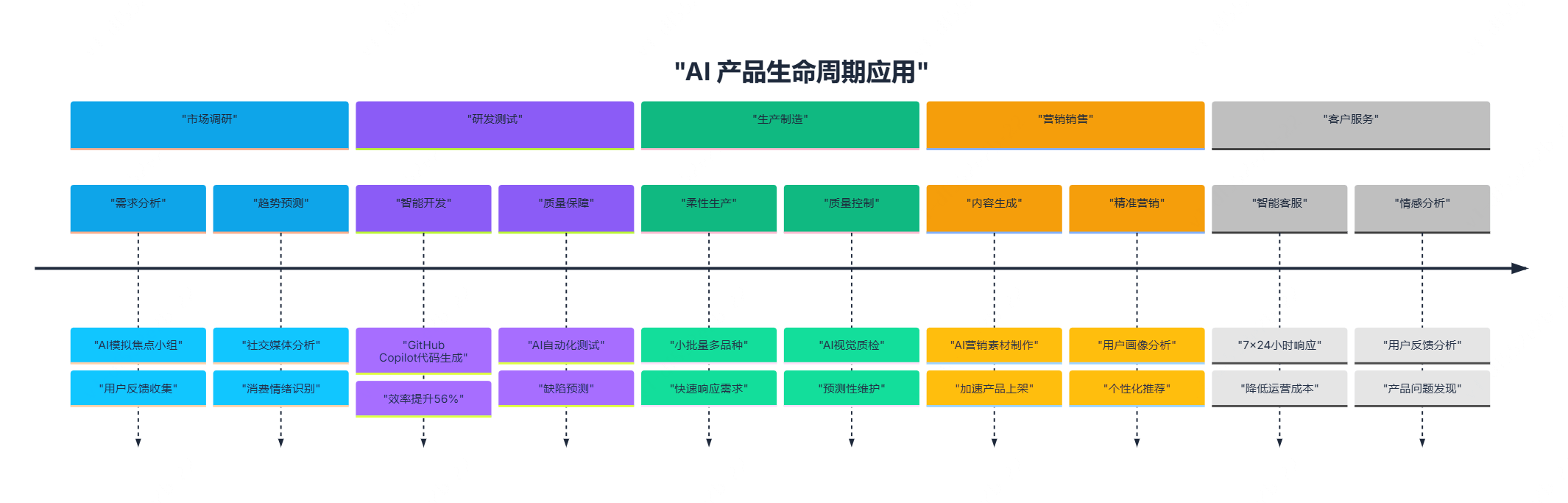
AI technology runs through every link of the product lifecycle, from market research, product design, and manufacturing to marketing promotion and after-sales service, playing a vital role and greatly improving efficiency and precision. In the early stages of product R&D, AI can precisely identify potential needs and consumption trends by analyzing massive market data and user feedback, guiding product definition and function planning.
| Lifecycle Stage | AI Application Scenario | Specific Solutions and Cases | Value and Benefits |
|---|---|---|---|
| Market Research and Concept Design | AI-assisted brainstorming, user needs analysis | Use large models such as GPT-4 to simulate focus groups, upload product prototype images, and have AI play different user roles (such as users of different age groups and interests) to provide feedback, thereby quickly validating product concepts and reducing the cost of early-stage research. | Accelerate the innovation cycle, reduce trial-and-error costs, and more accurately grasp user needs. |
| R&D and Testing | Intelligent code generation, automated testing, AI-assisted design | GitHub Copilotetc.AI programming assistantscan automatically generate code based on natural language comments or function signatures, improving development efficiency by 56%. AI can also automatically generate test cases, cover edge scenarios, and predict high-risk modules where defects may exist in the code. | Shorten the R&D cycle, improve code quality, and reduce labor costs. |
| Production and Manufacturing | Flexible production, AI visual inspection, predictive maintenance | In the consumer electronics industry, AI-enabled flexible production models can meet the production needs of small batches and multiple varieties. AI visual inspection systems can automatically detect product defects, with accuracy and efficiency far exceeding manual work. | Improve production efficiency, reduce defect rates, and optimize supply chain management. |
| Marketing and Sales | AI-generated marketing content, precise user profiles, intelligent customer service | AI image generationtechnology can quickly produce massive amounts of marketing materials and accelerate the product launch process. By analyzing social media trends and consumer sentiment, AI can help companies quickly identify market hotspots and adjust marketing strategies. | Improve marketing efficiency, achieve precise reach, and increase conversion rates. |
| Customer Service and Support | AI chatbots, intelligent ticket assignment, sentiment analysis | AI customer service can handle a large number of repetitive inquiries 24/7, and complex issues can then be transferred to human agents. AI can also analyze the sentiment tendencies in user feedback, helping companies promptly discover product issues and improve them. | Improve service response speed, reduce customer service costs, and improve user satisfaction. |
(AI applications at each stage of the product lifecycle)
AI optimizes user experience
Through intelligent design, natural interaction, and personalized recommendations, create a "one thousand people, one thousand faces" product experience
Intelligent innovation in interface design
AI technology is carrying out disruptive innovation in UI design from multiple dimensions such as automated generation, personalized customization, and accessibility improvement. The traditional UI design process is time-consuming and labor-dependent. AI-assisted design tools can automatically generate interface elements and layouts that conform to design specifications, greatly improving design efficiency.
AI can break the "one-size-fits-all" static interface model. By continuously learning user behavior data, it dynamically adjusts interface layout, function entry points, and content display, creating a unique personalized operating environment for each user.
- AI-Assisted Design: Completely changes the workflow of UI/UX designers, automating a large number of repetitive and rule-based design tasks, allowing designers to focus more on creativity and strategy. AI tools can learn from massive amounts of excellent design cases and design systems (Design System) to understand and master principles such as design principles, color matching, and typographic layout.
- Personalized interface: Dynamically adjust based on user habits. Like a thoughtful assistant, it continuously observes and learns the user's behavioral patterns, dynamically adjusting itself to better serve the user. For example, a data analysis tool (such as FineReport) can, based on the user's historical operations, automatically place the most frequently used report templates or analysis functions in more prominent positions, adjust the ordering, shorten the user's operation path, and improve work efficiency.
- Improve accessibility: Optimize the design for different user groups. Help products better serve a broader user base, including people with disabilities. For example, for visually impaired users, AI can use image recognition technology to automatically generate detailed text descriptions (Alt Text) for images within an application, or use speech synthesis technology to read screen content aloud. For hearing-impaired users, AI can transcribe the audio content of voice calls or videos into text subtitles in real time.
Naturalization and Intelligentization of Interaction Methods (UX)
- Natural Language Interaction (NLI):It is one of AI's most revolutionary applications in optimizing user experience, elevating human-computer interaction from a "machine language" model based on precise instructions to a "human language" model based on everyday conversation. Users no longer need to memorize complex commands or click through cumbersome menus; they only need to say or type their needs in natural language, and AI can understand and execute them.
- Multimodal Interaction:It is the next-generation interaction paradigm driven by AI, going beyond a single voice or touch input and, by integrating multiple information channels such as voice, vision, gestures, touch, and even environmental perception, achieving more comprehensive, more natural, and more efficient human-computer communication. This interaction method imitates the way humans perceive and communicate through the coordination of multiple senses in the real world.
- Predictive Interaction:It is the "superpower" that AI gives to products, marking the transformation of a product from a tool that passively responds to instructions into an intelligent partner that can proactively predict and satisfy user needs. By deeply analyzing users' historical behavioral data, current contextual information (such as time, location, and device status), and external data (such as weather and traffic conditions), AI can build accurate user profiles and, on this basis, predict the user's next intention.
Case: Netflix's AI personalized recommendation system
Netflix uses AI to analyze massive amounts of data such as users' viewing history, search records, ratings, viewing devices, and viewing times to build a unique profile for each user. Based on this profile, Netflix not only recommends movies and series that users may like, but even creates multiple posters in different styles for the same film to attract clicks from users with different interests. It is said that up to 80% of viewing time on Netflix comes from algorithmic recommendations.
AI-Driven Product Innovation
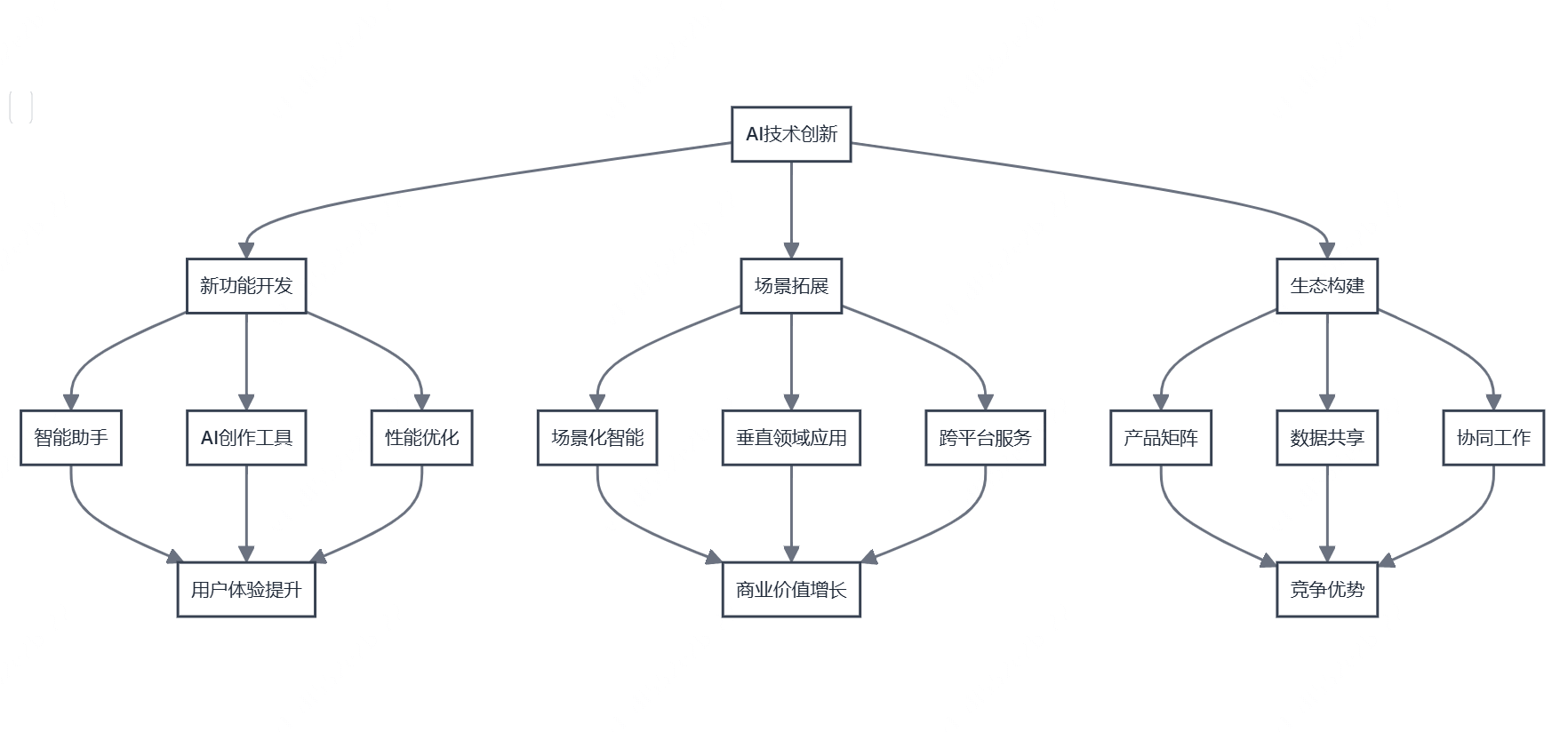
Artificial intelligence (AI) is not only a powerful tool for optimizing existing product experiences, but also a core engine for driving disruptive product innovation and opening up entirely new functions and application scenarios. AI technologies, especially generative AI and large language models, are pushing the boundaries of product capabilities to new heights. They no longer merely enhance or improve existing functions, but can create new functions that were previously unimaginable, such as AI agents capable of complex conversation and creation, or content creation tools that can generate high-quality videos based on text descriptions. AI also prompts companies to rethink product positioning and value, driving their evolution from single hardware or software products to intelligent scenario solutions that connect multiple devices and coordinate multiple services.
Developing New Functions: AI Empowers Products with "Superpowers"
AI technology has brought revolutionary changes to product development, capable of injecting unprecedented "superpowers" into traditional products and enabling qualitative leaps in functionality. This innovation is reflected at three levels:
- AI as a core function: Intelligent assistants (such as Siri and Alexa) are typical examples. With natural language interaction at their core, they transform devices such as phones and speakers into intelligent hubs that can understand and execute users' complex instructions. With the development of large language models (LLMs), the concept of AI agents has emerged. They can not only answer questions but also proactively plan, break down, and execute tasks. For example, vivo's PhoneGPT is an agent carried on a phone that can perceive user and environmental information, understand user intent, and proactively invoke various phone functions to complete tasks, such as booking restaurants and arranging itineraries. Another important direction is AI creation tools, which use generative AI technology to allow users to generate high-quality images, music, text, and even videos through simple text descriptions or sketches.
- AI enhances existing functions: Such as photo optimization and performance scheduling. AI's enhancement of existing functions often produces a "touch of gold" effect, breathing new life into traditional functions. In the smartphone field, AI photography is one of the most successful applications. Through AI scene recognition, a phone can automatically determine whether the subject is a landscape, portrait, or food, and invoke the corresponding optimization algorithms, enabling ordinary users to take professional-grade photos. AI can achieve "computational photography," greatly improving image quality under limited hardware conditions through technologies such as multi-frame synthesis, noise reduction, and HDR.
- AI creates entirely new interaction experiences: Such as gesture control and context awareness. AI technology is spawning entirely new interaction methods beyond traditional touch and voice, making product interaction experiences more futuristic. Gesture Control is a typical example. Through AI vision algorithms, devices can recognize specific gestures users make in the air to enable operations such as page turning, screenshots, and play/pause, which is especially practical in scenarios where users' hands are inconvenient or need to remain clean. Context Awareness is another important innovation direction. By fusing data from multiple sensors such as microphones, cameras, and accelerometers, AI can perceive the user's environment and state in real time. For example, the AI headphones Bose is developing can automatically adjust noise cancellation modes and sound effects according to the intensity and type of ambient noise and the user's activity state (such as sitting still or running), achieving an "intelligent transparency" listening experience.
Expanding application scenarios: from a single product to an intelligent ecosystem
The value of AI lies not only in empowering individual products, but also in its ability to connect and integrate, breaking down barriers between products and connecting isolated devices into an intelligent ecosystem that works in coordination.
- Scenario-based intelligence: The core idea is to link multiple smart devices around a specific user need scenario (such as "coming home," "sleeping," or "leaving home") to provide one-stop automated services. AI is the brain that enables this linkage.
- Ecosystem layout: A higher-level strategy for enterprises based on scenario-based intelligence. By building an AI-centered product matrix covering users' needs in multiple aspects, they lock in users and establish long-term competitive barriers. Technology giants such as Apple, Google, and Huawei are all actively building their own intelligent ecosystems. In this ecosystem, the phone is the core entry point and control hub, while watches, headphones, tablets, computers, TVs, smart home devices, and others serve as extensions, connected and sharing data through a unified AI platform and cloud services.
- Discovering new markets: In the healthcare field, AI can analyze physiological data collected by wearable devices to achieve real-time monitoring and early warning of users' health conditions, and provide personalized health recommendations. In industrial manufacturing, AI can be used for predictive maintenance, predicting failures in advance by analyzing machine operation data to reduce downtime. In the retail industry, AI can optimize product display and inventory management by analyzing foot traffic data and consumer behavior.
AI Application Practices and Cases for Different Types of Products
An in-depth analysis of specific applications of AI in consumer electronics, software applications, and smart hardware
Consumer Electronics Products: AI Brings Hardware to Life
- Smartphones: They are the greatest integrators of AI technology applications. Take vivo's PhoneGPT as an example; it can proactively plan and execute complex tasks based on users' natural language instructions, such as "Help me plan a three-day trip to Beijing and book a cost-effective hotel." PhoneGPT will automatically call multiple applications such as maps, travel, and hotel booking to complete the entire process. AI photography has become a core selling point for major smartphone manufacturers. Through functions such as AI scene recognition, AI beauty, and AI night mode, phones can automatically optimize shooting parameters, allowing ordinary users to easily take great photos.
- Smart Home Appliances: The AI butler concept proposed by the COLMO brand connects all high-end home appliances into a coordinated whole through AI technology. The AI butler can learn users' living habits. For example, if the user usually goes to bed at 10 p.m., it will automatically adjust the bedroom air conditioner to the most sleep-friendly temperature at 9:30 and turn off unnecessary lights. Furthermore, it can achieve cross-device scenario-based linkage. When the user is cooking in the kitchen, the range hood automatically adjusts the airflow according to the stove's heat; when the user is preparing to take a shower, the water heater has already preheated to the user's usual temperature.
- Wearable Devices: Smartwatches, through a variety of built-in sensors, can monitor users' heart rate, blood oxygen, sleep quality, and other data continuously 24/7. AI algorithms can analyze this massive amount of data, identify abnormal patterns, and issue health warnings to users, such as detecting signs of suspected atrial fibrillation. In the earphone field, AI is creating a completely new listening experience. Take the AI technology Bose is developing as an example; the goal is to give earphones "context awareness" capabilities. When the user is on a noisy subway, deep noise cancellation is automatically enabled; when the user is walking on the street, it automatically switches to "transparency mode," allowing the user to hear surrounding traffic sounds and ensuring safety; when someone is talking to the user, it can automatically lower the music volume and enhance the human voice.
Software Applications: AI Improves Service Efficiency and Value
- Streaming Platforms: Netflix uses AI to analyze massive amounts of data such as users' viewing history, search records, ratings, viewing devices, and viewing times to build a unique profile for each user. Based on this profile, Netflix not only recommends movies and series that users may like, but even creates multiple posters in different styles for the same film to attract clicks from users with different interests.
- Office Software: AI-assisted writing features, such as Microsoft's Copilot, can automatically generate text content such as emails, reports, and presentations based on simple user prompts, greatly improving writing efficiency. In data analysis, AI can transform complex data into intuitive charts and insights. Taking iFLYTEK's meeting earphones iFLYBUDS, developed by Future Intelligent Technology, as an example of an AI meeting assistant, it can transcribe meeting speech into text in real time, support multilingual translation, intelligently distinguish speakers, and automatically generate meeting minutes, solving the pain points of low efficiency and error-proneness in traditional meeting records.
- Customer Service: AI chatbots are the most widely used application. Through natural language processing (NLP) and machine learning technologies, chatbots can answer users' common questions 24/7 without interruption, handle simple queries and requests, and free human customer service agents from repetitive work so they can focus on handling more complex customer issues that require more emotional care. AI sentiment analysis technology can identify and understand the emotions expressed by users in conversations, such as satisfaction, anxiety, or anger. When the system detects negative user emotions, it can automatically transfer the conversation to an experienced human customer service agent, or adjust the robot's response strategy to soothe and communicate in a more empathetic way.
Smart Hardware: AI Defines the Next Generation of Hardware Forms
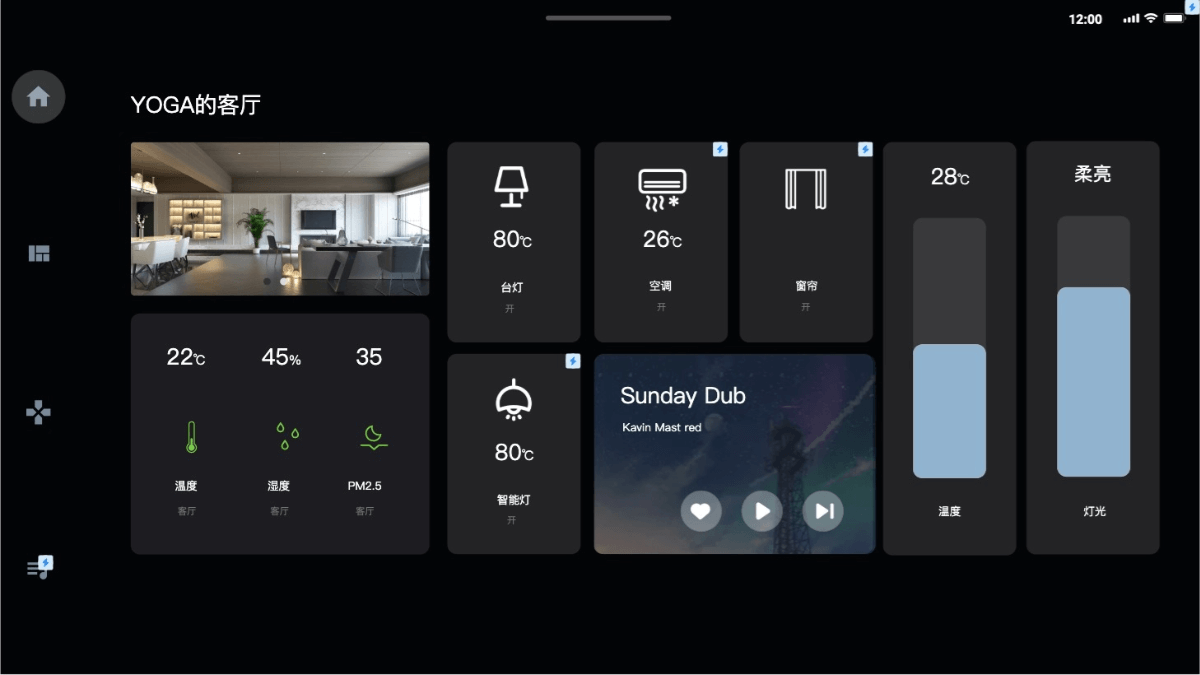
- Whole-Home Intelligence:Committed to building a unified, collaborative, proactively serving intelligent ecosystem. Its core lies in a powerful "home brain"—a core device that integrates an AI hub, multi-protocol gateway, and edge computing capabilities. This "brain" can connect all smart devices in the home, collect data through multimodal perception (voice, vision, sensors), and use AI algorithms for unified analysis and decision-making.
- AI-Native Hardware:Refers to a new category of devices that treat AI as the core and soul from the outset of design, rather than adding AI features to traditional hardware. Through innovative interaction methods and forms, they solve user pain points in specific scenarios or create entirely new user experiences. AI Pin and Rabbit R1 are two recently notable examples. AI Pin is a screenless wearable device that, through laser projection and voice interaction, frees users from dependence on smartphones and allows them to interact with the digital world more naturally. Rabbit R1 is a handheld AI device that, through its unique "Large Action Model" (LAM), can learn and execute users' operations across various apps, becoming a cross-application general-purpose intelligent assistant.
- Robotics and Automation: AI technology is transforming robots from executors of preset programs into "agents" capable of autonomous perception, decision-making, and action. In the industrial field, AI-driven robots can already handle complex assembly, welding, and quality inspection tasks. In the consumer field, home robots are also becoming increasingly "smart." Taking Dyson's 360 Vis Nav robot vacuum as an example, it is equipped with an advanced AI vision system that can build a home map in real time, identify and avoid obstacles, and plan the most efficient cleaning path. It can recognize different floor materials (such as carpets and hard floors) and automatically adjust suction power and brush head speed to achieve the best cleaning effect.
In-Depth Case: Haier Smart Home Brain Platform
The Haier Smart Home Brain Platform is a typical case of whole-home intelligence. By integrating IoT, AI, and big data technologies, it has the ability to think, make decisions, and interact emotionally.
- Can automatically generate exclusive smart scenes
- Proactively recommend services users need
- Achieve a leap from passive response to proactive intelligence
Challenges Faced and Future Trends
Current Challenges
- Data Privacy and Security: Features such as personalized recommendations and predictive interactions require large amounts of user behavior data. How to protect user privacy while providing intelligent services is the primary challenge enterprises must face.
- Technical Costs and Implementation Difficulty: Training high-quality large models requires enormous computing power investment, which is a huge threshold for small and medium-sized enterprises. At the same time, the implementation of AI technology also faces specific challenges such as model lightweighting and robustness.
- User Acceptance and Trust Building: AI sometimes produces inaccurate and biased content, affecting user trust. Improving the explainability of AI and letting users understand the decision-making logic is crucial for building trust.
Future Trends
- AI Agent: Will become the core interaction entry point for products. It can not only passively respond to instructions, but also proactively perceive the environment, understand user intent, plan and execute complex tasks, becoming the user's "digital butler".
- Multimodal Large Models: Will break the limitations of a single information modality, allowing products to simultaneously process and understand multiple types of information such as text, voice, images, and video, enabling more natural and richer interaction experiences.
- Embodied Intelligence: Will bring AI from the digital world into the physical world, enabling robots and other devices to perceive, understand, and act in real environments like humans, achieving deep interaction with the physical world.
| Challenge Areas | Current Status | Solution Directions | Expected Benefits |
|---|---|---|---|
| Data Privacy | Users are concerned about data security, and regulations are becoming increasingly strict | Federated learning, differential privacy, data minimization | Enhance user trust and comply with regulatory requirements |
| Technical Costs | High training costs for large models and high hardware requirements | Model compression, edge computing, cloud services | Lower the threshold and accelerate popularization |
| User Acceptance | Doubt about AI accuracy and reliability | Explainable AI, knowledge enhancement, human-machine collaboration | Improve user trust and satisfaction |
| Technology Implementation | Limited model generalization ability and poor scenario adaptability | Transfer learning, multi-task learning, continual learning | Improve practicality and adaptability |
(AI Application Challenges and Opportunities Matrix)
AI technology is no longer a distant concept, but a real force that profoundly affects product development. It is fundamentally changing the definition, value of products and their relationship with users. For enterprises, actively embracing AI and deeply integrating it into product strategy is no longer a "multiple-choice question", but a "required question" concerning future survival and development. Those enterprises that can successfully use AI to optimize experiences and drive innovation will occupy an absolutely advantageous position in future market competition.
Advice for Enterprises: How to Start the Journey of AI-Empowered Product Innovation
-
Start from user pain points, not technology showmanship: When introducing AI features, always focus on solving users' core pain points and real needs. Avoid using AI for AI's sake and treating technology as a gimmick. The most successful AI applications are often those that integrate into users' daily lives "like a gentle rain moistening things silently" and solve real problems.
-
Take small steps, move fast, iterate quickly: The development of AI products should adopt an agile development model, starting from a small, verifiable feature point, quickly launching an MVP (minimum viable product), and continuously iterating and optimizing through user feedback. This helps reduce initial investment risk and ensures that the product direction always stays aligned with user needs.
-
Value data, build a data loop: Data is the "fuel" of AI. Enterprises should establish the ability to collect, process, and analyze data as early as possible, and build a loop from "data to insights to optimization." By continuously analyzing user behavior data, they can not only optimize existing AI models but also provide direction for future product innovation.
-
Invest in talent, cultivate "AI + product" composite capabilities: The success of AI products depends on composite talent who understand both AI technology and product design. Enterprises should actively recruit and cultivate relevant talent, and encourage close collaboration among algorithm engineers, data scientists, product managers, and designers to form an innovation culture of "human-intelligence collaboration."
-
Uphold ethics, build user trust: While leveraging AI and data, user privacy and data security must be put first. Establish transparent privacy policies, ensure users have control over their own data, and strive to improve the fairness, reliability, and interpretability of AI models. Only by winning users' trust can AI products gain lasting vitality.