
What is AI-Infra-Guard
AI-Infra-Guard is an efficient, lightweight, and easy-to-use AI infrastructure security assessment tool open-sourced by Tencent, capable of discovering and detecting potential security risks in AI systems. AI-Infra-Guard supports fingerprint recognition for 28 AI frameworks, covers a database of over 200 security vulnerabilities, and supports rapid scanning and vulnerability identification. The tool is ready to use out of the box, requires no complex configuration, and provides flexible YAML rule definitions and matching syntax. The core components of AI-Infra-Guard are simple and efficient, with low resource usage and cross-platform support. Users can perform security assessments based on local scanning, specified targets, or reading targets from files, and can combine AI analysis features to further enhance detection capabilities.
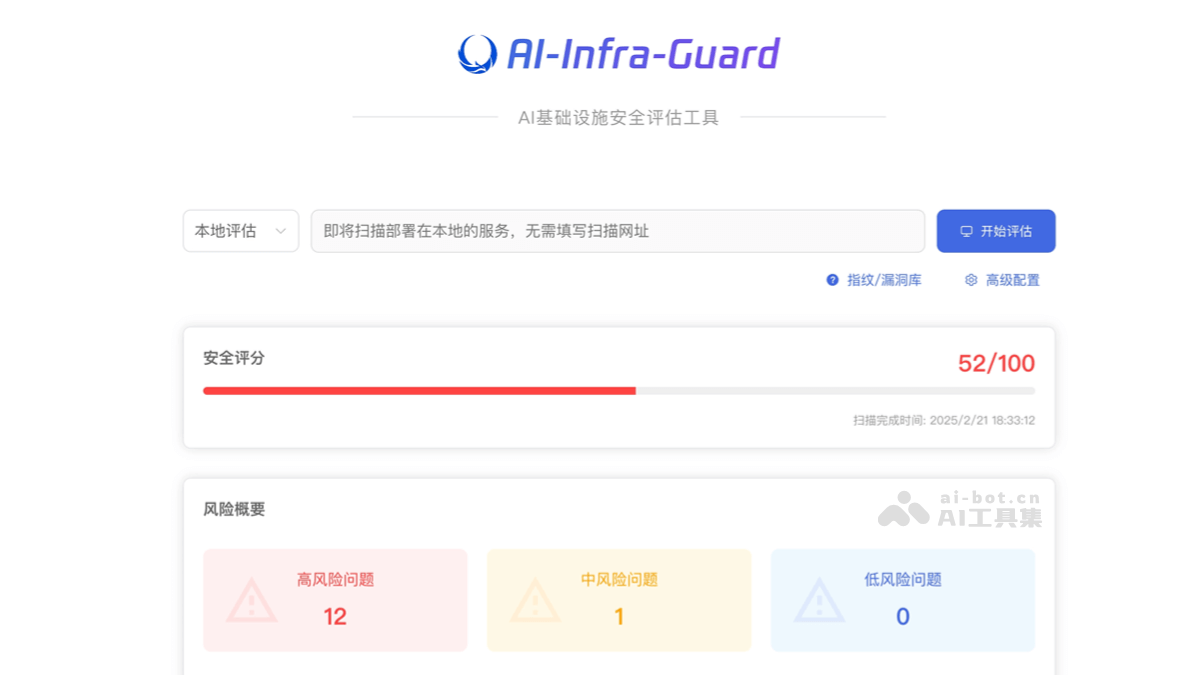
Main Features of AI-Infra-Guard
- Efficient Scanning: Supports fingerprint recognition for 28 mainstream AI frameworks, quickly locating AI components used in the system. Covers a database of over 200 security vulnerabilities, comprehensively detecting known security risks.
- Indirect Prompt Injection Detection: Identifies attack methods that indirectly inject malicious instructions through external data.
- Multi-language Code Analysis: Supports multiple languages such as Python, TypeScript, Java, etc., without the need to develop separate detection rules.
- Vulnerability Detection: Provides detailed vulnerability information, including vulnerability descriptions, severity ratings, and remediation recommendations. Supports security assessments for various AI components, such as Gradio, JupyterLab, Triton, etc.
- Detailed Security Reports: Generates reports containing risk descriptions, technical details, and remediation recommendations.
- Flexible Usage Methods: Supports WEBUI and command-line operations, local scanning, multi-target scanning, and file reading.
- Lightweight Design: Core components are simple and efficient, with small binary file size and low resource usage. Supports cross-platform use, including Windows, Linux, and macOS.
- Easy to Extend: Users can customize rules as needed. Provides flexible matching syntax, supporting fuzzy matching, regular expression matching, and more.
Technical Principles of AI-Infra-Guard
- AI-driven Dynamic Detection: Based on a ReAct-like (Reasoning + Acting) framework, combining AI's reasoning and acting capabilities, supporting AI interaction with external tools to obtain additional information and provide more reliable detection results.
- Dynamic Execution and Simulated Attacks: AI agents can autonomously execute system commands (such as reading files, starting services, accessing networks, etc.), simulating an attacker's perspective to analyze potential attack chains and exploitability.
- Multi-language Code Analysis: Based on AI's natural language processing and code understanding capabilities, supports multiple programming languages (such as Python, TypeScript, Java, etc.), without the need to develop separate static code analysis (SAST) rules for each language. Analyzes code logic based on semantic understanding to identify potential security vulnerabilities (such as command injection, arbitrary file read/write, etc.), avoiding false positives associated with traditional keyword-based matching.
- Indirect Prompt Injection Detection: Targeting common indirect prompt injection attacks in MCP services, AI agents analyze data flows in code and examine how external data is introduced into the AI conversation context. Combining comprehensive assessment of documents, code, and output data, identifies malicious instructions hidden in external data (such as web content, files, etc.).
- Risk Model Mapping: Based on the predefined model of 9 major categories of MCP security risks, AI agents autonomously understand these risk patterns and plan detailed detection strategies. According to the characteristics of different MCP services, the detection strategy is dynamically adjusted to ensure the comprehensiveness and accuracy of detection.
- Fingerprint Matching and Vulnerability Database: Based on WEB fingerprinting technology, quickly identify the AI components and frameworks used in the target system. Combined with a predefined vulnerability database (more than 200 vulnerability fingerprints), quickly match known vulnerabilities and provide detailed vulnerability information and remediation suggestions.
AI-Infra-Guard Project Address
- GitHub Repository:https://github.com/Tencent/AI-Infra-Guard
AI-Infra-Guard Application Scenarios
- AI Development and Deployment: Help development teams quickly detect security vulnerabilities in frameworks and components when developing and deploying AI models, remediate risks in advance, and ensure system security.
- Cloud Service Security: Cloud platforms scan AI services, promptly discover and remediate vulnerabilities, and ensure the security of user data and the platform.
- Security Audit and Compliance: Support enterprises in conducting security audits, generate vulnerability reports, and meet industry compliance requirements.
- IT Operations Management: Enterprise operations teams regularly scan AI systems, monitor security status, and quickly respond to and remediate issues.
- Security Research and Community Contribution: Researchers and the community study new vulnerability detection methods and contribute new fingerprints and vulnerability rules.