
I believe many people have had the thought of writing a song.
Maybe it was late at night when emotions surged, and a few off-key musings drifted through your mind; maybe you wanted to prepare a special gift for someone important, but nothing felt heartfelt enough no matter how you looked at it. But most thoughts are set aside after a spin—after all, you don't play an instrument, don't understand music theory, and can't even read numbered musical notation. Writing a song seems like something only professional musicians can do.
I used to think the same way. Until I tried making my first song with AI. Starting from a casual sentence that came to mind, in less than half an hour I had a complete arrangement, vocals, and mix, and later it was successfully released on music platforms.
Today I'll talk with everyone about how ordinary people with no musical background can use AI to make their first original song.
First, let's break a misconception: making a song no longer requires learning music theory first
In the past, making a complete song had a very high barrier to entry. Lyric writing, composing, arranging, recording vocals, and mixing—each step required corresponding professional skills. For ordinary people wanting to get started, just learning basic music theory would consume a lot of time, and most of the time they could only stay at the "just thinking about it" stage.
But AI has fundamentally changed this.
It has taken over the most technically dependent steps: arrangement and instrumentation, vocal performance, pitch correction, and mixing. You don't need to understand how chords fit together, don't need to know how drumbeats lock into the rhythm, and don't need to research how to make vocals clean. You only need to clearly state what you want to express and what kind of feeling you want, and it can generate a complete finished product.
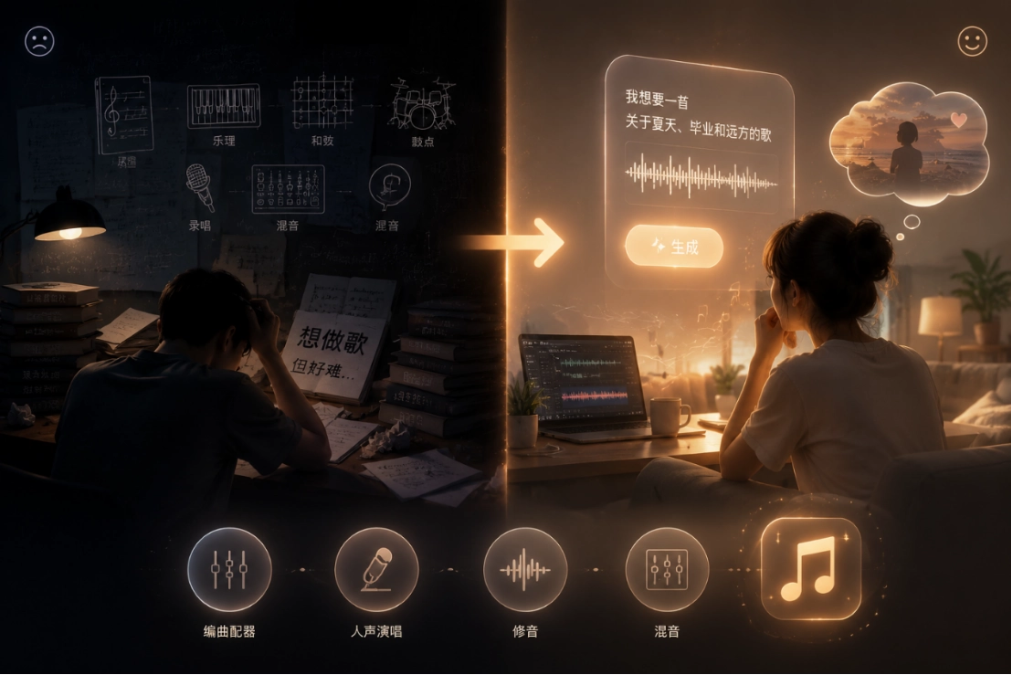
To put it plainly, making songs used to depend on technical skill. Now, for ordinary people making songs, it depends on whether you have emotions and stories you want to express. Once the technical barrier is leveled, everyone's feelings and experiences can become songs.
For inexperienced beginners, it's easy to get dizzy from various complex pages and features. Here I recommend a very easy-to-use AI music tool—Yinshu AINot only is the interface simple and clean, but it also focuses on an AI music community. Many AI music experts share their experience there, and when you see a style you like, you can make the same one. It's very suitable for beginners to learn.
From zero to one, make your first original song in five steps
You don't need to prepare any professional knowledge, nor learn complex software in advance. Follow these five steps, and in half an hour you can have your first song.
1. First decide on a very small theme
Don't start with grand themes like life or ideals. The smaller the thing, the easier it is to do well.
It could be the evening breeze you felt on the way home from work, an old friend you haven't seen for a long time, the moment your cat knocked over a water cup at home, or some unspoken emotion. Just choose a small thing you've recently felt something about as the core of this song.
Don't be afraid the theme is too small. Songs that truly move people often grow from specific small things.
2. Write one sentence you most want to express
You don't need to write complete lyrics, and even less to force rhymes or parallelism. Just write one sentence you most want to say, as natural as everyday speech.
For example, if you miss a friend, write: the road I walked with you last summer, I still often walk it now; if you enjoy being alone, write: it turns out eating alone can also be very peaceful.
This sentence is the anchor of the whole song. All the later melody, lyrics, and emotions will unfold around it.
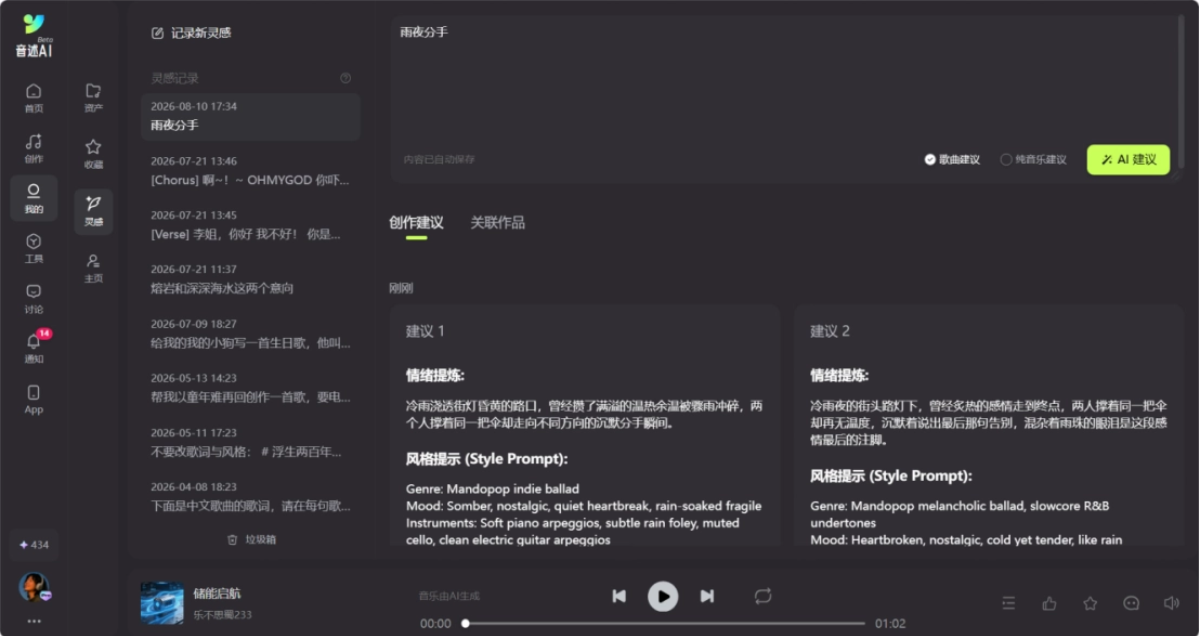
If you have scenes and ideas in your mind but can't express them, you can use this Yinshu AI inspiration feature to refine the emotions and specific visual scenes with AI suggestions.
3. Tell the AI your requirements and directly generate a complete work
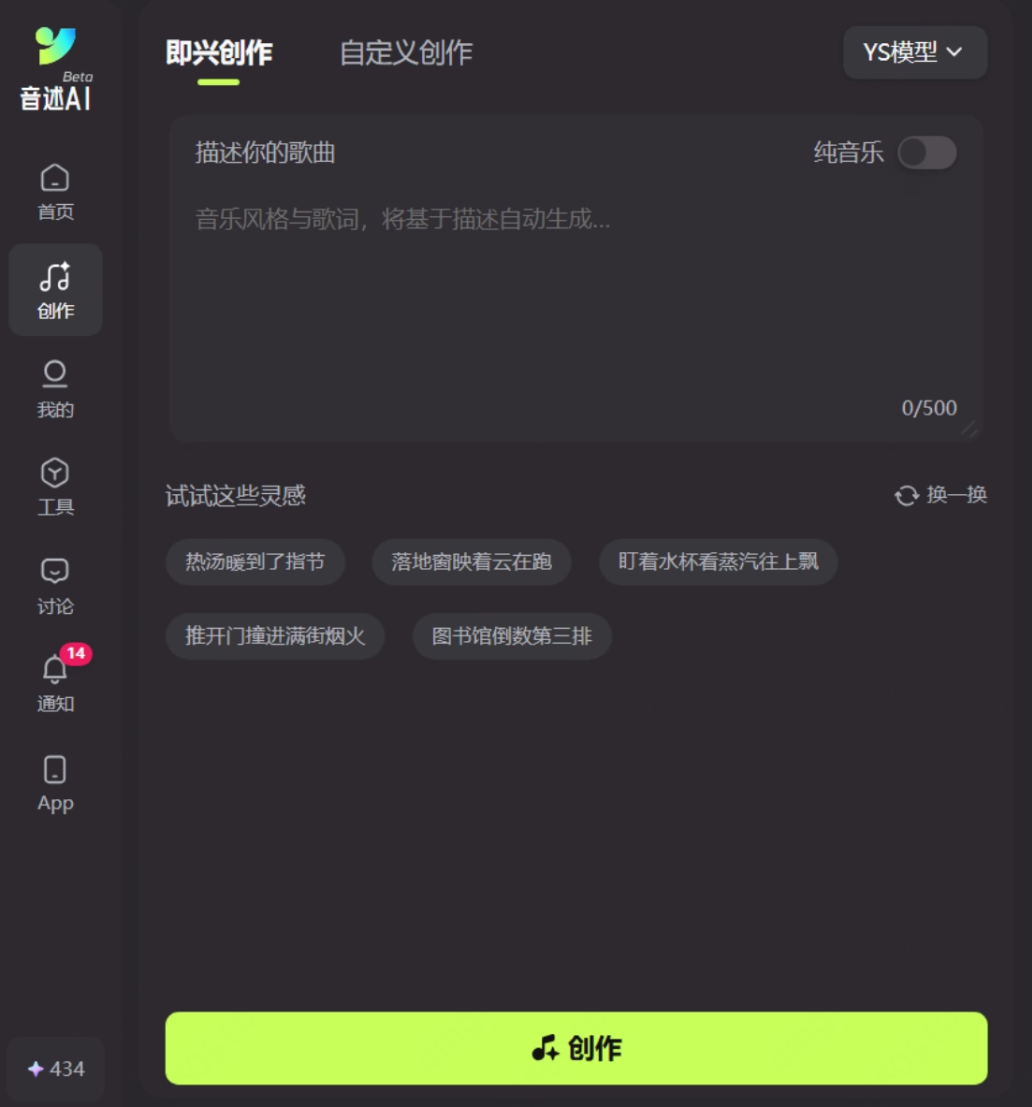
Enter the theme and core sentences you've thought of, along with the style and feeling you want, into the AI tool together.
You don't need to use any professional terminology, just speak plainly. For example, you can directly write:
A gentle pop song about the mood of walking home alone after work, with the core line "the evening breeze brushes my shoulder, as if it's okay if no one speaks," sung by a female voice, accompanied by guitar, with a quiet overall atmosphere, about two minutes long.
Yinshu AI's improvisation feature is especially friendly to beginners. You don't need to understand any complicated operations. Enter these words, and in a few minutes it can generate a song with vocals, complete arrangement, and mixing. The tool has many ready-made style templates built in. Even if you only fill in one core sentence, it can produce a decent finished product, and you don't need to worry at all about professional steps like arrangement and instrumentation.
4. Spend ten minutes fine-tuning the details
The first generated version probably won't be 100% satisfactory, but don't panic, and don't overturn everything and start over. Just change the parts you feel uncomfortable with.
For example, if you think the intro is too long, say "shorten the intro to within 8 seconds and go straight into the vocals"; if you think a certain lyric isn't suitable, just replace that line; if you think the singing speed is too slow, say "speed up the overall tempo a bit."
Same as before, no need to use professional terms, just clearly state your feelings and requirements. The AI will adjust according to your needs. After two or three changes, it will basically be very close to the feeling you want.
5. Export the finished product and you can put it on platforms
After adjusting to satisfaction, you can directly export the audio file. Now major music platforms have opened individual musician registration. You can apply with your identity information, upload your work, fill in the relevant information, and after review and approval, your song can be searched and heard by everyone.
The whole process, if fast, can be completed in one afternoon. From a vague idea to a formal work that others can hear, this was something unimaginable just a few years ago.
The 3 pitfalls beginners are most likely to fall into when making their first song
I took quite a few detours when I made my first one. I've summarized the three most common pitfalls. Avoiding them in advance can save you a lot of unnecessary trouble.
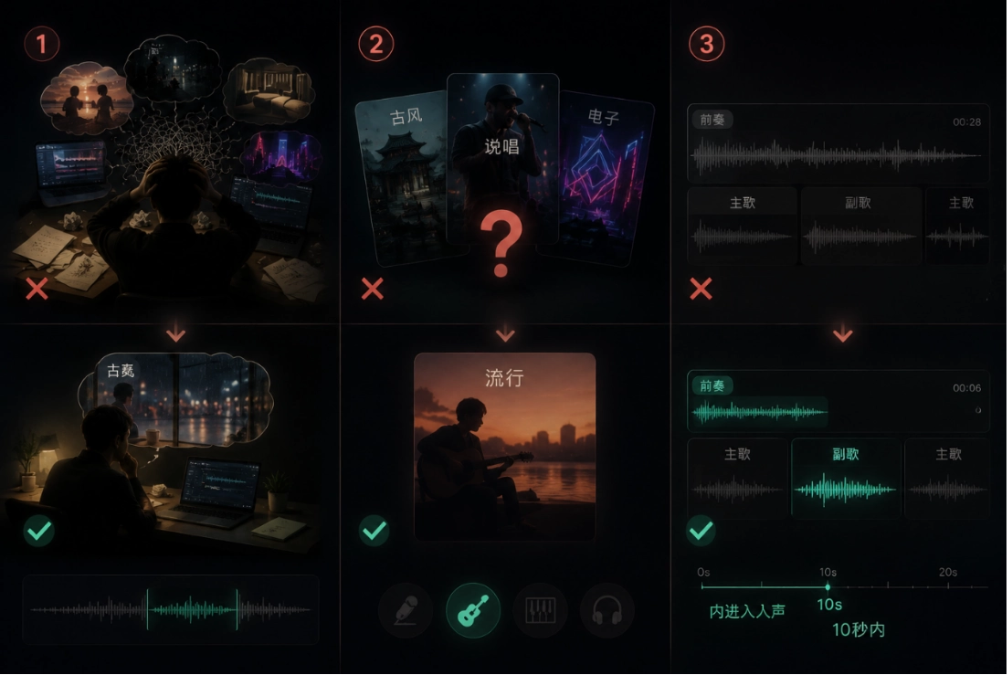
1. The first pitfall: being greedy for too much, wanting to cram all content into one song
Many people, when making a song for the first time, always want to stuff all emotions and all stories into it. They want to write about meeting and also about parting, they want to add piano and also electronic music. In the end, the whole song is packed and messy, and after listening you can't remember any key point.
Actually, for your first song, telling one small thing well and expressing one emotion clearly is enough. The more focused the content, the easier it is to move people.
2. The second pitfall: choosing styles randomly, trying whatever is popular
One moment you think ancient-style music sounds good, the next you think rap is cool, and then you want to try electronic style. You generate each style once, and in the end none of them feels right.
Beginners don't need to blindly chase trends. Just choose the style you usually listen to the most and feel most strongly about. If you often listen to pop, start with pop; if you often listen to folk, start with folk. The more familiar you are with the feeling of that style, the easier it is to judge whether the generated result is good.
3. The third pitfall: the intro is too long, always feeling that the atmosphere must be built up first
Many people think a song needs a long intro, slowly building the atmosphere to have texture. But today people have very limited patience when listening to songs, especially when posted on short-video platforms. If the intro goes over ten seconds or so without vocals, most people just swipe away.
For your first song, don't over-pursue a sense of atmosphere. Keep the intro within 10 seconds and let the vocals and core content come out as soon as possible—that matters more than anything.
For an ordinary person's first song, doing these few things is enough to make it sound good
Don't pursue perfection, and don't judge yourself by the standards of professional songs. For an ordinary person's first original song, doing these few things already makes it a very good piece of work.
First, the emotion must be sincere. You don't need to force gorgeous wording, and you don't need to force rhymes. Your true feelings matter more than any technique. Even if the lyrics are simple and direct, as long as the emotion is real, someone will be able to empathize.
Second, have one line people can remember. That's the core line you decided on at the beginning. Put it in the chorus, repeat it twice, and if others can recall that line after listening, the song has taken hold.
Third, don't make it too long. Keep it between two minutes and two and a half minutes, with a simpler structure: verse, chorus, then one more chorus and you can wrap up. There's no need to force in a bridge or a lengthy outro. Concise and clean is actually more pleasant to listen to.
Finally, I want to tell everyone that many people don't dare to start making songs not because they lack ability, but because they're blocked by the stereotype that you have to understand music theory to write songs.
But that's long been not the case. The point of tools is originally to let more people express their own ideas. You don't have to wait until you've learned guitar, don't have to wait until you understand chords, and don't have to wait until you've trained a good singing voice. As long as you have emotions you want to express and moments you want to record, you can start right now.
If you also want to make your first song of your own, why not open音述AIand try it. Type in that sentence in your heart, and maybe ten minutes later, you'll have your own first original work.