
On September 24, at the Yunqi Conference held in Hangzhou, Wu Yongming, CEO of Alibaba Group and Chairman and CEO of Alibaba Cloud Intelligence Group, delivered a keynote speech. He believes that achieving artificial general intelligence, AGI, is already a certainty, but this is only the starting point. The ultimate goal is to develop super artificial intelligence, ASI, that can self-iterate and comprehensively surpass humans.
Wu Yongming systematically elaborated for the first time the three-stage evolution path toward ASI:
- First stage: "Intelligence Emergence," in which AI acquires generalized intelligence by learning from massive amounts of human knowledge.
- Second stage: "Autonomous Action," in which AI masters tool use and programming capabilities to "assist people." This is the stage the industry is currently in.
- Third stage: "Self-Iteration," in which AI, by connecting to the physical world and achieving self-learning, ultimately achieves "surpassing humans."
To achieve this goal, Wu Yongming clarified Alibaba Cloud's strategic path. As a "full-stack artificial intelligence service provider," Alibaba Cloud will implement its AI strategy through two core paths: first, Tongyi Qianwen firmly adheres to the open-source and open route, committed to building the "Android of the AI era"; second, build a super AI cloud as the "next-generation computer" to provide a global intelligent computing network.
To support this grand vision, Wu Yongming said that Alibaba is actively advancing a three-year 380 billion AI infrastructure construction plan and will continue to add even greater investment. According to long-term planning, in order to welcome the arrival of the ASI era, compared with 2022, the first year of GenAI, the energy consumption scale of Alibaba Cloud's global data centers will increase 10-fold by 2032.
The following is the full text of the speech——
Before starting the speech, I want to especially thank the developer friends who support the entire Chinese and even global technology industry. Today is the 10th anniversary of the Yunqi Conference. The Yunqi Conference originated from Alibaba Cloud's developer conference. It is the vast number of developers who have driven the development of China's and even the global cloud computing, AI, and technology industries. So, before the speech, I want to especially express my highest gratitude to the developers.
In today's world, an intelligent revolution driven by artificial intelligence has just begun. Over the past few hundred years, the industrial revolution amplified human physical strength through mechanization, and the information revolution amplified human information processing capabilities through digitization. This time, the intelligent revolution will far exceed our imagination. Artificial general intelligence, AGI, will not only amplify human intelligence, but also liberate human potential, paving the way for the arrival of super artificial intelligence, ASI.
In the past three years, we have already clearly felt its speed. In just a few years, AI's intelligence has rapidly risen from the level of a high school student to that of a doctoral student, and it can even win a gold medal in the international IMO. AI Chatbot is the feature with the fastest user penetration rate in human history. AI's industry penetration speed exceeds that of all technologies in history. Token consumption doubles every two to three months. In the past year, total investment in the global AI industry has exceeded 400 billion U.S. dollars. In the next five years, cumulative global investment in AI will exceed 4 trillion U.S. dollars. This is the largest computing power and R&D investment in history, and it will inevitably accelerate the creation of more powerful models and accelerate the penetration of AI applications.
Achieving AGI, an intelligent system with human general cognitive abilities, now appears to have become a certainty. However,AGI is not the end point of AI development, but a brand-new starting point. AI will not stop at AGI; it will move toward super artificial intelligence (ASI) that surpasses human intelligence and can self-iterate and evolve.
The goal of AGI is to free humanity from 80% of routine work, allowing us to focus on creation and exploration. As a system that comprehensively surpasses human intelligence, ASI may create a group of "super scientists" and "full-stack super engineers." ASI will solve currently unsolved scientific and engineering problems at an unimaginable speed, such as conquering medical challenges, inventing new materials, solving sustainable energy and climate issues, and even interstellar travel, among others.ASI will drive technological leaps at an exponential rate, leading us into an unprecedented intelligent era.
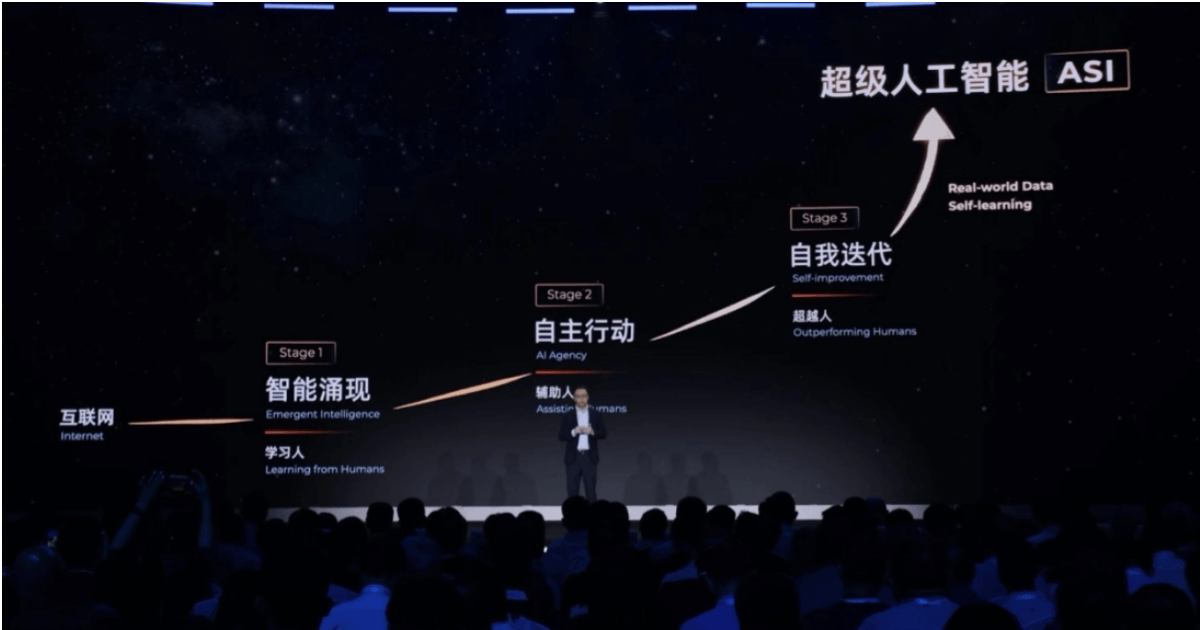
We believe that the path to ASI will go through three stages:
The first stage is "Intelligence Emergence," characterized by "learning from humans."
The development of the internet over the past few decades has provided the foundation for intelligence emergence. The internet has digitized almost all knowledge in human history. The information carried by these words and texts represents the complete set of human knowledge. Based on this, large models first acquired generalized intelligence capabilities by understanding the collective knowledge of the world, emerged with general conversational abilities, can understand human intentions, answer human questions, and gradually developed reasoning abilities to think through multi-step problems. Now, we see that AI has approached the top level of human performance in various subject tests, such as gold medal level in the International Mathematical Olympiad. AI is gradually gaining the possibility to enter the real world, solve real problems, and create real value. This has been the main thread of the past few years.
The second stage is "Autonomous Action," characterized by "assisting humans."
At this stage, AI is no longer limited to language communication, but has the ability to act in the real world. Under human goal setting, AI can decompose complex tasks, use and create tools, autonomously complete interactions with the digital world and the physical world, and have a huge impact on the real world. This is exactly the stage we are in now.
The key to achieving this leap,first is that large models have acquired Tool Use capabilities, enabling them to connect to all digital tools and complete real-world tasks.The starting point of humanity's accelerated evolution was beginning to create and use tools, and now large models have also acquired the ability to use tools. Through Tool Use, AI can, like humans, call external software, interfaces, and physical devices to execute complex real-world tasks. At this stage, because AI can assist humans in greatly improving productivity, it will rapidly penetrate into almost all industries and fields, including logistics, manufacturing, software, commerce, biomedicine, finance, and scientific research.
Second, the improvement of large models' Coding capabilities can help humans solve more complex problems and digitize more scenarios.Current Agents are still relatively early, mainly solving standardized and short-cycle tasks. To enable Agents to solve more complex and longer-cycle tasks, the most critical thing is the Coding capability of large models. Because Agents can autonomously Code, in theory they can solve infinitely complex problems, understanding complex requirements and autonomously completing coding and testing like an engineering team.Developing the Coding capability of large models is an essential path to AGI.
In the future, natural language will be the source code of the AI era, and anyone can create their own Agent using natural language.You only need to input in your native language and tell the AI what you need, and the AI can write logic itself, call tools, build systems, complete almost all work in the digital world, and operate all physical devices through digital interfaces. In the future, there may be more Agents and robots than the global population working alongside humans, having a huge impact on the real world. In this process, AI will be able to connect most scenarios and data in the real world, creating conditions for future evolution.
AI will then enter the third stage—"self-iteration," characterized by "surpassing humans."This stage has two key elements:
First, AI has connected the full amount of raw data from the real world.
At present, the fields where AI is advancing fastest are content creation, mathematics, and Coding. We see that these three fields have obvious characteristics. The knowledge in these fields is 100% defined and created by humans, all in text, and AI can 100% understand the raw data. But for other fields and the broader physical world, what today's AI encounters is more often knowledge summarized by humans, lacking extensive raw data from interaction with the physical world. This information has limitations. For AI to achieve a breakthrough that surpasses humans, it needs to obtain more comprehensive and more raw data directly from the physical world.
Let me give a simple example. For instance, if the CEO of an automobile company wants to iterate next year's product, they will most likely rely on countless user surveys or internal discussions to decide what features the next car will have, which strengths it should achieve compared with competitors, and what capabilities should be retained. It is still very difficult for AI to do this now, and the core point is that the data and information it obtains are all secondhand data from research. If one day AI has the opportunity to connect all the materials and data for this car, the next car it creates will far exceed what is created through countless brainstorming sessions. This is just one example in the human world, let alone the more complex physical world, which is far from something AI can understand merely through human knowledge summarization.
Therefore, for AI to enter a higher stage, it needs to obtain more comprehensive and more raw data directly from the physical world, just as in the early stage of autonomous driving, relying only on human summaries and Rule-based methods to achieve autonomous driving could not achieve very good results. The new generation of autonomous driving mostly adopts end-to-end training methods, learning directly from raw onboard camera data, and has achieved a higher level of autonomous driving capability. Even for the relatively simple problem of autonomous driving as it appears to us now, relying only on human-summarized knowledge and rules cannot solve it, let alone the entire complex physical world. Merely letting AI learn the patterns summarized by humans is far from enough.Only by letting AI continuously interact with the real world and obtain more comprehensive, more real, and more real-time data can it better understand and simulate the world, discover deep patterns beyond human cognition, and thereby create intelligence capabilities stronger than humans.
Second, Self-learningself-learning
As AI penetrates more physical world scenarios and understands more physical world data, AI models and agent capabilities will also become stronger and stronger, and there will be opportunities to build training infra, optimize data processes, and upgrade model architecture for the upgrade and iteration of its own models, thereby achieving Self learning. This will be a critical moment in AI development.
As capabilities continue to improve, future models will, through continuous interaction with the real world, acquire new data and receive real-time feedback. With the help of reinforcement learning and continual learning mechanisms, they will autonomously optimize, correct deviations, and achieve self-iteration and intelligent upgrades. Every interaction is a fine-tuning, and every feedback is a parameter optimization. After countless cycles of scenario execution and result feedback, AI will self-iterate to intelligent capabilities surpassing humans, and an early artificial superintelligence (ASI) will take shape.
Once a certain singularity is crossed, human society will be like pressing the accelerator key, and the pace of technological progress will exceed our imagination. A new explosion of productivity will drive human society into a brand-new stage. This path toward artificial superintelligence is becoming increasingly clear before our eyes. With the evolution of AI technology and the explosion of demand across industries, AI will also bring about a huge transformation in the IT industry.
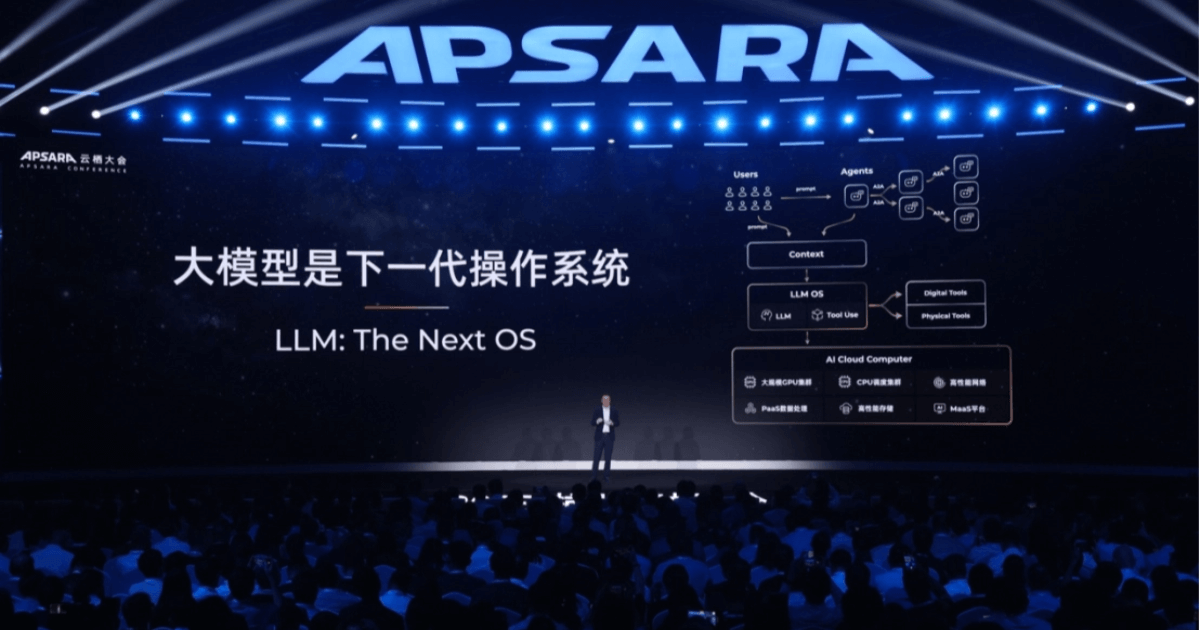
Our first judgment is: large models are the next-generation operating system.We believe that the technology platform represented by large models will replace the position of today's OS and become the next-generation operating system. In the future, almost all tool interfaces linked to the real world will be connected to large models. All user needs and industry applications will execute tasks through large-model-related tools. The LLM will be the intermediate layer that carries the interactive scheduling of users, software, and AI computing resources, becoming the OS of the AI era. Let us make some simple analogies: natural language is the programming language of the AI era, the Agent is the new software, Context is the new Memory. Large models connect various Tools and Agents through interfaces such as MCP, similar to the bus interfaces of the PC era, and Agents complete multi-Agent collaboration through protocols such as A2A, similar to the API interfaces between software.
Large models will devour software. As the next-generation operating system, large models will allow anyone to create unlimited applications using natural language. In the future, almost all software that deals with the computing world may be Agents generated by large models, rather than today's commercial software. The potential developer base will grow from tens of millions to hundreds of millions. In the past, due to the cost of software development, only a small number of high-value scenarios were developed by engineers into commercialized software systems. In the future, all end users will be able to satisfy their needs through tools such as large models.
Model deployment methods will also diversify, and models will run on all devices. The current mainstream way of calling model APIs to use models is only an initial stage; in fact, it looks very primitive. It is similar to the time-sharing stage of the mainframe era, where each person had only one terminal connected to a mainframe for time-sharing. This approach cannot solve data persistence, lacks long-term memory, is not real-time enough, cannot solve privacy, and is not plastic enough. In the future, models will run in all computing devices and have persistent memory, an end-cloud collaborative operating state, and can even update parameters at any time and self-iterate, similar to how today's OS runs in various environments.
It is precisely based on this judgment that we made a strategic choice: Tongyi Qianwen chooses the open route, to build the Android of the AI era. We believe that in the LLM era, the value created by open-source models and the scenarios they can penetrate will be far greater than those of closed-source models. We firmly choose open source precisely to fully support the developer ecosystem and explore the infinite possibilities of AI applications together with developers around the world.
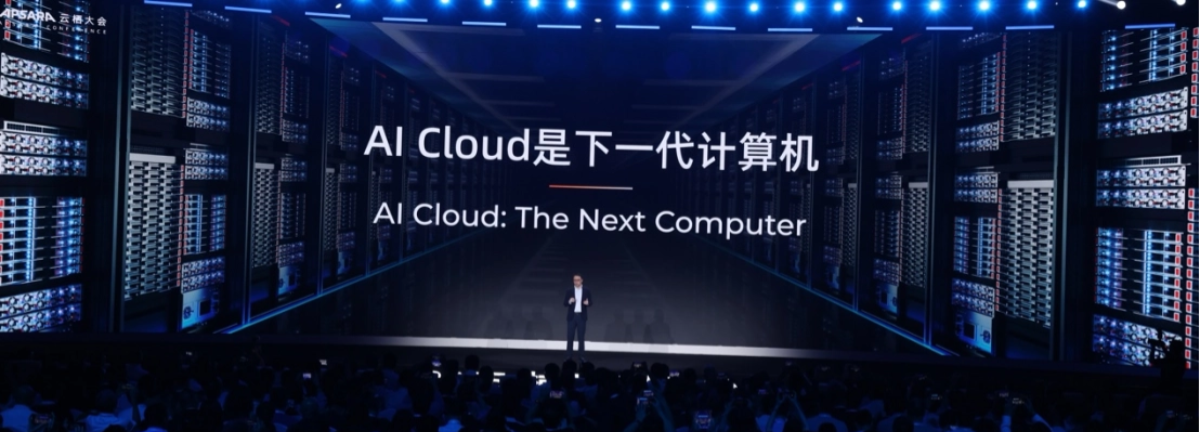
Our second judgment: super AI cloud is the next-generation computer.
Large models are a new OS running on top of AI Cloud. This OS can satisfy anyone's needs. Everyone will have dozens or even hundreds of Agents. These Agents work and collaborate 24 hours a day without interruption, requiring massive computing resources.
The computing paradigm within data centers is also undergoing a revolutionary change, accelerating from traditional computing centered on CPUs to AI computing centered on GPUs. The new AI computing paradigm requires denser compute power, more efficient networks, and larger cluster scales.
All of this requires ample energy, full-stack technology, millions of GPUs and CPUs, collaborative networks, chips, storage, and databases operating efficiently, and handling demands from around the world 24 hours a day.This requires ultra-large-scale infrastructure and full-stack technology accumulation. Only a super AI cloud can carry such massive demand. In the future, there may be only 5-6 super cloud computing platforms in the world.
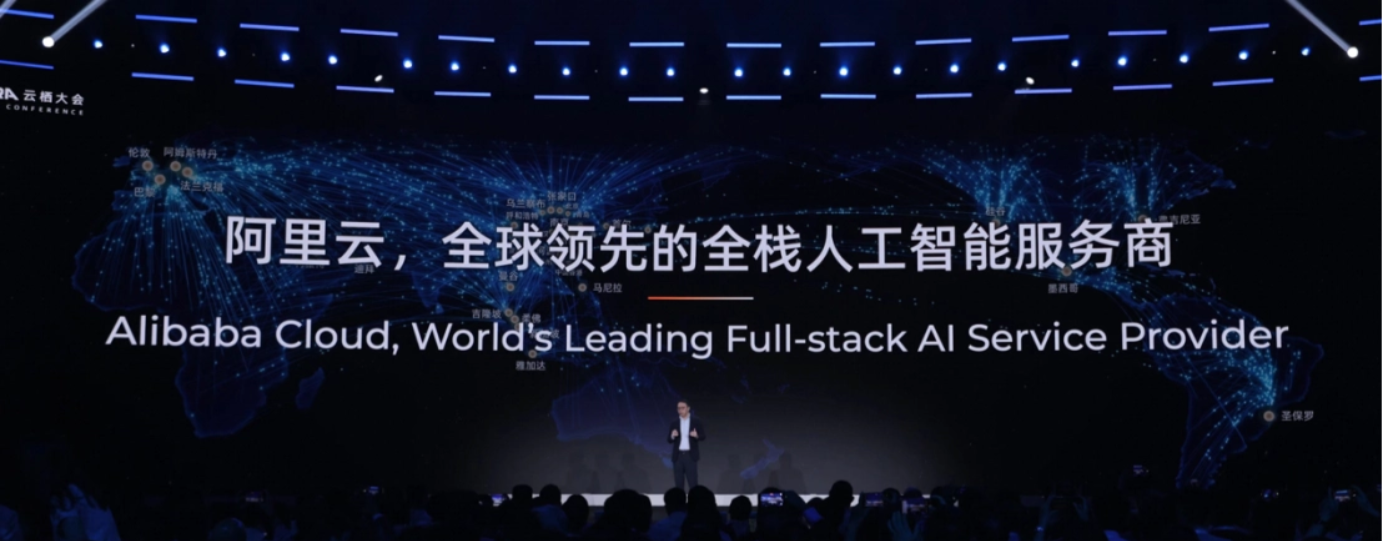
In this new era,AI will replace energy's position and become the most important commodity, driving the daily work of thousands of industries. The vast majority of AI capabilities will be generated and transmitted in the form of Tokens on cloud computing networks.Tokens are the electricity of the future.In this brand-new era,Alibaba Cloud's positioning is as a full-stack artificial intelligence service provider, offering world-leading intelligence capabilities and a global AI cloud computing network, providing developer-ecosystem-friendly AI services around the world.
First, we have a globally leading large model — Qwen. Qwen has open-sourced more than 300 models, covering all modalities and all sizes, and is the open-source model most popular among global developers. As of now, Qwen has more than 600 million global downloads and more than 170,000 derivative models. It is the world's number one open-source model matrix and can be said to be the large model with the widest penetration into computing devices.
At the same time, Alibaba Cloud provides the one-stop model service platform Model Studio, which supports model customization and rapid Agent development, and also provides an Agent runtime environment such as AgentBay, as well as a series of developer kits such as Lingma/Qoder, enabling developers to conveniently use model capabilities and create and use Agents.
Second, Alibaba Cloud operates China's number one and globally leading AI infrastructure and cloud computing network, and is one of the few super AI cloud computing platforms in the world capable of vertical integration of software and hardware. At the hardware and network levels, Alibaba Cloud's self-developed core storage systems, network architecture, and computing chips form the most solid foundation of Alibaba Cloud's large-scale computing clusters.
Alibaba Cloud is going all out to build a brand-new AI supercomputer. It possesses both the most leading AI infrastructure and the most leading models, and can achieve collaborative innovation in infrastructure design and model architecture, thereby ensuring the highest efficiency when calling and training large models on Alibaba Cloud, making it the most user-friendly AI cloud for developers.
The speed of development in the AI industry far exceeds our expectations, and the industry's demand for AI infrastructure also far exceeds our expectations. We are actively advancing a three-year 380 billion AI infrastructure construction plan, and will continue to add even greater investment. From the perspective of the long-term development of the AI industry and customer demand that we see now, in order to welcome the arrival of the ASI era, compared with 2022, the first year of GenAI, Alibaba Cloud's global data center energy consumption scale will increase 10-fold by 2032. This is our long-term plan, and we believe that through such saturated investment, we can drive the development of the AI industry and welcome the arrival of the ASI era.
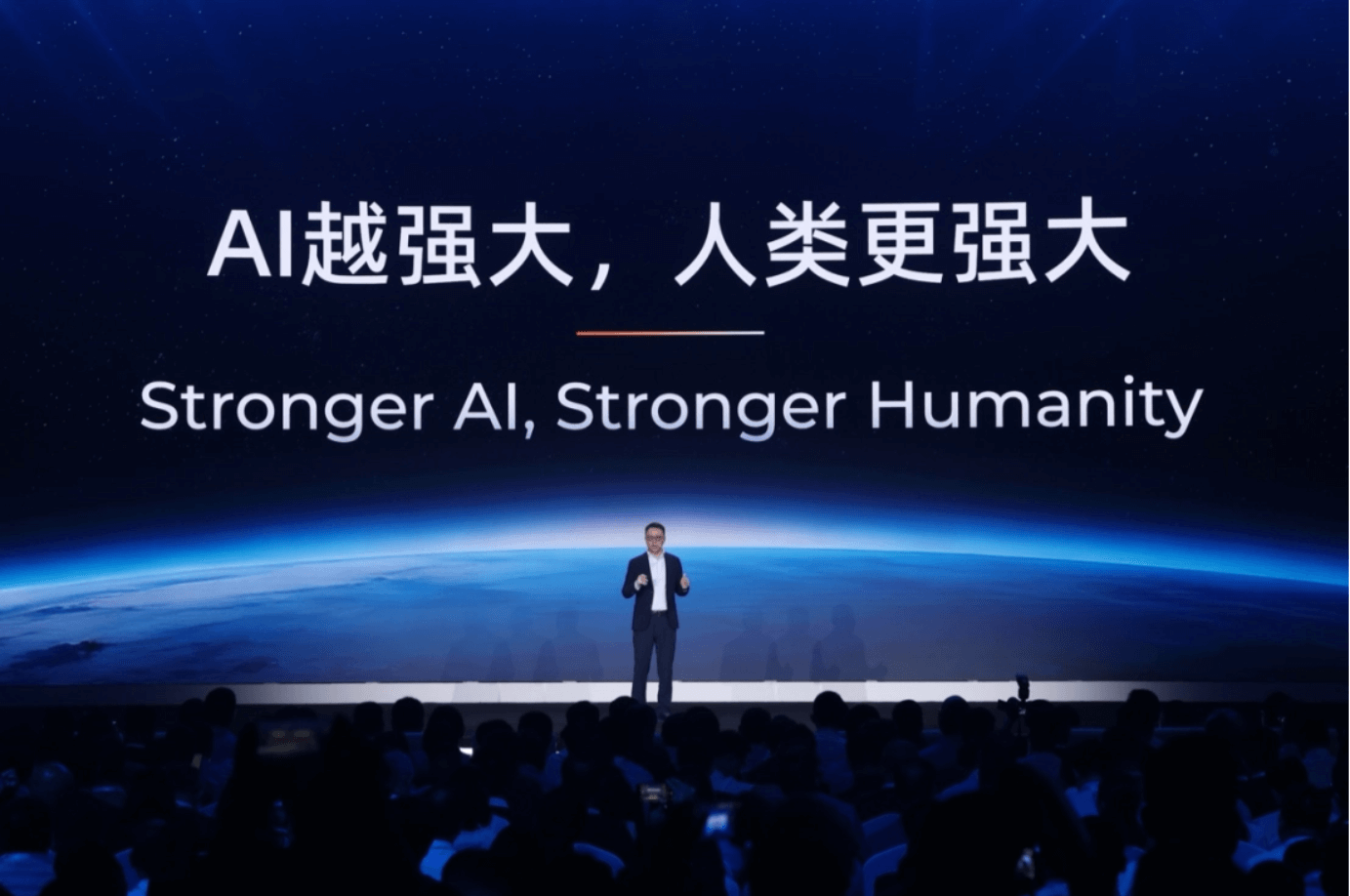
After super artificial intelligence arrives, what kind of collaborative relationship will humans and AI have?
Future AI will become increasingly powerful, and once ASI surpassing human intelligence is born, how will we humans and AI coexist? We are full of optimism about the future. After superintelligent AI arrives, humans and AI will have a brand-new way of collaborating. Programmers may have already felt it: we can give an instruction, and through a tool like Coding, let it create in 12 hours a system we need. From this we see an early prototype of how humans and AI will collaborate in the future. So we believe, from Vibe Coding to Vibe Working. In the future, every household, factory, and company will have numerous Agents and robots serving us 24 hours a day. Perhaps in the future, every person will need to use 100 GPU chips to work for them.
Just as electricity once amplified the lever of human physical strength, ASI will exponentially amplify the lever of human intelligence. In the past, we spent 10 hours of time to obtain 10 hours of results. In the future, AI can let our 10 hours of output be multiplied by tenfold or a hundredfold leverage. Looking back at history, every time a technological revolution unlocks more productivity, it creates even more new demand. Humans will become more powerful than at any time in history.
Finally, I want to emphasize that everything has only just begun. AI will reconstruct the entire infrastructure, software, and application system, becoming the core driving force of the real world and setting off a new round of intelligent revolution. Alibaba will continue to invest, and together with partners and customers, let AI go deep into industries and create the future together. I wish everyone a fulfilling and enjoyable Apsara Conference. Thank you all!