

The ChatExcel team recently completed an angel funding round of nearly ten million yuan, invested by Shanghai Changlei Capital and Wuhan Donghu Angel Fund.
According to official disclosures, this funding will mainly be used for product R&D iteration and global operations, further advancing its exploration and implementation in the direction of "AI DataAgent."
As a AI Native team, ChatExcel has served over ten million user sessions cumulatively over the past two years, and once won first place nationwide in the intelligent office group at CCTV's "Win in AI+" entrepreneurship competition.
Today, it can not only process data in multiple formats such as Excel, databases, and web pages, but has also launched the world's first vertical model adapted forAIPClocal deployment, building a complete data loop.
In the view of founder Pang Dawei, this is only the beginning: "ChatExcel is not just a tool, but also the team's first ticket to keep up with the AI era. We hope that through full-chain data capabilities, we can connect data from acquisition to value monetization, so that ordinary people can also have their own data agents."
Product name: ChatExcel
Slogan: Just through chat, AI can process Excel and data analysis
Main function: In one sentence, process Excel spreadsheets and database data, no functions needed, and get data insights in 10 seconds
Official website:ChatExcel
The following is our interview with ChatExcel founder Davis:
K-Jie Research Society
Hi~Davis, can you introduce what you have been busy with recently?
🧑🏻💻 Davis
Recently, we have mainly been iterating the product around the direction of AI DataAgent, while also advancing commercialization.
K-Jie Research Society
I saw your recent traffic data, which has increased several times compared with last month. Can you share how this was achieved?
🧑🏻💻 Davis
I think the core point is that the product has iterated. Our traffic grew by about 175%, entering the top five for growth rate in Feifan's rankings. Domestic traffic ranking is around 58th. This result exceeded our expectations.
We have done almost no commercial advertising, so the growth mainly comes from the product iteration itself. At the same time, exposure from some large platforms and large channels also brought part of the traffic increase. Overall, it is the product and natural exposure that drove the growth.
It is not that we do Excel because of AI, but because Excel itself is worth doing
K-Jie Research Society
I saw on your official website that you won first place in the intelligent office group at CCTV's "Win in AI+". Can you share how you won this first place?
🧑🏻💻 Davis
"Win in AI+" is an entrepreneurship program re-held in the AI era by the production team of CCTV's "Win in China" back then. We first participated in the preliminary round at Alibaba Cloud's Yunqi Conference last year, which was live-streamed on site. After that, we went through three rounds of competition, eventually reached the finals, and won first place.
The competition format is similar to what everyone sees on TV: founders need to introduce their products and business models within two to three minutes, and judges and audience members score them.
For our team, this was a very good opportunity. It not only gained us exposure, but also made us rethink: What is our core competitiveness? Where are our goals and barriers? What direction should we take in the future? This is a bit like an "elevator pitch," requiring us to explain the product and vision clearly in an extremely short time.
More importantly, on a platform like CCTV, we gained a lot of traffic and exposure, while also facing sharp critiques from judges and investors. These incisive questions pushed us to reflect: where do we still need to improve, and how should we prepare for the future? Overall, this program has been very helpful to us.

K姐研究社
What was your original motivation for building the ChatExcel product?
🧑🏻💻 Davis
The core members of our team come from Peking University. Two PhD co-founders were already doing research related to data processing and Excel when they were graduate students. At that time, we were still using BERT this generation of AI technology; we didn't start doing it because GPT appeared.
Later, during their doctoral studies, the two PhDs, under their advisor's guidance, tried to redo data processing using the Transformer architecture. By the second half of 2022, we gradually switched to this new architecture. It just so happened that GPT rose in 2023, so we followed the trend, positioned the product as ChatExcel, and launched it for users.
So our starting point was truly to solve Excel problems, not to choose this direction because AI appeared.
The harder the problem, the more valuable it is
K姐研究社
Your team is currently under 10 people. What is the composition roughly like?
🧑🏻💻 Davis
Our team actually only has 8 people, and basically all of them have product and technical backgrounds. You could say we are a highly technical team, and we firmly believe in the AI era.
K姐研究社
That is indeed a very small team size.
🧑🏻💻 Davis
AI products rely on product and technical capability; it is a PFG model. So we believe growth must depend on iteration of product strength. Other application tactics are just icing on the cake, but in the face of technology iteration cycles, they likely cannot compete.
So even though we only have 8 people, we still iterate our product in the way of product and technology iteration.
K姐研究社
When new architectures and AI technology handle Excel, what is the biggest difference from traditional methods?
🧑🏻💻 Davis
The biggest difference is that users' habits and expectations have changed. In the past, users needed to memorize functions and formulas, or even write code; now users only care about the result, not the process. As long as they hand over the spreadsheet and data to the system, they expect immediate feedback.
This approach is actually more in line with people's real expectations and usage process, just like using ChatGPT: state your needs clearly and get the result.
K姐研究社
You just mentioned that the team is almost all engineers, but you already have a very large user base in China. How did you reach so many users?
🧑🏻💻 Davis
Mainly through product strength and user self-propagation. We don't have much funding to invest in traffic or find big influencers to promote it; growth relies on the value of the product itself.
In addition, we started relatively early, so we have some first-mover advantage. Strictly speaking, we are among the earliest batch in China to do AI applications. Although there was a period of stagnation in the middle, after two years we are still ranked first in this track. The reason behind this is that the direction of AI + Excel and AI data processing has a very high threshold, and there is almost no comparable product on the market.
People often say "hard but right," and I think that makes a lot of sense. For example, in the AI era, what you should really do are those hard problems: How do you ensure accuracy? How do you support multiple data types? How do you handle large databases? How do you ensure data security? These are all technical barriers.
The reason we have been able to accumulate so many users is that we keep iterating and gradually meeting users' expectations.
We also started from 10 users, then slowly built up to 1,000 and 10,000. After users try it, they give feedback, and we iterate again to meet more of their needs, so they continue using it and bring word-of-mouth referrals.
So, in essence, our growth still relies on product strength.
How do you make users believe the results are accurate?
K姐研究社
Many users now treat AI as a daily office tool, for example writing copy, making PPTs, and so on. But in data scenarios, AI still has hallucination issues, and users often need to repeatedly verify results. How do you solve the problem of "whether the results are accurate"?
🧑🏻💻 Davis
That's a good question. What we build is a data agent, and Excel is just one type of file.
So how do we solve accuracy? There are two aspects:
First, we do it behind the scenes using AI coding. We believe the capabilities and processing rules of AI Coding are accurate.
Second, we make the process trustworthy and visible. I let users see the entire chain of file and data processing, and they can intervene. The process is transparent.
For example, we now provide services to the Big Four audit firms, and they require that the coding process must be visible, so that it can prove there are no problems with the logic.
How do you prove trustworthiness? Your results must be verifiable.
In addition, data accuracy is also related to the data source. If the data source quality is poor, the results will definitely be poor, so this also involves data quality and data governance issues.
So this is not something solved by model capability alone, but jointly solved across multiple dimensions such as the model, product interaction, visualization, and data sources. The entire DataAgent chain is actually very long.
Commercialization direction—productizing form, productizing capability
K姐研究社
How is your revenue situation now? Have you already started making money?
🧑🏻💻 Davis
Making money, we are making money.
K姐研究社
I saw that you launched SaaS enterprise edition, AIPC edition, and all-in-one private deployment versions, and also opened MCP and API interfaces. There are many external product forms, so what is your key direction for commercialization?
🧑🏻💻 Davis
Our focus is actually just one thing: productization. Deliver in a Product way. In the end, it faces C-end users.
This C can be an individual user accessing our website through the internet, or downloading the client, or experiencing it on other products through MCP, including the APP version and enterprise version we made, all of which revolve around this point.
At the same time, we are also solving another key issue: security. In the usage scenarios of data agents, what everyone cares about most is security and sensitivity. The simplest way is to keep files from leaving the laptop, leaving the local area network, or leaving the company's scope.
We did quantitative training of the model and separately made a data model that can support deployment in AIPC, all-in-one machines, or within a local area network.
These are our two directions for commercialization:
- Productizing the form;
- Productizing the capability—being able to deploy the model to a single computer.
K姐研究社
From your perspective, what proportion of future revenue contribution will come from C-end and B-end roughly?
🧑🏻💻 Davis
We still focus mainly on C-end users, and currently our revenue mainly comes from the C-end. Although we also have some B-end customers collaborating with us, overall our focus is still on solving data processing problems for C-end users. We are not doing a traditional BI product, so at this stage the C-end share will be larger.
Different positioning from WPS and Office, not comparable
K姐研究社
Currently, there are quite a lot of applications on the market that C-end users can use for spreadsheets and data processing, such as WPS and Office, which also integrate AI capabilities, and some newly emerging ones like Aibiao. How do you compete with these tools? What is your differentiation?
🧑🏻💻 Davis
The difference lies in different positioning. We are not just doing spreadsheet processing; our positioning itself is DataAgent (data intelligent agent).
Products like WPS and Office are essentially still spreadsheet editors, just with AI added on top of the editor, or they only solve a certain single-point problem, such as generating charts.
ChatExcel builds an AI DataAgent around the full data chain (data acquisition, data preparation, analytical insights, data visualization, decision application, value exchange), enabling data to flow and creating a business closed loop.
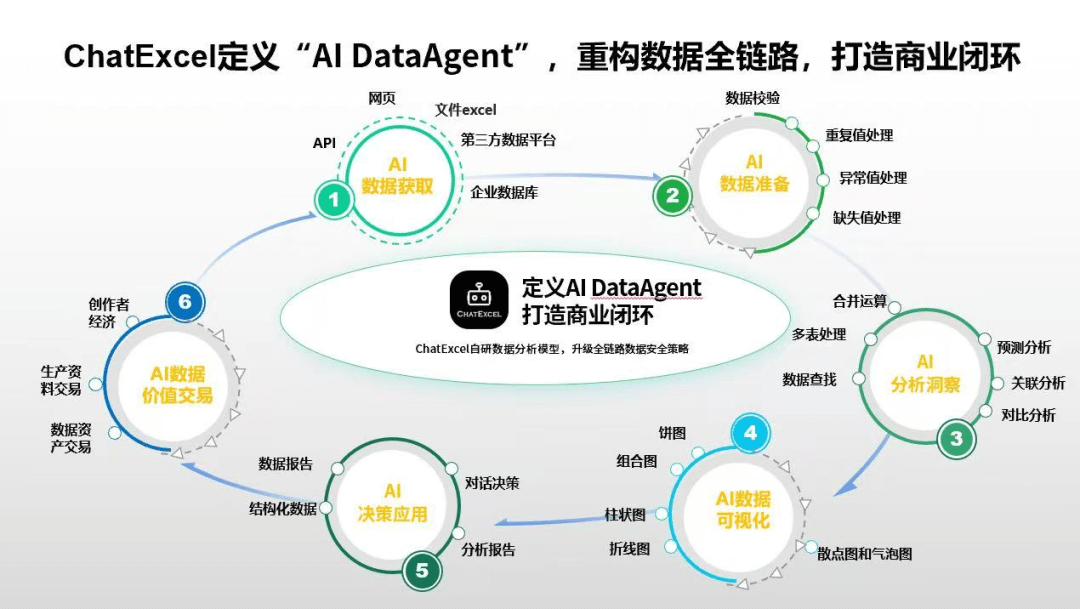
Different nodes have different scenarios, and each real user has different data needs in different work scenarios.
We and WPS and Office are doing different things. We believe we are something new, so there is not much comparability, right?
Although there is some overlap in the problems solved, the technical route and positioning are different. Competition certainly exists, but I believe the truly effective competition must be competition among new things in the AI era, not the model of "old products plus AI."
K姐研究社
So you are an AI-native application, without the obstacles of traditional products?
🧑🏻💻 Davis
Yes. Our biggest competitiveness lies in the fact that we are an AI Native team, doing AI Native products. Our perspective is to build products as model capabilities improve, and continuously evolve along with the maturity of models, which is completely different from old products.
Old products certainly have their advantages and barriers, but our biggest opportunity today lies in—what problems new AI products can solve.
Our team is less than 10 people, yet we can achieve such data and commercialization results. The logic behind this is also because we are an AI Native team.
The boost AI brings us is very obvious. Whether it is our view of things, team composition, or our technological evolution, you will actually find that in our team, the embodiment of AI and overall model capabilities is very obvious.
The biggest opportunity in the future is overseas
K姐研究社
How is your progress in overseas markets?
🧑🏻💻 Davis
Our overseas product (English version) has already launched, and we are doing overseas promotion. But overseas we are still a "newborn"
K姐研究社
So is the overseas version completely isolated from the domestic version?
🧑🏻💻 Davis
Yes, completely isolated. We use a completely new domain name. There are some similarities in interaction, but overseas it is a completely new name and carrier, and we are doing it anew PMF, market testing, and commercialization testing.
We firmly believe that the biggest opportunity in the future is still overseas. Essentially, we are an efficiency tool, and overseas users have a stronger willingness and ability to pay for efficiency tools, so this is a huge opportunity for us.
We are also increasing investment, and in the second half of the year we will put a large amount of resources and energy into the iteration of overseas products.
Sister K Research Society
What do you think about the differences between domestic users and overseas users?
🧑🏻💻 Davis
Overall, we are all facing C-end users, but the differences are still significant.
The first is the difference in usage habits and payment habits. Domestic users themselves differ, for example, between first-tier cities along the southeastern coast and other regions, or across different industries.
Overseas can also be further segmented: Europe and the United States, Japan, Japan and South Korea, South America, and the Middle East all have completely different usage habits, and behind that are differences in the level of informatization and payment levels.
At present, we are still making progress, and there may be more conclusions in a few months. But from the current feel, different countries do indeed differ in usage habits and payment capacity.
But for us it is still okay, because the data we process is essentially all spreadsheets: Excel, Sheets, or Data, and these are universal worldwide. So the difficulty of localization is relatively not that great.
Small team of 8 people, nearly ten million in financing completed
Sister K Research Society
Can you disclose the latest financing progress? Are you considering starting a new round?
🧑🏻💻 Davis
We completed a round of financing in the first half of the year, and may start a new round soon. This week we will officially announce the previous round of financing, which will also prepare for the next round.
Sister K Research Society
What is the main goal of this financing?
🧑🏻💻 Davis
It is mainly for product iteration and overseas markets. Although our team itself is already making money, doing overseas requires more investment.
In addition, at this stage what matters is speed. Whether it is team depth, technical iteration, or user growth strategy, all require funding support.
Sister K Research Society
What kind of investment do you prefer? Will you screen investments?
🧑🏻💻 Davis
We do not have a particularly clear preference, after all, we are still relatively early.
The previous round of financing has been completed. Next, we hope investors can identify with our direction of doing data agents, have understanding, and also bring resource help. Especially overseas, if the investor has accumulated experience in this area, it will be more valuable to us.
Frequent iteration can help us quickly find the right direction
Sister K Research Society
Your update frequency is especially high. How do you choose the direction of iteration? Why can you maintain such a high update frequency?
🧑🏻💻 Davis
This is related to our understanding of products in the AI era. Essentially, it relies on the growth of product strength to attract users. Users in the AI era are willing to grow together with startup teams, so we will continue to iterate according to user needs.
Second, frequent updates can help us quickly find the right direction. With a high iteration frequency, the trial-and-error cycle is shorter, and the trial-and-error cost is lower. We can continuously obtain positive feedback.
The shorter the positive feedback cycle, the more correct the direction.
If it is updated only once every half a year, the trial-and-error cycle is too long, and in the AI era it simply cannot keep up. Now one month already brings earth-shaking changes, so update frequency is a very important thing.
Sister K Research Society
I probably noticed you around the end of 2022, but it was not until 2025 that your productization gradually improved. Have people also commented that your progress is relatively slow?
🧑🏻💻 Davis
There are indeed such comments. But the reason behind it is very objective: our team comes from Peking University, and the two PhD partners were still studying for their doctorates at the time, and their studies came first. For example, last year they happened to be in the first year of their PhD, so during that period there was almost not much iteration, and the main energy was still put into studying.
AI entrepreneurs must acknowledge their own boundaries
K姐研究社
How do you view the current ecological niche? For example, you have already partnered with leading companies like Alibaba and Huawei.
🧑🏻💻 Davis
I think the ecological niche itself is a kind of competitiveness and barrier. But the core still depends on whether your product is unique in the industry and whether it can solve a segmented, vertical problem, and this point may be something that big companies have not yet put resources into in a short period of time.
In addition, I have always believed that in the AI era, especially in China, startup teams must be very open in pursuing ecosystem cooperation. AI technology has models and boundaries, and the team's own capabilities and resources also have boundaries, so openness to cooperation is the best growth strategy, rather than closing off and overlapping in doing the same thing separately.
I think today is a very good era for this batch of entrepreneurs and products in the AI era. Big companies are willing to open up resources, platforms, and traffic to help and embrace small third-party teams like us.
We need to embrace this rhythm and maintain an open mindset. In fact, what everyone is doing now with MCP logic is the same. Doing well and solidly in a segmented direction is already very challenging. You must believe that your team has boundaries, and do not think that because your team is large, you can do everything. This is very important.
K姐研究社
Domestic vendors like Huawei, Alibaba Cloud, Tencent Cloud, and ByteDance Volcano already provide server and database services themselves. Do you worry that they will directly copy your products and then provide them to their customers?
🧑🏻💻 Davis
We have never worried about this issue. In fact, it is not just the AI era; all software products will face competition, and this is the norm. Before we were born, many teams were already working in similar directions, and competition is always all-around competition.
But in the AI era, the pace of iteration is very fast, and we do not think big companies necessarily have an advantage just because they do this. Especially in China, big companies have their own higher-priority matters and may not necessarily invest resources in this segmented field.
For us, what matters more is to focus on doing our own things well. We are making a new AI Native product, and user expectations are also very high. The customer groups we have not yet covered are already very large, so rather than worrying about whether others will do it, it is better to focus on how and at what speed to meet user needs.
The positioning is to do AI Decision (AI decision intelligent agent)
K姐研究社
I saw on the official website that you have two upcoming products, called ChatData and ChatPanel. Could you introduce them separately?
🧑🏻💻 Davis
These two products will be launched within two weeks. In fact, they are part of our product iteration roadmap. Our positioning is to do AI Decision (AI decision intelligent agent), starting from high-frequency general scenarios like Excel, first serving C-end users, and accumulating data and usage habits.
We believe there are multiple types of data. The first Source is the file type, and the second is the database type.
ChatData, which we are about to launch, is handling database-type data. For example, whether you have a MySQL database, SQL Server, or Spark and various other databases, we support processing directly through AI.
ChatPanel is oriented toward external data. Data can roughly be divided into three categories: file-type data (such as Excel), database-type data (mostly internal enterprise data), and public data, such as web page data and third-party internet data. We automatically obtain web page data and generate tables and analysis reports.
For example, I want to know which brands had the highest mobile phone sales across all platforms during 618, and how the new energy vehicle rankings look. Our agent can directly scrape and generate visualized results.
From a product roadmap perspective, we started from Excel, then expanded to databases, then to third-party public data, and even support integration with third-party APIs, as well as the MCP protocol. As long as it is data, regardless of the source, we hope to cover the entire chain from acquisition, processing, and refinement to applied analysis.
The new products mentioned on the official website are actually implementing this direction.
The AI era has just begun. ChatExcel is a starting point, not the destination.
K姐研究社
I understand that David, you were also an entrepreneur before, right?
🧑🏻💻 Davis
Yes.
K姐研究社
Previously you were doing marketing-oriented ToB SaaS, and now you are working on ChatExcel. Will this be your last startup project?
🧑🏻💻 Davis
I would count myself as a serial entrepreneur. Previously I was mainly doing marketing-related enterprise service SaaS. As for whether ChatExcel will be the last project? I don't think so.
ChatExcel is just the name of a project at this point in time. The AI era has only just begun. I see it more as a ticket for our team, and also for me personally, to enter this era.
It can only mean that we have just caught up with the pace of this era, while in the coming decades and even centuries, there will still be a great many things to do. As for exactly where it will go, it is impossible to judge now.
So whether this is the first or the last project is not important. What really matters is: choosing the right direction in this era, persisting in doing it, and maintaining an open mindset to keep iterating.
Original article link:Exclusive interview with ChatExcel's Pang Dawei: What did he do right behind completing tens of millions in angel round financing?