
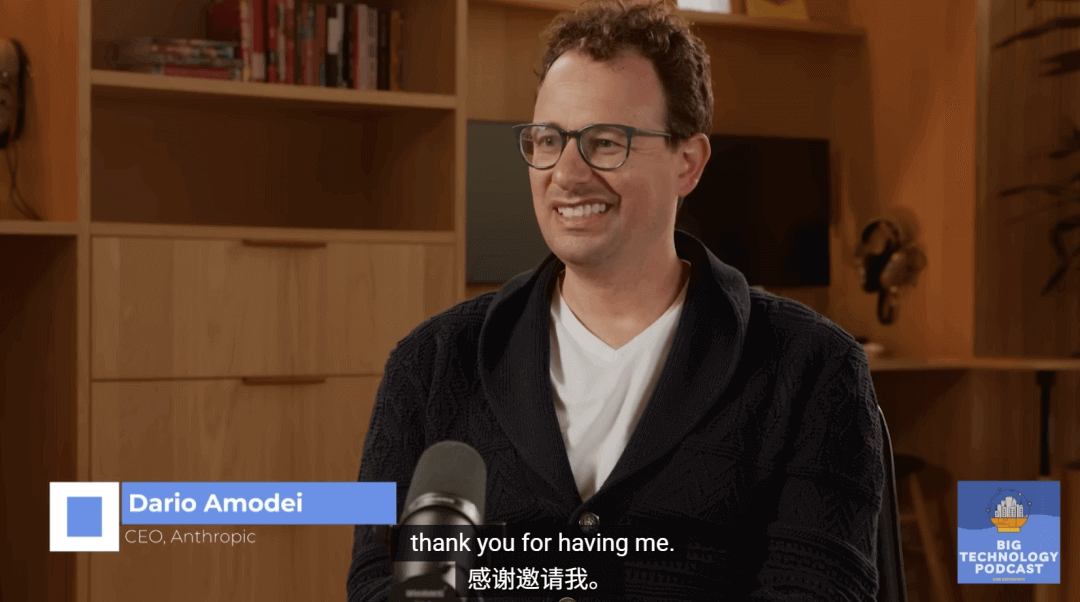
Recently, Anthropic CEO Dario Amodei responded directly in an interview: I am not a "doomer"; I am one of the people who understands the benefits of AI technology best.
Dario Amodei holds a PhD in biophysics from Princeton. During his doctoral studies, he won the Hertz Fellowship (one of the most prestigious research fellowships in the United States), and after graduating he did postdoctoral work at Stanford School of Medicine for several years.
He has worked at Baidu, Google, and OpenAI.
During his time at OpenAI, he led the development of GPT-2 and GPT-3, and proposed RLHF technology, enabling large models to learn for the first time to converse according to human intent.
Until 2021,Dario he founded Anthropic with his sister Daniela and several core members. In three years, they built the Claude series, one of the world's most competitive large models.
In an interview lasting more than an hour, he said bluntly that AGI is a pseudo-concept, and discussed scaling laws, profit logic, the open-source bubble... I listened carefully to the whole thing and compiled 11 core viewpoints, which may also change your view of AI's future.
01. Summary of Dario's Core Viewpoints
Not a doomer, but one of the people who understands the benefits of technology best
The pace of AI evolution is far faster than imagined. A few years ago, models could not even clearly say a sentence; now they can complete PhD-level tasks, and AI is gradually penetrating the real economic system.
Dario has always believed in the role of scaling laws. He understands that no one can truly predict the future, but some things must be said upfront.
He does not deny AI's enormous potential, and may even be more optimistic than anyone about the changes it can bring. Precisely because he can clearly see those benefits, he feels even more responsible for reminding the world not to ignore the risks behind them.
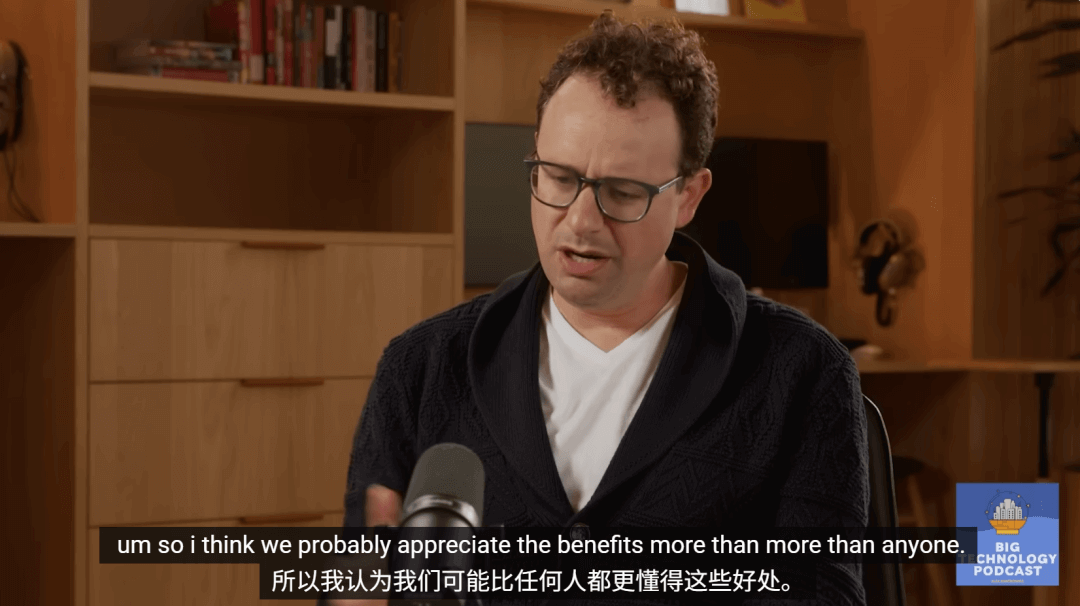
AGI is a dopamine bait, not worth mentioning
Dario believes that AGI (artificial general intelligence) and ASI (artificial superintelligence) are vague terms with marketing connotations. He refuses to use these terms and instead focuses on the improvement of models' real capabilities.
Although he does not use these terms, he is still one of the few people in the industry with the shortest expected timeline for AI capability leaps, and one of the most optimistic.
The real explosion may be just in the next two years
Dario Amodei says that the capabilities of large models are entering a second stage—reinforcement learning, reasoning, and computing power are improving substantially, especially in math and code tasks, where they are already approaching professional standards.
Most people do not realize that this is anexponential curve。
Assuming performance doubles every six months, early on no change is visible; once it approaches a critical point, growth departs from intuition.
For example, Anthropic went from zero revenue in 2023 to more than $4.5 billion in the first half of 2025, and is repeating the trajectory of the internet in the 1990s.
AI may be only two years away from a true explosion.
AI coding capability is undergoing an exponential leap
Coding is one of the capabilities of Claude models that is improving fastest.
Anthropic is not a company focused on building development assistants, yet it has been racing ahead in this direction: 18 months ago, the model could only score 3% on coding benchmarks; now it has surged to 72%-80%.
Inside Anthropic, the vast majority of code is written directly by Claude models, or at least written with model involvement. Other companies have seen similar phenomena.
In terms of returns, progress is also continuously accelerating. Models are entering a stage of "self-development."
The secret of model evolution lies in talent density
Each release of a Claude model brings improvements in architecture, data, and training methods, all of which are part of new technologies.
Anthropic does not often publicly discuss the details, but continuous technological innovation is key to improving model performance. To this end, Anthropic strives to maintain a high talent density, as this is a necessary condition for inventing new technologies.
No matter how high the bid, our team cannot be bought away
Anthropic's core team has an extremely low attrition rate. It is not that no one tries to poach them, but that no one can poach them away.
Dario made it clear that they do not rely on "premium pay to retain people" or engage in individual negotiations. Systematic job levels and unified compensation are part of Anthropic's long-term culture.
"We do not retain people with money, but with a shared vision," he said. Passion, a sense of mission, and long-term commitment are the things that cannot be priced. Even if the other party is Zuckerberg, he may not necessarily be able to buy them away.
Losing 3 billion is not losing money, but betting on the next generation of AI
Anthropic is expected to lose 3 billion US dollars this year. It sounds scary, but it is actually entirely normal.
Dario compares model development to an investment project: suppose training a model in 2023 costs 100 million US dollars, and after deployment it earns 200 million, yielding a profit of 100 million that year. But in 2024, another 1 billion is spent training a new model. Even if the old model continues to make money, the company's books still show a loss. Each model, viewed individually, is profitable, but the company as a whole does not appear profitable because it continuously invests in next-generation research and development.
This model is common in the industry: as long as models continue to improve, companies will increase investment and drive business scale growth.
If one day model performance stagnates, costs will decline and profitability will steadily improve; otherwise, both investment and revenue will continue to grow exponentially.
Open source ≠ free, and it is not the key to determining victory or defeat
Whether it is open source or not is not important. Compared with the superficial freedom of "open weights," Dario values a model's performance on tasks more: Is the model useful? Can it run fast? Does it save money? Is it suitable for business scenarios?
Even if you obtain the parameters, deploying them to the cloud for inference still requires burning money, doing optimization, and pushing forward under a heavy load. Dario pays more attention to this: whoever can do better on tasks wins. What he wants is results, not labels.
In other words: whoever is more usable wins.
We use 20 billion to compete with others' 100 billion
Anthropic's revenue growth over three years has been astonishing, from 0 to 4.5 billion. Dario believes this relies on "talent density" and "capital efficiency," rather than spending money to compete. He said: "What others can do with 1 billion, we may do with 100 million."
API revenue accounts for the bulk, and we are betting on the enterprise market
60%-75% of Anthropic's revenue comes from the API, with another portion coming from the Claude application. Dario made it clear that enterprise-grade is the future, especially in high-value scenarios such as law, finance, and pharmaceuticals.
Doing technology while ensuring safety
He recalled his experience leading GPT-3 and RLHF at OpenAI, and pointed out that capability and alignment cannot be studied separately. He left OpenAI because of differences in philosophy on governance and pace. He founded Anthropic to advance safe AI in a way he trusts.
AI safety should not degenerate into a corporate slogan or bargaining chip, but is a responsibility the industry must shoulder together.
Dario promotes a "responsible scaling strategy," proactively disclosing dangerous capability evaluations, constitutional AI, and interpretability research, not to monopolize safety dividends, but to keep the entire industry on a steadier track.
He does not agree with the pessimism of the cyberneticists, nor does he accept the fanaticism of the accelerationists. He is more concerned with this: as model capabilities continue to approach the high-risk zone, does the industry have sufficient testing and technical reserves? If one day the risk of losing control exceeds the controllable threshold, he will be the first to call on the entire industry to slow down.
In the torrent of exponentially exploding technology, he chooses a path that is not ingratiating—pushing the entire industry to "compete on a higher plane."
02. Some Sharing
In this interview, Dario Amodei spoke many truths that many people avoid discussing. He did not talk about AGI or "superintelligence"; instead, he focused on the improvement of specific model capabilities, discussing reasoning, computation, and reinforcement learning.
Not because he is pessimistic, but because he has seen the enormous consequences this exponential curve may trigger. His worry is not that the model will not succeed, but that it will succeed too quickly.
He does not want to stop others from doing AI; he hopes everyone will "compete on a higher plane"—not scrambling over who launches first, but who can do the best job without making mistakes.
I quite agree with his views on talent. Enthusiasm, a sense of responsibility, and long-term commitment cannot be bought with money. No matter how high an offer you give, you cannot retain people who truly identify with the vision. What do you think?

Get the "original 1-hour Dario interview video" by scanning the QR code to follow and replying: 20250811
Original link:Leaving OpenAI, breaking 4.5 billion in revenue in three years, what exactly did the Anthropic CEO do right?