
"Talent Cultivation and General Education Curriculum Development in the Era of Artificial Intelligence 2.0" reviews the development of artificial intelligence from 1.0 (deep learning) to 2.0 (large models), and analyzes the characteristics, limitations, and latest progress of large models. The report points out that large models possess powerful generation and reasoning capabilities, but also face issues such as data dependence and high costs. In terms of talent demand, the report emphasizes the different competency requirements for applied talent, IT professional talent, and AI professional talent, and proposes educational pathways for different levels of talent. The report provides a detailed introduction to the design concepts and implementation methods of AI general education courses, including course objectives, content, teaching methods, and resources, to enhance the AI literacy and human-machine collaboration capabilities of the general public through general education.

Obtain the original PDF file of the "Talent Cultivation and General Education Curriculum Development in the Era of Artificial Intelligence 2.0" report
Scan the QR code to follow and reply: 20250807
The Development History of Artificial Intelligence
- AI 0.0(1956-2006): This stage was based on rules and expert systems, relied on manual feature engineering, had strong interpretability but weak generalization ability.
- AI 1.0(2006-2020): This stage centered on deep learning; CNN/RNN/Transformer architectures drove breakthrough progress in computer vision and natural language processing, but still relied on large amounts of labeled data for training.
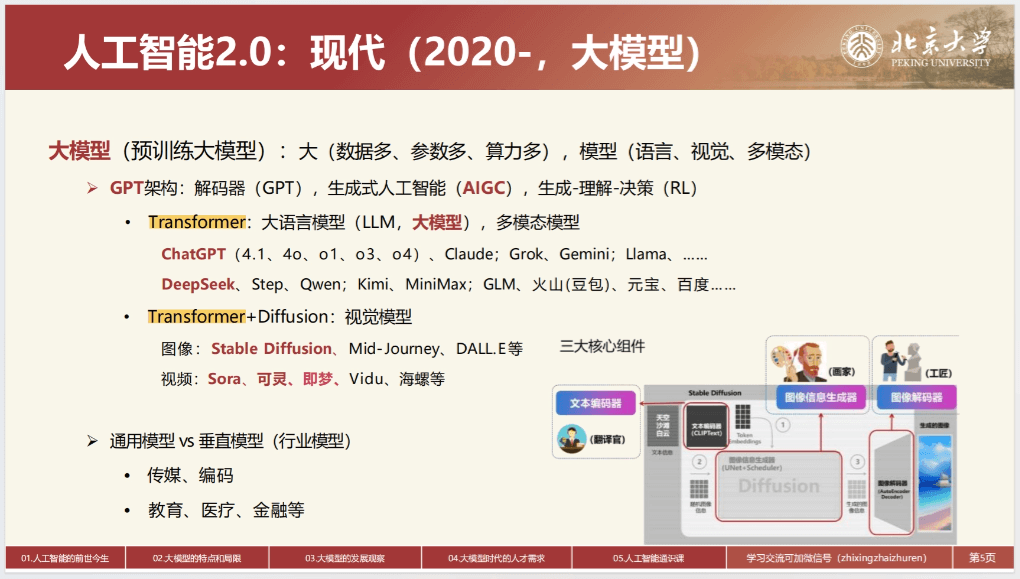
- AI 2.0 (2020-present): This stage has entered the era of large models, with multimodal generative models represented by GPT/Stable Diffusion achieving cross-modal interaction among text, images, and video, while reasoning capabilities have significantly improved (such as the DeepSeek R1 model).
Characteristics and Limitations of Large Models
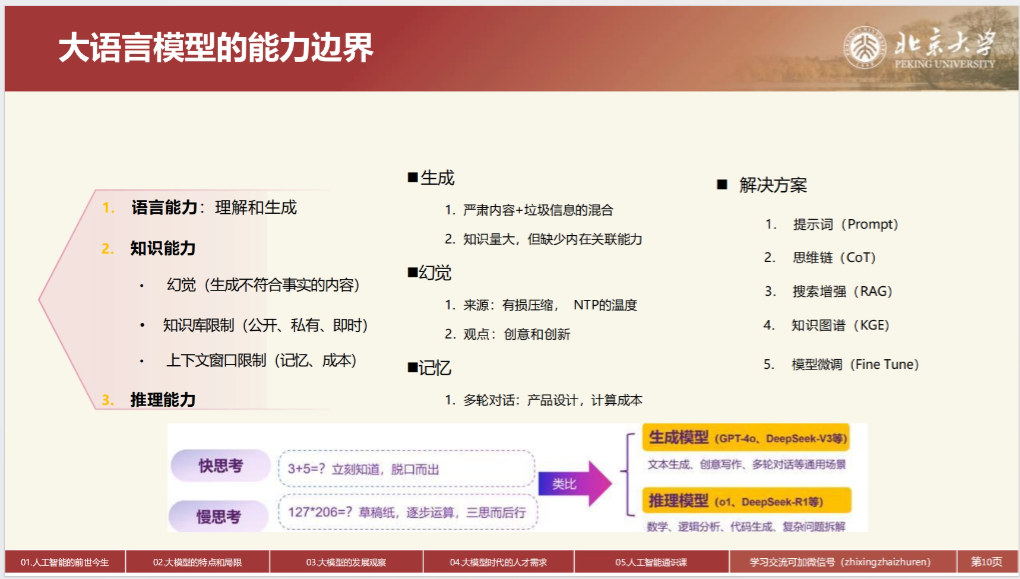
- Characteristics of Large Models
- Powerful generative capability: Large models can generate high-quality text, images, videos, and other content, bringing unprecedented changes to creative industries, content creation, and other fields.
- Multimodal fusion: By combining multiple modal data such as language and vision, models can more comprehensively understand and express the world, providing stronger technical support for applications such as intelligent interaction and autonomous driving.
- Complex reasoning capability: Based on long-chain reasoning technology, large models can gradually decompose complex problems and perform multi-step logical reasoning, handling more complex tasks and scenarios.
- Limitations of Large Models
- Data dependence: The training of large models requires massive data support; the quality and diversity of data directly affect model performance and the accuracy of generated results.
- High computing power requirements: The training and inference processes have extremely high requirements for computing resources, resulting in persistently high R&D and application costs, which limits widespread application in some resource-constrained scenarios.
- Hallucination problem: Generated content may be inconsistent with facts and requires further verification and screening to ensure the authenticity and reliability of information.
Observations on the Development of Large Models
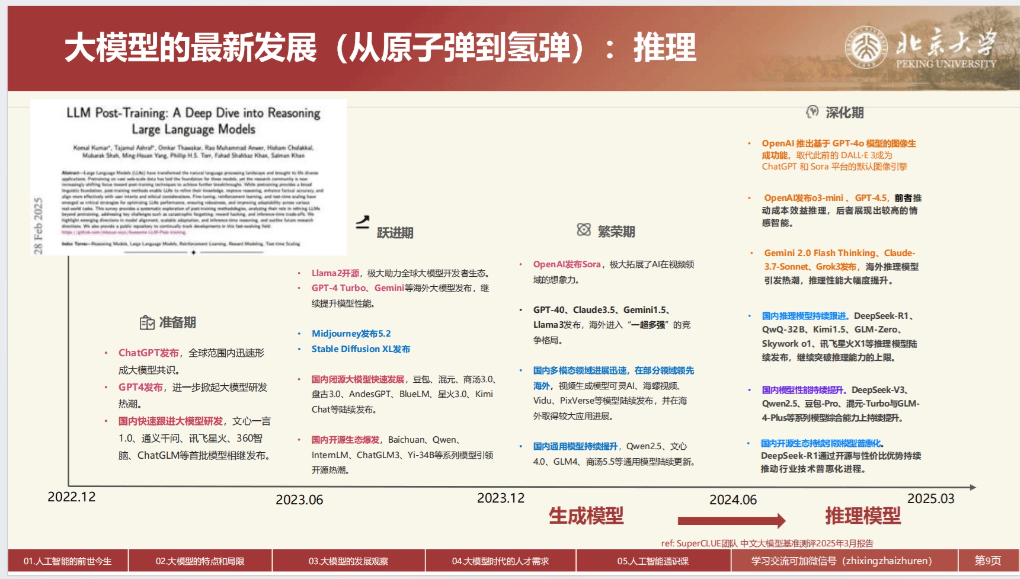
- Leap Period (2020-2022)
- The release of ChatGPT: The launch of ChatGPT in 2020 quickly triggered a global wave of attention and research on large models, and its powerful language generation capabilities and interactive experience showed people the enormous potential of large models.
- The push from GPT-4: The release of GPT-4 in 2022 further improved the performance and application scope of large models, promoting exploration and practice of large models in more fields.
- Boom period (2022-2023)
- The explosion of multimodal models: Multimodal models such as Stable Diffusion and Mid-Journey emerged one after another, expanding the application of large models from the text domain to visual domains such as images and video, bringing new opportunities to industries such as creative design and film and television production.
- The rise of domestic large models: Domestic enterprises accelerated the pace of research and development of large models, and the first batch of models such as Ernie Bot and Tongyi Qianwen were released one after another, demonstrating domestic technological strength and development potential in the field of artificial intelligence.
- Deepening period (2023-present)
- Breakthroughs in reasoning models: The emergence of reasoning models such as DeepSeek-R1 and QwQ-32B significantly improved the reasoning ability and efficiency of models, providing stronger support for solving complex problems.
- Performance improvement and open-source ecosystem: The performance of domestic models continued to improve, with models such as Qwen2.5 and GLM-4 being continuously updated and optimized. At the same time, the open-source ecosystem flourished, with the open-sourcing of series models such as Baichuan and Qwen, promoting the inclusiveness of large model technology and accelerating the implementation of industry applications.
Talent demand in the era of large models
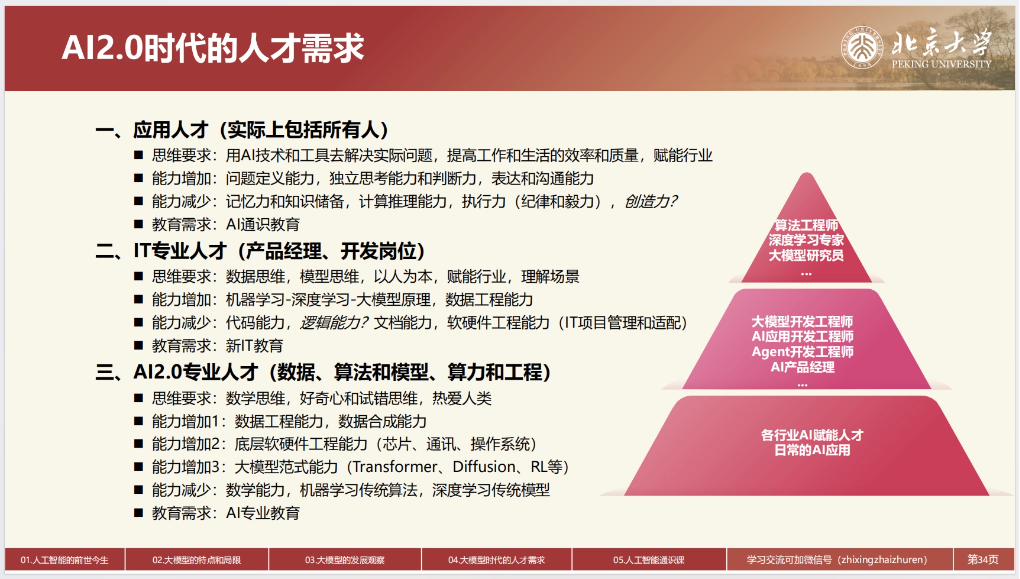
- Application talent
- Thinking requirements: Possess the ability to use AI technologies and tools to solve practical problems, and be able to apply AI to all aspects of work and life to improve efficiency and quality.
- Ability enhancement: Strengthen abilities such as problem definition, independent thinking, and communication and expression, and better collaborate with AI to complete tasks.
- Educational needs: Through AI general education, popularize basic AI knowledge and application skills, and cultivate AI literacy and human-machine collaboration ability among the general public.
- IT professional talent
- Thinking requirements: Master data thinking and model thinking, carry out system design and optimization with data as the core, and empower industries.
- Ability enhancement: Improve abilities in machine learning, deep learning, data engineering, and other areas, and adapt to the new requirements for IT talent in the AI era.
- Educational needs: Carry out new IT education, update the IT professional curriculum system, integrate AI-related technologies and application content, and cultivate interdisciplinary talent who understand both traditional IT and AI technologies.
- AI2.0 professional talent
- Thinking requirements: Possess mathematical thinking, curiosity, and a trial-and-error spirit, and love exploring the essence and mysteries of human intelligence.
- Ability enhancement: Master capabilities in data engineering, underlying software and hardware engineering, and large model paradigms (such as Transformer, Diffusion, RL, etc.), and be able to engage in research, development, and innovation of frontier AI technologies.
- Educational needs: Build an AI professional education system, cultivate AI professional talent with deep theoretical foundations and innovative ability, and promote the continuous development and breakthroughs of artificial intelligence technology.
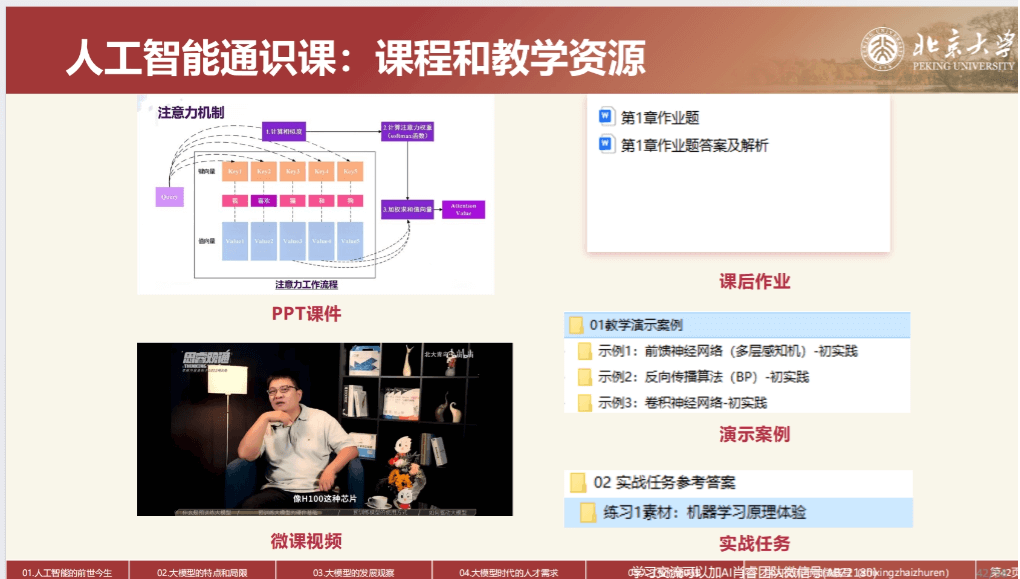
AI General Education Course
- Course Objectives: Cultivate learners' comprehensive understanding of artificial intelligence, master the application capabilities of generative AI, enhance human-machine collaboration and critical thinking, and lay a solid foundation for future learning and work.
- Course Content: Cover the fundamentals of artificial intelligence, core technologies (such as the Transformer architecture), application domains (finance, healthcare, education, etc.), as well as the challenges faced and future development directions, to build a complete knowledge system.
- Teaching Methods: Adopt diverse methods such as case analysis, hands-on practice, project-based learning, and interdisciplinary integration to enhance learners' practical abilities and innovative thinking.
- Teaching Resources: Provide PPT courseware, micro-lecture videos, teaching demonstration cases, as well as practical tasks and assignments, supporting blended online and offline learning to meet the needs of different learners.
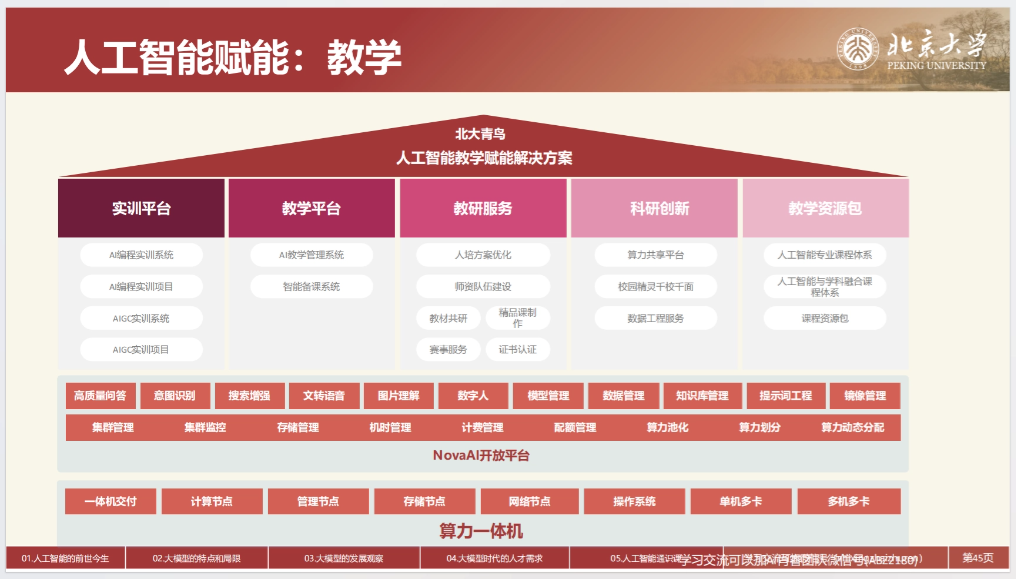
AI-Empowered Education
- AI-Empowered Teaching: Through AI-assisted teaching tools and intelligent learning analytics, improve teaching efficiency and personalized learning experience, and promote the intelligent development of education.
- Course Creation Tools: Utilize AI-assisted course design and no-code engineering delivery to lower the threshold for course creation and improve the development efficiency and quality of teaching resources.
- Implementation of the AI General Education Course: Through the tiered design of general education courses, general cultivation courses, and general application courses, gradually enhance students' AI literacy, human-machine collaboration capabilities, and professional application abilities, achieving the popularization and deepening of artificial intelligence education.
Obtain the original PDF file of the report "Talent Cultivation and General Education Curriculum Development in the Era of Artificial Intelligence 2.0"
Scan the QR code to follow and reply: 20250807