
Tencent Research Institute's "AI Coding Non-Consensus Report" focuses on the AI Coding field and explores the revolutionary impact of AI Coding in software development. The report points out that AI Coding is changing the essence of programming, elevating it from code writing to a new dimension of expressing intent and realizing vision. It analyzes the high penetration rate of AI Coding on both individual and enterprise sides, its business growth, and its profound impact on organizational structure and the role of developers. At the same time, the report presents the non-consensus and controversial focal points in the industry regarding product form, model selection, payment models, and other aspects, and predicts that AI Coding will lower the threshold for programming, promote the development of personalized applications, and trigger a major transformation in the software development paradigm.

To obtain the PDF original file of Tencent Research Institute's "AI Coding Non-Consensus Report", scan the QR code to follow and reply: 20250725
AI Coding: A Paradigm Revolution in Software Development
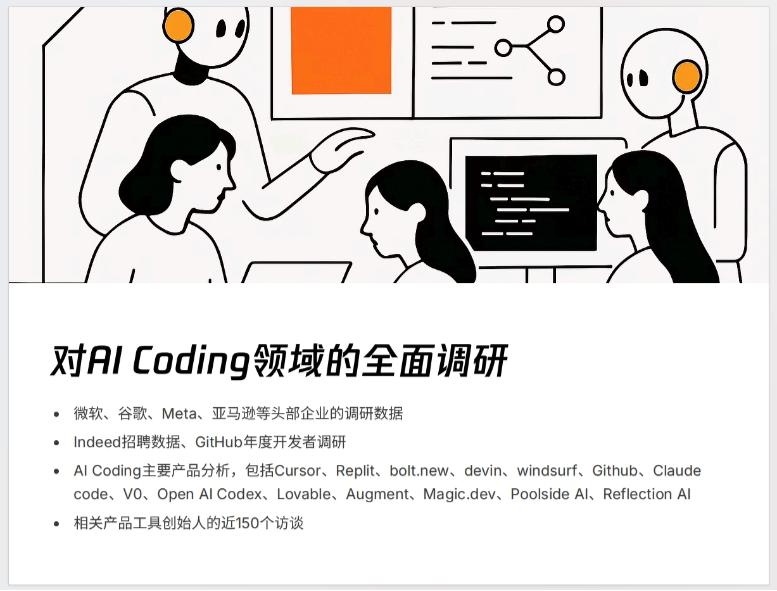
The Explosion and Current State of AI Coding
- Extremely high penetration rate: On the individual side, the penetration rate of AI programming tools has reached 47%, second only to AI writing. On the enterprise side, AI Coding is the fastest to implement and most influential AI application scenario, with more than half of enterprise AI implementation concentrated in code generation.
- Business explosion: Over the past three years, revenue in the AI Coding field has grown extremely rapidly, and many unicorn companies have emerged, with financing and valuations repeatedly hitting new highs. For example, companies such as Cursor, Replit, and Bolt.new have seen annual revenue soar from the millions to hundreds of millions of dollars in a short period, while their teams remain very lean.
Industry "Non-Consensus" and Controversial Focal Points
The report particularly emphasizes that although the trend of AI Coding has become a consensus, there is still a large amount of "non-consensus" and even disagreement within the industry on seven major aspects: specific product form, model selection, value assessment, payment models, enterprise promotion strategies, impact on organizations, and the future market landscape. These mainly include:
- Product form: local vs cloud
- Some products emphasize the flexibility and security of local development, while others focus on cloud collaboration and resource integration.
- Model selection: self-developed vs third-party
- Some companies insist on self-developed large models, pursuing ultimate customization and control; others focus on mixed scheduling of multiple models, flexibly selecting the optimal model.
- Value assessment: efficiency improvement vs efficiency reduction
- The vast majority of developers believe that AI Coding can greatly improve efficiency, but some research and some enterprise data show that AI tools may lead to reduced efficiency or lower code quality in certain scenarios.
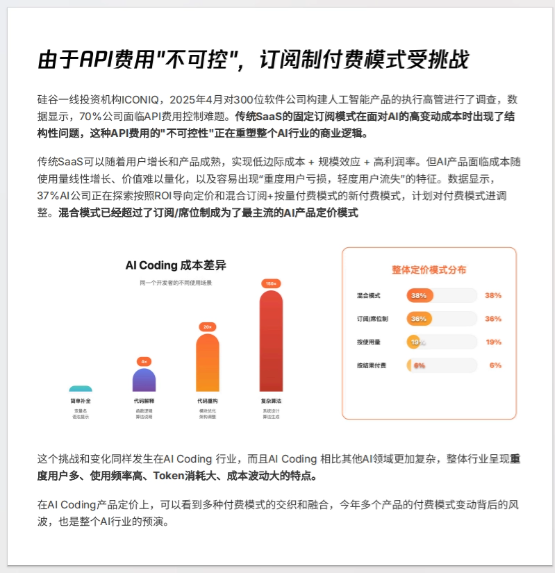
- Payment model: fixed vs on-demand
- The traditional subscription model faces the challenge of AI's high variable costs. More and more products are adopting a hybrid billing model of subscription + usage-based pricing and introducing more complex billing dimensions.
- Enterprise attitude: aggressive vs gradual
- Some enterprises require employees to use AI Coding tools, and even include this in performance evaluations; others proceed cautiously, focusing on security and compliance.
- Organizational impact: layoffs vs expansion
- AI Coding boosts productivity; some companies have laid off staff as a result, but others use the same budget to hire more people who understand AI collaboration, innovating team structures.
- Market landscape: professional vs. inclusive
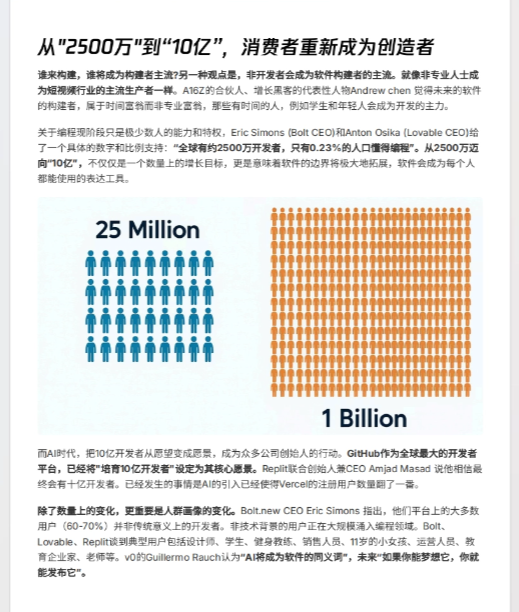
- AI Coding is driving a significant lowering of the programming barrier, making "everyone is a developer" possible in the future, and software development is moving from a professional skill to something inclusive.
The future trends of AI Coding
- Intent-driven, code automation
- Programming will shift from "writing code" to "expressing intent," with AI automatically generating and refining code, and developers taking on more of the roles of "coach," "product manager," and even "taste gatekeeper."
- Transformation of product definition and innovation models
- AI Coding not only improves the efficiency of writing code, but also brings changes in product definition, requirement transformation, automated operations, and more. In the future, the focus of software development will shift from "can it be done" to "is it done well," with taste and innovation becoming core competitiveness.
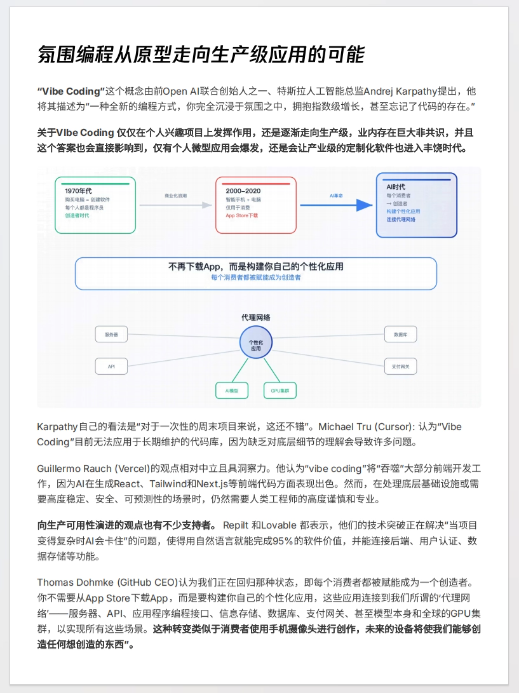
- Explosion of micro/personalized applications
- As the barrier lowers, non-technical people quickly develop software through AI Coding tools, giving rise to a large number of personalized, micro applications and greatly unleashing innovation potential.
- Transformation of the developer role
- AI will not completely replace developers; developers need to have stronger comprehensive capabilities, including underlying technology, product thinking, managing AI teams, and more.
Get the Tencent Research Institute's "AI Coding Non-Consensus Report" PDF original file, scan the code to follow and reply: 20250725