
What is Agno
Agno is a lightweight framework for building agents. Agno supports multimodality (text, images, audio, video) and multi-agent collaboration, enabling rapidagent creation, 5000 times faster than LangGraph, supports any model and provider, with no vendor lock-in. Agno provides memory management and knowledge base support, can store user sessions and agent states in a database, and implements dynamic few-shot learning based on vector databases. Agno supports structured output and real-time monitoring, helping users track agent sessions and performance in real time.
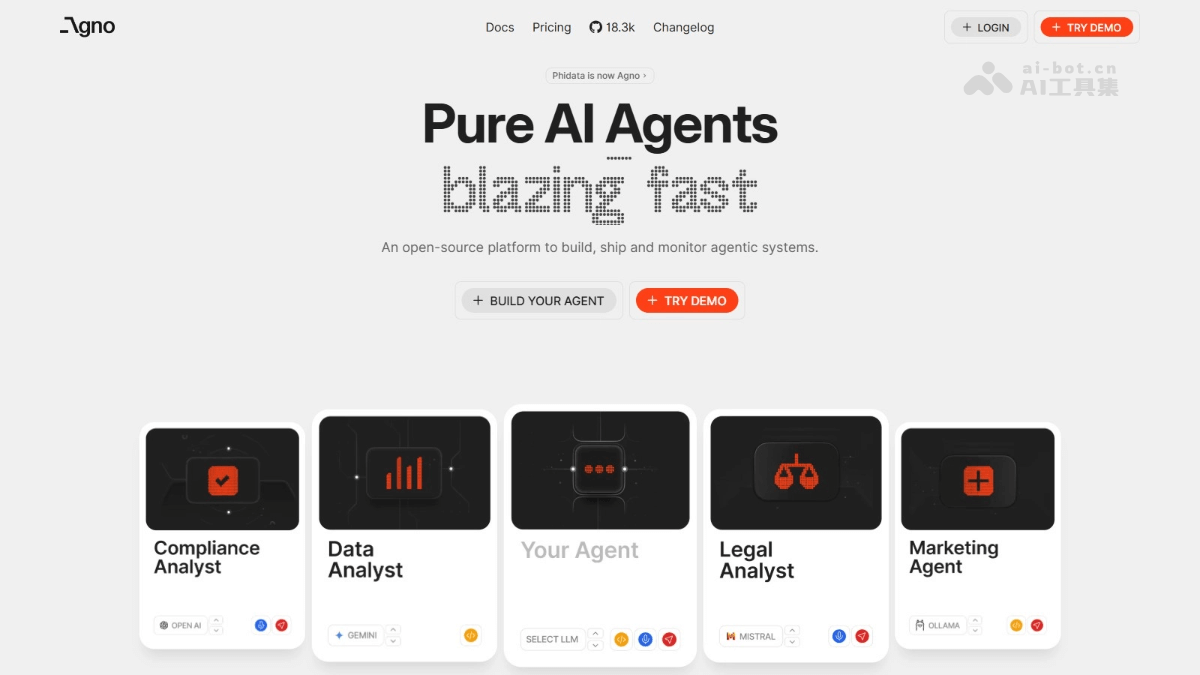
Agno's main features
- Ultra-fast agent creation: Creating agents is 5000 times faster than traditional frameworks (such as LangGraph).
- Model agnosticism: Supports any model and provider, allowing users to choose different models as needed without worrying about vendor lock-in.
- Multimodal support: Native support for multiple data modalities such as text, images, audio, and video.
- Multi-agent collaboration: Supports assigning tasks to multiple specialized agents for efficient division of labor and collaboration.
- Memory management: Stores user sessions and agent states in a database to ensure data persistence and security.
- Knowledge base support: Implements retrieval-augmented generation (RAG) or dynamic few-shot learning based on vector databases, improving agents' knowledge retrieval capabilities.
- Structured output: Agents support responses in structured data formats, making integration with other systems easier.
- Real-time monitoring: Track agent sessions and performance in real time on agno.com for easier management and optimization.
Agno's technical principles
- Pure Python implementation: Agno is written in Python, avoiding complex graph structures, chained calls, or other complex patterns, making the code more concise and understandable while also making it easier for developers to get started quickly.
- Dependency-free architecture: Uses a dependency-free design, supporting any model, any provider, and any modality.
- Vector database integration: Supports integration with vector databases, using their efficient retrieval capabilities to implement retrieval-augmented generation (RAG) or dynamic few-shot learning.
- Multi-agent collaboration mechanism: Based on task assignment and division of labor, decomposes complex tasks into multiple subtasks handled separately by different specialized agents.
Agno's project address
- Project website:https://www.agno.com/
- GitHub repository:https://github.com/agno-agi/agno
Agno's application scenarios
- Intelligent customer service: Quickly responds to customer inquiries, supports text and voice interaction, and handles different issues through multi-agent collaboration.
- Content recommendation: Analyzes user behavior and preferences, and recommends personalized content by combining multimodal data.
- Smart education: Provides students with personalized learning suggestions and tutoring, and supports multimodal teaching resources.
- Medical assistance: Analyzes medical records, images, and voice descriptions to assist doctors in diagnosis and provide structured suggestions.
- Office assistant: Manages schedules, arranges meetings, handles emails, etc., improving office efficiency through voice or text interaction.