
What is AgileGen
AgileGen is a generative software development framework that enhances the software creation process based on human-AI collaboration. AgileGen contains two core parts: end-user decision-making and the AgileGen agent. The framework uses the Gherkin language to design and confirm user stories and acceptance criteria, ensuring that software code stays consistent with user requirements. AgileGen collects user decisions based on an interactive system, automatically generates software prototypes, supports iterative improvement based on user feedback, and ultimately provides software products that meet user needs.
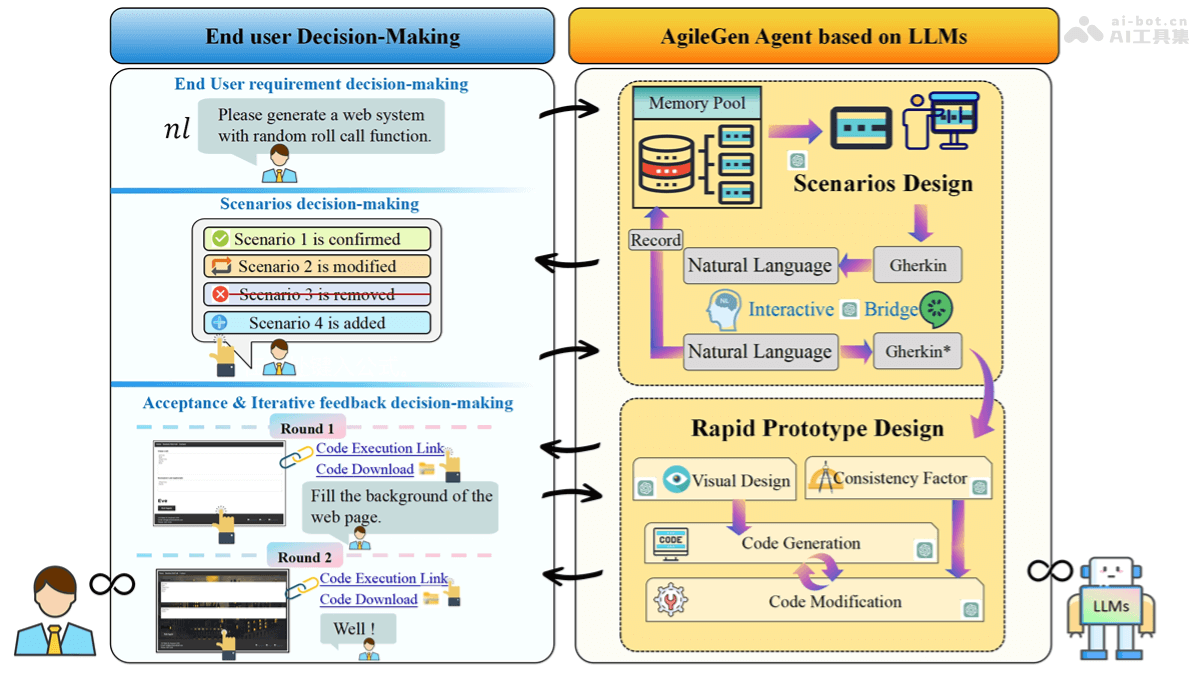
Main features of AgileGen
- User requirement collection and clarification:Supports users in proposing raw requirements in natural language, based onthe user decision-making process to clarify and refine requirements.
- Scenario design:Uses the Gherkin language to design scenarios based on user requirements,and converts scenarios into natural language for user decision-making.
- Code generation:Automatically generates software code based on scenarios confirmed by users.
- Prototype design and feedback:Quickly generates software prototypes for user testing and feedback,and performs iterative modifications to the code based on user feedback.
- Memory pool mechanism:Collects user decision scenarios, provides recommendations for similar requirements, and improves decision-making efficiency.
Technical principles of AgileGen
- Behavior-Driven Development (BDD): Adopts the core concepts of BDD and uses the Gherkin language to describe user stories and acceptance criteria.
- Large Language Models (LLMs): Generates code that meets user requirements based on the comprehension capabilities of large language models.
- Human-computer interaction bridging: Designs interaction bridges to convert between the formal Gherkin language and informal natural language.
- Iterative feedback loop: Implements iterative development based on rapid prototyping and user feedback, and quickly responds to changes in user requirements.
- Consistency factor extraction: Extracts business logic consistency factors from user stories to guide code generation.
- Self-updating mechanism of the memory pool: Collects and analyzes user decisions, and continuously optimizes and adjusts the generation strategy.
AgileGen project address
- GitHub repository:https://github.com/UGAIForge/AgileGen
- arXiv technical paper:https://arxiv.org/pdf/2407.15568
- Online experience Demo:https://huggingface.co/spaces/HarrisClover/AgileGen
Application scenarios of AgileGen
- Startups and small software development teams: Quickly transition from the proof-of-concept stage to the development of a minimum viable product (MVP), reducing development time and cost.
- Non-technical business users: Business analysts or product managers implement business requirements without deep programming knowledge.
- Education and training: In academic environments, serves as a teaching tool to help students understand the entire software development process, from requirement collection to code generation.
- Rapid prototyping: In occasions requiring rapid iteration and concept validation, such as hackathons or innovation labs, accelerates prototype creation and testing.
- Enterprise internal tool development: Large enterprises develop internal tools and applications, improving work efficiency and the speed of responding to market changes.